 Vista
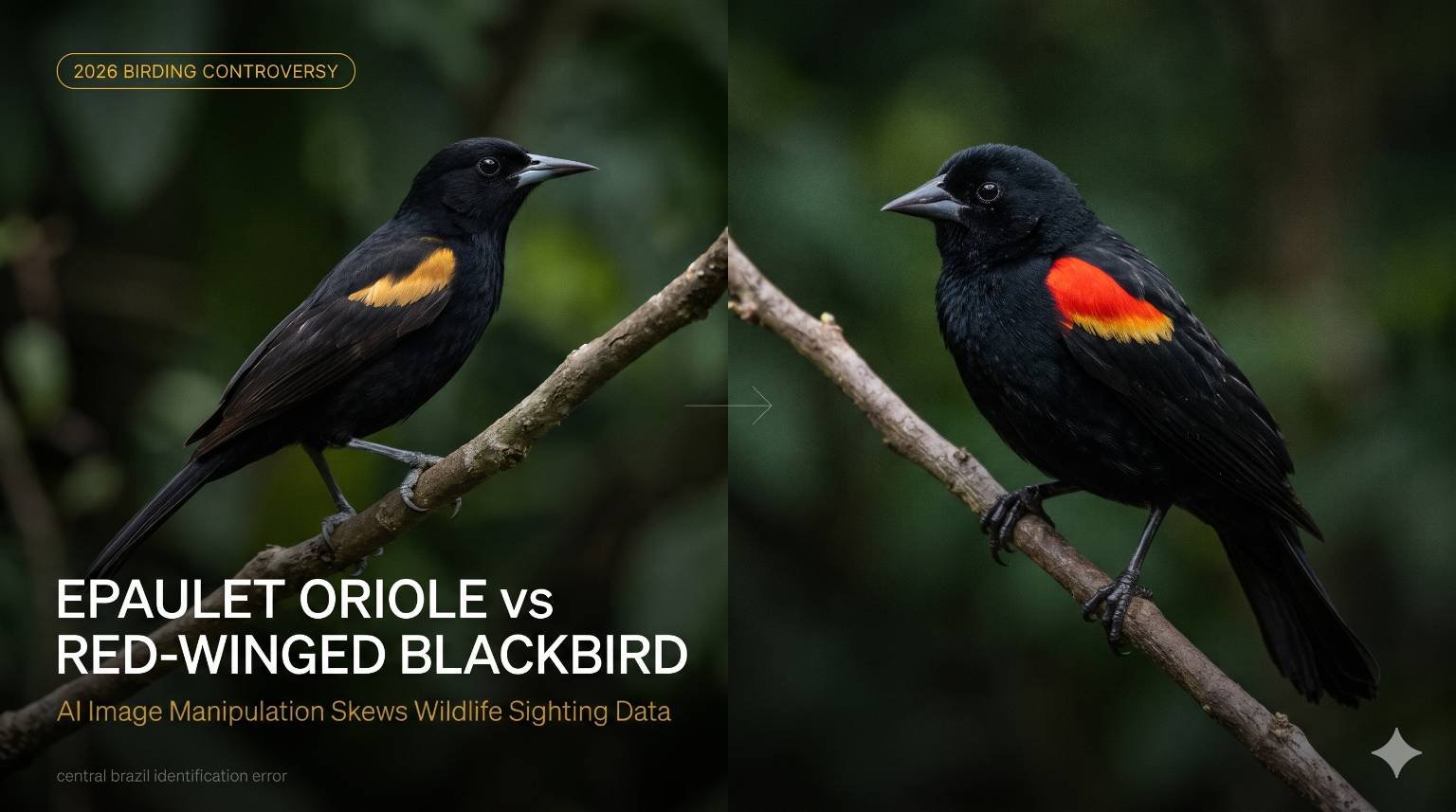
Epaulet Oriole vs Red-winged Blackbird: a 2026 birdwatching controversy showed how an edited photograph of a common South American oriole could be mistaken for a North American blackbird in Brazil. This fact-check identifies the two species, explains the shoulder-colour differences and shows why reliable wildlife records need the original evidence, not just a beautiful picture.
What happened in the Brazil bird-photo identification case?
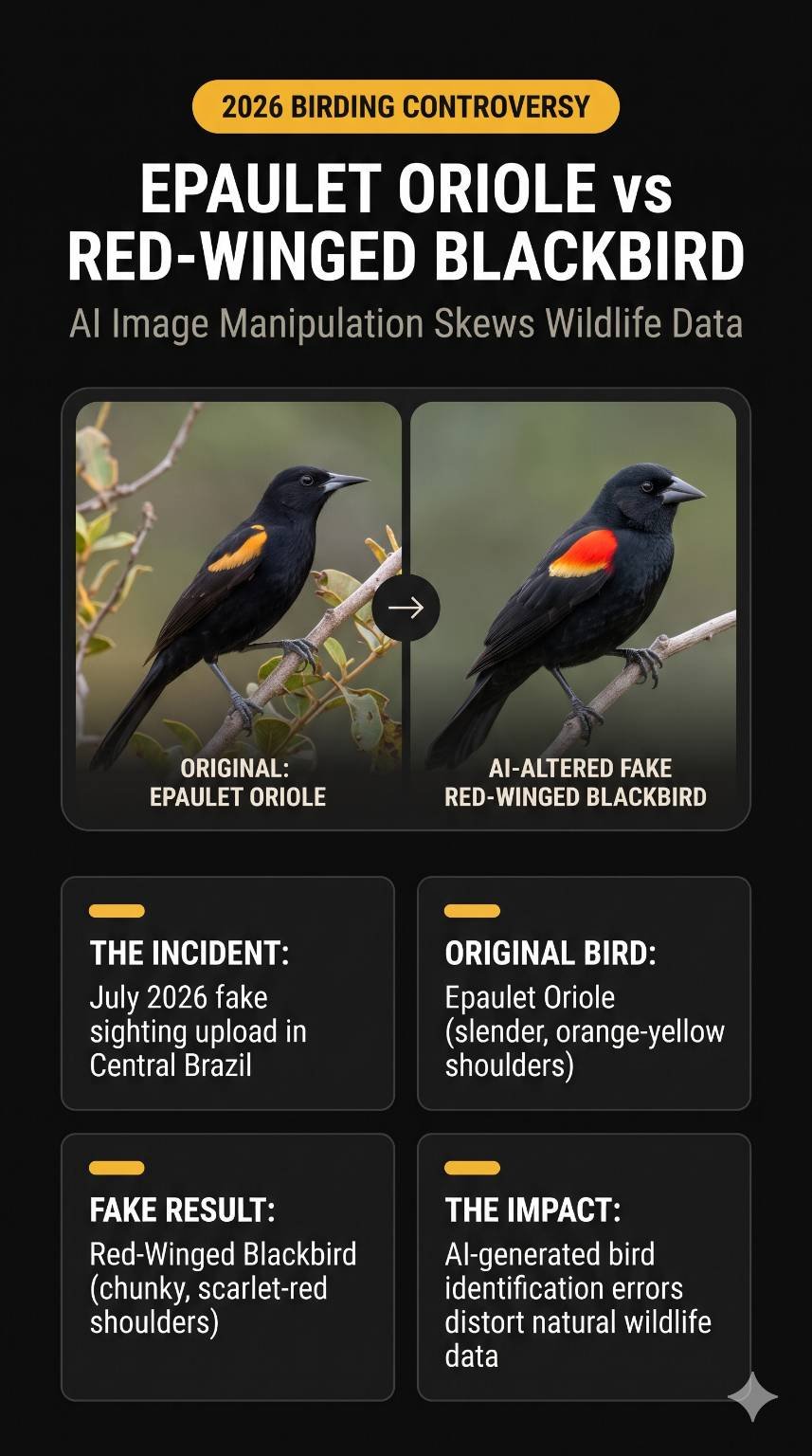
In 2026, researchers used a striking bird identification error from Brazil to explain how altered images can mislead wildlife databases. A photograph originally showing an epaulet oriole, Icterus cayanensis, became associated with a supposed sighting of a red-winged blackbird, Agelaius phoeniceus. The second bird is common in North America, so a record from central Brazil attracted attention as a potential first national sighting. Yet an attractive photograph does not automatically prove that an unusual species was present. Researchers examining the record showed how image enhancement can change biologically important details, making a familiar local bird look like a different species. A short commentary in Nature Ecology & Evolution argued that citizen-science platforms need safeguards against this problem. Readers searching “Epaulet Oriole vs Red-winged Blackbird” can use this story to learn about both species and the importance of retaining an unaltered observation record. The case is not evidence that the two birds are the same animal. They belong to different genera and have different typical geographic distributions.
The two scientific names and why they matter
The epaulet oriole has the scientific name Icterus cayanensis, while the red-winged blackbird is Agelaius phoeniceus. Both belong to the broader New World blackbird-and-oriole family Icteridae, but a shared family does not mean the species or genus is interchangeable. The epaulet oriole occurs in South America and can be seen in the Amazonian region of Brazil. The red-winged blackbird is widespread across North America, especially around wetlands and grassy areas where breeding males advertise territories. On a visual comparison chart, use the names beside the birds rather than only “black bird with orange shoulder.” The scientific names help readers understand why a claimed appearance of Agelaius in central Brazil was remarkable. A rare visitor can genuinely turn up far from its usual range, but rarity raises the need for stronger evidence; it does not allow a surprising photograph to be accepted without question. Location, date, original file and independent field notes all contribute to an identification.
How are the birds visually different?
Male red-winged blackbirds usually have glossy black bodies with prominent red shoulder patches and yellow edging, although the exact visible pattern varies by population and posture. Cornell’s All About Birds guide notes that males can expand or conceal these shoulder patches during display. Epaulet orioles are also dark birds but have yellow, ochre or chestnut shoulder markings depending on the subspecies or regional form. In many typical images a yellow or golden shoulder patch points toward an epaulet oriole, while bright scarlet with yellow edging suggests a male red-winged blackbird. However, colour must never be the sole criterion: lighting, a bird turning its wing, wear, age, camera exposure and individual variation can change an image. Structural features such as bill shape, body proportions and the rest of the plumage, along with location and calls, should also be considered. Female red-winged blackbirds look much browner and streakier than black adult males. A comparison of only two glossy-black males cannot teach every age or sex variation.
Why a colour change can become a false species record
The 2026 commentary describes a real candidate sighting whose visual evidence was compromised after a photograph had been processed. The authors also demonstrated the problem with a controlled example. Their figure includes an original epaulet oriole image from the Macaulay Library and a manipulated version that closely resembles a red-winged blackbird. The demonstration is useful because it isolates what goes wrong: software instructed simply to improve image quality can infer and add details that were not recorded by the camera. In a bird identification task, shoulder colour, bill contour or feather markings are not decorative pixels. They are characters observers use to decide which species is present. Once those details are changed, a high-resolution output can look more convincing even though it contains less trustworthy evidence. The critical distinction is between the historical report and the authors’ reproduced demonstration; not every illustration in the scientific article is the exact original public submission. A strong fact-check states what was observed, what was altered and which image serves as the research demonstration.
What did researchers and bird-record platforms say?
The Nature Ecology & Evolution authors warned that generative editing poses a challenge for projects that collect photographs, sounds and other observations from volunteers. Such citizen-science data can reveal breeding patterns, migration routes and species distributions at scales professional researchers could not sample alone. If images of a common species are altered into a rare species, the database can contain misleading occurrence records. The Cornell Lab’s eBird and Macaulay Library help centre consequently explains restrictions on media that add or remove biological features. Its examples reproduce the epaulet oriole demonstration to show how a seemingly benign enhancement can transform an identification. The issue is not that every hobby photograph is untrustworthy; thousands of accurate observations are valuable. The lesson is to use unmodified evidence when documenting wildlife and to report substantial edits transparently. A beautiful image created for an educational comparison is not the same as a field record used to confirm a rare bird sighting.
Where did the apparent sighting happen and why was it surprising?
Reports described a candidate observation in central Brazil, a region far outside the red-winged blackbird’s familiar North American range. Ornithologists know that birds occasionally wander across great distances, so an unexpected record cannot be dismissed solely because it is unusual. But a claimed first national record needs careful documentation. Experts may review the original photograph, the time and place, bird vocalisations, multiple views, habitat and local species that might be confused with the reported visitor. The epaulet oriole is a more geographically plausible alternative in parts of Brazil. When the apparent record was examined, the photographic evidence did not establish a genuine red-winged blackbird. This is exactly why scientific databases keep a process for reviewing rare sightings rather than counting every upload as an accepted range extension. Search engines can preserve an erroneous headline for years, so readers should trace a surprising range claim back to the ornithologists’ assessment instead of citing a reposted thumbnail.
How should birdwatchers document a rare bird?
First, save the original files from the camera or phone, including the metadata if available. Second, record the location, date, habitat and behaviour before memory fades. Third, take several photographs or an audio recording, where practical and without disturbing the bird. Fourth, make only minimal adjustments needed to reproduce the observed scene and retain an untouched copy for verification. Fifth, use reputable field guides and compare likely local species, not only the most exciting identification. Sixth, accept that uncertainty is part of observation: a record listed as “oriole species” may be more scientifically valuable than a confidently misidentified rarity. A transparent identification note should also say when an image is a comparison graphic rather than evidence from the observation. In regions with poor internet access, field notes, sketches and collaborations with local bird experts can be especially valuable. These simple practices help citizen-science projects maintain trust without discouraging people from participating or learning.
Can computer vision and photo apps identify these birds reliably?
Automated bird identification tools can be convenient starting points, but their outputs depend on training data, image quality and the features remaining in a picture. A model may perform well on a clear male red-winged blackbird from North America and less well on a partial view or altered photo from South America. If enhancement has replaced a yellow shoulder patch with a red one, both humans and image classifiers might be led toward the wrong label. That is a failure of input integrity, not necessarily proof that all automated species classification is useless. Good practice combines multiple evidence types: the image, geographical range, season, voice and specialist review. An educational chart can demonstrate where confusion arises without promising that a single visual cue always settles the question. Readers should be especially cautious when an app returns an extremely rare species based on one cropped or heavily processed photo. Check the original evidence and be willing to change the identification when new facts emerge.
What do the pictures in this article represent?
The featured comparison illustrates the difference between an oriole with yellowish shoulder markings and a male blackbird with red-and-yellow shoulder markings. Its role is educational. It is not being submitted as the untouched original evidence for the Brazilian sighting, nor as a photograph proving a particular bird visited a named place. The infographic below the title summarises how image manipulation can mislead identification, and its text should be read as a guide to the 2026 research case. For the scientific figure, visit the Nature Ecology & Evolution article and Cornell’s official image-policy page. Photographs in species guides should have their own provenance and photographer credits. Do not describe the two images here as the exact before-and-after files from a historical birdwatcher’s phone unless their origin and file chain can be documented. Such restraint matters particularly in a fact-check: repeating a false visual claim while discussing misinformation would undermine the purpose of the article.
What does the case teach us about scientific evidence?
A reliable wildlife observation is more than a visually attractive picture. The location must be meaningful, the date recorded, the species identity justified and the underlying media trustworthy. The epaulet-oriole episode shows that apparently small cosmetic changes can contaminate a database when those changes affect diagnostic features. It also reminds readers that scientific correction is a strength: independent reviewers can detect and revise misidentifications rather than treating the first report as permanent truth. In a wider context, the same principle applies to rare insect sightings, rediscovered mammals and archaeology images. A comparison picture can help people learn, but it should not silently replace a source specimen or original observation. Anyone publishing image-driven explanations should distinguish observed evidence from illustrative material and connect readers to the primary references. That combination protects both reader understanding and the value of citizen science for future conservation decisions.
Epaulet Oriole vs Red-winged Blackbird FAQ
Is the red-winged blackbird normally found in Brazil?
It is primarily a North American species. The central-Brazil candidate record discussed in 2026 did not establish a genuine sighting.
What bird was in the original observation?
Researchers identified the underlying bird as an epaulet oriole, Icterus cayanensis.
What is a quick colour difference?
Epaulet orioles may show yellowish shoulder markings; male red-winged blackbirds often show bright red shoulder patches with yellow edges.
Can an enhanced picture count as scientific proof?
Not if the enhancement changes the diagnostic characters or fabricates plumage details.
Are they in the same genus?
No. The oriole is Icterus cayanensis and the blackbird is Agelaius phoeniceus.
Where is the detailed research case explained?
Read the 2026 Nature Ecology & Evolution commentary and Cornell eBird/Macaulay’s media policy.
Conclusion and verifiable references
The message of this case is straightforward: correct species names, original observation evidence and transparent documentation matter more than polished pixels. A rare bird record should be verified before becoming a claim about distribution. Updated 23 November 2026.
Sources: Lees et al., Nature Ecology & Evolution, 2026; Cornell eBird and Macaulay Library photo editing policy with the example; Cornell identification guide; Animal Diversity Web Epaulet Oriole species profile.
Related science reading
- Indian Bramble Shark (Echinorhinus roinee): New Kerala Deep-Sea Species, Photos & Facts
- India Deep Ocean Mission Discoveries 2026: New Sharks, MATSYA-6000 & 2028 Dive Target























Share Your Opinion
Comments are closed on this post.