 Vista
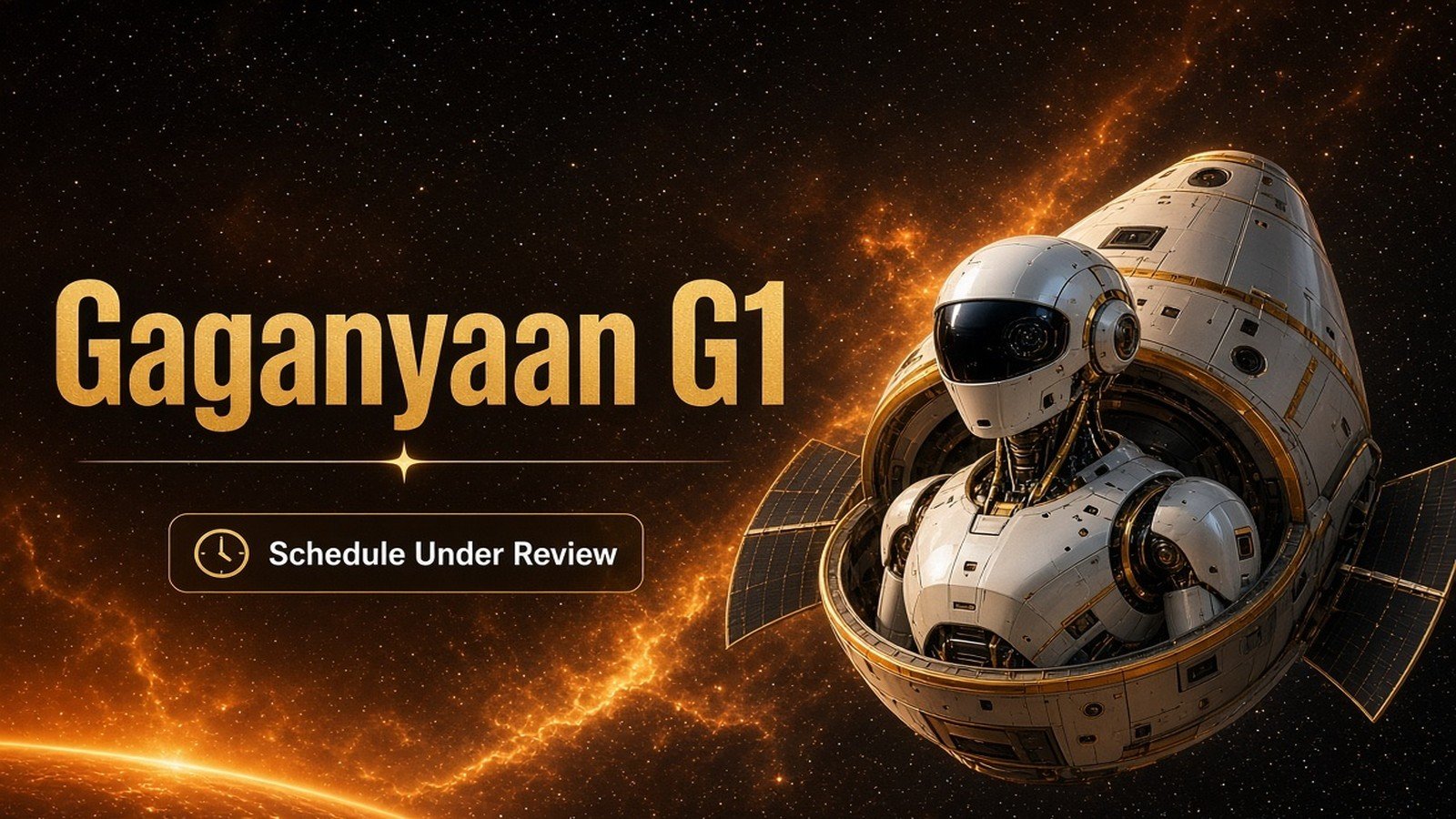
Gaganyaan G1 launch date and Vyommitra update (22 November 2026): India’s first uncrewed Gaganyaan orbital test has not received a new confirmed public launch date. The government’s August parliamentary update targeted October–December 2026, while an India Today report dated 20 November 2026, citing unnamed ISRO officials, said a launch before February 2027 looks unlikely. February is therefore a reported possibility, not an announced booking, countdown or final ISRO schedule. G1 is intended to test spacecraft systems before any astronauts fly, with the half-humanoid Vyommitra associated with the first uncrewed mission.
The important story is not simply a possible delay. Gaganyaan must demonstrate ascent, separation, orbital-module functions, atmospheric re-entry, parachute deceleration and recovery with reliability appropriate for a later crewed mission. Several important ground and air-drop milestones were announced in 2026, but completed component tests are not the same as an end-to-end orbital flight. This explainer separates official achievements, media reporting and still-pending milestones. Last checked: 22 November 2026.
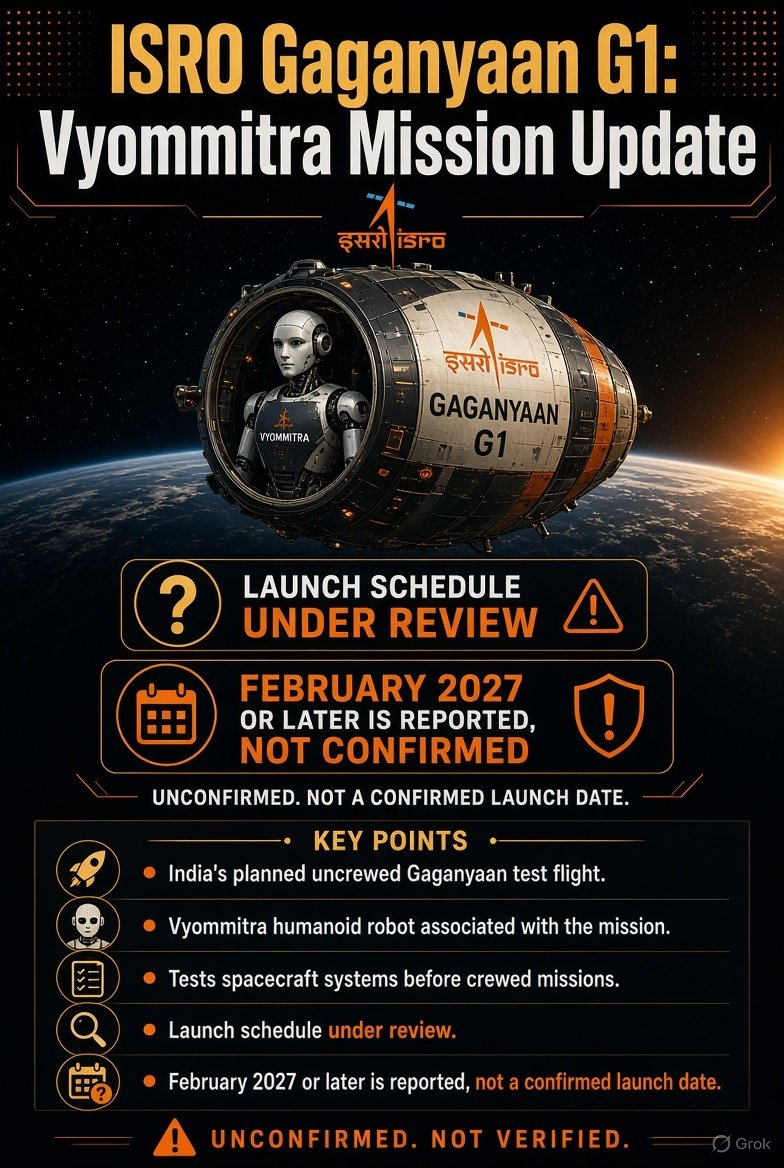
Gaganyaan G1 launch date: official target versus February 2027 report
In August 2026 the Department of Space told Parliament that the first uncrewed experimental mission, carrying the Vyommitra half-humanoid, was targeted in Q4 2026. Q4 means October, November and December. ISRO also wrote in an October technical update that G1 was targeted for 2026. Neither statement specifies a binding day and time for a public launch. Complex missions often keep a broad target until integration, reviews and range readiness allow a firm countdown.
On 20 November 2026, India Today reported that senior officials who were not named expected the first flight to occur no earlier than February 2027, citing continued validation work. This is a significant fresh report and a useful reader question, but it does not replace a formal ISRO press announcement. A news outlet can report changing internal expectations before the government publishes a revised target. Until then, the best headline is “Gaganyaan G1 February 2027 report explained,” not “Gaganyaan launch officially fixed for February 2027.”
| Statement | Status as of 22 Nov 2026 |
|---|---|
| G1 is an uncrewed orbital test | Confirmed programme design |
| Vyommitra associated with G1 | Officially described by PIB |
| G1 Q4 2026 target | Published official target in August 2026 |
| G1 not before February 2027 | 20 November media report citing unnamed officials |
| Exact launch date and time | Not confirmed in cited official update |
| First Indian astronauts fly on G1 | False: G1 is uncrewed |
What is Gaganyaan G1 and why is it uncrewed?
Gaganyaan is India’s programme to demonstrate that Indian launch and spacecraft systems can transport a crew to low Earth orbit and return them safely. The immediate challenge is human safety, not simply getting a payload into space. The vehicle must behave correctly during launch, while in space, through atmospheric re-entry, after parachute deployment and during recovery. A test can succeed in one area while exposing issues elsewhere; that is exactly why flight trials precede human missions.
The label G1 identifies the first planned uncrewed Gaganyaan orbital flight. Indian government updates describe additional uncrewed flights ahead of the first human demonstration. The sequence is a development pathway, not proof that later vehicles have already flown. Some early coverage describes G1 as a “robot astronaut mission.” A more accurate explanation is a spacecraft systems test that can carry a robotic experimental payload. The capsule is designed around eventual human-spaceflight needs, but there are no human passengers on G1.
Human-rated LVM3 technology, the orbital module, crew-module protection, propulsion, attitude control, environment-related engineering, parachutes and sea recovery all contribute to that pathway. A launcher reaching the intended trajectory would be important, yet the mission would not be fully validated by launch alone. The ability to separate the crew module, survive re-entry and bring it back for inspection is a core part of the demonstration.
Who is Vyommitra and what can the half-humanoid robot test?
Vyommitra is ISRO’s female-presenting half-humanoid prototype for the Gaganyaan programme. “Half-humanoid” matters: it is not a person, not a newly recruited human astronaut and not a full autonomous science-fiction robot that can replace every crew member. Public programme statements connect it to robotic technology demonstrations and human-spaceflight preparations. The name combines Sanskrit-rooted references to space and friendship, but the hardware purpose is technical rather than ceremonial.
In an uncrewed spacecraft, automated interfaces and sensors can help engineers study how relevant systems respond during a real mission. The Vyommitra demonstration is associated with crew-interaction concepts and monitored spacecraft functions; the exact flight-specific experiment list should be read from ISRO’s payload statement when released. Online claims that the robot will personally perform every astronaut task, choose the launch date or independently pilot a dangerous landing are exaggerations without the relevant mission documentation.
Why use such hardware before a human flight? Real flight exposes vibration, acceleration, temperature changes, communications constraints and other stresses that simulated tests alone cannot reproduce perfectly. A robotic experiment can add evidence without putting a person aboard. But success or failure must still be evaluated against the published mission objectives. It would be misleading to claim that Vyommitra has already completed its G1 flight simply because it was introduced publicly years earlier.
What ISRO completed in 2026: separation, parachutes and recovery tests
ISRO’s October 2026 announcement described Crew Module–Service Module separation tests at Vikram Sarabhai Space Centre, Thiruvananthapuram. The tests simulated separation connections and checked how important avionics, navigation, heat-shield-related and other systems tolerate the shock. This work directly reduces uncertainty around a vital phase of the upcoming uncrewed flight. It does not mean an actual in-space separation was achieved in October; the reported tests took place in a ground simulation setup.
In July 2026, ISRO described an Integrated Main Parachute Airdrop Test at Sheopur, Madhya Pradesh, focused on the main parachute’s structural margins under the demanding expected G1 load condition. It is easy to underestimate parachutes when looking at a giant rocket, yet a safe capsule recovery depends on decelerating reliably after re-entry. Gaganyaan’s parachute sequence includes several types fulfilling different roles; one successful test cannot replace every needed qualification.
An April 2026 second Integrated Air Drop Test also used a representative crew-module mass released over a planned sea drop area near Sriharikota. Such work examines parts of deceleration and recovery in conditions approximating real descent. Separately, modules, propulsion systems and ground infrastructure have undergone development and readiness steps. These tests provide genuine progress to write about, instead of treating speculative launch dates as the only news.
Why can a Gaganyaan launch target move even after successful tests?
Human-spaceflight programmes depend on a system of systems. Rocket stages, crew module, service module, emergency procedures, recovery teams, tracking networks, software, thermal protection and environmental controls must fit together. An issue with integration or a validation result can require further analysis without implying that the overall programme is a failure. Completing hardware manufacturing is a milestone, but flight readiness also requires extensive checks and formal clearances.
A public target may change because engineers need to demonstrate margins under abnormal conditions, confirm separation timing or repeat a test after an unexpected result. The November media report referred to further simulations and technical assessments, but readers should not translate this into an invented single mechanical fault. No such specific explanation has been established by an official G1 delay announcement in the cited material. Good reporting preserves that uncertainty and gives practical context rather than assigning blame without evidence.
Likewise, a quote about the overall percentage of work completed is not the same as a predictive countdown. Some high-risk work happens near the end of integration; a simple “80% done means a launch in a few weeks” calculation has no technical basis. A safe mission should be evaluated by demonstrated readiness, not pressure to meet a round-number anniversary or a viral timetable.
G1 versus G2, G3 and the first crewed Gaganyaan flight
Official programme descriptions distinguish the initial G1 uncrewed test, further uncrewed flights and a later mission with Indian astronauts. The reason for more than one rehearsal is straightforward: different vehicles and progressively complete configurations allow engineers to verify the combined safety chain. An early uncrewed flight can expose issues to fix before the next stage; passing one flight is not a blanket certification for all crewed operations.
Parliamentary updates in 2026 targeted subsequent uncrewed missions and the first crewed demonstration in 2027. These are programme targets, not a guarantee of the calendar if the first launch shifts. Do not promote an old year into a fresh confirmed date for the first human flight. The precise sequence should be checked on official ISRO and Department of Space pages whenever a revised timetable appears. Importantly, Gaganyaan is not the same mission as Chandrayaan or the proposed Bharatiya Antariksh Station; those projects may share expertise, but they have distinct objectives and hardware.
How to verify real launch news and avoid fake live links
People search “Gaganyaan G1 live streaming,” “Vyommitra robot launch date,” “G1 launch countdown,” “Gaganyaan 2027 date confirmed,” “ISRO G1 launchpad,” and “Gaganyaan first test flight result.” These are legitimate next-search questions, but the search results can be polluted by recycled launch footage. An official mission page should clearly identify the launch vehicle, payload, schedule in IST, mission status and the agency issuing the update. A YouTube stream can show old flight videos with a new thumbnail; that is not a reliable schedule.
Check ISRO’s website and PIB for fresh announcements. When a date is reported only by a newspaper, read the date of the article and distinguish an attributed official statement from unnamed-source reporting. A photograph of a rocket or robot is not proof that the current G1 mission has launched. On the final day, ISRO may change the launch window for operational reasons, so treat preliminary timetables as provisional.
Myth versus fact: Gaganyaan G1 in 2026–27
- Myth: ISRO officially fixed February 2027. Fact: February appeared in a 20 November report, not a confirmed official date.
- Myth: Vyommitra is a human astronaut. Fact: It is a half-humanoid robot for an uncrewed test.
- Myth: Parachute testing means the complete G1 flight happened. Fact: Ground and drop tests are distinct milestones.
- Myth: The first Gaganyaan test is a lunar mission. Fact: It is for low Earth orbit and safe return capability.
- Myth: A delayed target proves mission failure. Fact: The reason and readiness must be evaluated from actual evidence.
FAQs: Gaganyaan G1 and Vyommitra launch date
What is the official Gaganyaan G1 launch date?
As of 22 November 2026, the cited government update gives Q4 2026 as a target, not a precise launch day. A newer press report says the flight may not occur before February 2027; no official date is confirmed here.
Will Vyommitra fly on G1?
Government statements associate the half-humanoid Vyommitra with the first uncrewed experimental mission. Check ISRO’s final payload listing for flight-specific details.
Why does G1 have no astronauts?
It is a systems-rehearsal mission intended to gather evidence about flight and recovery safety before a crewed mission.
What are the major successful 2026 tests?
Examples include Crew Module–Service Module separation testing, the July integrated main parachute drop test and April air-drop recovery-related testing.
Is the first crewed Gaganyaan flight confirmed for 2027?
2027 has appeared in official target planning, but a fixed launch date is not guaranteed; milestones depend on successful uncrewed demonstrations.
Where can I watch a genuine launch countdown?
Use the official ISRO mission page and verified agency channels after ISRO announces the final window.
Conclusion: monitor milestones, not rumours
The meaningful Gaganyaan G1 update is the gap between a published Q4 2026 target and newer reporting suggesting February 2027 or later. Vyommitra remains a planned robotic technology demonstration, while ISRO’s documented separation and parachute tests show substantive preparation. No exact launch date should be printed as confirmed until an official notice appears. For a related visual learning resource, see our space-science orbit and satellite diagrams.
Official sources and reporting
- PIB / Department of Space: August 2026 parliamentary update, G1 target and Vyommitra
- ISRO: October 2026 Crew Module–Service Module separation tests
- ISRO: July 2026 integrated parachute drop test
- ISRO: April 2026 air-drop recovery test
- PIB: Gaganyaan progress and systems
- India Today, 20 November 2026: reported possible launch slip, not official date
Editorial note: this is a news explainer, not an official ISRO mission notice. The attached diagram is illustrative and does not document an actual G1 launch or an exact robot flight configuration.























Share Your Opinion
Comments are closed on this post.