 Vista
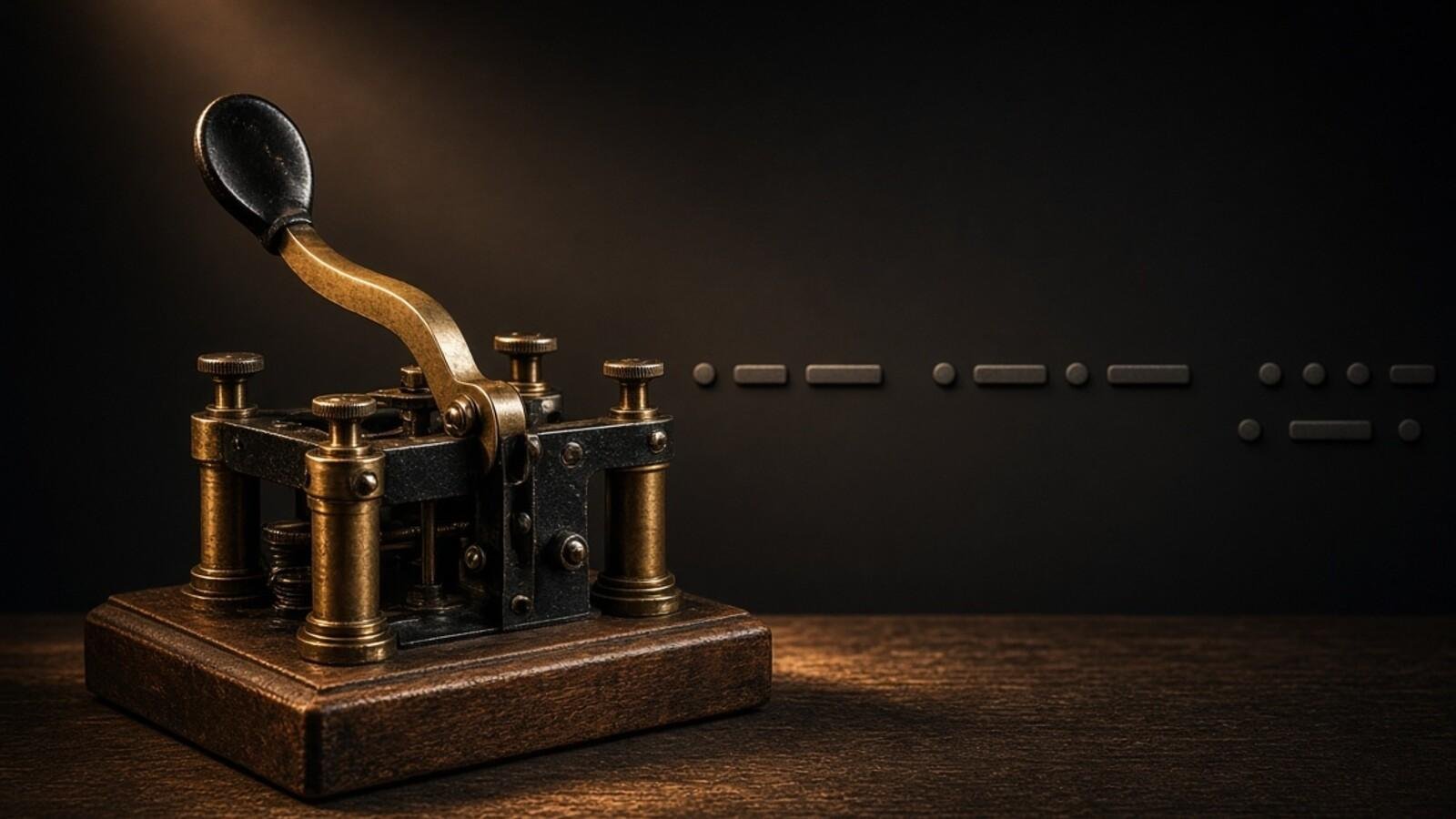
Quick answer: International Morse code represents letters and numbers with short signals (dots or dits) and long signals (dashes or dahs). A Morse code alphabet chart lets you look up A–Z, digits 0–9 and a decoding tree, but accurate communication also needs consistent rhythm and spacing. The ITU-R M.1677-1 recommendation is the key standard reference for International Morse code.
Updated: 21 November 2026.
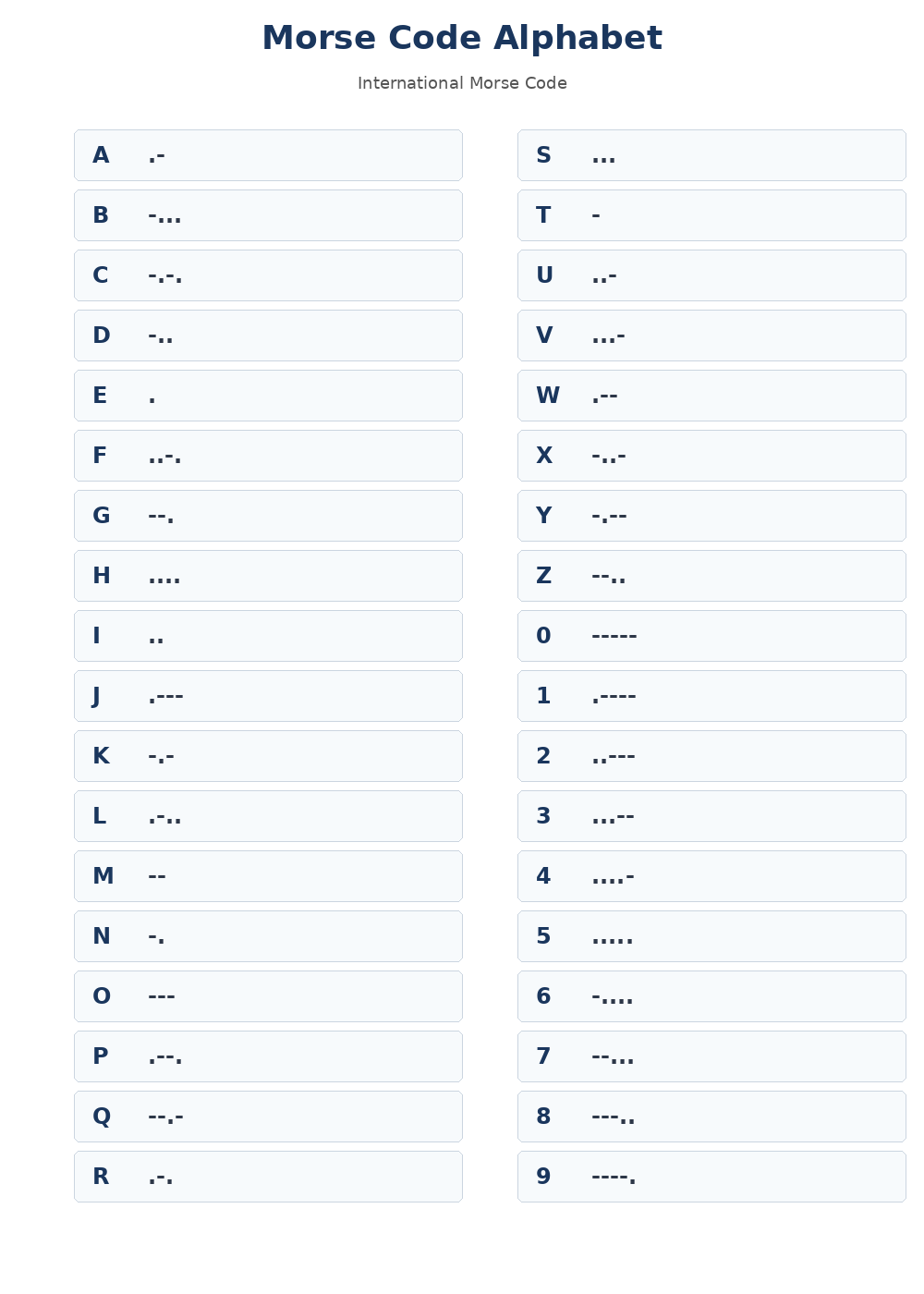
Morse code alphabet A–Z: dots and dashes
Each Latin alphabet letter has a defined pattern of dots and dashes in International Morse. The familiar letter A is dot-dash, N is dash-dot, E is a single dot, T is a single dash, S is three dots, and O is three dashes. These short patterns are easy to practise, but the longer letters require attention to sequence. Moving one signal changes a character: R is dot-dash-dot, while W is dot-dash-dash. Correct order matters more than how attractive the print chart looks.
The A–Z table below is intentionally written as ordinary text characters instead of relying solely on an infographic. You can copy it into a learning notebook or use it to check a poster. The chart uses a period for a short signal and a hyphen for a long signal; the real sound or light transmission is a timed event, not a punctuation mark. Some websites draw long horizontal lines instead of hyphens, but that change of style should not change the signal pattern. For technical operation use a recognised procedure rather than treating this table as a complete radio manual.
Verified Morse alphabet A–Z table
| Letter | Morse | Letter | Morse |
|---|---|---|---|
| A | .- |
N | -. |
| B | -... |
O | --- |
| C | -.-. |
P | .--. |
| D | -.. |
Q | --.- |
| E | . |
R | .-. |
| F | ..-. |
S | ... |
| G | --. |
T | - |
| H | .... |
U | ..- |
| I | .. |
V | ...- |
| J | .--- |
W | .-- |
| K | -.- |
X | -..- |
| L | .-.. |
Y | -.-- |
| M | -- |
Z | --.. |
Morse code numbers 0 to 9
Each decimal digit uses five Morse elements. Zero is five dashes, five is five dots, and the other digits transition between dots and dashes in a predictable progression. One begins with a single dot followed by four dashes; nine uses four dashes and a final dot. Recognising this symmetry can be easier than memorising ten unrelated strings. A number should be spaced from neighbouring characters in the same way as other Morse characters, rather than cramming all its signals together.
When encoding a phone number, time or short identifier, practise each digit separately first. A signal like three dots and two dashes corresponds to digit 3; changing the ordering does not preserve that meaning. Do not confuse a period used as a visible dot with an actual punctuation character in a Morse message. In real communication, punctuation marks can have their own Morse sequences. Beginner charts often omit punctuation to stay readable; consult the ITU reference when a message requires full symbol coverage.
Morse code numbers 0–9
| Number | Code | Number | Code |
|---|---|---|---|
| 0 | ----- |
5 | ..... |
| 1 | .---- |
6 | -.... |
| 2 | ..--- |
7 | --... |
| 3 | ...-- |
8 | ---.. |
| 4 | ....- |
9 | ----. |
Timing: the 1–3–7 rule and why spaces matter
Morse is a rhythmic code. A dot takes one basic time unit and a dash takes three. The gap between elements inside one character is one unit. Between letters in a word, the gap is three units; between words, it is seven. These proportions explain why reading the same written dots and dashes without timing can be misleading. A long delay can change how a listener divides the message into letters, even if the sender’s intended letters were individually correct.
For a practice lamp, think of a one-unit flash for a dot and a three-unit flash for a dash. Leave one unit of darkness between parts of a letter. After the letter, wait the remaining interval so the total between characters is three units. Between words, allow seven units. Faster or slower sending changes the absolute duration but should retain these ratios. Some training methods use longer spaces while students develop recognition; actual operating conventions still matter. Good Morse practice is as much about listening and pacing as it is about memorising a printed alphabet.
How the Morse code binary decoding tree works
A Morse decoding tree branches for each incoming signal. At the top, choose the left branch for a dot and the right branch for a dash in the commonly drawn learning layout. After one signal you reach E or T; after a second signal the next branches correspond to the two-element letters. Follow each signal in order until the character ends. The tree is a visual shortcut for decoding a sequence, not a different international alphabet. Its layout may be mirrored on some websites, so check whether the chart clearly labels the dot and dash directions.
Try decoding dot-dash: from the root follow dot, then dash, reaching A. Dash-dot leads to N. Three dots lead to S, and three dashes to O. You can reverse the process to encode a letter, but beginners often find it easier to start with the conventional dot-dash table and then practice the tree. For long words, real-time listening is faster once the patterns become familiar. A tree is most useful during the learning stage and for checking unfamiliar sequences against a written reference.
What SOS means and what it does not mean
The internationally recognised SOS distress signal is commonly written as three dots, three dashes and three dots. In its distress-signalling use it is treated as a continuous distinctive group, rather than merely three unrelated letters spelled out casually. Many popular expansions such as ‘Save Our Souls’ are memorable backronyms, not the original technical reason for the code. Avoid teaching children that SOS stands for a mandatory English phrase.
A flashing SOS light may be a useful educational demonstration, but an emergency requires more than copying nine signals. At sea or in aviation, use the appropriate distress systems and procedures, including relevant radio and emergency services, rather than relying only on Morse. Unauthorised or misleading distress messages can interfere with rescue operations. In a classroom, you can explain why the pattern is easy to recognise, then practise it as a history and communication example without presenting the activity as complete emergency training.
Morse code translator: encoding and decoding text
A Morse translator converts typed characters to dot-dash groups or attempts to decode groups back into letters. For accurate results, the tool must know where one character ends and the next begins. Many websites represent letter boundaries with spaces and word boundaries with a slash, but that text convention is only a convenient notation. A machine cannot infer arbitrary missing spaces with complete reliability. If the source is an audio recording, noise, signal speed and timing errors can produce ambiguous results.
When checking an online Morse code converter, test a few known pairs such as E dot, T dash, A dot-dash and N dash-dot. Then try a digit and a word containing repeated letters. The common phrase HELLO, for example, gives four dot for H, dot for E, dot-dash-dot-dot for L twice, and three dashes for O. Compare the result against the ITU patterns. Avoid entering confidential information into unknown online translation websites. Morse can encode a message, but it is not encryption or a method of securing private data.
How to learn Morse code quickly without memorising a bad chart
Start with short frequent letters, such as E, T, A, N, I and M. Practise hearing the shapes as ‘dit’ and ‘dah’ rather than counting dots at every stage. Add letters in small groups and review them through short words. Then learn all ten digits and common punctuation if needed. Many learners find brief daily listening practice more effective than staring at a full poster for one long session. Track accuracy before raising speed.
The biggest avoidable mistake is learning a misspelled or AI-generated chart. A single wrong element changes the intended character; if a chart shows the same sequence for two standard Latin letters, something needs checking. Verify a printable poster against a plain table derived from ITU M.1677-1. Different extended-character systems can add non-English letters, so do not assume one global chart covers every language’s special symbols. For beginners in India, explanations can be Hindi while the International Morse character set remains defined by its standard.
Morse code versus binary, semaphore and maritime flags
Morse code is sometimes called ‘binary-like’ because it has two visible element types. However, it is not simply ordinary computer binary: Morse letters have variable-length patterns, timing gaps and operational procedures. Semaphore uses positions of two handheld flags to represent characters; nautical signal flags are physical flags that can carry standalone maritime meanings. These different communication systems should not be merged into one visual legend.
A student can compare three exercises to see the difference. Write a message in Morse using time-based dots and dashes, display a character with two semaphore arm positions and identify a nautical flag from the International Code of Signals. The mapping and use are distinct even if all three communicate visually. Such comparison is valuable for general knowledge, scouting or school projects, but professionals must rely on their own governing codes. An attractive poster is a learning aid, not a certified navigation or radio manual.
Frequently asked questions
What does A mean in Morse code?
A is dot-dash: .-
How many dashes are in Morse number 0?
Five, written as —–.
What is Morse SOS?
A continuous distress sequence commonly depicted as … — …, with three dots, three dashes and three dots.
What is the 1–3–7 rule?
One time unit for a dot and for internal gaps, three for a dash and letter gaps, seven for word gaps.
Is Morse code the same as a binary encoding?
No. It uses variable-length dot-dash signals and timed gaps rather than ordinary fixed-width computer binary.
Conclusion
A useful Morse code chart combines an accurate dot-dash alphabet, five-element digit codes, a well-labelled decoding tree and careful timing. Verify patterns before relying on any generated poster.
Sources
- ITU-R Recommendation M.1677-1 — International Morse Code
- US Coast Guard — International Code of Signals (Morse section)
Educational reference, not a replacement for operational radio or distress procedures.











Share Your Opinion
Comments are closed on this post.