Legal disclaimer
This article gives general Indian legal information, reviewed on 9 October 2026. Admissibility depends on the proceeding, applicable evidence law, relevance, authenticity and court directions. It is not permission to intercept communications, access another person’s device or publish private audio. Ask an advocate to assess your recording and the lawful method of presenting it.
A recording can matter, but it is not automatic proof
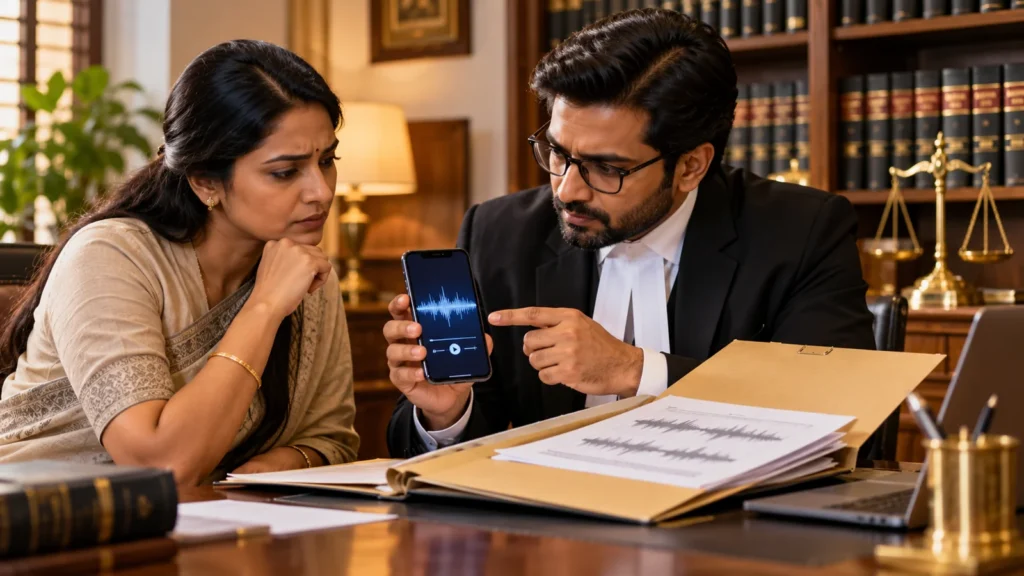
A call recording may support a claim about a conversation, threat, transaction or other relevant event. The court still needs to consider where it came from, who is speaking and whether the content reliably represents the conversation. Having an audio file on your phone does not automatically establish its source, completeness or the truth of every statement within it.
Separate three questions: whether the recording is relevant to the dispute, whether it can be admitted through the applicable procedure, and how much evidentiary weight it deserves. A file can be admitted yet remain insufficient to prove the claim. Conversely, a genuine conversation may encounter procedural difficulties if the required foundation or supporting material is missing.
A transcript helps the court understand audio but is not automatically a substitute for the recording. If important words are unclear, say so accurately. Do not fill gaps with the version most favourable to you. A copied message saying that somebody else heard a call also raises different questions from a properly proved recording of that call.
Section 65B and the current BSA framework
The title uses a widely searched older provision, Section 65B of the Indian Evidence Act, 1872. For proceedings governed by the Bharatiya Sakshya Adhiniyam, 2023, the relevant electronic-record provisions include Sections 61–63. BSA commenced on 1 July 2024 and Section 170 contains savings for specified pending proceedings. Check the applicable framework rather than relabelling every submission automatically. [1]
Section 65B and BSA Section 63 address the legal foundation for electronic outputs, including relevant certificate requirements. They are not interchangeable blank forms. Under BSA, Section 63(4) and the statutory Schedule specify a certificate framework including the party and expert portions and hash information. Ask counsel how these requirements apply to the material being tendered.
The date you recorded the call alone does not settle every transitional issue. The relevant proceeding and savings provision matter. The original device, a copied audio file, an exported recording and a transcript may also require different analysis. Do not describe any document bearing the heading “65B certificate” as automatically sufficient under all present or older proceedings.
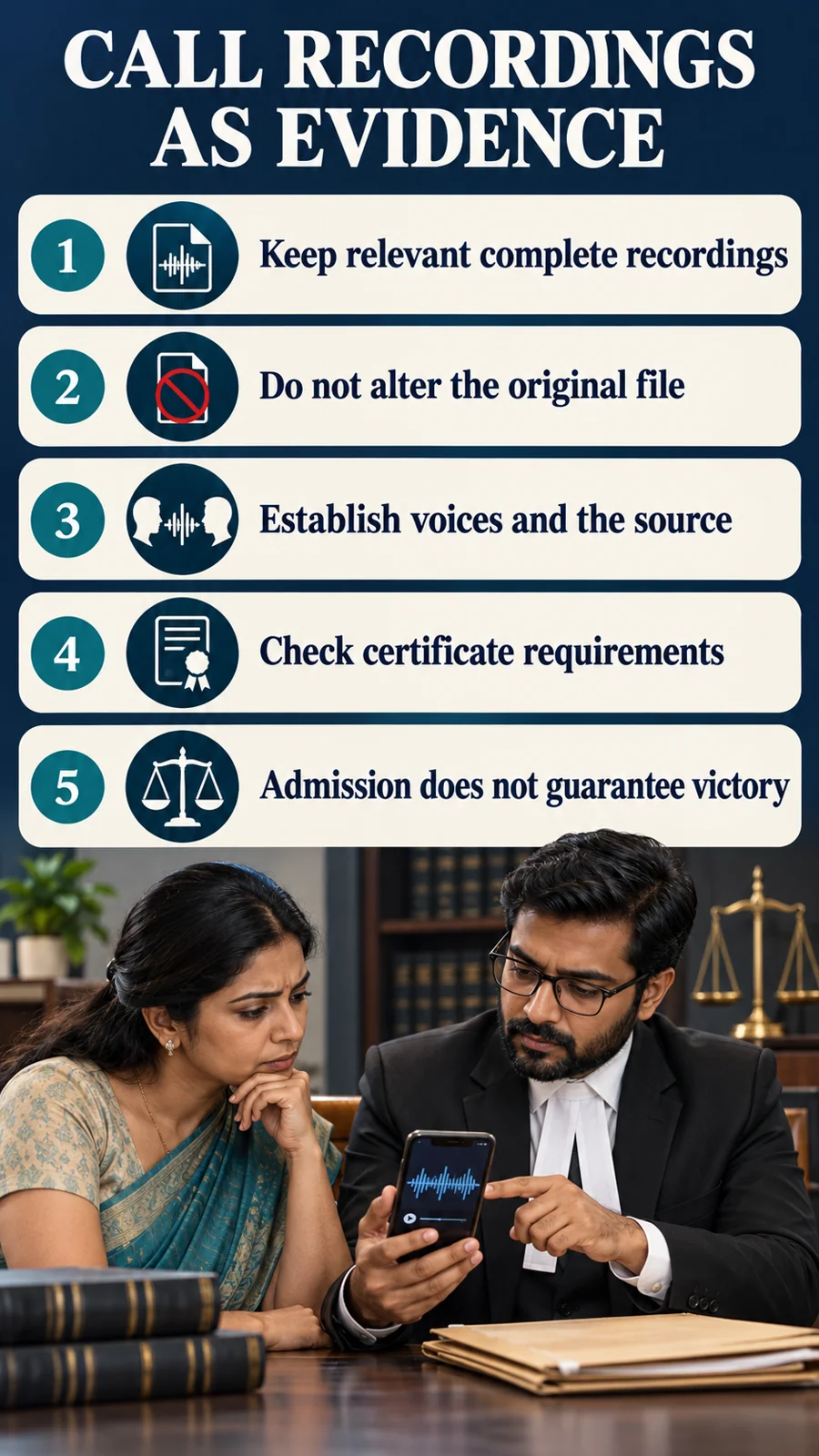
FACT: A certificate is not a guarantee that the recording is genuine, legally obtained or sufficient to win the case. Admissibility and the court’s assessment of its reliability are separate questions.
What the court needs to assess
Explain why the conversation relates to a fact in issue or another legally relevant fact. An embarrassing conversation unrelated to the dispute does not become helpful evidence simply because it is private. Identify the particular point you rely on and provide enough surrounding context for that point to be assessed fairly.
Voice identification matters. The relevant witness, source records and, where needed, forensic examination may help establish who is speaking. A phone number displayed in an app is not conclusive proof of the speaker’s identity. Do not assume a contact name saved by you establishes the other person’s identity or that a voice label proves the conversation’s participants.
Accuracy and integrity also matter. Editing, unexplained gaps, compression, missing metadata or repeated forwarding can create disputes about authenticity. They do not all have identical consequences, but they need honest explanation. AI-generated or cloned voices introduce additional concerns. Never present a synthetic conversation as if it were a real exchange between the parties.
Preserve the actual source and complete context
Keep the original audio and, where lawfully available, the device or source on which it was recorded. Retain available dates, file details and relevant logs. Make a secure backup without overwriting the original. Write an accurate note describing how you obtained the material and who handled it, rather than creating a story after a challenge is raised.
If you need a listening copy, distinguish it clearly from the untouched source. Do not trim the original to hide an unfavourable exchange. A working excerpt can be prepared for convenience if disclosed and supported by the complete recording through the appropriate process. The advocate should decide how the source, excerpt and transcript are presented without misleading the court.
Forensic tools and hash values can help document file integrity, but a hash alone does not prove who spoke or whether the initial recording was truthful. It can indicate whether the same file changed after hashing. Get qualified assistance where necessary, keep the corresponding report and avoid treating a technical-looking number as a complete legal authentication process.
Certificates: what should not be oversimplified
In Arjun Panditrao Khotkar v Kailash Kushanrao Gorantyal, decided on 14 July 2020, the Supreme Court explained the Section 65B certificate requirement for the relevant electronic output under the older Act. It also discussed proving an original device through its owner or operator and obtaining a certificate when the necessary system is controlled by someone else. [2]
Therefore, saying “every recording needs a 65B certificate without any exception” oversimplifies the older-law position. Equally, saying “I have my phone, so no formal proof is ever necessary” is wrong. Whether the original is actually produced and proved, what output is being tendered and which law governs all matter. Do not automatically transplant an older-law exception into every BSA question.
Under BSA Section 63, counsel should examine the current text, certificate Schedule, appropriate signatories, device or source details and required expert material. Do not ask a person with no relevant knowledge to sign an invented account. A notarial stamp by itself does not establish compliance with electronic-record requirements. The certificate should reflect genuine facts about production and the record.
If the evidence comes from a service provider or another person’s system, ask about lawful production, preservation or court assistance. Do not hack the account to obtain a convenient certificate or file. Missing access requires an appropriate procedural request, not fabrication. Timing and any permitted later compliance depend on the applicable law, case stage and court directions.
Privacy and admissibility are different legal questions
Do not assume that every non-consensual recording is automatically excluded in every Indian proceeding. Also do not assume that a potentially admissible file grants unrestricted permission to record, intercept or circulate communications. The manner of obtaining it, the parties, the forum, privileges and the applicable substantive law can raise separate legal issues.
Recording a conversation in which you participate is not identical to intercepting communications between other people or secretly accessing their device. This article does not provide methods for covert surveillance. Seek specific advice before obtaining sensitive material, and avoid sharing private audio publicly as pressure on a complainant, spouse, employee or business counterpart.
Privacy concerns are especially important when intimate information, minors or unrelated third parties appear in a recording. Ask counsel about limiting disclosure and any appropriate confidential or in-camera handling. Do not assume a case filing allows publication on social media. Preserve the original for lawful use while avoiding unnecessary exposure of people whose details do not need to be public.
What Vibhor Garg v Neha actually decided
In Vibhor Garg v Neha, 2025 INSC 829, decided on 14 July 2025, the Supreme Court addressed recorded conversations between spouses in matrimonial litigation. It restored the Family Court’s order permitting the specified recording material to be taken on record. The decision discusses the spousal communication provision and its exception for proceedings between married persons, alongside evidence and privacy issues. [3]
This should not become a headline that every secretly obtained recording is lawful or automatically accepted everywhere. The matrimonial context, Family Court framework and proof requirements matter. Taking material on record does not settle the disputed facts or guarantee the divorce claim succeeds. The opposing party may raise genuine issues about the recording and its interpretation.
The decision discusses relevance, identification and accuracy in assessing recorded conversations. Those concerns remain practically important even when a court has flexibility to receive useful material. Do not use the judgment to justify installing spyware, manipulating audio or threatening public disclosure. Counsel should apply its actual reasoning to the correct proceeding and relevant evidence law.
Present the recording through the proper process
Give your advocate the original source, full recording, accurate chronology, relevant logs, any genuine certificate and a careful transcript. Identify unclear words, language differences and who prepared the transcript. If translation is needed, arrange an appropriate accurate version rather than relying unquestioningly on an automated transcript that may mishear names, dates or negations.
Ask about the court’s filing format, copies, timing, witness foundation and any application needed. Courts may require specific arrangements for playback or production. A random link to an online drive is not universally a complete evidentiary submission. Keep sensitive files secure and share them only through the authorised legal route with the necessary parties and safeguards.
If the other side relies on questionable audio, preserve their supplied version and raise specific objections through counsel. Do not edit it to demonstrate your own preferred meaning. Examination of the source, expert assistance, relevant cross-examination and context may be appropriate. The legal response should address actual authenticity or admissibility issues instead of automatically calling every adverse recording fake.
Frequently asked questions
1. Is a recording on my phone automatically valid evidence?
No. Relevance, speaker identification, integrity and the applicable evidentiary procedure need assessment. Possession alone does not establish every required fact.
2. Is Section 65B still the provision in every case?
No. The older Act may govern saved proceedings; BSA Sections 61–63 govern the relevant current framework. Ask counsel to check the transition and the actual submission.
3. Does notarising a certificate guarantee admission?
No. Genuine production details, the correct legal requirements and appropriate signatories matter. A stamp is not a substitute for them.
4. Can I submit only a short edited clip?
Do not conceal the full context or alter the original. Ask counsel how a disclosed working excerpt can be supported by complete source material.
5. Does Vibhor Garg permit every secret recording?
No such universal permission follows. The judgment concerns matrimonial proceedings and their legal context; authenticity and other applicable legal limits still matter.
Advice
Preserve genuine material early, keep the complete context and avoid modifying the source. Consult an advocate about the correct evidence law and certificate framework before filing. Use qualified assistance for disputed audio or necessary expert material. Protect private information, avoid public pressure tactics and remember that admission of a recording does not by itself establish your whole case.
Related reading: How to avoid arrest by police: Step-by-step procedure to get anticipatory bail under Indian law · How to reduce traffic challan in Lok Adalat: Virtual court procedure and penalty waiver rules
Official sources and judgments
[1] Ministry of Home Affairs — BSA, particularly Sections 61–63, 170 and the certificate Schedule: https://www.mha.gov.in/sites/default/files/2024-04/250882_english_01042024_0.pdf
[2] Supreme Court — Arjun Panditrao Khotkar v Kailash Kushanrao Gorantyal, 14 July 2020: https://api.sci.gov.in/supremecourt/2017/39058/39058_2017_34_1501_22897_Judgement_14-Jul-2020.pdf
[3] Supreme Court — Vibhor Garg v Neha, 2025 INSC 829, 14 July 2025: https://api.sci.gov.in/supremecourt/2021/31421/31421_2021_5_1501_62289_Judgement_14-Jul-2025.pdf
Detailed legal disclaimer
This educational article does not endorse interception, spyware, unauthorised device access, fabricated audio, false certificates, threats or public disclosure of private communications. No admissibility, evidentiary weight, court outcome or platform-policy approval is guaranteed. Current law, statutory savings, court directions and individual facts require professional assessment. This disclaimer does not remove legal duties or protect unlawful conduct.