Legal disclaimer
This article provides general Indian legal information, reviewed on 9 October 2026. It does not promise a reduction or waiver of a traffic fine. Eligibility, compounding notifications, court orders and registration arrangements vary by State and event. Verify your challan and current official instructions; obtain legal advice for a contested or serious case.
What can actually happen to a traffic challan?
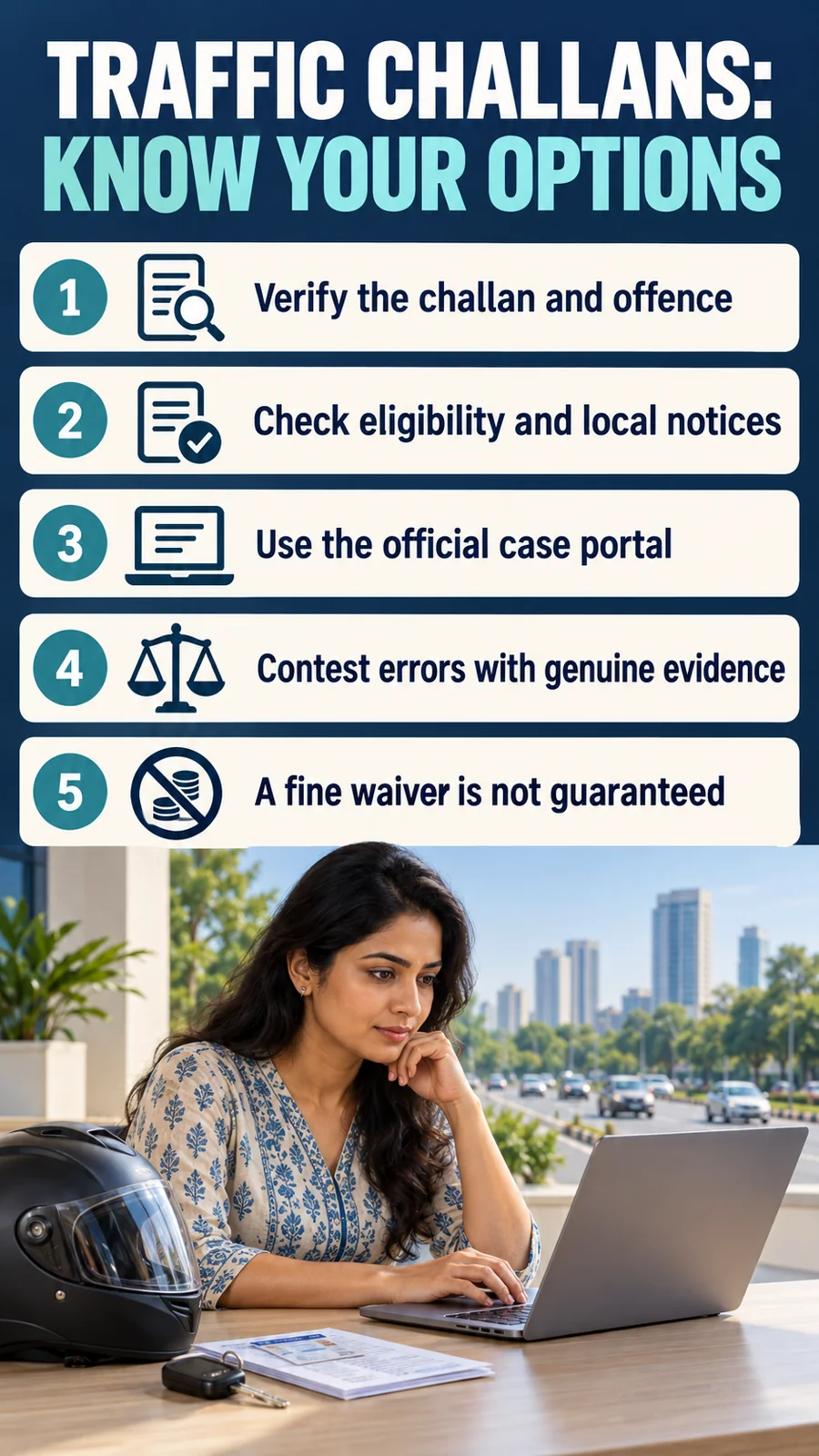
A challan can be paid through the appropriate official route, challenged if there is a genuine error, or considered for lawful settlement where the offence and local arrangements permit it. These are different options. An advertisement promising that every fine disappears in Lok Adalat misstates the position. Decide from the actual offence and present case status, not the headline amount alone.
First identify the issuing authority, challan number, vehicle, date, location, alleged violation and applicable provision. Check whether it remains with the enforcement authority, has moved to a virtual court or is before another court. The correct next step depends on that stage. One notice may cover more than one offence, each requiring its own legal assessment.
Do not deliberately delay payment simply to accumulate challans for a hoped-for discount. An upcoming event does not suspend an existing summons or deadline. Check the actual case instructions, especially if the matter has been transferred, a hearing date exists or an order has already been passed. Old social-media instructions may belong to a different city or earlier event.
Lok Adalat is not an automatic amnesty
Ordinary Lok Adalat is a settlement forum under the Legal Services Authorities Act, 1987. Its role is to help parties reach an appropriate settlement rather than conduct a full contested trial. Sections 19–21 concern organisation, reference and awards. The statutory framework excludes non-compoundable criminal offences from ordinary Lok Adalat settlement. [1]
The Motor Vehicles Act, 1988 includes Section 200 concerning composition of specified offences, with the relevant State notification and authorised arrangements being important. This does not authorise a driver to select a preferred amount. Nor does it establish a nationwide percentage discount applicable to every traffic offence. The particular offence and notification need checking. [2]
Depending on the lawful arrangements, an eligible case may be settled on terms that reduce the amount, but the possibility is not an entitlement. A complete waiver also cannot be promised. Do not infer eligibility merely because another driver received relief. Their offence, location, stage, record and event rules may differ from yours.
FACT: Neither visiting Lok Adalat nor using Virtual Courts guarantees that your challan will be reduced or cancelled. Eligibility and the actual lawful order or settlement control the result.
Step 1: Check eligibility and the local notice
Look for the current notice issued by the relevant State or District Legal Services Authority, court or traffic authority. Check the event date, covered jurisdiction, eligible offences, any cut-off for challan dates, token or registration requirements and the place or online arrangement. Do not substitute a forwarded poster for the official notice.
Some events may require advance registration or a limited appointment slot. Others use a different process. There is no universal national booking page or token rule covering all locations. If the notice is unclear, ask the organising authority or court registry. A general national schedule does not prove that your particular traffic matter is included.
Do not assume that serious allegations, accident-related criminal proceedings or every drunken-driving case can be settled as routine petty traffic matters. Examine the actual provision and whether the offence is legally compoundable. A case involving additional criminal allegations is not necessarily resolved by disposing of a traffic challan. Ask an advocate rather than applying someone else’s result.
Step 2: Gather accurate documents
Keep the challan details, available notice or summons, registration certificate, driving licence and identity material required by the local process. Bring genuine records relevant to any error. A wrong vehicle number, duplicate entry, earlier payment or disputed location should be supported by specific material rather than a broad statement that the system is always unreliable.
Organise each challan separately. If several exist, one receipt or settlement does not automatically close all of them. Note whether the vehicle belongs to you, who was driving and what the allegation says. Do not sign a false declaration or identify another person dishonestly to avoid consequences. Ownership and responsibility must be addressed under the applicable law.
A financial difficulty may be explained honestly where relevant to the permitted process. It does not compel cancellation of a lawful fine. Avoid fabricated income records or medical documents. Tell the authority exactly what relief you seek and on what genuine basis, without assuming that hardship changes the statutory limits for every offence.
Step 3: Attend or complete the authorised process
Follow the official instructions for presenting the eligible matter. Confirm whether personal attendance, an authorised representative or another permitted arrangement is required. An agent’s promise that attendance is never necessary is not a substitute for the notice. Carry the registration acknowledgment if the event requires one, and keep track of the assigned bench or appointment.
Understand any proposed settlement before agreeing. Check the case number, amount, payment instructions and whether the order addresses all relevant violations. Pay through the official channel and retain the receipt and award or disposal order. An informal cash payment without an official record does not prove that the proceeding has been closed.
If settlement is not reached, ordinary Lok Adalat does not become a full trial court simply because the case was listed there. The appropriate proceeding can continue through the competent forum. Do not assume failed negotiations mean acquittal. Equally, do not agree to an inaccurate record merely because you feel pressure to finish quickly.
What Virtual Courts can and cannot do
Virtual Courts is a separate online case-handling facility, not a synonym for Lok Adalat. Where your State and department are supported and the case is present, the official portal permits checking details and the available payment or contest option. Use the current instructions shown for your case rather than expecting identical screens everywhere. [3]
The official FAQ describes choosing the relevant State, searching the case, viewing details and proceeding to payment or a request to contest with the applicable verification. When a contest request is processed, the acknowledgment supplies the assigned court and date. Preserve that acknowledgment and follow the resulting court directions; submitting the request does not itself cancel the challan.
Use https://vcourts.gov.in/virtualcourt/ by typing the address yourself or following a verified official route. Do not disclose an OTP to an unknown caller or pay through an unrelated link promising clearance. If the case is not found, verify the correct department and current transfer status with the authority. Absence from this portal does not prove the challan is invalid.
A wrong challan needs a genuine challenge
If the vehicle number, photograph, time, location or payment status is genuinely wrong, ask about the relevant grievance or contest procedure. Keep the original notice and supporting records. Explain the specific mismatch. A lawful challenge is different from asking for a discount while admitting the violation, and the appropriate route may also differ.
A photograph does not always resolve every legal issue by itself. Its connection with the vehicle and alleged violation matters. Conversely, a claim that you personally were elsewhere may not automatically answer every owner-related allegation. Present the actual facts to the authority or advocate and address the relevant offence rather than relying on a generic defence script.
If you contest and receive a court date, treat it as a real proceeding. Follow summons and response requirements. Do not assume that choosing the online contest button postpones everything indefinitely. Where documents were retained or licence-related action is involved, ask separately about the lawful process for that issue; a payment receipt may not answer every associated question.
Receipts, duplicate payments and the final record
After payment or settlement, retain the reference number, receipt and relevant order. Check the official case status after the normal processing period. A delayed update does not automatically mean payment failed. Contact the relevant authority with the actual transaction and case details before paying again. Payment verification and duplicate-payment remedies depend on the applicable system.
Avoid claiming that disposal of one challan wipes out every licence-related consequence or separate proceeding. Read the scope of the order. If another authority needs proof, provide the genuine receipt or court record. Do not edit a PDF, create a receipt screenshot or use a paid intermediary’s message as evidence of judicial disposal.
What Supreme Court principles explain the limits?
State of Punjab v Jalour Singh, (2008) 2 SCC 660 explains the conciliatory role of ordinary Lok Adalat and the importance of settlement rather than independent adjudication. The Supreme Court’s official judgment dated 19 December 2024, linked below, also discusses this authority. The principle explains why listing alone is not a guaranteed verdict in your favour. [4]
This is a procedural principle, not a Supreme Court rule granting all drivers a fixed discount. Traffic eligibility still requires the Motor Vehicles Act, relevant notification, actual offence and local arrangements. Do not attach a famous case name to an invented percentage or claim that an ordinary Lok Adalat can disregard a statutory restriction.
Frequently asked questions
1. Is every traffic challan eligible for Lok Adalat?
No. Check the offence’s compoundability, current stage and local event instructions. Non-compoundable criminal offences cannot be settled through ordinary Lok Adalat.
2. Is a fifty-per-cent reduction guaranteed?
No nationwide guarantee follows from these rules. Any lawful relief depends on the particular case and applicable arrangements.
3. Are Virtual Courts and Lok Adalat the same?
No. Virtual Courts provides online case options for supported matters. Lok Adalat is a statutory settlement process with its own eligibility and arrangements.
4. What if the challan is wrong?
Use the appropriate grievance or contest route with genuine evidence. Requesting to contest does not itself prove the error or cancel the case.
5. Does one payment close all my challans?
Not automatically. Match each receipt and order with the specific challan or offences it covers and verify the official record.
Advice
Check the offence and stage first, then the official local notice. Choose honestly between paying, contesting a real error and seeking permitted settlement. Keep registration details, genuine documents and every receipt. Follow court dates, avoid unofficial clearance promises and ask an advocate about serious allegations. Better driving and valid documents prevent repeat problems more reliably than waiting for a possible reduction.
Related reading: How to avoid arrest by police: Step-by-step procedure to get anticipatory bail under Indian law · Is call recording admissible in Indian court? Privacy issues and Section 65B certificate mandate
Official sources and judgments
[1] NALSA — ordinary Lok Adalat, settlement and jurisdiction: https://nalsa.gov.in/lok-adalats/
[2] India Code — Motor Vehicles Act, 1988, including Section 200: https://www.indiacode.nic.in/indiacode/handle/123456789/1798?col=123456789%2F1362&view_type=search
[3] Virtual Courts — official procedure and FAQ: https://vcourts.gov.in/virtualcourt/faq.php
[4] Supreme Court — judgment dated 19 December 2024 discussing State of Punjab v Jalour Singh: https://api.sci.gov.in/supremecourt/2015/881/881_2015_9_1507_58088_Judgement_19-Dec-2024.pdf
Detailed legal disclaimer
This educational article does not endorse bribery, false records, dishonest driver identification or ignoring notices. No reduction, waiver, registration slot, disposal date or platform-policy approval is guaranteed. Current State notifications, court directions and individual facts prevail. Obtain specific professional advice where needed. This disclaimer does not remove legal obligations or protect unlawful conduct.