Legal disclaimer
This article provides general legal information about Indian court procedure, reviewed on 9 October 2026. It is not advice for a particular case. Consult an advocate about the actual summons, applicable procedural law and orders. Outcomes depend on the court, case type, service record and reasons for absence.
What a court summons actually means
A summons is a court direction requiring the person named to attend or respond as specified. Read the entire document, including the court name, case number, your role, hearing date and any requirement to produce records. A civil defendant, criminal accused and witness may have different responsibilities. One explanation cannot cover all three without these distinctions.
Verify the case through the official eCourts service and, where necessary, the court registry or your advocate. A missing online entry does not conclusively prove a document is fake: records can be delayed or a different court portal may apply. Do not send money or identity documents to an unverified caller claiming that payment cancels a warrant.
A court summons, police notice, advocate’s legal notice and debt recovery message are different documents. Do not assume that a threatening private message carries the authority of a court order. Equally, do not dismiss a genuine court summons merely because you disagree with the allegations. Address authenticity and the underlying dispute through the proper legal process.
Refusing delivery does not guarantee invalid service
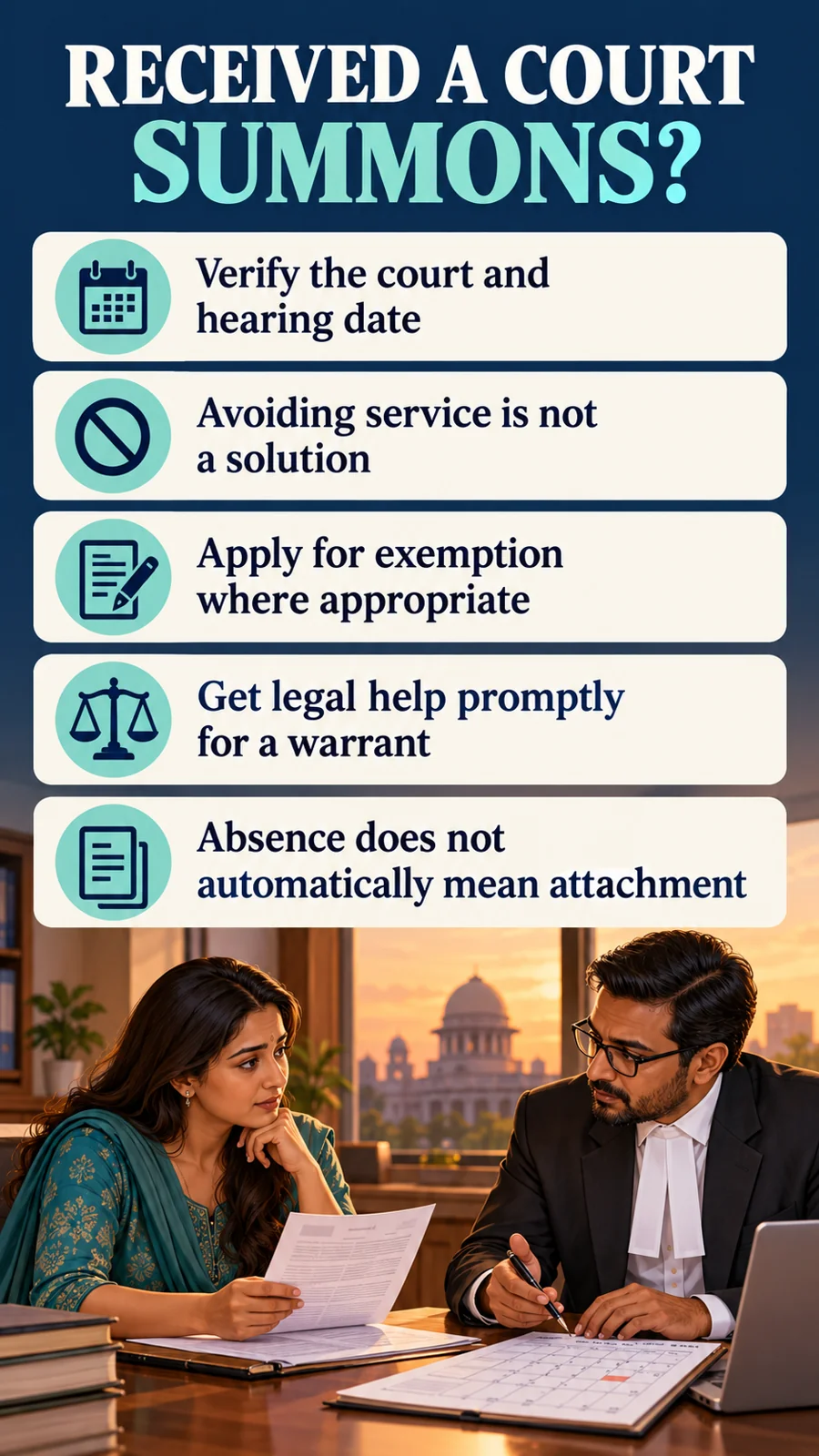
FACT: Avoiding a summons does not automatically prevent the court from proceeding. The court examines whether service was legally sufficient; your refusal to sign is not a universal defence.
Under the Bharatiya Nagarik Suraksha Sanhita, 2023, criminal summons provisions include personal service, specified service through an adult family member when the person cannot be found, and affixation followed by the court’s assessment. The detailed requirements matter. Handing a document to any neighbour or employee is not automatically equivalent to valid service on you.
Civil service follows the Code of Civil Procedure and applicable rules, including provisions concerning refusal and substituted service. The process server’s report and the court’s order can become important. Keep an honest record if the address was wrong or you genuinely did not receive the document. Do not invent an incorrect-address explanation after learning of the case.
Electronic service can also be legally recognised under the relevant framework. BNSS provides for electronic summons, subject to applicable requirements and rules. Neither “all WhatsApp summons are invalid” nor “every WhatsApp message is valid service” is reliable advice. Ask your advocate to check authentication, the method authorised and the service record in the actual case.
Civil cases: absence can affect the case without automatic arrest
In an ordinary civil suit, if the defendant fails to appear despite sufficient service, the court may proceed ex parte under the applicable provisions. That means it may hear the plaintiff without the defendant’s participation. It does not mean the plaintiff automatically wins every claim: the court must still consider the legally required material and relief.
If the plaintiff is absent, the suit may instead face dismissal, depending on who attends and the relevant rule. Witness attendance and other special proceedings require separate analysis. Do not use an ordinary defendant’s situation to predict what will happen to a witness or someone disobeying a specific order to attend personally.
Responding to summons may involve appearing through counsel and filing a written statement within the applicable time. Deadlines differ across ordinary civil suits, commercial disputes and particular proceedings. A generic internet claim that everyone has the same number of days is unsafe. The relevant statute, court order and category of case should determine your deadline.
If an ex parte order or decree already exists, legal remedies may include an application to set it aside or another appropriate challenge. Grounds, limitation and the stage of proceedings matter. Attending a later hearing does not automatically erase an earlier decree. Give the advocate copies of the orders and service records promptly rather than waiting for execution action.
Criminal cases: why a warrant may follow non-appearance
For criminal proceedings governed by BNSS, section 90 allows a court, after recording reasons, to issue a warrant instead of or in addition to summons in specified situations. These include a relevant belief that the person has absconded or will not obey the summons, or non-appearance following proper service without a reasonable excuse. The facts and procedural conditions must be assessed.
A missed hearing is therefore serious, but it does not mechanically produce the same order in every case. Whether you were served, whether personal attendance was required, whether exemption was granted and whether a genuine reason was placed before the court all matter. An advocate’s presence does not itself prove that your personal attendance was excused.
A warrant is a procedural instrument for securing attendance; it is not a finding of guilt. BNSS section 72 provides that a warrant remains in force until cancelled by the issuing court or executed. Ignoring it or assuming it expires at the next hearing is not a safe response. Obtain the actual order and seek appropriate court relief promptly.
Bailable and non-bailable warrants: understand the distinction
A warrant with a direction allowing release on specified security is commonly described as a bailable warrant. A non-bailable warrant does not carry that same release direction. The precise wording and court order control the response. Do not confuse this distinction with the separate statutory classification of an offence as bailable or non-bailable.
In Satender Kumar Antil v CBI, (2022) 10 SCC 51, the Supreme Court discussed the need for reasoned use of coercive process and cited Inder Mohan Goswami v State of Uttaranchal, (2007) 12 SCC 1. These decisions caution against mechanical issuance of non-bailable warrants and emphasise the importance of personal liberty and securing attendance appropriately.
The frequently described progression from summons to bailable warrant and then non-bailable warrant is not an unconditional entitlement to three chances in every case. Serious facts or the governing procedure may justify a different response. Equally, a headline saying arrest is inevitable after one absence is misleading. Your advocate should apply the judgments to the actual order and case history.
Genuine inability to attend: apply instead of assuming exemption
If illness, a conflicting court appearance or another genuine difficulty prevents attendance, tell your advocate before the hearing and supply accurate supporting material. Seek the appropriate exemption or adjournment from the court. A request being filed does not mean it has been granted. Confirm the order and any conditions, including the next date and future attendance requirements.
BNSS section 228 permits a Magistrate, in the relevant setting, to dispense with an accused’s personal attendance and allow appearance through an advocate. The court retains the power to require attendance later. Older proceedings governed by CrPC may involve section 205 and other relevant provisions. These are discretionary procedural remedies, not permission to ignore court directions indefinitely.
Electronic proceedings under BNSS section 530 may be available within the applicable framework. Remote attendance requires the appropriate court arrangement or permission; you cannot choose a video call yourself and treat it as compliance. Never submit a fabricated medical certificate or ask counsel to give a false explanation. Dishonest material can create additional legal exposure and damage a legitimate application.
Proclamation and attachment require separate legal conditions
BNSS section 84 concerns proclamation where a warrant has been issued and the court has the relevant reason to believe the person has absconded or concealed themselves so that the warrant cannot be executed. The proclamation must require appearance at a specified place and time, allowing at least thirty days from publication. This is a distinct procedure, not an automatic label applied to every absent person.
Section 85 governs attachment following proclamation, with recorded reasons and statutory safeguards. The court can order attachment simultaneously with proclamation in the specified circumstances involving imminent disposal or removal of property. Consequently, neither “attachment happens after every missed hearing” nor “attachment can never happen before thirty days have passed” accurately states the law.
Do not transfer or hide assets as a response to a warrant or proclamation. Obtain the actual orders, identify ownership accurately and ask an advocate about lawful objections or remedies. Property belonging to relatives is not automatically yours merely because of the relationship. Any third-party claim depends on real ownership, records and the applicable procedure, rather than a convenient assertion after attachment.
Which procedural law applies?
BNSS came into force on 1 July 2024, but section 531 contains savings for specified pending proceedings under CrPC. The applicable framework cannot always be decided only from the alleged offence date or the date of a notice. Give your advocate the FIR, case history and existing orders so the correct provision is used.
For a civil suit, the CPC, special statutes and local rules remain important. Matrimonial proceedings, commercial disputes and witness summons can involve additional requirements. This article explains common principles; it does not replace reading your individual order. A court may also expressly direct personal attendance even where representation through an advocate is otherwise ordinarily possible.
Frequently asked questions
1. Does refusing to accept a summons stop the case?
No. Refusal and other service records may support legally sufficient service under the applicable procedure. Challenge an actual service defect with truthful evidence through the court.
2. Will I definitely be arrested after missing one hearing?
No universal rule gives that outcome. Criminal courts may use warrants when legal conditions are met, while ordinary civil non-appearance may result in ex parte proceedings. Read the actual order urgently.
3. Is sending my lawyer always enough?
No. It depends on your role, the procedural law and any direction requiring personal attendance. Obtain exemption where needed and check that it was granted.
4. Can an electronic summons be genuine?
Yes, within the applicable legal framework. Verify the issuing court, case details, authentication and service method. Do not assume every message is a valid summons or that all electronic service is invalid.
5. Does absence automatically lead to attachment of my property?
No. Proclamation and attachment involve distinct conditions and orders. BNSS allows simultaneous attachment in specified circumstances, so get advice about the actual stage without relying on a fixed waiting-period claim.
Advice
Create a simple file containing the summons, envelope or electronic message, case number, hearing date and all previous orders. Contact an advocate promptly, check what attendance or response is required, and submit genuine documents if you need relief. Keep proof of filing and confirm the court’s decision. If a warrant exists, ask about appearance, recall and bail as distinct issues requiring case-specific handling.
Related reading: Can ancestral property be sold without consent of all legal heirs? Partition deeds and court injunctions · How to remove name from false FIR: Section 482 CrPC quashing petition in High Court explained
Official sources and decisions
[1] Ministry of Home Affairs: BNSS, including sections 63–73, 84–85, 90, 228, 530 and 531: https://www.mha.gov.in/sites/default/files/2024-04/250884_2_english_01042024.pdf
[2] India Code: Code of Civil Procedure, 1908, particularly Orders V and IX: https://www.indiacode.nic.in/bitstream/123456789/2191/5/190805.pdf
[3] Supreme Court: Satender Kumar Antil v CBI, judgment dated 11 July 2022, discussing Inder Mohan Goswami and coercive process: https://api.sci.gov.in/supremecourt/2021/27955/27955_2021_5_1505_36261_Judgement_11-Jul-2022.pdf
Detailed legal disclaimer
This material is educational and does not guarantee exemption, cancellation of warrants, bail or any particular court outcome. It does not encourage avoidance of service, absconding, concealment of assets, fabricated documents or disobedience of orders. Rules and judgments must be checked against the applicable law and facts. Obtain professional advice before acting; a disclaimer does not remove obligations imposed by law or protect unlawful conduct.