Legal disclaimer
This article provides general legal information about India, reviewed on 9 October 2026. An advocate should examine the FIR, alleged offences, current stage and applicable procedural law. Calling a complaint false does not establish that conclusion or guarantee a particular remedy.
Understand what removing a name means
Lawful options may include providing genuine evidence during investigation, seeking appropriate bail and applying for judicial relief where justified. Erasing a name from the original FIR, not being proceeded against in a police report and having proceedings quashed are different outcomes. Do not treat them as one simple administrative request.
Read the allegations and available records before deciding that a complaint is false. Investigation may produce a relevant conclusion, but the historical FIR and subsequent judicial proceedings raise separate questions. A promise that someone can make a name disappear for payment is not reliable legal advice. No particular outcome follows merely from submitting an application.
This article explains available rights and processes. It does not teach evasion, witness pressure or alteration of evidence. Present an innocence claim through genuine material and the appropriate legal route. Disagreement with an investigation does not justify ignoring a valid attendance notice, bail condition or court direction.
Section 482 CrPC and Section 528 BNSS
Since BNSS commenced on 1 July 2024, older CrPC references must be read with the applicable current framework. The High Court’s relevant inherent powers appear in Section 482 of the old CrPC and Section 528 of BNSS. Matching section numbers across the two laws does not mean that the provisions address the same subject. [1]
Section 482 of BNSS concerns anticipatory bail; it is not the old CrPC quashing provision. Anticipatory bail was addressed by Section 438 CrPC. This distinction matters when deciding the correct legal basis for an application. A familiar internet keyword should not replace checking the actual statute.
Section 531 BNSS contains savings for relevant pending appeals, applications, trials, inquiries and investigations. Determine the applicable framework from the relevant procedural stage and judicial interpretation. The alleged offence date alone should not be used to classify every later filing automatically under one code. Get advice about the particular proceeding. [1]
Establish the FIR and current status
Record the FIR number, police station, date, invoked provisions and alleged personal role. Obtain the FIR and relevant orders through the appropriate lawful route. Not every FIR is available in a public online listing. An advocate can explain the relevant police or court process for obtaining the material needed.
Check whether investigation continues, a report has been filed, cognizance has been taken or summons has been issued. Attendance notices, bail conditions, warrants and earlier applications also matter. The original FIR copy alone may not reveal the present arrest or hearing position. Advice should reflect the current record.
Family and business disputes may involve parallel civil, revenue or matrimonial proceedings. Show the relevant pleadings and orders to the adviser. Their existence does not automatically make a criminal allegation false, although they can help establish context. Avoid obtaining advice from a selectively favourable summary that omits earlier litigation.
FACT: Filing a quashing petition does not automatically stop investigation or arrest. Protection depends on an actual judicial order and its applicable conditions.
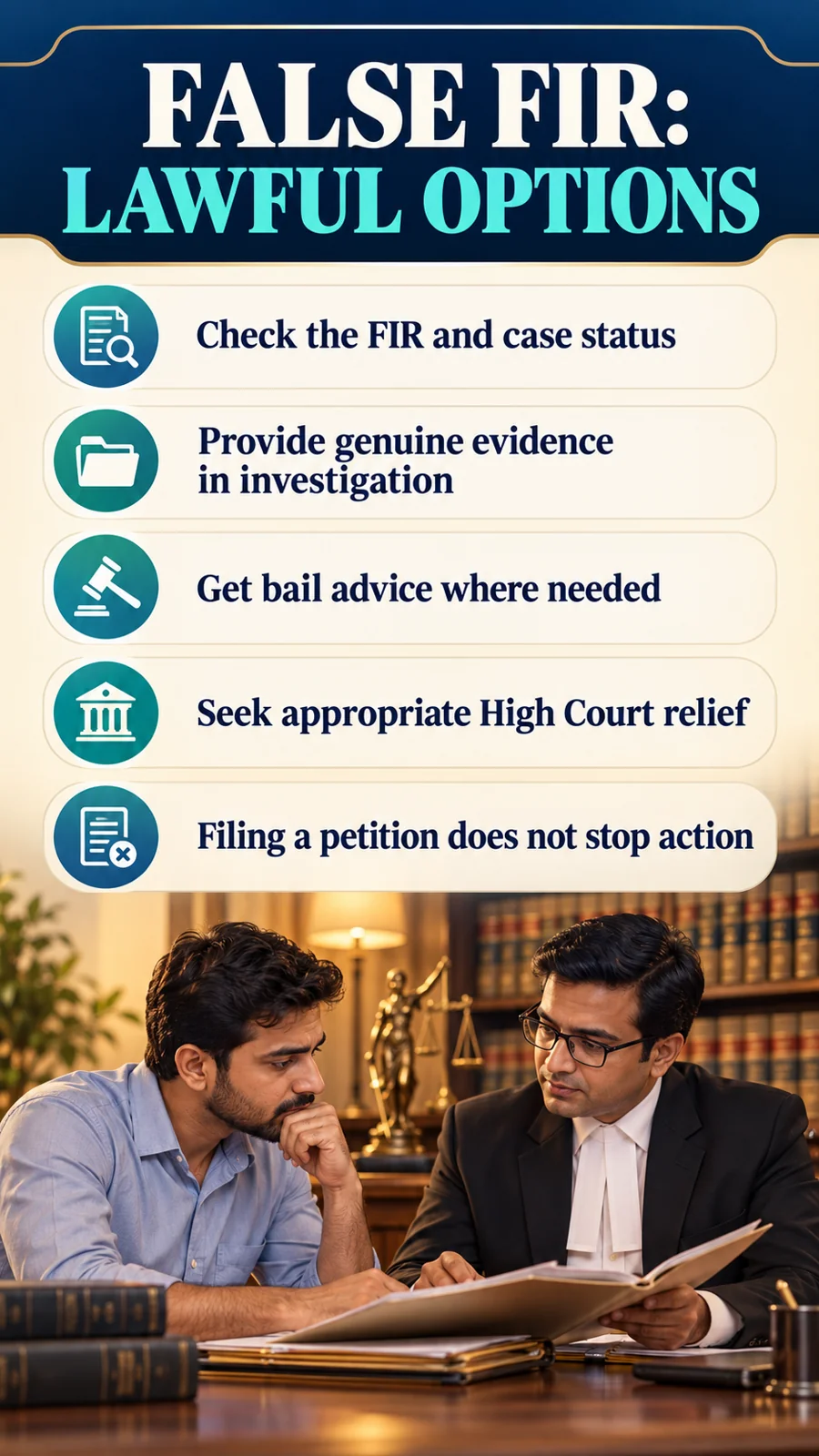
Provide genuine evidence during investigation
Prepare an accurate chronology and identify the original documents relevant to the allegations. Travel, attendance, bank transactions, authentic messages or other records may matter in a particular case. No single document should be promised to defeat every allegation. Its authenticity, context and connection with the alleged role require assessment.
An appropriate written representation to the investigating officer, supported by genuine material, may be useful. Preserve the submission and actual acknowledgment. Request fair consideration without assuming that the agency must reach your preferred result. Comply with applicable lawful notices and directions while taking advice about your rights.
Preserve original digital files, relevant device or account information and available metadata. A cropped screenshot can omit important context. Applicable electronic-evidence requirements under the Bharatiya Sakshya Adhiniyam or the saved older framework require assessment. Do not delete, edit or fabricate evidence to improve the appearance of a defence.
Where concrete facts indicate investigative unfairness, ask about a representation to the appropriate supervisory authority or available judicial relief. That step does not itself extinguish the original allegations. Coaching a witness or threatening the complainant can create additional proceedings and undermine a legitimate defence. Use recognised processes instead.
Police reports, discharge and quashing differ
Section 193 BNSS addresses the report following investigation; Section 173 CrPC is relevant in the applicable older framework. Evidence may lead to a charge-sheet, closure or another relevant conclusion. The report’s effect and the Magistrate’s decision require separate examination, including any available complainant objections. [1]
A lack of sufficient material against a person can be recorded through the proper process. However, omission from a charge-sheet or submission of a closure report should not be described as final judicial exoneration in every situation. The court can assess the matter and available further procedure under the applicable law.
After a charge-sheet, discharge may be considered according to the case type and stage. Acquittal after trial is another outcome. The High Court’s inherent jurisdiction addresses abuse of process and the ends of justice; it is not ordinarily a substitute for conducting a full trial of every contested defence fact.
When High Court quashing may be considered
State of Haryana v. Bhajan Lal, 1992 Supp (1) SCC 335 sets out illustrative grounds. Relevant questions can include allegations that do not disclose an offence even when taken as stated, an express legal bar or an abuse of process in the required circumstances. These are not an automatic checklist guaranteeing termination of a case. [2]
An allegation of revenge is not the whole answer. If the allegations and material disclose an offence requiring investigation, a motive dispute may not prevent inquiry. Similarly, calling something a civil dispute does not remove genuine cheating or other criminal ingredients. Connect the proposed ground with the actual allegations and relevant legal requirements.
Neeharika Infrastructure v. State of Maharashtra, 2021 SCC OnLine SC 315 explains limits on blanket intervention during investigation and insufficiently reasoned interim protection. The official decision dated 20 July 2021 in A P Mahesh Cooperative Urban Bank Shareholders Welfare Association also discusses that authority. The power must be exercised cautiously. [3]
In Rocky v. State of Telangana, 2025 INSC 1384, the Court applied the limited Bhajan Lal grounds and declined quashing on that case’s facts. This does not create a universal new prohibition. It illustrates that the allegations, procedural stage and material can change the result. An individual assessment remains necessary. [2]
Address arrest risk separately
Bail and quashing are different reliefs. If there is a real apprehension of arrest, an advocate can assess anticipatory bail or other appropriate protection. After arrest, the applicable bail route differs. Do not postpone necessary bail or attendance steps simply because a quashing petition is awaiting a hearing.
Read the complete text of any interim order. Its duration, conditions, cooperation requirements and next hearing date matter. A petition number or filing receipt is not itself an order preventing arrest. Obtain any necessary clarification from the actual judicial record rather than an informal interpretation.
Prepare the petition and assess any settlement
The advocate should examine the FIR, relevant report, orders, chronology and genuine grounds before preparing the appropriate High Court petition. Check jurisdiction, necessary parties and filing requirements. Relevant previous cases and applications should not be concealed in an affidavit. Accurate disclosure helps the court assess the request properly.
A genuine settlement in some private disputes can support an appropriate request for relief. Compounding and quashing are different concepts. Serious offences, public interest and statutory restrictions can mean that settlement alone is insufficient. Forced settlement or asking a complainant to give a false account is not a lawful route.
If relief is granted, obtain the order and check its precise scope and compliance. Proceedings against a particular applicant may be treated differently from the entire case. Recording the correct status in police and court systems can require further steps. Historical FIR copies and internet records are not guaranteed to disappear automatically everywhere.
Frequently asked questions
Will a police application immediately erase my name from the FIR?
There is no general guarantee. Investigative conclusions, the report and the court process have different effects.
Are Section 482 CrPC and Section 482 BNSS both quashing provisions?
No. BNSS inherent High Court powers are in Section 528; Section 482 BNSS concerns anticipatory bail.
Does filing the petition stop arrest?
No automatic protection follows. Check an actual order and obtain separate bail advice where needed.
Does every settlement end an FIR?
No. The offence, public interest, genuine consent and applicable legal limits matter.
Are discharge, closure and quashing the same?
No. They involve different stages and powers. Check the actual order and current status.
Advice
Take the FIR and present case status to an advocate promptly. Preserve genuine evidence, make appropriate representations and comply with lawful notices and orders. Understand investigation outcomes, quashing and bail separately. Avoid promises of guaranteed deletion, fabricated alibis, witness pressure and evidence alteration.
Related reading: Can ancestral property be sold without consent of all legal heirs? Partition deeds and court injunctions · What happens if you ignore court summons? Bailable vs non-bailable warrants and legal consequences
Official sources and judgments
[1] Ministry of Home Affairs — Bharatiya Nagarik Suraksha Sanhita, 2023, Sections 193, 482, 528 and 531: https://www.mha.gov.in/sites/default/files/2024-04/250884_2_english_01042024.pdf
[2] Supreme Court — Rocky v. State of Telangana, 2025 INSC 1384, discussing Bhajan Lal grounds: https://api.sci.gov.in/supremecourt/2025/31507/31507_2025_17_1501_66455_Judgement_04-Dec-2025.pdf
[3] Supreme Court — A P Mahesh Cooperative Urban Bank Shareholders Welfare Association v. Ramesh Kumar Bung, 20 July 2021, discussing Neeharika: https://api.sci.gov.in/supremecourt/2021/12228/12228_2021_40_1501_28636_Judgement_20-Jul-2021.pdf
[4] Supreme Court — official judgments and orders search portal: https://scr.sci.gov.in/scrsearch/
Detailed legal disclaimer
This educational article does not endorse false affidavits, fabricated alibis, destruction of evidence, bribery or pressure on complainants and witnesses. Individual facts, procedural stage, statutory savings and court orders require assessment. No bail, quashing, deletion, timetable or platform-policy approval is guaranteed. This disclaimer does not remove legal duties or another person’s rights.