
Legal disclaimer
This article provides general Indian legal and financial information, reviewed on 9 October 2026. It is not individual advice. Consult an advocate about the agreement, security, notices and proceedings, and verify any settlement directly with the authorised lender.
A lower payment needs the lender’s approved agreement
One-Time Settlement, or OTS, may involve a lender agreeing to accept less than the claimed dues under its policy and commercial assessment. A borrower cannot pay a smaller amount unilaterally and declare the balance cancelled. Neither approval nor a percentage discount is guaranteed. The lawful route is to explain genuine hardship, make a realistic proposal and obtain authorised written terms.
Deliberately defaulting, hiding income or using false medical records to pressure the bank is not lawful negotiation. It can increase costs, reporting consequences and legal exposure. Compare settlement with full repayment or affordable restructuring where those options are available. An immediate reduction has to be weighed against future credit and other consequences, rather than treated as free money from the lender.
FACT: A technical write-off is an accounting step. It does not automatically release the borrower. Relief under an OTS depends on approved terms and compliance with them.
Settlement, restructuring and write-off
A compromise settlement specifies the mutually agreed amount and treatment of the lender’s claims. Restructuring changes repayment arrangements and can preserve an ongoing exposure. A technical write-off concerns the bank’s accounts; RBI’s current directions make clear that it does not waive recovery claims against the borrower. These terms should not be used interchangeably as if each means cancellation of the debt. [1]
RBI’s Commercial Banks Resolution of Stressed Assets Directions, 2025, updated in October 2026, state that compromise settlement is not a borrower’s entitlement. They also treat a compromise arrangement with payment beyond three months as restructuring for regulatory purposes. This does not mean that every longer agreement is automatically invalid; its classification, applicable conditions and approved terms must be understood. [1]
Eligibility is different from a right to approval
The lender’s board-approved policy, account status, collateral, recovery prospects, payment capacity and proposal feasibility can matter. A particular scheme may contain cut-off dates or exclusions. Commercial banks, NBFCs and other lenders can have different applicable instruments. A settlement advertised by another institution does not establish eligibility on your own account.
An older loan, missed instalments or a discount given to another borrower does not automatically produce the same result. Realisable collateral value and recovery costs can form part of the assessment. Approval must come from the proper authority. A collection caller’s willingness to discuss a figure is not necessarily sanction of the proposal. Ask for account-specific written communication through an official channel.
Prepare the financial records first
Request an updated statement showing principal, interest, charges, payment credits and the total claimed balance. Keep the agreement and notices. Where job loss, illness or a business setback explains the difficulty, supply accurate relevant records. Assess available savings, liquid funds and lawful support honestly. The proposed amount and payment dates should reflect money you can realistically arrange.
If the claim contains errors, distinguish the correction request from settlement negotiation. In a disputed debt, written acknowledgements and admissions can have legal implications, including limitation questions. Obtain advice about the documents before signing. This is a reason to understand what you are admitting and agreeing to, not a reason to make false statements or conceal resources.
Submit a realistic written proposal
Write to the authorised branch or designated settlement channel with the loan reference, concise hardship explanation, relevant evidence and payment proposal. Ask for consideration under the applicable policy and a written response. A promise beyond your capacity can lead to a failed settlement and renewed recovery. A smaller but realistic proposal can be discussed without pretending that the bank is obliged to accept it.
Keep acknowledgement and all communications. Verify anyone who asks for supporting financial information and never provide account credentials to a purported negotiator. State the lawful source and availability of proposed funds accurately. A pending application does not itself suspend interest or proceedings. If urgent protection is needed, ask an advocate about the available interim arrangement or court relief.
Read the approval letter carefully
Check the lender, account reference, approved amount, deposit, instalments, deadlines and authorised signatory. Clarify whether the payment is full and final, which claims are waived and whether there are contingent recovery clauses. The status of guarantors, co-borrowers and securities also needs attention. Do not assume that a reduction in one account releases every related obligation.
Read the default clause and treatment of amounts already paid if a deadline is missed. Identify who can grant an extension. A telephone assurance does not necessarily amend the sanctioned terms. Obtain an authorised written change rather than assume that the due date moved. Clarify an ambiguous letter before payment; the attractive headline amount should not obscure conditions that determine whether the concession is completed.
Pay through verified channels and keep proof
Independently confirm the recipient account with the lender. Avoid a personal UPI transfer or payment to an agency employee without proper authorisation and a receipt. Preserve each transaction reference and acknowledgement. Ensure that payments are identified against the correct account. Allow for processing time and confirm that the lender received the funds rather than waiting until the final day to initiate a transfer.
After completing the approved payments, request settlement completion confirmation and the relevant no-dues or closure record. For secured lending, ask about release of documents and satisfaction of charges under the applicable process. Do not infer a guarantor’s release without checking the terms. Keep the complete file for future statements, reporting questions or litigation about whether the settlement was performed.
Where recovery proceedings are already pending
The relevant commercial-bank directions require a settlement in pending judicial recovery proceedings to be subject to obtaining a consent decree from the concerned judicial authority. A letter from the bank is not permission to miss a hearing. Ask your advocate how the settlement, disposal and existing interim orders need to be recorded in that forum. A cheque prosecution or other criminal proceeding can require separate legal steps. [1]
Compromise does not automatically extinguish every criminal or regulatory consequence involving genuine fraud or wilful-default classifications. Applicable laws and directions retain their safeguards. List every connected notice, case and order and ask what remains to be addressed. Completion of a payment arrangement is not blanket immunity, nor does it automatically close proceedings across different forums.
Credit reporting and future borrowing
A discounted settlement can be reported differently from full repayment. Earlier default and settlement status may affect future credit assessment. No fixed score improvement or promise of a new loan after a particular number of months is reliable for every borrower. Request accurate reporting and check the report afterwards. Do not pay intermediaries who promise to erase truthful history or mislabel settlement as full closure.
For covered commercial-bank compromise exposures other than farm credit, the policy cooling period before fresh exposure has a regulatory floor of twelve months; a bank can prescribe longer. Farm credit and different regulated entities can have different rules. This is not a guarantee of approval after twelve months or a blanket nationwide prohibition applying identically to every lender. Eligibility and credit assessment still matter. [1]
What Supreme Court decisions show
Bijnor Urban Cooperative Bank v. Meenal Agarwal, decided on 15 December 2021, is an important reference against treating OTS as an absolute borrower right. In AGM, State Bank of India v. Tanya Energy Enterprises, 2025 INSC 1119, the Supreme Court considered eligibility, borrower conduct and scheme conditions. Reviewing compliance with an applicable rule or policy is different from ordering approval of every settlement application. [2]
Sardar Associates v. Punjab & Sind Bank, (2009) 8 SCC 257 illustrates the importance of applicable RBI guidelines. The figures and dates in its particular older scheme are not a universal discount formula today. A legally reviewable policy error can require a remedy tailored to the facts. Naming a judgment does not force a lender to grant a concession regardless of eligibility and the proposal.
If the settlement cannot be completed
Depending on the sanctioned terms, missing a date can cause the concession to lapse, revive a larger claim or produce other consequences. Do not assume that an initial deposit permanently protects the discount. Seek an authorised extension before the due date where possible. If there is no written approval, you should not treat the schedule as changed merely because someone said the bank would be flexible.
Discuss a workable alternative and obtain advice where proceedings are involved. Before paying an upfront fee to a settlement consultant, verify authority, the actual service and the limits of any promise. A third party cannot guarantee the bank’s approval. Financial distress can make a guaranteed waiver or credit-cleanup offer appealing; independently check what is being offered before paying or disclosing personal records.
Frequently asked questions
Can every borrower obtain a fifty-per-cent discount?
No. There is no universal percentage. The policy, account and authorised lender’s approval determine the offer.
Does technical write-off cancel the loan?
No. Accounting treatment can leave the legal recovery claim intact.
Does an OTS application stop a court case?
Not automatically. An appropriate arrangement or judicial order may be required.
Can I pay the agent first and obtain the letter later?
Verify authority, approved terms and the official payment channel first, and retain all records.
Is a new loan guaranteed after twelve months?
No. A cooling period and a fresh credit approval are different issues. The new lender still assesses eligibility.
Advice
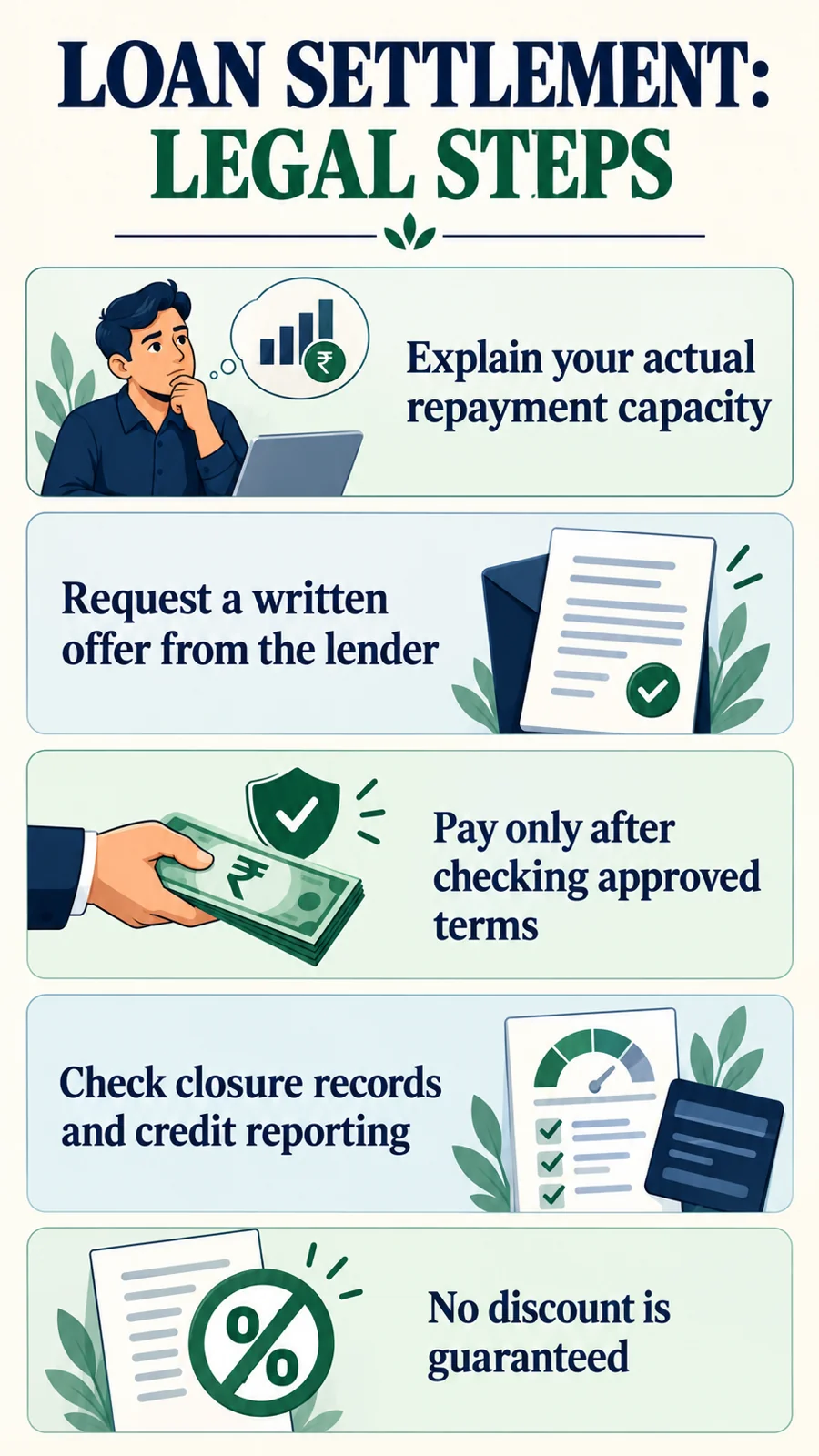
Explain genuine repayment capacity and compare the total cost and credit implications of full repayment, restructuring and settlement. Read every approved condition, pay through verified channels on time and obtain completion records. Where litigation is pending, complete the appropriate judicial recording as well. No discount or outcome should be treated as guaranteed merely because negotiation has begun.
Related reading: How to deal with bank recovery agents legally: RBI harassment guidelines and filing police complaint · Can credit card company file police case? Civil dispute reality vs illegal recovery threats
Official sources and judgments
[1] RBI — Commercial Banks Resolution of Stressed Assets Directions, 2025, updated October 2026, paragraphs 87–101: https://rbidocs.rbi.org.in/rdocs/notification/PDFs/165MD.PDF
[2] Supreme Court — AGM, State Bank of India v. Tanya Energy Enterprises, 2025 INSC 1119, discussing Bijnor Urban: https://api.sci.gov.in/supremecourt/2023/33541/33541_2023_9_1501_64220_Judgement_15-Sep-2025.pdf
[3] Supreme Court — Sardar Associates v. Punjab & Sind Bank, (2009) 8 SCC 257: https://api.sci.gov.in/jonew/judis/35195.pdf
[4] RBI — official current-directions index page: https://www.rbi.org.in/Scripts/BS_ViewMasDirections.aspx?id=13145
Detailed legal disclaimer
This educational article does not encourage intentional default, concealed income, forged evidence or evasion of court process. The agreement, lender policy, current rules and individual facts require assessment. No settlement approval, fixed discount, credit-score result, new loan or platform-policy approval is guaranteed. Obtain appropriate advice before acting. This disclaimer does not remove legal duties or another party’s rights.