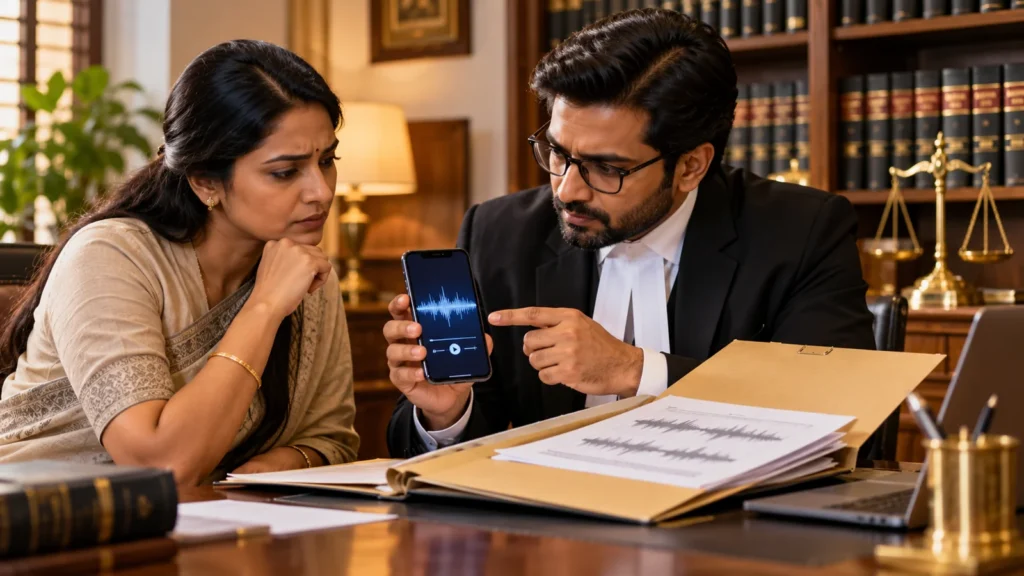
Respond with facts, cooperation and lawful protection
Being named in a matrimonial cruelty complaint can be frightening, but arrest is not automatically required merely because an FIR exists. If you dispute the allegations, preserve genuine records, understand the notice and obtain legal advice about protection. Calling a case false is your position, not a finding. Neither every complaint nor every denial should be assumed correct without examining the facts.
Legal disclaimer: This article is general legal information. Show the complete FIR, notice and all alleged offences to a qualified criminal-law advocate for advice about your situation.
The recent development discussed here is the Supreme Court's Satender Kumar Antil order dated 15 January 2026. It concerns the general arrest framework under BNSS, rather than a new rule declaring matrimonial complaints false. It should be read alongside the earlier Arnesh Kumar safeguards. Dates matter when articles describe a decision as new. [1][2]
Understand the allegation and the applicable criminal law
IPC Section 498A dealt with cruelty by a husband or his relatives against a wife. BNS Sections 85 and 86 now provide the corresponding offence and definition of cruelty. The offence includes punishment up to three years and a fine. Ordinary disagreement does not automatically establish the required criminal elements. [3]
The date the FIR was registered is not the only question when deciding which law applies. The dates of the alleged conduct, continuing allegations and the repeal and savings provisions can matter. Old proceedings may correctly refer to IPC and CrPC, while newer matters require consideration of BNS and BNSS.
Read every section in the FIR. Dowry-related offences or other allegations may appear alongside cruelty. Their punishment and bail implications should be examined separately. A person describing the matter simply as a “498A case” may leave out a charge that materially changes the advice you need.
Give your advocate the full document rather than a screenshot of the heading. Prepare names, dates, places and the alleged role of each accused. Where something is unclear, mark it as a question instead of filling the gap with an assumption.
What do the Supreme Court's arrest safeguards mean?
In Arnesh Kumar v. State of Bihar, decided on 2 July 2014, the Supreme Court gave directions against automatic arrest and required consideration of its necessity. Judicial scrutiny of detention is also important. These safeguards do not prevent investigation or create complete immunity from lawful arrest. [1]
In Satender Kumar Antil v. CBI, 15 January 2026, 2026 INSC 115, the Court explained BNSS Section 35. For the relevant category of offences punishable up to seven years, notice is the normal course and arrest is an exception requiring the statutory conditions and objective necessity. Having the power to arrest does not make its use compulsory. [2]
Compliance with a notice remains important, but it should not be marketed as an absolute guarantee against arrest. The law permits arrest in justified circumstances with the required recorded reasons. The offences alleged and the facts of your case still need individual examination. [2][4]
FACT: Arrest protection, anticipatory bail and cancellation of an FIR are different forms of relief. Obtaining one does not automatically produce the others.
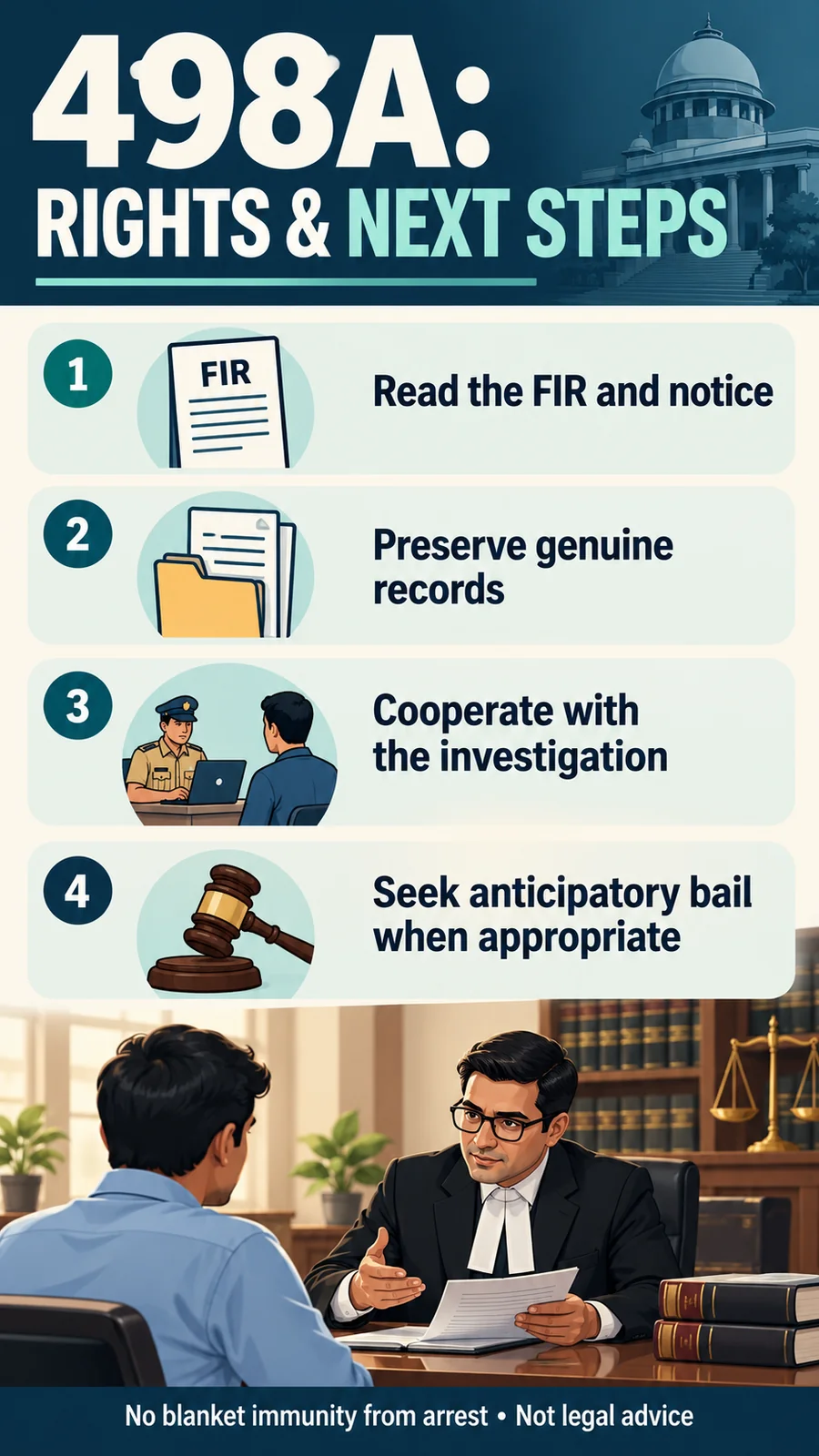
First steps after receiving an FIR or police notice
Record the FIR number, police station, offences and investigating officer's details. Read the notice for the date, location and requirements. If a genuine difficulty prevents attendance, seek advice about a timely written request. Ignoring the notice is not a defence strategy.
Build a chronology of the alleged events. For each event, identify what is claimed, where you were and which records exist. If a relative lived elsewhere, record that person's actual circumstances separately. A collective statement that the entire family is innocent does not answer specific allegations against different individuals.
Keep copies of documents submitted and the available acknowledgment of submission. Read a document before signing it and ask for clarification where necessary. Provide a factual account without trying to debate the entire legal case informally at the police station.
Speak with your advocate about urgent deadlines and the realistic risk of arrest. Do not wait for an internet comment to confirm that the case is “minor.” An early consultation can help separate an immediate protection issue from the longer work of answering allegations.
Preserve records without manufacturing a defence
Relevant material may include genuine chats, emails, bank entries, travel and employment records, previous complaints and available medical documents. Preserve the complete relevant context. Deleting inconvenient portions while keeping favourable messages can make the record harder to evaluate and may undermine credibility.
Retain original files and devices where practical. A screenshot's existence does not automatically establish its authenticity or the meaning attributed to it. Ask about the applicable evidence requirements and certification for electronic records. Do not edit timestamps or generate a conversation that did not happen.
Do not enter someone else's account without authorisation or obtain private information through unlawful access. Evidence preservation should concern records lawfully available to you. If additional records are needed, discuss lawful requests and production with your advocate.
Where you suggest a witness, describe what that person actually observed. Do not coach a witness to repeat your version or ask relatives to coordinate a story. A clear distinction between personal knowledge and assumption makes the facts easier to assess.
Anticipatory bail and quashing serve different purposes
Where there is a genuine apprehension of arrest, ask about anticipatory bail before the Sessions Court or High Court. BNSS Section 482 is the relevant new provision; older applicable proceedings may involve CrPC Section 438. Relief is discretionary and subject to the case and any conditions imposed. [4]
The application should explain the allegations, available material, willingness to cooperate and the reason protection is sought. Urgent interim protection may require a separate request. If relief is granted, read the actual order: attendance, travel or contact restrictions must not be overlooked.
Quashing concerns ending proceedings on appropriate legal grounds. The High Court's inherent powers are addressed in BNSS Section 528, corresponding to old CrPC Section 482. The repeated number 482 is a source of confusion: always identify both the statute and the purpose. [4]
Do not expect the High Court to resolve every disputed factual issue solely because an accused denies the complaint. Your advocate must assess whether quashing is appropriate or whether the matter requires another procedural route or trial. Bail is not an acquittal, and an FIR is not a conviction.
Advice: avoid intimidation and retaliatory mistakes
Do not threaten the complainant or a witness to withdraw the case. Contact through relatives or social media can also become pressure. If a genuine settlement is possible, use legal representation or an authorised mediation process and complete the necessary court steps.
A counter-complaint should be assessed on its own facts. Filing something purely to create leverage can produce another dispute without strengthening your defence. A later acquittal does not, by itself, establish that every original allegation was deliberately fabricated.
Prepare one folder containing the chronology, FIR, notice, accused persons' individual circumstances and supporting records. Write the questions you need answered: immediate risk, protection, response deadlines and the appropriate long-term route. Avoid anyone promising guaranteed quashing or a police “arrangement.”
If professional fees are difficult, ask the District Legal Services Authority about eligibility for assistance. Do not assume you must choose between doing nothing and paying someone who offers an illegal shortcut. Lawful preparation remains the useful path throughout the case.
FAQ
Is arrest mandatory once a 498A FIR is registered?
No. Applicable arrest requirements and judicial safeguards matter. Any additional offences in the FIR must also be examined.
Does Arnesh Kumar give complete immunity?
No. It protects against automatic and unjustified arrest, not investigation or an arrest that satisfies the law.
Does a police notice make anticipatory bail unnecessary?
Not universally. Show the notice and allegations to an advocate to assess your individual risk and available options.
Does a settlement automatically cancel the FIR?
No. The offences and applicable law determine which judicial steps may be necessary. Complete those steps rather than assuming cancellation.
Is BNSS Section 482 the same subject as CrPC Section 482?
No. BNSS 482 concerns anticipatory bail; BNSS 528 addresses the High Court's inherent powers. Identify the statute before relying on a number.
Related reading and sources
Related reading: How to avoid paying maintenance to wife legally: Grounds for refusal and court exceptions · Can you get divorce without going to court? The reality of mutual consent and legal documentation
[1] Arnesh Kumar (2014) 8 SCC 273, original directions reproduced in the Satender Kumar Antil judgment. Official search https://scr.sci.gov.in/scrsearch/
[2] Satender Kumar Antil v. CBI, 15 January 2026, 2026 INSC 115, particularly paragraphs 24–33: original judgment copy https://order.law/api/pdf/SCIN010378892022?order=3sdi0 ; official search https://scr.sci.gov.in/scrsearch/
[3] BNS 2023, Sections 85–86: https://www.mha.gov.in/sites/default/files/2024-04/250883_english_01042024.pdf
[4] BNSS 2023, Sections 35, 482, 528 and 531: https://www.mha.gov.in/sites/default/files/2024-04/250884_2_english_01042024.pdf
Detailed legal disclaimer: This article explains lawful rights and procedures without declaring any unexamined complaint false. It does not endorse intimidation, evidence tampering, fabricated complaints, evasion of investigation or disobedience of court orders. Outcomes depend on the allegations, evidence, applicable law and procedure. Seek advice from a qualified advocate about your own case.