
A lawful challenge starts with the claim and the evidence
If you are searching for how to avoid paying maintenance to your wife legally, the useful question is whether the particular claim or amount is justified under the applicable law. There is no universal exemption. You can contest inaccurate facts, ask for adjustment or seek modification when circumstances change. Hiding income or stopping a court-ordered payment is not a lawful substitute.
Legal disclaimer: This article provides general legal information, not advice for your individual case. Show the application, notices and orders to a qualified advocate before acting.
Maintenance proceedings involve financial support, not simply a contest between two people who have separated. A demand does not automatically establish entitlement to the entire requested amount. Equally, calling that demand unfair does not cancel an existing obligation. Preparing an honest account of the facts is more useful than searching for a guaranteed way to pay nothing.
Identify the law before choosing a defence
Different proceedings can involve BNSS Section 144, the corresponding older CrPC Section 125 where applicable, Sections 24 and 25 of the Hindu Marriage Act, or monetary relief under the Domestic Violence Act. Their requirements and remedies are not identical. An exception in one provision should not be presented as a universal defence to every maintenance claim. [1][2]
BNSS came into force on 1 July 2024. Savings provisions can preserve the older procedure for proceedings already pending. The date of the application and procedural history matter; changing a section number without examining those details can create confusion. Ask your advocate which provision actually governs your proceeding. [1]
Hindu Marriage Act Section 24 concerns support during proceedings for a spouse without sufficient independent income, and is available to either spouse within its terms. Section 25 concerns permanent alimony. Keep temporary support, final support and recovery of arrears separate when discussing your options. [2]
Read the complete application and order. Check whether the amount includes support for a child, litigation expenses or arrears from an earlier period. A short message from the other party may omit precisely the information needed to understand the next legal step.
What issues can be raised legitimately?
You can put forward reliable information about actual income, financial needs, existing payments and the inaccuracies you identify in the claim. Explain each disputed statement with its supporting record. A general assertion that the requested amount is excessive gives your advocate much less to work with than a clear comparison of the claim and the actual figures.
A wife's employment is relevant, but employment and sufficient income are different questions. A qualification, an old job or a social-media photograph does not by itself establish current financial self-sufficiency. Conversely, verified regular income should be disclosed and considered. Avoid turning either proposition into a promise about the result. [3]
BNSS Section 144(4) contains exceptions concerning living in adultery, refusal to live with the husband without sufficient reason, and separation by mutual consent. These require proper legal interpretation and proof. An accusation alone does not establish an exception, and safety-related circumstances can be relevant to whether separate residence has sufficient justification. [1]
Do not mechanically apply a married-wife cohabitation exception to a divorced wife's claim. The relationship and applicable decisions require separate examination. Similarly, a dispute about the wife's entitlement does not automatically defeat a child's claim for support. Identify whose entitlement and which period you are actually contesting.
Financial records are more useful than a fixed-percentage claim
There is no universal rule that every wife receives a fixed percentage of the husband's salary. Actual resources, needs and responsibilities matter. In Rajnesh v. Neha, decided on 4 November 2020, the Supreme Court addressed financial disclosure and the treatment of overlapping maintenance proceedings. [3]
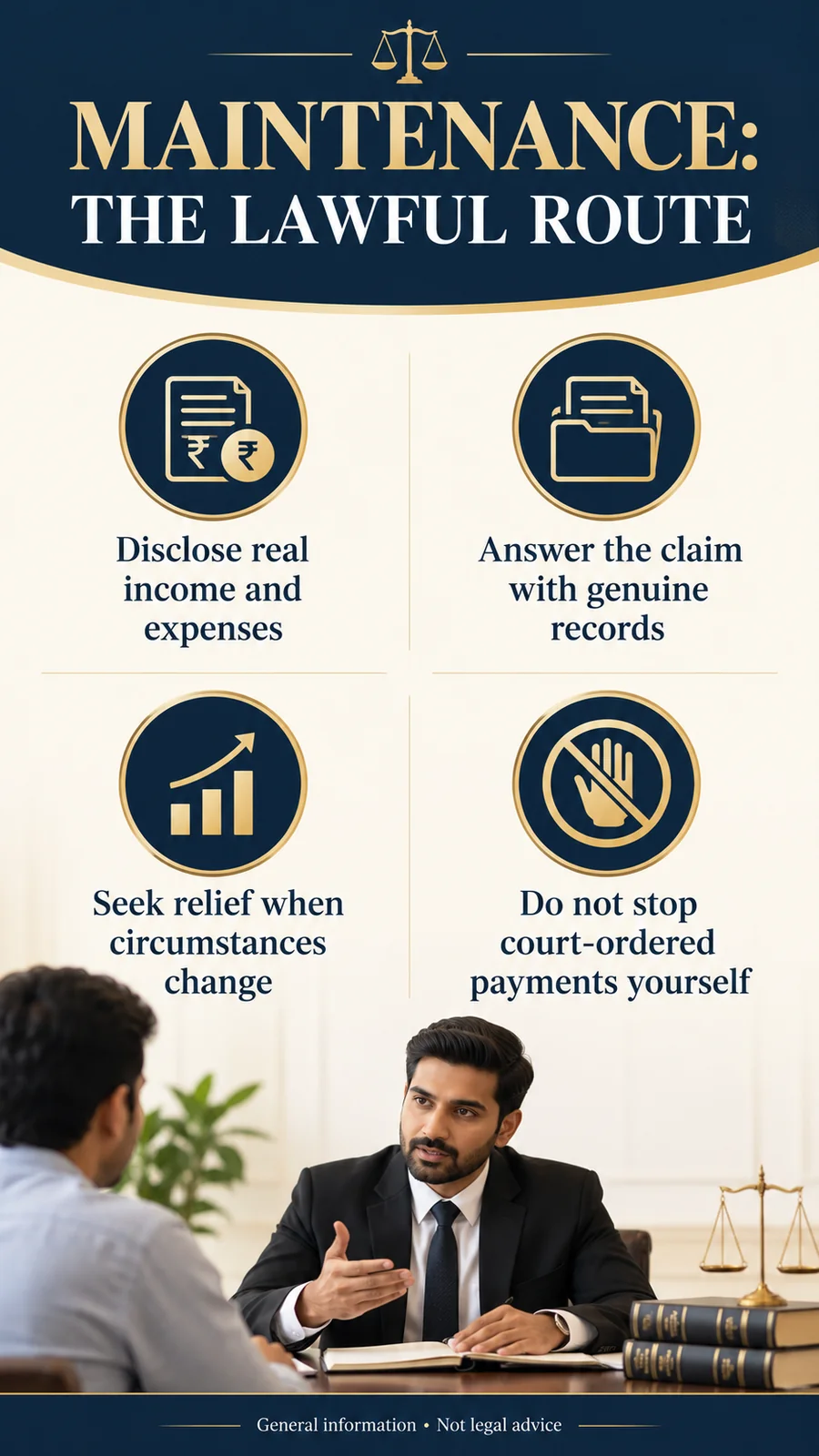
Prepare available salary slips, tax returns, bank statements and business accounts. Add records of necessary treatment, housing costs and genuine dependants where relevant. Do not assume that every loan repayment or lifestyle expense will reduce the obligation. Ask your advocate which items are material and how they should be supported.
If employment has ended, retain the termination letter and records showing current income. If business earnings fluctuate, prepare the relevant period rather than selecting a particularly bad month. An unexplained discrepancy between your figures and your bank activity can distract from a legitimate argument about affordability.
Make a simple payment schedule: date, amount, method, purpose and the order to which it relates. This is especially useful if support has been paid through several channels. Keep original receipts and bank entries. Do not create a retrospective acknowledgment that falsely suggests an earlier payment took place.
FACT: The right to challenge a maintenance order does not give you the right to suspend it yourself. Filing an application does not automatically grant a stay.
An order already exists: what should you do next?
Check its date, the starting date for payment, the amount and any arrears. Ask about the correct challenge or modification route and whether separate interim relief is required. Appeal, revision and modification are not interchangeable terms. The appropriate forum depends on the governing law and the type of order.
Where circumstances genuinely change, support the change with documents. BNSS Section 146 provides for alteration in relevant circumstances. That does not mean every reduction in income produces an equal reduction in maintenance. The court decides whether and how the order should change. [1]
If several proceedings exist, disclose all previous orders and payments. Adjustment is not the same as automatic dismissal of every other case. Be clear about the recipient, period and purpose of each payment so that a claim for credit does not confuse spousal support with a different obligation.
Mistakes that can undermine an otherwise reasonable case
Do not hide earnings, fabricate expenses, give an inaccurate affidavit or manipulate assets to mislead the court. Such conduct can damage credibility and may lead to separate legal consequences depending on the facts and procedure. A legitimate request for a lower amount becomes harder to assess when the financial account is unreliable.
Do not access another person's account without permission or buy unlawfully obtained financial information. Ask your advocate about proper disclosure and lawful production of records. Information gathering should help the case, not introduce a separate privacy or criminal dispute.
Avoid hostile messages about payments or repeated threats to stop supporting the household. Keep necessary communication calm and preserve the complete context. If you cannot meet an upcoming payment, seek advice promptly rather than waiting until arrears become a larger dispute.
Advice: organise the facts and ask precise questions
Take one organised folder to your consultation. Include the application, orders, financial records and payment history. Write a short list of disputed statements and place the relevant document beside each. This makes it easier to discuss the merits, the forum and the immediate deadlines without losing time on unrelated disagreements.
Ask what relief is available, what must be proved, whether urgent interim relief is needed and what the expected costs are. No responsible professional can guarantee that all maintenance will disappear. If fees are difficult, ask the District Legal Services Authority about eligibility for legal aid.
If settlement is possible, specify the amount, payment dates, method, arrears and child-related expenses. A private agreement does not automatically cancel an existing court order. Have the necessary judicial steps and recording of terms completed. Keep proof of compliance after the settlement, too.
FAQ
Does a working wife automatically lose maintenance?
No. Actual sufficient income, needs and the applicable provision must be examined. A job title alone does not answer those questions.
Does leaving the matrimonial home end entitlement?
Not automatically. The reason for living separately and the relevant legal provision matter. Safety concerns can be important.
Can I stop paying after losing my job?
Do not treat job loss as permission to ignore an order. Seek advice on modification and any necessary interim relief using genuine records.
Does divorce automatically end maintenance?
No. The applicable law, remarriage, settlement and existing orders can affect the position. Review them before assuming liability has ended.
Does contesting the wife's claim also stop child support?
No. The child's claim and needs are separate. Identify each obligation rather than treating all support as one disputed payment.
Related reading and sources
Related reading: How to save yourself from false 498A case: Supreme Court guidelines and anticipatory bail process · Can you get divorce without going to court? The reality of mutual consent and legal documentation
[1] BNSS 2023, Sections 144, 146 and 531: https://www.mha.gov.in/sites/default/files/2024-04/250884_2_english_01042024.pdf
[2] Hindu Marriage Act 1955, Sections 24 and 25: https://www.indiacode.nic.in/handle/123456789/1560
[3] Rajnesh v. Neha, 4 November 2020, (2021) 2 SCC 324: original Supreme Court judgment copy https://casestatus.in/supreme-court/order/SCIN010378752018/0 ; official judgment search https://scr.sci.gov.in/scrsearch/
Detailed legal disclaimer: This content explains general rights and procedures using publicly available laws and judicial decisions. It does not replace examination of your documents or professional advice. We do not recommend income concealment, false affidavits, fabricated evidence or disobedience of court orders. Outcomes depend on the facts, governing law and local procedure. Consult a qualified advocate before taking an individual legal step.