 Vista
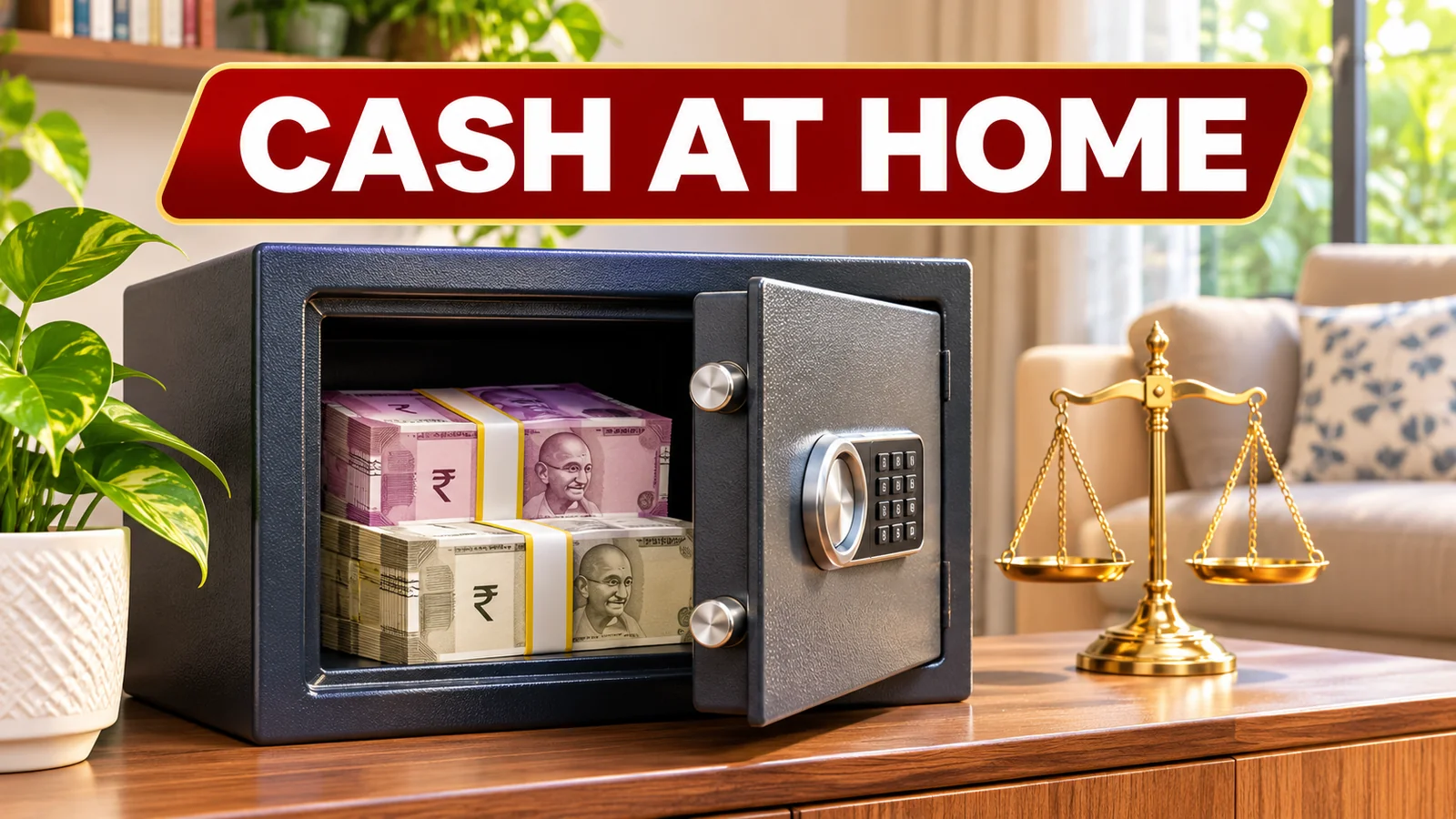
During weddings, festivals, shop seasons or harvest, many families have a good amount of cash at home. The question follows: “How much cash can I legally keep at home? Will the Income Tax Department catch me?” The direct answer is that India has no fixed legal limit on cash kept at home. The condition is that you can explain where the money came from. Trouble usually starts not from holding cash, but from how you receive it, lend it, deposit it, or fail to show its source.
This post explains in simple language why holding cash is not illegal, which limits you must watch, what can happen if cash has no explainable source, and which papers keep you safe.
The short answer: no ceiling, but the source matters
The income tax law does not set a maximum amount of cash an individual can keep at home. If the money came from your salary, business income, farm income, sale proceeds or another lawful transaction, and you can prove it, holding any amount is not illegal. Problems begin when you cannot show the source.
Limits you must watch (chart)
| Transaction | Rule | Penalty for breach |
|---|---|---|
| Receiving cash (in a day, from one person or for one occasion) | No acceptance of ₹2 lakh or more in cash (Section 269ST) | Penalty equal to the amount received |
| Taking a loan or deposit in cash | No acceptance of ₹20,000 or more in cash as a loan or deposit (Section 269SS) | Penalty equal to the loan or deposit amount |
| Large cash withdrawals from a bank | TDS above a threshold (Section 194N) | TDS is deducted on the withdrawal |
Note: after the new Income Tax Act, 2025 came into force, section numbers have changed, but news reports describe the same underlying limits. Some reports list further limits (such as ₹10,000 and ₹10 lakh) that apply to specific situations. Confirm your own case with a chartered accountant.
What the ₹2 lakh limit really means
The ₹2 lakh limit is on receiving cash, not on keeping it at home. If someone gives you ₹2 lakh or more in cash in a day, in a single transaction or for one occasion such as a wedding, it can be a violation, and the penalty can equal the amount received. So for land sales, vehicle sales or repaying large debts, use bank transfers or cheques. Splitting a large amount into smaller pieces to dodge the rule can also be caught in an inquiry.
The ₹20,000 limit: loans and deposits
Taking a cash loan of ₹20,000 or more from a relative or friend also falls under the rules. Informal cash loans are common in families, but using a bank for larger amounts avoids disputes and notices later.
What happens if cash with no source is found?
If the Income Tax Department finds cash at your home during a search and you cannot give a satisfactory source:
- It may be treated as undisclosed income.
- The cash can be seized.
- Heavy tax and penalties can follow.
Reports differ on the rate. Some chartered accountants quoted penalties of about 84% under the older law, and some reports mention up to 137%. A November 2026 report says that under the new law’s Section 104, unexplained cash attracts a special tax of 30%, which becomes about 39% with surcharge and cess. The numbers differ because the law has changed and every case has its own facts. So do not treat any single figure as final and take advice for your own case.
Papers that protect you
- Salary slips and bank statements showing that the cash came from your earnings.
- Bank withdrawal slips for cash you took out yourself.
- Sale receipts or agreements for land, vehicles or goods, with proof of payment.
- Business books: daily sales registers, GST records and bills.
- Mandi receipts for the sale of farm produce.
- Written record of gifts: the list of money received at a wedding and the names of givers, within the rules.
- Income tax returns showing the income you declared in earlier years.
TDS on large cash withdrawals
TDS applies under Section 194N on very large cash withdrawals from a bank. The threshold and rate depend on whether you have filed returns, so ask the bank or an adviser before withdrawing a big sum. Note that money you took out from the bank has a record at the bank, which can later serve as evidence in your favour.
Think about safety too
- Keeping a lot of cash at home is risky because of theft and fire.
- Keep money you do not need right away in a bank. You earn interest and your records stay clear.
- Make large payments by UPI, cheque or NEFT. That leaves proof of who was paid and when.
- Do not advertise your cash. Stay away from anyone offering to “save tax” or “whiten your cash”.
Common misunderstandings
- “Keeping more than ₹2 lakh at home is illegal.” Wrong. The limit is on receiving cash, not holding it.
- “Deposit all the cash in the bank and everything is fine.” Not necessarily. Large cash deposits are reported by banks and you may be asked for the source.
- “The department will never know about cash at home.” Evidence can be examined during an inquiry, so keep records.
Frequently asked questions (FAQ)
How much cash can I keep at home?
There is no fixed limit. You must be able to prove the source.
Why is receiving ₹2 lakh in cash prohibited?
Under Section 269ST, accepting ₹2 lakh or more in cash in a day, from one person or for one occasion can attract a penalty equal to the amount received.
What happens if cash is found in a raid?
If you prove the source, no action follows. If you cannot, the cash can be seized and tax and penalties can apply.
How much wedding cash can I keep?
Keep a record of the gifts and givers, and keep in mind the ₹2 lakh limit from a single person or occasion.
Is taking a cash loan wrong?
Taking ₹20,000 or more as a cash loan is prohibited. Use a bank.
This is general information, not legal or tax advice. Consult a chartered accountant for your own situation.
Also read: Income Tax Notice Received? What 143(1), 139(9), 142(1), 143(2) and 148 Mean and How to Respond | How Many Days Does an ITR Refund Take in India? Timeline, Status and Reasons for Delay
Sources
- Income Tax Department: Mode of receipts and payments (incometaxindia.gov.in)
- Business Today: How much cash can you keep at home, the limits that actually matter
- Business Today: 84% penalty and unaccounted cash at home
- Taxscan: Permissible limits on holding, carrying and transacting cash
- Business Standard: Restrictions on cash transactions and Section 194N
- Republic World and DNA India: rules for cash at home




















Share Your Opinion
Comments are closed on this post.