Israeli election results are pointing toward difficult coalition negotiations rather than an immediate, clear new government. Reports available on October 29, 2026 described Benjamin Netanyahu’s bloc ahead of Gadi Eisenkot’s opposition camp, while both remained short of the 61 seats associated with a majority in the 120-member Knesset. Counting votes and forming a government are separate stages.
This is an explainer of the provisional result and what comes next, not a certified final-results declaration or a live counter. Seat projections can change as further ballots are included. The most useful way to follow the story is to distinguish a party’s result, a political bloc’s combined seats and an actual agreement to support a government.
Israeli election results: what the reported numbers show
An October 29 morning update from The Jerusalem Post described projections of 53 seats for Netanyahu’s bloc, 48 for the opposition camp and 19 for Arab-led parties. Those figures are a dated reporting snapshot. They should not be presented as certified final numbers or mixed with a later count without checking the update time.
Reuters reporting carried by GMA News similarly described neither main camp having an outright majority at that stage. The central point is the lack of a ready majority, rather than a claim that the largest projected bloc has already installed a new government. A lead and a completed governing arrangement answer different questions.
The arithmetic illustrates the problem. A group on 53 seats is eight short of 61; one on 48 is thirteen short. Those are calculations from the reported snapshot, not predictions about who will join whom. Adding seats on paper does not establish that the parties represented by those seats will accept a common programme or support the same candidate.
Why the largest party and the largest bloc are different
A party is an electoral list, while a bloc is a grouping used to describe potential political partners. A headline about a leading bloc should not be read as though one party alone won every seat in that total. The distinction becomes especially important when readers compare an individual party’s percentage with a multi-party bloc’s seat projection.
Blocs also involve political assumptions. Parties may have shared positions before an election, but an agreement to enter government still has to be reached. A projection can identify a possible route; it cannot substitute for an announcement by the parties themselves. When reporting changes, check whether the change concerns counted votes, a seat calculation or a party’s negotiating position.
The same caution applies to phrases such as kingmaker. A smaller party may have numerical importance because its support could help a grouping reach a threshold. That description does not mean it can choose a government by itself. Its influence depends on the available combinations, the willingness of other parties to cooperate and the formal parliamentary process.
How votes become Knesset seats
The Knesset’s official explanation of the electoral system describes elections through national party lists and a qualifying threshold of 3.25%. Its seat-allocation guide explains the proportional distribution and the Bader–Ofer method used for remaining seats. The calculation is more involved than rounding each headline percentage independently.
For readers, the practical implication is that a percentage and a projected seat total are not interchangeable. Lists near the threshold can affect the distribution, while the treatment of remaining seats also matters. A simple spreadsheet that multiplies every displayed percentage by 120 may therefore fail to reproduce the official allocation.
An exit poll is different again. It estimates voting patterns before the official count is complete. Counted ballots provide another stage of evidence, and formal publication follows the prescribed process. It is possible for a headline to be accurate about an exit poll while being outdated as an account of the count. Always identify which stage is being described.
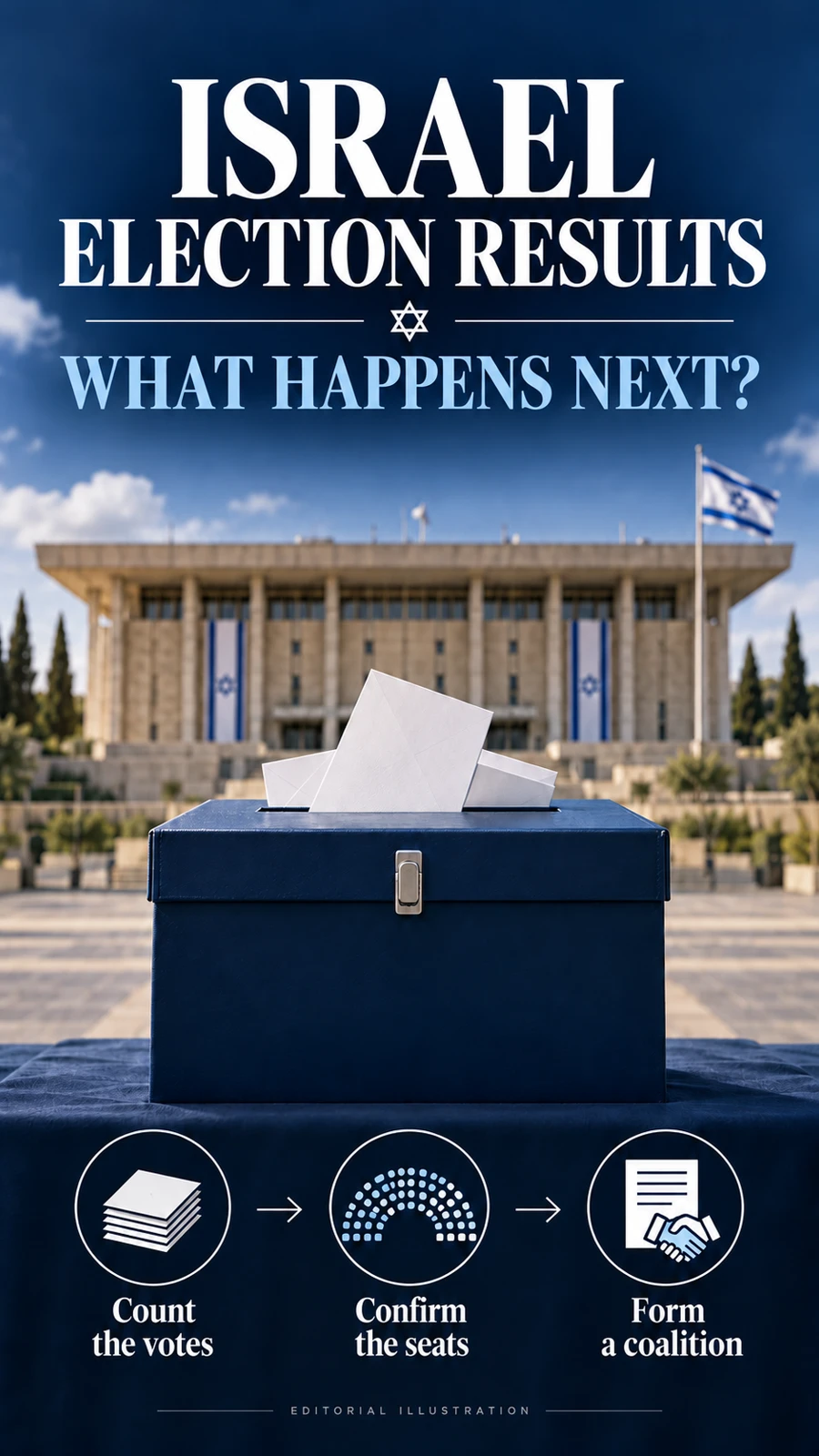
FACT box: what is settled and what is still provisional
Election date: 27 October 2026.
Parliament: The Knesset, with 120 members.
Majority reference point: 61 seats.
Qualifying electoral threshold: 3.25%.
Reported early snapshot: Netanyahu bloc 53, opposition camp 48, Arab-led parties 19.
Status of that snapshot: Provisional reporting, not certified final results.
This article: Checked against reporting and official process information available on 29 October 2026.
What happens after counting and formal publication?
The Central Elections Committee’s published activity timetable lists October 27 as election day and November 4 for publication of the results. A timetable entry is distinct from a news organisation’s forecast of when the broad outcome may become clear. Readers should avoid treating the earliest likely projection as the formal legal publication.
According to the Knesset’s government-formation guide, the president consults parliamentary group representatives and assigns the task of forming a government within seven days of publication. The member selected initially has 28 days, with a possible extension totalling up to 14 additional days. That is why reports sometimes describe an initial opportunity lasting up to 42 days.
The guide also describes a government presenting itself to the Knesset and requesting confidence before taking office. The outgoing government continues its functions until a new one is formed. For the present story, that means continued incumbency should not automatically be described as a fresh, completed mandate for a newly assembled cabinet.
The broader legal process has further steps if an attempt fails. This article does not predict that any particular stage will be reached. The point is that an inconclusive seat picture leads into a structured process; it does not leave the country without any governing arrangements immediately after election night.
Analysis: the questions coalition talks have to answer
The first question is numerical: can a proposed arrangement obtain the support it needs? The second is political: will the relevant parties actually provide that support? A mathematically possible combination is only a starting point. Negotiators also have to address policy, leadership and how they would work together in parliament.
The third question is evidential: what has actually been announced? A politician saying that talks are desirable is different from naming negotiating teams. Naming teams is different from agreeing a coalition document. Signing an agreement is different from completing the required parliamentary confidence stage. Clear reporting should identify the latest completed step rather than jump to the final outcome.
There is also a distinction between participation in a cabinet and other forms of parliamentary support. A headline that says one party is needed for the numbers does not establish what role it would accept. Until public positions and agreements are clear, readers should treat proposed combinations as scenarios, not settled arrangements.
These are general analytical questions, not private information about negotiations. They provide a way to evaluate developments consistently regardless of which leader benefits. The same standards should apply to claims of victory, claims that a coalition is impossible and suggestions that another election is inevitable.
Advice: how to read result updates without being misled
Check the timestamp and the denominator first. A percentage may refer to ordinary ballots, all ballots, polling stations or another part of the process. Two numbers can look contradictory when they measure different things. Read the accompanying description before deciding that the count has moved backwards or that one source must be wrong.
Next, look for attribution. Is the seat total from the election authority, a broadcaster’s model or a political campaign? A campaign’s celebration is part of the political reaction; it is not certification. Similarly, an allegation about the process requires evidence and an official finding before it can be treated as an established fact.
Finally, keep domestic political outcomes separate from forecasts about international policy. The election result alone cannot establish the exact policy of a cabinet that has not yet been formed. For broader background on how countries assess international choices, our strategic autonomy explainer discusses a different, general foreign-policy concept.
Frequently asked questions
Who won the Israeli election?
The reporting examined here describes Netanyahu’s bloc leading provisionally, but without a clear majority. A lead in seats is not the same as completing the formation of a new government.
How many seats are used as the majority benchmark?
The Knesset has 120 members, and 61 is the majority reference point used in the reports discussed here.
Are the 53–48–19 figures final?
No. They are a dated provisional reporting snapshot. Check the Central Elections Committee and the latest update time for later results.
Why do reports mention 28 days and 42 days?
The first government-formation opportunity is 28 days, with a possible presidential extension of up to 14 additional days, according to the Knesset’s guide.
Does a caretaker government mean the election is cancelled?
No. Continued operation of the outgoing government is part of the transition arrangements. It does not replace the count or the formation process.
Editorial note: Information checked on 29 October 2026. This is a dated explainer, not a live results service or legal opinion. Projections may change. Analysis is separate from reported facts. Both images are AI-generated editorial illustrations, not photographs of voting or counting.