Fear of closing your eyes in the shower: begin here
Fear of closing your eyes in the shower can make a routine task feel difficult. You may worry that someone is behind you while washing your face, then open your eyes and find an ordinary room. Mocking the fear does not help. A useful starting point is to separate what the feeling predicts from what you can actually observe.
This experience alone does not establish a supernatural presence, a particular mental illness or a real intruder. Equally, clear signs of an actual threat should not be dismissed as anxiety. Deal with genuine safety concerns first.
Could reduced visual information and running water contribute?
Closing your eyes temporarily removes visual information about the room. Running water can make quieter sounds harder to distinguish. In that setting, uncertainty about what is behind you is one plausible way to understand the fear, rather than a proven cause in your case.
Water does not switch off your hearing. Nor does everyone share one demonstrated “primal brain programme” that explains this experience. A story about ancestors becoming vulnerable to predators should not be presented as an established diagnosis.
If the fear became stronger after a frightening film or video, mention that sequence when discussing it. That observation would not prove that horror media caused every person’s experience.
Does it mean anxiety, a phobia or claustrophobia?
Anxiety can involve tension and anticipating something bad. Fear in a bathroom alone does not diagnose an anxiety disorder. See the NHS information on anxiety, fear and panic.
Claustrophobia concerns confined spaces; fear specifically when closing your eyes is not automatically claustrophobia. The NHS claustrophobia guide explains that condition.
Intensity, persistence and interference with daily care matter more than assigning a label from one trigger. The NIMH phobia guide describes fears that are out of proportion to actual danger and affect ordinary activities.
Describe a feared presence separately from seeing or hearing one
“I worry someone might be behind me” and “while fully awake, I clearly see or hear someone” describe different experiences. Neither sentence alone supplies a diagnosis. Describe what happened as accurately as you can, without needing a medical term.
Seek medical advice for repeated perceptions while awake that others do not share. Sudden confusion, rapidly worsening experiences or a risk of harming yourself or someone else needs immediate help. See NHS advice on hallucinations. In India, call 112 for an emergency; elsewhere use your local emergency number.
FACT: The intensity of fear does not establish an external presence. Recurring distress also deserves more than being dismissed as “just imagination.”
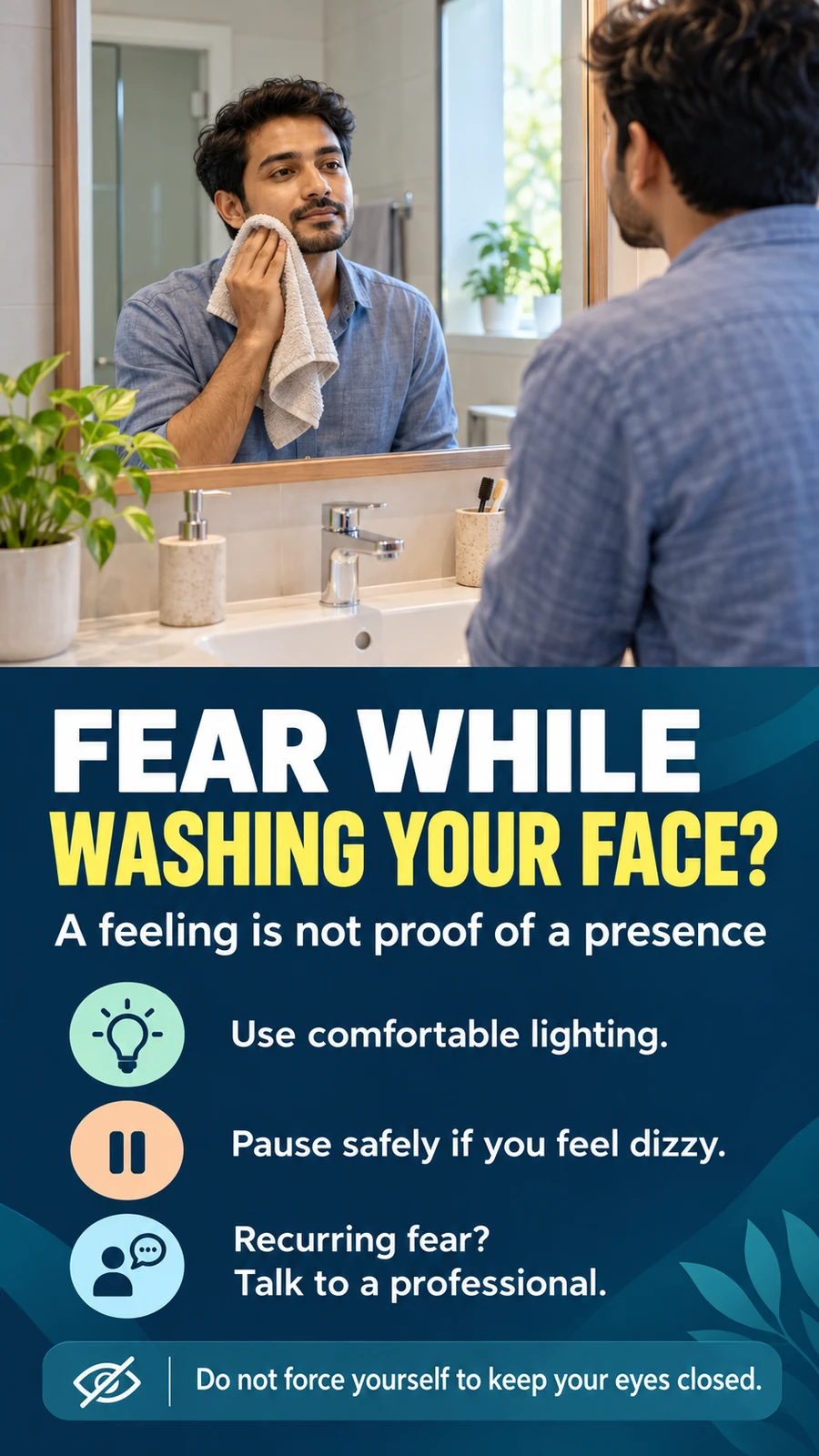
Advice: keep face washing physically safe
Use comfortable lighting, keep everyday items within reach and reduce slip hazards. Do not rush, spin around or walk with your eyes closed because you feel frightened. If dizzy, stop the water and sit in a safe, stable place.
Follow ordinary eye safety when using water and cleanser. Do not force soapy eyes open to monitor the room, or make prolonged eye closure into a courage challenge. Choose a comfortable, normal washing routine.
Once safely settled, let your breathing remain gentle rather than forcing deep breaths or holding them. The NHS breathing exercise is a supportive practice, not a substitute for assessment or treatment.
New severe chest pain, fainting or serious breathing difficulty should not be assumed to be anxiety or managed by waiting for a breathing exercise to work.
Notice repeated checking without turning it into another task
Ordinary household safety is different from repeatedly checking behind you or in the mirror for perfect certainty. If checking becomes frequent and distressing, tell a counsellor about that pattern.
A brief note can help: when the fear occurred, what preceded it, what you noticed after opening your eyes and what activity was affected. You do not need to count every thought or constantly monitor yourself.
You might tell someone, “I feel frightened while washing my face and want to understand it.” Family members can listen calmly and avoid frightening pranks, secretly standing behind the person or forcing them to prove the fear wrong.
Related reading: Sudden Anxiety and a Racing Heart at Night: Causes and What to Do
Related reading: Fear of a Supernatural Presence: Check Sleep, Symptoms and Safety
When to seek help and what treatment may involve
Speak with a healthcare or mental health professional if fear makes you postpone washing, disrupts self-care or persists. Mention sleep, recent stressful events, medicines and other symptoms. You do not need to decide on the cause before the appointment.
For a diagnosed phobia, CBT and appropriately planned gradual exposure may be used. See NIMH treatment information. Do not improvise challenging exposure on a wet floor, while dizzy or in water; plan with a professional.
Do not start sedatives or anxiety medication based on an article, or stop prescribed treatment without medical advice. Unverified products and rituals should not replace appropriate care.
Frequently asked questions and disclaimer
Is feeling someone behind me evidence of a ghost? No. A fearful expectation does not establish a presence. Assess actual safety evidence separately.
Is every shower fear claustrophobia? No. Fear of confinement, closing the eyes and other symptoms need to be understood in context.
Should I shower in the dark to prove courage? No. Use ordinary safety and seek a professional plan if needed.
Does happening only at night identify a condition? No. Timing is context, rather than a diagnosis.
Should I check behind me each time? Repeated checking is not a required safety rule. Discuss an escalating pattern with a counsellor.
Disclaimer: General health education only, not an individual diagnosis or treatment plan. Sources are linked in the relevant sections. Obtain urgent medical help for severe or sudden symptoms.