 Vista
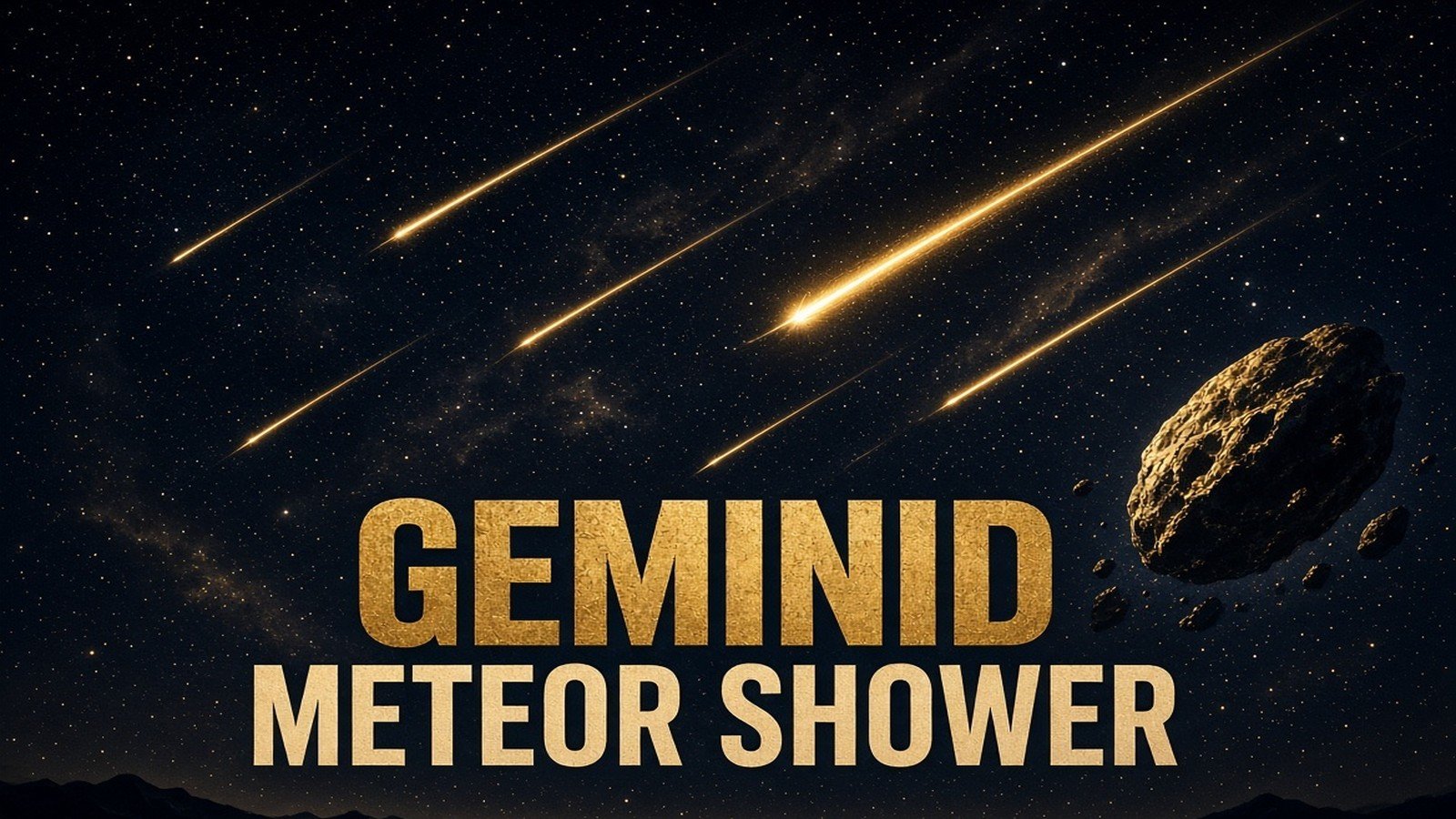
Geminid meteor shower 2026: plan to watch the night of 13–14 December 2026, and keep the evening of 14 December open too. The predicted formal maximum around 14:00 UTC on 14 December is approximately 7:30 p.m. Indian Standard Time, but a meteor shower does not switch on at one minute. In a dark sky, the hours from about 10 p.m. until before dawn offer some of the most comfortable opportunities to spot bright Geminids. A low waxing-crescent Moon makes 2026 favorable for observers.
Quick answer: The Geminids are visible without a telescope. Find a dark, unobstructed place, allow your eyes time to adjust, and scan a broad area of sky rather than staring at one star. NASA says roughly 40–50 meteors per hour may be seen under dark skies; actual counts in a city can be drastically lower. Updated 22 November 2026; all viewing forecasts depend on weather, light pollution and local horizon.
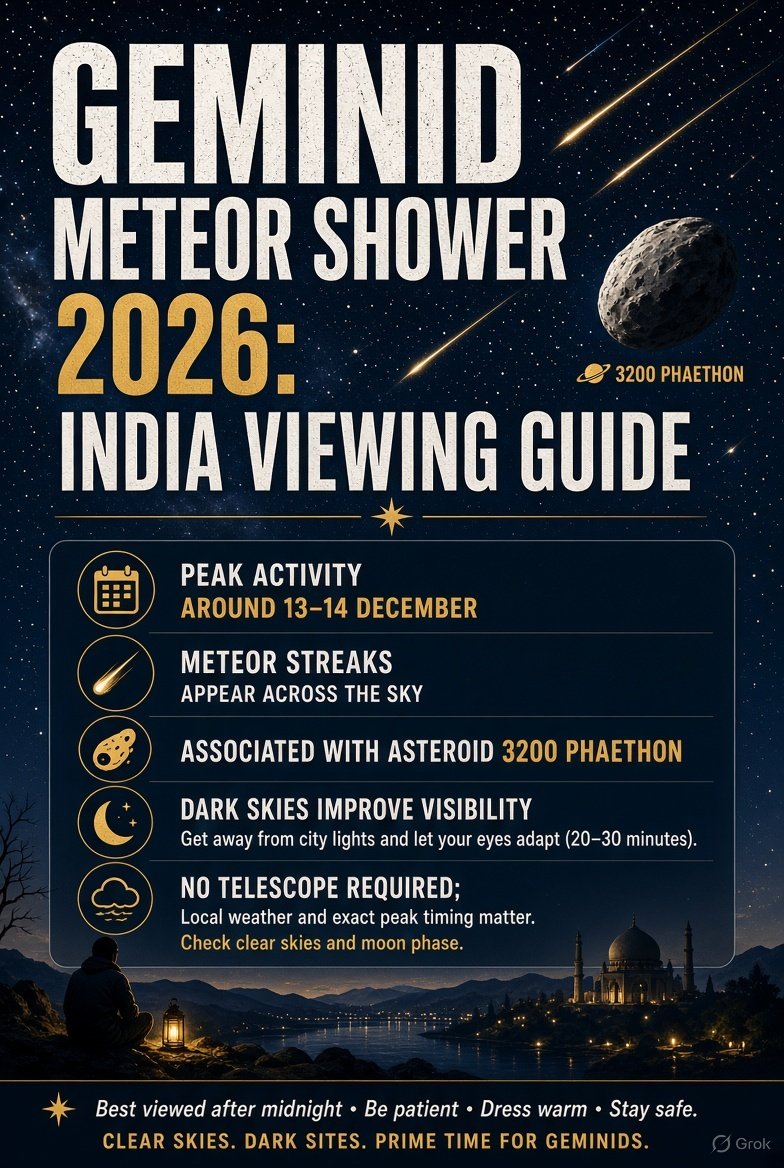
Geminid meteor shower 2026: date, peak and India time
NASA’s 2026 shower guide identifies the Geminids as active from 4–17 December, with the main peak described as 13–14 December. The International Meteor Organization and Spain’s National Geographic Institute indicate a predicted maximum near 14:00 UTC on Monday 14 December. Add five hours and thirty minutes for India: approximately 7:30 p.m. IST on 14 December. These are two valid ways to describe a broad event: one names the traditional strongest observing night, and the other specifies a predicted instantaneous maximum. Neither guarantees that you will see meteors exactly at a given clock time.
If you can schedule only one outing, late 13 December through early 14 December is a widely recommended window. If the sky is cloudy or your local radiant is low then, late 14 December into early 15 December is a sensible second attempt because useful activity can continue around the maximum. Viewing can also be worthwhile on adjacent nights, albeit with generally fewer meteors. A calendar date alone never tells the whole story: dusk, the radiant’s height, cloud cover, nearby lights and the waxing Moon all influence the result.
| 2026 Geminids question | Practical answer |
|---|---|
| Main observing night | 13–14 December; also try 14–15 December |
| Predicted formal maximum | 14 December around 14:00 UTC / 7:30 p.m. IST |
| Convenient India observing hours | After roughly 9–10 p.m. through pre-dawn; check your city |
| Moon at peak | Waxing crescent, about 15% illuminated according to IMO calendar |
| Equipment | Naked eyes, patience and a dark observing location |
| Parent body | Asteroid 3200 Phaethon |
Where should you look? Gemini direction versus the whole sky
The shower takes its name from Gemini, the Twins, because the meteor tracks seem to fan out from a point called the radiant in that constellation. The radiant lies near the bright twin stars Castor and Pollux. But a meteor can flash far away from Gemini; that is perspective, not an error. NASA specifically notes that the naming constellation is not where the particles physically originate. There is little benefit in looking through a narrow telescope at Castor.
For observers in Delhi, Mumbai, Kolkata, Chennai, Hyderabad, Bengaluru, Jabalpur or smaller Indian towns, begin by identifying a wide, dark part of the sky away from lamp posts. Gemini climbs higher as the night progresses. Around mid-evening you can begin watching, with stronger opportunities later when the radiant is higher. A clear view overhead and to either side is more useful than obsessing about one compass bearing. The exact rise time and orientation change with latitude, so use a location-aware sky chart instead of a viral screenshot promising the same direction at every hour.
Do not point a laser at aircraft or disturb wildlife while observing. You do not need special glasses because meteors are not a solar event. A reclining chair or ground mat helps you see more sky than constantly craning your neck. If traveling outside the city, choose a safe access route, share your whereabouts with someone you trust and respect local access rules.
How many shooting stars will you actually see in India?
Headlines often promise 120 or 150 shooting stars every hour. Such numbers usually describe an idealized maximum or a standardized zenithal hourly rate, not what an ordinary person standing near streetlights will count. NASA’s 2026 guide gives a more down-to-earth expectation of 40–50 meteors per hour under dark skies, while noting that roughly 120 may be seen in excellent circumstances. The difference matters for truthful planning: a bright urban sky, poor weather, clouds, a low radiant or blocked horizon can reduce observed counts substantially.
You may see several meteors close together, then none for ten minutes. That uneven pattern is normal. The shower is not a continuous waterfall of light, and photographs showing dozens of streaks often combine many exposures over hours. A single phone shot rarely looks like a dramatic composite image. For a meaningful observation, record the time interval, your approximate location, whether the Moon was visible, and how many streaks you counted without moving around too much.
When two people compare notes, distinguish bright fireballs, shorter flashes and aircraft. Satellites generally move steadily over seconds or minutes; aircraft can show blinking navigation lights. A meteor typically races across a small section of sky in a fraction of a second. Individual Geminids are often bright, sometimes colorful, but they do not all look identical.
Why Geminids come from asteroid 3200 Phaethon
Most famous meteor showers are associated with debris left along a comet’s orbit. The Geminids are unusual: the identified parent is 3200 Phaethon, an object commonly described as an asteroid or possible rock comet. As Earth crosses the stream of small particles associated with this orbit, grains enter our atmosphere at high speed. Frictional interactions and heating produce brief glowing trails. The solid particles are generally tiny; they are not large stars falling to Earth.
NASA lists the meteoroid speed near 35 kilometres per second. That sounds startling, but the particles are very small and the glowing event normally happens high above the ground. The scientific phrase meteor refers to the streak of light, while meteoroid describes the particle before entry and meteorite describes any surviving material reaching the ground. Seeing many Geminids does not mean an asteroid is on course to strike your neighborhood.
Because Phaethon’s particle trail intersects Earth’s orbital path each year, the shower returns on a predictable season. Its exact strength and maximum vary somewhat from year to year. Therefore a previous year’s spectacular photos are helpful for understanding possibilities but are not proof of how many streaks will be visible in December 2026.
Moon phase, weather and the best dark-sky conditions
Moonlight can erase faint meteors from view. The IMO calendar reports a waxing crescent about 15% illuminated near the 13–14 December peak, generally favorable compared with a bright full-Moon shower. In India the Moon will not dominate the whole night. However, don’t confuse a low Moon phase with a guarantee of perfect darkness: nearby roads, stadium lights, haze, fog and air pollution can have a much larger local impact.
Check the cloud forecast on the day, including low cloud and haze rather than precipitation alone. You need a broad clear sky, not necessarily absolute darkness at every horizon. Pick a place where your eyes are shielded from direct white lighting and avoid looking at your phone screen every minute. Allow around 20–30 minutes for dark adaptation. Keep a warm layer, drinking water, and a safe place to sit. In December, open fields can be surprisingly cold late at night in northern and central India.
How to photograph the Geminid meteor shower with a phone or camera
A modern phone with an astrophotography or long-exposure mode can capture a bright meteor by luck, but dedicated cameras with a stable tripod, wide-angle lens and remote shutter generally improve your chances. Position the camera on a large dark patch of sky instead of using digital zoom on Gemini. Manual camera users can start with a wide aperture, moderately high ISO and exposures long enough to record stars but short enough to avoid severe trailing; test and adjust for your lens, sky brightness and sensor.
Keep taking images over a long session. Meteors occur unpredictably and a single 30-second exposure does not provide an honest measure of total activity. If combining frames later, label the result as a composite rather than claiming dozens of meteors appeared simultaneously. Be skeptical of social media clips showing a constant stream of ‘shooting stars’ over city buildings: many are timelapses, composites or unrelated visuals.
Myth versus fact: common 2026 Geminids misunderstandings
- Myth: All 150 meteors appear exactly at 7:30 p.m. Fact: The predicted peak is approximate and observed hourly rates vary considerably.
- Myth: A telescope is required. Fact: Naked-eye wide-field viewing is better.
- Myth: Look only at Castor. Fact: Trails can cross any clear region of sky.
- Myth: Shooting stars are falling stars. Fact: They are meteoroids burning in Earth’s atmosphere.
- Myth: The same hour is best in every country. Fact: Time zone, local night and radiant height all matter.
Frequently asked questions: Geminids December 2026
When is the Geminid meteor shower peak in India in 2026?
The main night is 13–14 December; the predicted formal maximum on 14 December around 14:00 UTC converts to about 7:30 p.m. IST. Try both nights around the peak.
What time should I go outside in Delhi or Mumbai?
After about 9–10 p.m. is a practical starting point, and late night to pre-dawn can be productive. Check the local sky and cloud cover first.
Can Geminids be seen without binoculars?
Yes. Naked eyes and an unobstructed field of view are preferable to magnification.
How many Geminids will be visible per hour?
NASA cites 40–50 under dark skies as an expectation and notes higher ideal rates are possible. No count is guaranteed for an individual location.
Is the 2026 Moon favorable for Geminids?
Yes, a roughly 15%-illuminated waxing crescent means relatively little lunar interference on the main observing night.
Are meteors dangerous or a sign of an asteroid impact?
Ordinary shower meteors are brief atmospheric events caused by tiny particles, not a prediction of a dangerous local impact.
Final viewing checklist
Choose 13–14 December as your primary outing and 14–15 December as your backup; verify your local weather, get away from direct lights, dress warmly, sit safely, scan the whole sky and give yourself at least 45–60 minutes of patient observing. Save dramatic photos for later—seeing even a few genuine meteors with your own eyes is the point. The shower is a real, predictable astronomical event, not a one-minute spectacle or a guaranteed number of flashes.
For related visual learning, explore our space-science star map and orbit diagrams and Moon phases chart.
Verified astronomy sources
- NASA Science: Geminids meteor shower, 2026 observing facts
- International Meteor Organization: 2026–27 meteor calendar
- American Meteor Society: 2026 shower calendar and lunar conditions
- National Geographic Institute of Spain: 2026 Geminids maximum
- timeanddate: December 2026 Moon phases in India
Image note: the informational poster is an educational illustration, not a literal view of the sky at a specified location. Local conditions can change observation results.






















Share Your Opinion
Comments are closed on this post.