 Vista
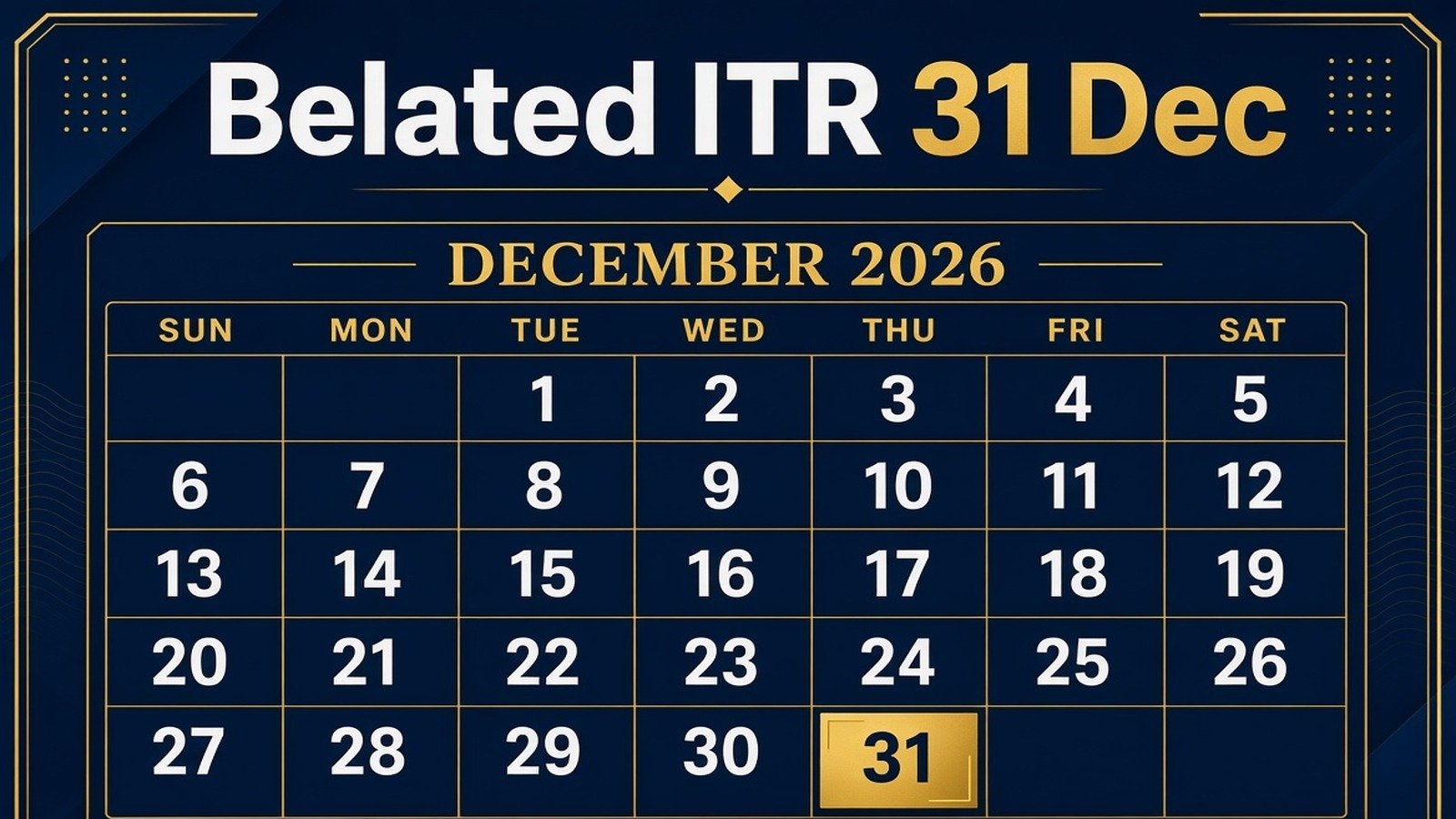
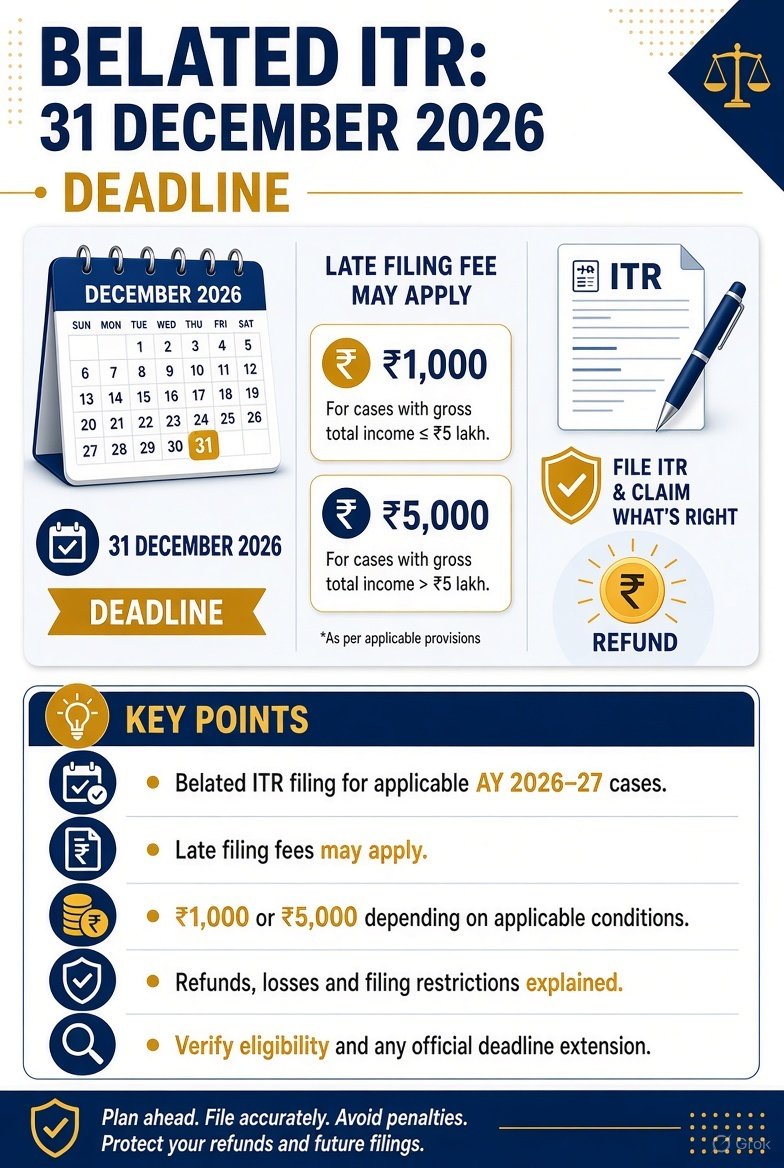
Belated ITR deadline 31 December 2026: this date applies to Assessment Year 2026–27, reporting income for FY 2025–26 under the old Income-tax Act, 1961. The relevant provision is Section 139(4), with possible Section 234F fee and a separate e-verification requirement.
Updated: 22 November 2026 | Official deadline: 31 December 2026
Belated ITR deadline 31 December 2026: the correct year and law
The Income Tax Department confirms that Thursday, 31 December 2026 is the deadline to furnish a belated Income Tax Return for Assessment Year (AY) 2026–27, or before an assessment is completed, whichever happens earlier. The return reports income earned during Financial Year 2025–26 (1 April 2025 to 31 March 2026). It is governed by Section 139(4) of the Income-tax Act, 1961, even though the filing takes place after the new Income-tax Act, 2025 took effect in April 2026.
The two labels are easy to confuse. AY 2026–27 is the assessment year of FY 2025–26, while Tax Year 2026–27 describes income earned from April 2026 to March 2027 under the new Act. A return for that new tax year is not due in December 2026. The department’s transition FAQ spells out that AY 2026–27 returns must use the older ITR forms and old law.
As of 22 November 2026, this is a future filing deadline. Taxpayers should avoid waiting until the final day because tax payment, AIS reconciliation, form validation and e-verification may take additional time. The deadline should be checked again against any later official extension, rather than assuming media speculation changes the law.
Who can file a belated return and when is it needed?
A belated return is an income-tax return filed after the original due date prescribed for the relevant assessment year but within the statutory late-filing period. Someone who had a normal July or August 2026 due date, did not submit an ITR in time and still needs to report FY 2025–26 income may use the belated-return route when eligible. The e-filing portal’s form selection and validation depend on taxpayer category, audit requirements and income sources.
Filing late is not a waiver from reporting taxable salary, professional earnings, bank interest, house-property income, capital gains or other relevant items. Equally, not everyone must file an ITR solely because they hold a bank account or received a small refund. Mandatory filing depends on income thresholds and separate statutory triggers. People unsure whether a filing obligation applied should compare their situation with the applicable old-Act rules or seek professional advice.
A late filer should still use the correct form rather than the easiest-looking form. For example, capital gains, foreign assets or business income can change whether ITR-1 is permissible. A misleading tutorial that tells everyone to use ITR-1 could lead to defective returns and more administrative delay.
AY 2026–27 versus Tax Year 2026–27: transition-year table explained
The Income Tax Department provides an explicit distinction. FY 2025–26 income → AY 2026–27 → Income-tax Act, 1961 → old ITR forms → belated deadline 31 December 2026. By contrast, income earned from 1 April 2026 through 31 March 2027 → Tax Year 2026–27 → Income-tax Act, 2025 → filing due during 2027. The two references share the digits 2026–27 but represent separate income periods.
This matters especially if a taxpayer already made a December 2026 advance-tax payment under the new Act. Advance tax paid against income of FY 2026–27 is not the same as a belated return for income of FY 2025–26. Selecting the wrong year can misallocate reported income, taxes or credits. Before starting the ITR, write down the beginning and ending dates of the income that needs reporting.
The older Act continues to govern proceedings linked with earlier income years. Do not use Section 263(4) of the new Income-tax Act, 2025 as the governing section for an AY 2026–27 belated return: the applicable citation here remains old Section 139(4).
Belated ITR late fee: ₹1,000 or ₹5,000 under Section 234F
The official portal FAQ says that a late-filing fee under Section 234F applies at ₹1,000 where total income does not exceed ₹5,00,000 and ₹5,000 in other cases, subject to the section’s legal applicability. The relevant test refers to total income, not the amount of cash sitting in the bank, the person’s gross receipts or their anticipated refund. Statutory exceptions should be checked for people not otherwise obliged to furnish a return.
A common misconception is that paying ₹5,000 automatically makes every delayed filing valid or guarantees that a refund will be processed. The fee relates to late submission and is distinct from any outstanding tax and interest. A taxpayer with unpaid dues might need to settle those before or during return filing, according to the e-filing calculation.
Someone with income exactly ₹5,00,000 may fall into the lower fee band if other statutory conditions are met; somebody whose applicable total income exceeds that threshold may fall into the higher band. Always use the portal’s computed fee and review the old Section 234F rather than relying solely on a graphic or a friend’s experience.
Does interest under Section 234A or 234B also apply?
The Section 234F late fee is separate from statutory interest on unpaid tax. Under the old Act, Sections 234A, 234B and 234C can be relevant depending on delayed filing, advance-tax defaults and deferment of instalments. Their application turns on the actual tax payable after permitted credits, the due dates and payments made. Filing a return late when sufficient tax was deducted at source may have a different interest consequence from filing late with a large unpaid balance.
A simplified illustration: a taxpayer may face the applicable Section 234F fee and additional interest because tax was unpaid for part of the year. The statutory computation requires the dates and amounts, so an arbitrary statement such as ‘everyone pays an extra 1% on total salary for each month’ is incorrect. Interest is generally linked to relevant tax shortfall, not gross income.
Check Form 26AS, AIS and payment challans to reconcile credits. If the portal’s figures disagree with records, the correction should be investigated before submission. A qualified CA may help when business income, foreign assets, multiple advance-tax payments or disputed credits are involved.
How to file a belated ITR online: the official portal steps
Start at incometax.gov.in and log into the authorised PAN account. Open e-File → Income Tax Returns → File Income Tax Return. Choose Assessment Year 2026–27, the correct filing mode and the applicable income-tax return form. The portal asks for the filing type; select the appropriate Belated Return under Section 139(4) where supported and appropriate.
Review personal information, bank account details, reported salary, house-property information, eligible deductions, tax computation and other schedules. Cross-check the figures against Form 16, Form 16A, bank interest statements, AIS/TIS and Form 26AS. Where data are prefilled, do not assume that each entry is accurate or exhaustive. Add information that is legally reportable and correct discrepancies with documentary support.
Once the schedules are complete, validate the return, review the tax calculation and pay any balance through the authorised e-Pay Tax flow using the correct old-law assessment-year details. Preview the declaration, submit the return and save the acknowledgement. The workflow and labels can vary by form and taxpayer category, so use the portal’s updated user manual if a screen differs.
Why e-verification within 30 days matters
Uploading an ITR is not necessarily the last step. The Income Tax Department’s e-verification guidance specifies a 30-day window from uploading the return to e-verify or furnish a signed ITR-V in the approved manner. Failure to verify in time can lead to a return being treated as not filed or to a later date being regarded as the filing date, with applicable late-filing consequences.
Available verification methods include Aadhaar OTP where eligible, net-banking or bank/demat account verification and other options shown by the e-filing portal. If the taxpayer chooses physical ITR-V, the official instructions specify how and where it must be submitted. Never share OTPs with third parties or use unofficial links promising to verify a return for a fee.
A particularly risky scenario is submitting the belated ITR on 31 December but ignoring the acknowledgement and verification status. Save the acknowledgement number, complete verification as soon as practical and inspect the portal status. Keep the verification confirmation with the tax records.
Can a belated return claim a tax refund?
A person who paid more tax through TDS, TCS or advance tax than the final assessed liability may be able to claim the excess in an otherwise valid belated return, subject to applicable rules and processing. Filing late does not automatically destroy every possible refund claim. However, refund interest and other consequences can differ, and tax authorities may ask for correct bank validation, verified identity and matching tax-credit details.
Make sure the bank account is prevalidated and the PAN information is consistent. Compare employer tax deduction with Form 26AS and AIS, particularly if an employer filed revised TDS statements. Declaring a refund based on inaccurate income or excessive deductions can trigger adjustments or queries; the goal is a correct return, not simply the largest refund figure.
After submission, the portal’s acknowledgement confirms the return was transmitted, not that a refund is sanctioned. Follow its processing status and respond through official channels if further information is requested. Do not pay an unknown agent a ‘refund unlocking charge’.
Which losses may not be carried forward after late filing?
A critical downside of missing the original due date is that some losses cannot normally be carried forward in a belated return because the old Act imposes timely-filing conditions for certain losses. These can include many business and capital-gain losses and some other category-specific losses. The position differs from loss on house property and from set-off rules for the same year, which have their own provisions.
It would be incorrect to state that every financial loss becomes unusable forever or that every late return preserves full carry-forward rights. The answer depends on the source of the loss, the section governing it, the original due date and whether a return was filed in accordance with Section 139(3). A taxpayer facing a large business loss should seek professional advice rather than rely on a short generic online checklist.
This is one reason that an individual with no income-tax payable may still need careful filing analysis when they have eligible losses or other mandatory filing triggers. A nil tax bill and no compliance consequences are not always the same thing.
Belated, revised and updated ITR: the differences
A belated return is the first return filed after the original due date under Section 139(4). A revised return under Section 139(5) corrects an original or qualifying belated return already filed. For AY 2026–27, the Department’s transition FAQ describes a revised-return window extending up to 31 March 2027, or earlier assessment completion, reflecting Finance Act 2026 changes. Relevant fees for certain late revised returns should be checked under the amended provisions.
An updated return (ITR-U) is a different mechanism under old Section 139(8A), potentially available after the ordinary belated and revised windows subject to stricter conditions, time limits and additional tax. It is generally not a tool to create a larger refund or reduce an earlier reported tax liability. People should not postpone a straightforward belated filing in the assumption that ITR-U is always interchangeable.
For example, someone who already filed an accurate original return in July 2026 does not need to file a second belated return merely because December approaches. If they discover an omission, they should assess whether a revised return is appropriate. The correct route depends first on whether an earlier return exists.
Missed 31 December 2026: what options may remain?
After the normal belated-return window closes, filing an ordinary Section 139(4) return for AY 2026–27 generally is no longer available. There may be a route through ITR-U for reporting qualifying additional income, subject to the special restrictions, time limits and extra tax. Exceptional condonation proceedings may apply to certain refund or loss claims where the governing conditions are met; they are not an automatic substitute for a normal belated filing.
A person who missed the deadline should not blindly select a newer tax year or edit an older date to trick the system. That can create inaccurate income reporting. Instead, check the then-current Department guidance and identify which return or application procedure applies to the facts. Seek an experienced tax professional if the return involves significant tax, foreign income or potential notices.
Since 31 December 2026 lies in the future at the date of this article, the most straightforward action is to file correctly before the deadline and verify promptly, avoiding the need to evaluate exceptional alternatives later.
Freelancers, salaried taxpayers and investors: a practical document checklist
Salaried people should collect Form 16, bank interest details and any other relevant income records. Freelancers and self-employed professionals should examine invoices, business expenses, TDS certificates, bank records and the applicable accounting or presumptive rules. Investors should look at demat and broker capital-gain statements as well as dividend, interest and other reportable income.
Before submission, reconcile AIS/TIS and Form 26AS rather than treating them as the sole complete account of income. Check which ITR form can legally accommodate the relevant schedules; ITR-1 is not suitable for all circumstances. Verify residential status, deductions, bank details, foreign accounts or assets where applicable, and any outstanding tax demand or challan payments.
A helpful final checklist is: correct AY 2026–27; correct Income-tax Act, 1961; Section 139(4) if belated; the appropriate ITR form; credible income and tax figures; late fee where applicable; verified bank details; e-verification and saved acknowledgement. These steps are more valuable than filing in haste with mismatched data.
Expected follow-up search questions for December 2026 ITR filing
Readers may search for ‘belated ITR 31 December 2026 late fee calculator’, ‘AY 2026-27 old Act or new Act’, ‘ITR section 139(4) December due date’, ‘revised ITR deadline March 2027’, ‘ITR e-verify 30 days after December 31’, ‘belated ITR refund delayed’, and ‘ITR-U after belated due date’. These are practical anticipated information needs, not measured Google Trends volumes.
For any filing or tax-payment decision, confirm the deadline on the government’s site before acting. Updates to a filing portal, tax-year terminology or legislation can create genuine changes, while unofficial forwards can quickly circulate outdated dates. Keep the official acknowledgement number, payment proof and verification records.
Belated ITR Filing 2026: FAQs
Is December 31, 2026 the last date for belated ITR?
For AY 2026–27, the official deadline is December 31, 2026 or earlier completion of assessment, subject to later formal changes.
Which financial year does this belated return cover?
Financial Year 2025–26, with income earned April 1, 2025 to March 31, 2026, assessed in AY 2026–27.
Which law applies: Income-tax Act 1961 or 2025?
The Income-tax Act, 1961. New Tax Year 2026–27 under the 2025 Act concerns income from April 2026 to March 2027.
How much is the late-filing fee?
Under old Section 234F, the official FAQ gives ₹1,000 where total income is at most ₹5 lakh and ₹5,000 otherwise, subject to statutory applicability.
Can a belated ITR be revised after December 2026?
For AY 2026–27, the amended revised-return window can extend to March 31, 2027 or earlier completion of assessment, subject to applicable fees and rules.
Must I e-verify my belated ITR?
Yes. The Department specifies a 30-day verification or signed ITR-V timeline; complete verification promptly.
Conclusion and official tax sources
Choose the correct assessment year, statutory framework and form; verify the return after filing. Check for any later official deadline changes.
- Income Tax Department – Income Tax Returns FAQs (2026 transition, deadlines and late fees)
- Income Tax Department – File ITR-1 (Sahaj) online, official user manual
- Income Tax Department – How to e-Verify your Income Tax Return
- Income Tax Department – ITR-V and 30-day verification deadline
- Income Tax e-Filing Portal
Disclaimer: General tax education, not individual legal or chartered-accountant advice. Consult a qualified adviser for complex filings.























Share Your Opinion
Comments are closed on this post.