 Vista

Quick answer: An International Maritime Signal Flags Chart identifies 26 letter flags, A–Z, and their common meanings under the International Code of Signals. For example, Alfa warns of a diver down, Bravo signals dangerous goods, Oscar indicates man overboard, and Whiskey asks for medical help. Individual flags must not be confused with semaphore arm positions or Morse dots and dashes.

Updated 21 November 2026. Operational reference: IMO International Code of Signals, 2005 edition as republished in 2022.
How the International Code of Signals flag alphabet works
Maritime signal flags are standardized visual designs that represent the letters A to Z. On a ship they can be hoisted individually or in groups to communicate information across language barriers. When a single alphabet flag is flown by itself, many letters have an operational meaning defined by the International Code of Signals (ICS). When several flags are grouped, their interpretation follows code rules rather than an arbitrary combination of individual meanings. The code exists to support maritime communication about navigation, safety and other practical matters.
The International Maritime Organization (IMO) publishes the International Code of Signals, with a 2005 edition available in a current 2022 digital publication. A flag chart is a useful introduction, but the full ICS provides signal rules, complements and situations not explained by a one-page poster. Flags are also used for ceremonial dress and in racing contexts, which can involve different conventions. Do not assume a row of decorative pennants hanging over a marina spells an operational distress message. Context and approved signaling procedures matter.
All 26 maritime signal flags A–Z: letter, phonetic name and meaning
Maritime alphabet flags have recognised phonetic names such as Alfa, Bravo, Charlie, Delta and Echo. These names are helpful for spelling over voice radio, but the printed letter, distinctive coloured flag and its single-letter ICS meaning are separate pieces of information. A learner should compare the actual geometry of the flag with an official image and then read the single-flag meaning. Some online pages reproduce outdated historical meanings. Always check the current ICS, especially for K, M, J, Y and Z, whose meanings are often confused in old graphics.
The quick-reference table below summarises the current general-use meanings, not the full detailed official text with its notes and exceptions. Bravo warns about dangerous goods, Oscar communicates man overboard, and Whiskey requests medical assistance. Romeo is a useful exception because it is assigned an alphabet flag yet has no general standalone single-letter ICS meaning. Some meanings change or have qualifications for fishing vessels or specific operations. Do not use this summary to satisfy formal maritime licensing requirements without consulting the full Code and your flag-state guidance.
| Letter | Flag name | Common ICS single-flag meaning |
|---|---|---|
| A | Alfa | Diver in the water; keep well clear and proceed slowly. |
| B | Bravo | Taking in, carrying or discharging dangerous goods. |
| C | Charlie | Affirmative: yes. |
| D | Delta | Keep clear; vessel is manoeuvring with difficulty. |
| E | Echo | Altering course to starboard. |
| F | Foxtrot | Disabled; communicate with me. |
| G | Golf | Require a pilot (special fishing context may differ). |
| H | Hotel | Pilot on board. |
| I | India | Altering course to port. |
| J | Juliett | On fire and carrying dangerous cargo; stay clear. |
| K | Kilo | Wish to communicate with you. |
| L | Lima | Stop your vessel immediately. |
| M | Mike | Vessel stopped, making no way through water. |
| N | November | Negative: no. |
| O | Oscar | Man overboard. |
| P | Papa | In harbour: persons report aboard; vessel preparing to sail. |
| Q | Quebec | Vessel healthy; requests free pratique. |
| R | Romeo | No standalone single-letter meaning assigned in current ICS. |
| S | Sierra | Operating astern propulsion. |
| T | Tango | Keep clear; engaged in pair trawling. |
| U | Uniform | You are approaching danger. |
| V | Victor | Require assistance. |
| W | Whiskey | Require medical assistance. |
| X | X-ray | Stop your intentions and watch for my signals. |
| Y | Yankee | Dragging anchor. |
| Z | Zulu | Require a tug (fishing context may differ). |
Important emergency flags: Alfa, Bravo, Oscar, Victor and Whiskey
A familiar blue-and-white Alfa flag warns that a diver is down and other vessels should keep well clear at slow speed. Bravo indicates dangerous goods activities, so approaching vessels need to consider the hazards. Oscar is the man-overboard flag; immediate action should follow a vessel’s man-overboard procedures, not merely a spectator’s understanding of the flag. Victor means assistance is required, and Whiskey specifically requests medical assistance. These are useful examples of why one flag can be much more than a decorative letter.
Some flags can be used together for a message with an entirely different operational significance. The N over C combination, for example, is widely recognised as a maritime distress signal. Do not infer that the meanings of the component flags should be concatenated as ordinary words. In actual danger, activate the appropriate emergency alerts, use distress radio communications and act in accordance with maritime procedures. Visual signaling can support awareness but visibility, distance, fog, weather and traffic conditions can limit its usefulness.
Navigation and manoeuvring flags: Delta, Echo, India, Lima and Uniform
Delta signals manoeuvring difficulty and asks other vessels to keep clear. Echo indicates an alteration of course to starboard, while India refers to an alteration to port. Lima tells the other vessel to stop immediately. Uniform warns another vessel that it is standing into danger. These examples demonstrate how the ICS supplies short standard meanings intended to be recognised quickly by trained mariners. Their interpretation should be tied to the actual navigation situation and the applicable collision-prevention rules.
It is dangerous to conclude that a coloured flag automatically changes the International Regulations for Preventing Collisions at Sea (COLREGs) or permits the flag-bearing vessel to ignore safe navigation. Signals are communication tools, not substitutes for lookout, speed management, radar, lights, sound signals and professional judgment. A classroom poster can explain the letters, but navigation training also needs rules, practice and discussion of conflicting information. When a visual signal is unclear, seek clarification using approved communication methods rather than improvising manoeuvres from a guessed symbol.
Quebec, Papa, Golf and Hotel: port entry and pilotage
Quebec communicates that a vessel is healthy and requests free pratique, a public-health-related port procedure. Papa in harbour context can indicate that personnel should report aboard as the vessel is about to proceed to sea. Golf may request a pilot, while Hotel communicates that a pilot is on board. These flags illustrate the close connection between signaling, harbour operations and legal or administrative procedures. A flag does not by itself prove that immigration, quarantine, port clearance or other permissions are already granted.
Operational meanings may include explanatory notes for special vessel types. In particular, fishing-vessel usage of some signals can differ from the general one-letter explanation. If you are a student preparing for a nautical examination, read the entire approved source including footnotes, not only a social-media infographic. Port guidance, VHF communication protocols and instructions from harbour authorities remain controlling. Replacing an official communication process with a mobile phone screenshot of a flag chart would be a poor safety practice.
Numeral pennants, substitute flags and the answering pennant
The ICS includes more than 26 alphabet flags. Ten numeral pennants can represent digits, while substitute flags may be used to repeat a symbol in a hoist according to the relevant procedure. An answering pennant has a distinct role in acknowledging or identifying code signaling. A set of 26 flags cannot therefore represent the complete visual-signaling equipment required for every code message. Some printed sets include all these extra items and some beginner charts do not; count and category should be clearly labelled.
A common mistake is to assign one of the numeral pennants the meaning of a similarly coloured letter flag. Another is to treat a substitute as a new alphabet character rather than a method for expressing a repeated signal. In training, identify the shape of a flag or pennant, its specific colour pattern, and whether it is an alphabet, number, substitute or answering item. A chart should not invent names or flip a design to fit an artistic grid. The approved flag design is essential for reliable identification at a distance.
Maritime flags versus semaphore flags versus Morse code
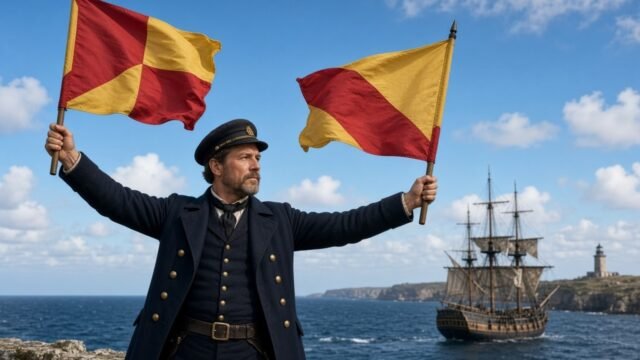
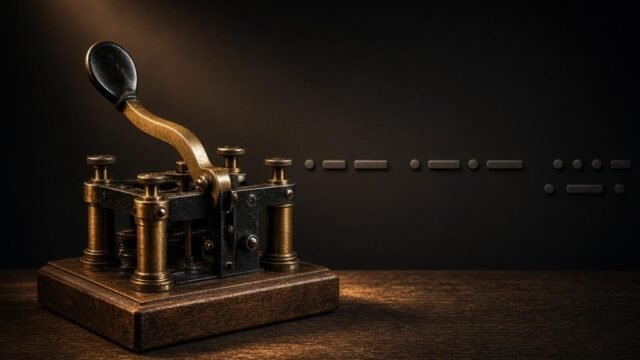
An ICS alphabet flag is a particular physical flag design, often flown by hoist. Semaphore represents a letter through the relative positions of two flags held by one person. Morse code transmits timed short and long elements and may use light or sound. These are three distinct representations and should not be merged. A red-and-yellow handheld semaphore flag is not automatically an ICS Bravo or Charlie flag simply because it is used near a ship.
This difference matters for educational posters and online image search. A student searching “maritime signal flags chart” usually wants to identify the 26 coloured flags and their meanings. Someone searching “semaphore flag alphabet” needs pictures of an operator holding two flags in each letter position. And “Morse code alphabet” needs precise dots and dashes. Mixing all three onto one unlabelled printable sheet can create a misleading reference. Separate charts are better for search clarity and for learners, even though the communication systems share a broader maritime history.
How to study a maritime signal flags chart accurately
Divide the 26 letters into manageable groups and compare printed shapes carefully. Learn high-salience flags first: Alfa for divers, Bravo for dangerous goods, Oscar for man overboard, Quebec for free pratique and Whiskey for medical assistance. Then add manoeuvring and general communication signals. Practise identifying a flag from its geometry rather than memorising only the English phonetic word. Some flags contain similar colours but different divisions, so the pattern and orientation matter.
When downloading an AI-created visual poster, do not assume every stripe and triangle is correct merely because the layout is attractive. Cross-check the visual with an official ICS illustration. An educational blog may provide a general-purpose chart, but professional mariners should use the authorised edition and local regulatory requirements. Keep the Code available where the operating procedure expects it. In a navigation emergency, communicate promptly through approved systems rather than relying on memory from a decorative image.
International maritime flags FAQs
What does the Alfa maritime flag mean?
A diver is down; other vessels should keep clear and proceed at slow speed.
What does the Oscar flag indicate?
Man overboard; the vessel should follow appropriate emergency procedures.
Does each of the 26 flags have a standalone meaning?
No. Romeo is part of the alphabet but has no general single-letter meaning assigned in the current ICS.
What is the difference between nautical signal flags and semaphore?
ICS uses individual flag designs, while semaphore uses the positions of a pair of handheld flags.
Can a maritime flag chart replace the official International Code of Signals?
No. The official code includes detailed procedures, combination signals and contextual notes.
Conclusion
Learn the alphabet flag’s shape, letter, phonetic name and single-letter meaning separately. A good maritime flag chart is a quick recognition guide; the current IMO Code and proper seamanship procedures remain authoritative for real communication and safety decisions.
Sources
- International Maritime Organization — International Code of Signals
- US Coast Guard — Publication 102 International Code of Signals
- US Naval History — Phonetic Alphabet and Signal Flags
This is a learning article, not a marine navigation, safety or examination authority. Signal meanings can have special context.








Share Your Opinion
Comments are closed on this post.