Old handwritten Satbara: start beyond the familiar name
A handwritten Satbara in a family file may contain a recognisable name and a faded survey number. Those details are useful, but they are only the beginning. Establish which village and period the page concerns, what each column says and how later entries connect with the historical record.
This is a guide to Maharashtra’s old 7/12 extracts. Do not treat the form as an identical version of another state’s khasra, khatauni or West Bengal khatian. Historical layouts can vary, so read the headings on the actual page.
All three pictures are fictional AI illustrations. They are not authentic Satbara extracts, certified copies or records of a real person’s land. Their invented markings contain no information to recover.
What do the 7 and 12 refer to?
Maharashtra’s official land-record information associates Village Form 7 with rights records and Form 12 with crop information. The distinction helps separate recorded land interests from information about cultivation.
A crop noted for an old season does not describe what grows there today. Similarly, a historical name is not a complete account of subsequent changes. Keep the page’s period separate from the present-day question you want to answer.
Recorded names, crop entries, parcel identity and a current ownership dispute may involve different questions. Read beyond the first familiar line rather than assuming the rest of the extract adds nothing.
Details to note on a handwritten page
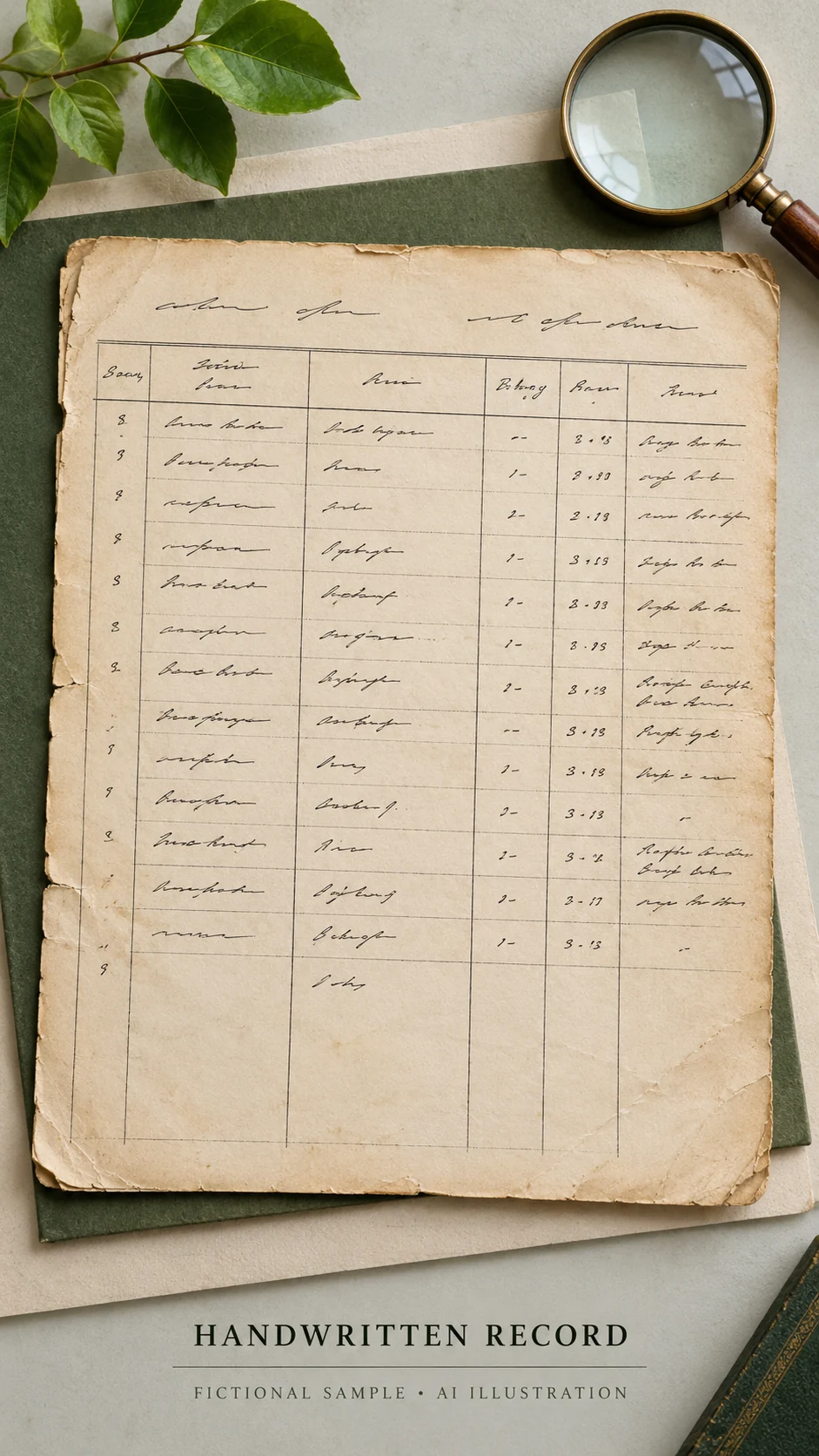
Identify district, taluka and village, then transcribe the survey or gat reference and any subdivision exactly. Retain slashes and decimal marks. If a digit is uncertain, preserve the uncertainty rather than silently replacing it with a plausible number.
Read personal names together with parent or spouse information, account references and other named people. Retain Marathi headings such as bhogavatadar or itar hakk in your notes where present. Names in different columns do not necessarily appear in the same capacity.
Separate the area unit, total parcel area and a person’s recorded share. Comparing two large numbers without checking what each represents can create a misleading discrepancy.
Look for mutation references, remarks, margin notes and continuation pages. A circle, crossing-out or different ink colour does not explain itself. Seek the related entry or order rather than guessing the significance of the mark.
Where to look for archived handwritten records
Use the official Mahabhumi gateway to reach the relevant Maharashtra service. e-Records is a separate archived-document portal. Finding a historical handwritten page and obtaining a current digitally signed 7/12 are different requests.
Prepare the village, taluka, record type, period and known survey or gat reference. Availability depends on the record and service; this guide does not promise a complete online history for every village.
If the record is unavailable, ask the relevant Talathi or village revenue officer, tehsil or record branch where that period’s register is held and how a copy can be obtained. A family photograph can help explain the enquiry, but should not be described as an officially issued certified extract.
How to compare handwritten and computerised entries
Make a comparison note with three parts: the older entry, the current entry and the question raised by the difference. Match village and parcel identity before comparing names, area, units, shares and remarks.
In a purely fictional example, an older reference “A” and a current “A/1” do not establish either an error or a subdivision relationship on their own. Look for the intervening change, mutation or resurvey record. These letters identify no real plot.
Mahabhulekh’s official notice describes e-Hakk applications for discrepancies involving handwritten and online information such as names, area or units. Read the current application options and supporting-document requirements. Submission does not guarantee approval.
A difference is not always a typing mistake. Where the issue is an underlying right, succession or a later transaction, a request labelled “name correction” may not resolve the whole matter. Establish the record trail and appropriate local process.
Advice: preserve the source and document the question
For reading, retain a clear straight image of the complete page, including margins and page references. Keep the source separately and label any contrast-enhanced reading copy. Do not fill missing letters and present the result as a new original Satbara.
Mark unclear wording as unreadable. OCR or AI may suggest a reading, but the suggestion is not an official transcription or authenticated translation. Ask the relevant record professional about uncertain entries and their context.
A simple enquiry can state the village, survey or gat reference, period and the particular discrepancy, then request the relevant record and applicable procedure. This organises the question; it is not a prescribed government form.
Retain the application, acknowledgement and response. Before a purchase, possession change or partition decision, obtain appropriate local verification. Conceal unnecessary personal information in publicly shared document images.
Five questions about old Satbara records
Does an old extract describe the current position automatically? No. Check its period and later records.
Is every handwritten–digital difference an error? No. A legitimate intervening change may explain it.
Where can an archived page be sought? Check e-Records through official links, then enquire with the responsible office if needed.
Is a normal screenshot a digitally signed extract? No. Check the issued file and official verification arrangements.
Does an e-Hakk application guarantee immediate correction? No. Application, scrutiny and decision are separate stages.
Sources and illustration disclosure
Disclaimer: general information about Maharashtra land records, not legal advice on an individual title, correction approval or dispute. Procedures depend on the record and circumstances. All three pictures are AI-generated fictional illustrations. Sources checked: 25 October 2026.
- Maharashtra Land Records Department: Village Forms 7 and 12, official FAQ
- Mahabhulekh: official handwritten–computerised discrepancy notice
- Mahabhumi: gateway to land-record services
- e-Records: official archived-document service
- Digitally Signed Satbara: official portal and notice on official use
- Maharashtra Land Records Department: service directory and record verification
- Supreme Court of India, 19 December 2025: mutation and title, paragraph 19
Related: old property deeds and certified-copy searches
Related: old Bengali land porcha, khatian and RS–LR records