Understanding the Belief Behind Lemon and Chilli
The practice of hanging a string of lemons and green chillies is a common sight at the entrances of homes, shops, and even on vehicles across India. This tradition is rooted in a folk belief, often referred to as ‘nazar utarna’ or warding off the evil eye. While documented in folklore archives, such as the Digital Folklore Archives at the University of Southern California, the existence of a tradition doesn’t scientifically validate its supernatural claims. These folk practices often intertwine with family habits, community memory, and symbolic meanings. The sense of peace or security derived from performing such rituals can be a genuine personal experience, but it doesn’t prove that the object has controlled external events or others’ intentions.
If this is a customary practice in your household, it can be maintained as a simple cultural exercise. However, it’s important not to elevate it to a universal religious rule, a guaranteed source of business income, or a substitute for health protection. Personal responsibilities and common sense should continue alongside these beliefs.
Is Hanging Lemon and Chilli Mandatory on Diwali?
No, it is not a mandatory practice for every household. Diwali celebrations vary significantly across different communities and families. Some focus on lighting diyas, others on creating intricate rangoli designs, worshipping specific deities, or preparing unique culinary traditions. Declaring a festival or worship incomplete due to the absence of one particular item is not appropriate. Questions about when to change the string, how many chillies to use, or in which direction to hang it often yield varied local answers. Without clear, authentic references, it’s unwise to impose a single number or direction as a strict rule for everyone, as changing the quantity doesn’t guarantee a different outcome.
Shopkeepers may acknowledge a customer’s faith but should not exert pressure to spend money. Messages like “If you don’t buy special lemons this year, the shop will close” can be fear-based sales tactics rather than genuine religious information. Prioritize your own needs and budget.
Is There a Scientific Reason for Lemon and Chilli?
Online discussions sometimes label lemon and chilli as natural pesticides, air purifiers, or agents that prevent all bacteria. While ingredients in a kitchen possess chemical properties, claiming that hanging them on a doorstep protects the entire house is a different assertion. The colour, smell, or taste of an item does not automatically prove its effectiveness as a mosquito repellent. For insect problems, focus on practical solutions like eliminating stagnant water, using nets, maintaining cleanliness, and correctly identifying the pest. Do not rely solely on this string for solutions to illnesses or serious pest infestations. Similarly, for genuine security, measures like locks, lighting, electrical systems, and professional help when needed are crucial. Replacing these practical measures with folk beliefs can be a significant oversight.
When scientific claims are made, it’s reasonable to ask: In which study, under what circumstances, and with what demonstrated effect? The table below summarizes common claims versus reality:
| Claim | What to Understand |
|---|---|
| Hanging it will prevent harm. | Such definite protection is not scientifically proven. |
| A specific number is required in every home. | Local customs vary; do not treat it as a universal rule. |
| It repels all insects. | Do not consider it a reliable pest control alternative. |
| If found outside, someone cast a spell. | It’s impossible to determine who placed it or why without evidence. |
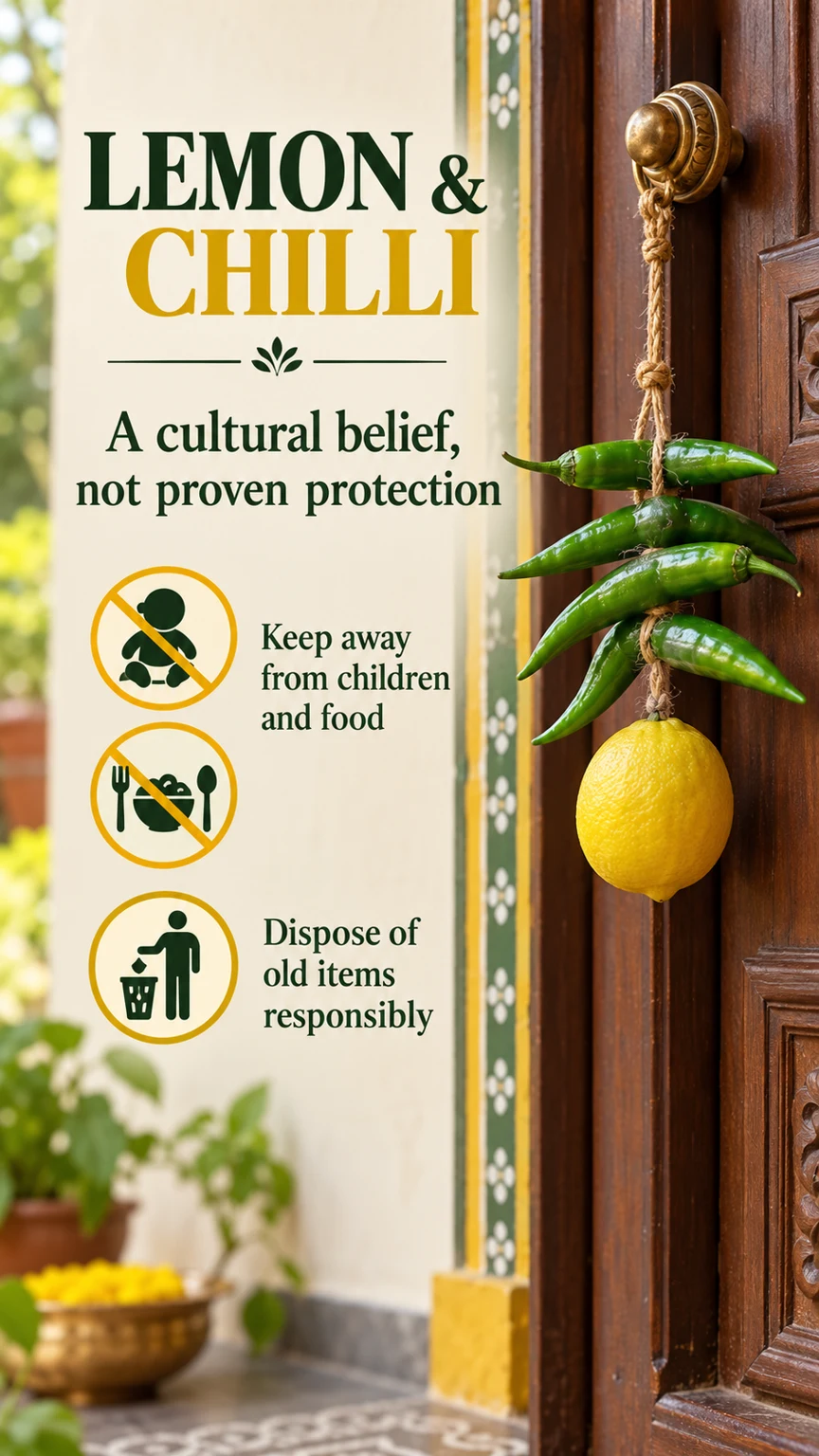
(Symbolic cultural image generated by AI; does not claim miraculous protection.)
Safe Practices for Tradition Keepers
If your family chooses to continue this decoration, ensure it’s placed where children or pets cannot easily reach it, and where it won’t fall when the door is opened or closed. Make sure any wires, needles, or sharp parts used for hanging are not exposed. Even a cultural item, if not displayed properly, can cause minor injuries. Keep it at a safe distance from diyas, incense sticks, and electrical decorations. Avoid hanging dry strings and threads near open flames. Do not climb on unstable chairs or ladders alone to hang the decoration. The decoration should never be prioritized over the safety of your home.
Do not use any lemon or chilli found hanging outside or lying on the ground for consumption. You cannot be sure of its cleanliness or what it has come into contact with. Keep items used for cooking separate from such decorations. If children mistake them for food, explain gently in simple terms.
Disposal of Old Lemon and Chilli Strings
Discarding an old string by leaving it on the road, in a drain, outside a temple, or at someone else’s doorstep is not a proper method of disposal. This simply shifts the waste burden onto someone else. Believing that ‘the curse will pass on’ by placing it at someone else’s property can also lead to social disputes. Separate the organic material (lemon, chilli) from accompanying threads, plastics, or metals according to your local waste management guidelines. Inquire about instructions where separate organic collection is accepted. Not all mixed strings are suitable for direct composting; they might contain artificial or sharp components. Flushing it down a river doesn’t make the item disappear. Waste left on public paths can also obstruct people and animals.
A practical way to respect the tradition is to ensure the material reaches an appropriate collection point without imposing an extra cleaning burden on anyone.
What to Do If You Find Unfamiliar Lemon and Chilli Outside Your Door?
Simply finding an object doesn’t allow you to definitively determine who placed it or their intention. It could be a fallen decoration, general waste, or part of someone else’s unique folk practice. Accusing neighbours or relatives without proof can damage relationships. If the situation appears to be like ordinary household waste, remove it using appropriate cleaning tools – there’s no need to rub it with bare hands to identify it. If it contains any sharp or obviously suspicious items, seek appropriate local assistance instead of tampering with it. Keep children away from playing with it.
If someone is repeatedly harassing you by placing objects at your door, the issue might be less about religious interpretation and more about behaviour and harassment. Document the dates and facts of the incidents. If there are threats or actual safety concerns, seek help accordingly, but avoid creating counter-objects based on assumptions of magic.
Why Not Burn to Test or Buy Expensive Remedies?
Burning chillies or unfamiliar materials to conclude ‘the evil eye’ is present based on smoke, sound, or ash is not a reliable method of testing. Performing such experiments at home can create unnecessary risks of smoke and fire. If open flames are used for worship, standard fire safety rules always apply. Do not make hasty decisions based on someone’s video or claim that “if you don’t pay now, disaster will strike.” Ask for proof and discuss with trusted family members. Giving an unknown person your OTP, bank PIN, or personal photos is not a requirement of religious faith. If your home experiences frequent stress, discuss the actual underlying issues – cleanliness, interpersonal conflicts, security, or finances. Attributing all problems to a single string can delay finding solutions. It’s also unnecessary to insult a family member with differing beliefs during respectful conversations.
Frequently Asked Questions
Why do people hang lemon and chilli on Diwali?
Some families and shops associate it with the folk belief of warding off the evil eye. Being a cultural practice does not provide scientific proof of protection.
Is it mandatory for every home to hang it?
No. Diwali traditions vary. Do not consider it a mandatory rule for everyone.
Does it keep mosquitoes and all insects away?
Do not rely on it as a trustworthy pest control alternative. Steps like cleanliness, using nets, and correctly identifying the problem are essential.
Where should I put the old string?
Separate organic and other components according to local waste collection guidelines. Do not leave it on the road, in a river, or at someone else’s doorstep.
Is a string found outside proof of black magic?
No. An object does not definitively reveal the person or their intention. Do not make accusations without evidence.
Should I check for the evil eye by burning chilli?
Smoke or ash does not provide a reliable check for supernatural effects. Do not use unnecessary smoke and fire.
Advice: Tradition Comes with Responsibility
You can view lemon and chilli as a family’s cultural choice. However, do not treat it as a guarantee for health, income, or security. Display the decoration safely, dispose of old materials properly, and avoid accusing others based on finding an unfamiliar object.
Related Question: What to do if you see lemon-vermilion or an unknown ‘totka’ at a crossroads?