You have agreed to separate, but the first-motion order lists the next hearing six months away. Under the Hindu Marriage Act, a court may waive that waiting period in a suitable case. A reasoned joint application, the reconciliation history and a workable settlement matter. Filing the application does not dissolve the marriage, and there is no guaranteed 15–30-day decree.
Can the six-month cooling period be waived?
Yes. Apply jointly in the competent court handling your mutual-consent divorce for waiver of the waiting period under section 13B(2), Hindu Marriage Act, 1955. In Amardeep Singh v. Harveen Kaur (2017), the Supreme Court held that this period is directory and may be waived on appropriate facts. This is a judicial discretion exercised in the existing case, not an online divorce certificate or dissolution through a private agreement.
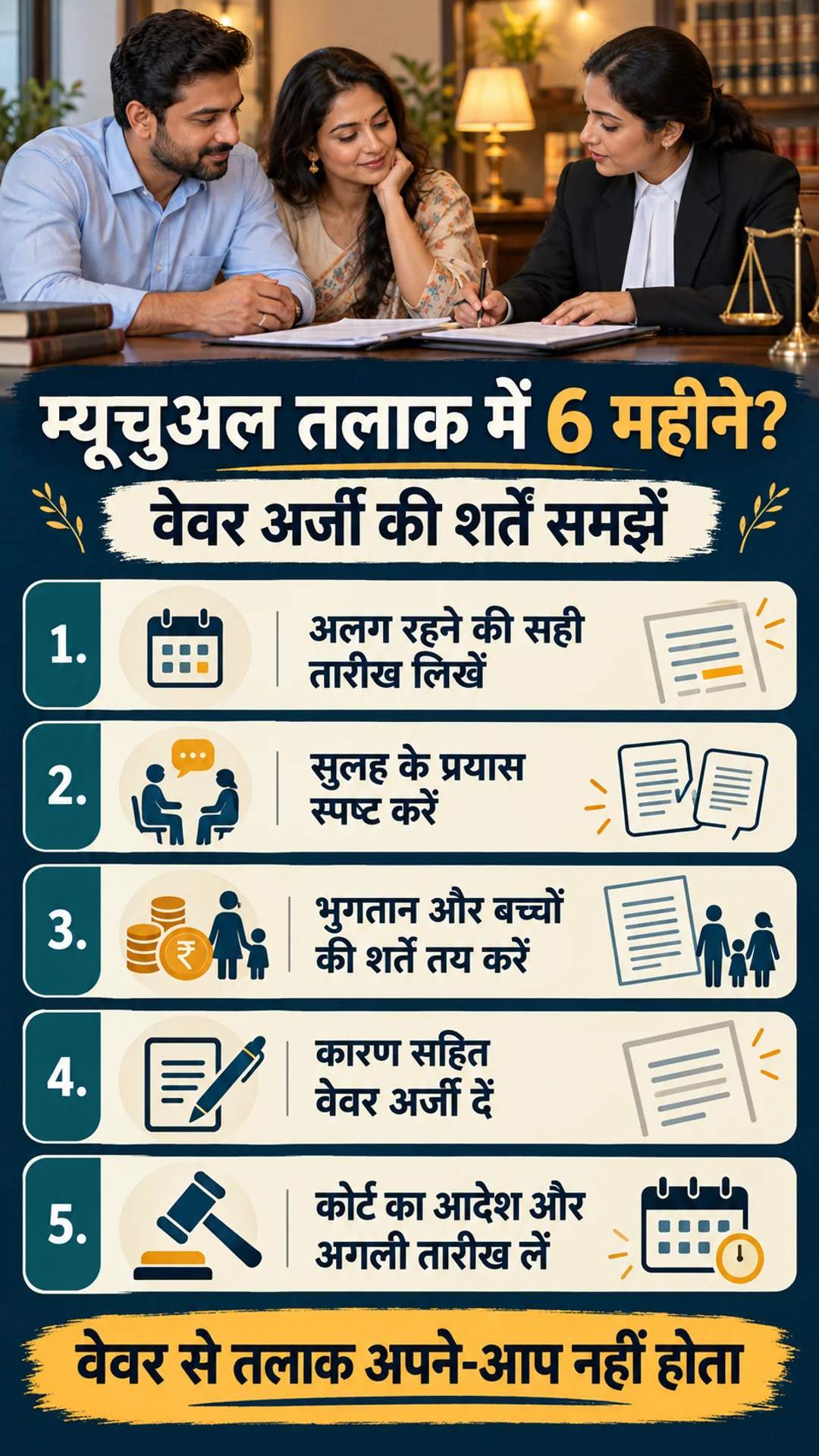
- Check the marriage law and eligibility for the joint petition.
- Keep the first-motion order and an accurate separation chronology.
- Settle maintenance, children and outstanding disputes clearly.
- File a truthful, reasoned joint waiver application with supporting records.
- Follow the waiver order, second-motion procedure and decree requirements.
One year of separation is different from six months of waiting
Section 13B(1) requires the spouses to have lived separately for one year or more, to have been unable to live together and to have mutually agreed to dissolve the marriage. Waiving section 13B(2) does not automatically waive that one-year requirement. Living separately concerns the marital relationship and facts; different postal addresses are not the only consideration. Never backdate the separation to create eligibility.
The ordinary section 13B(2) rule requires the joint second motion no earlier than six months and no later than eighteen months after presentation of the petition. The waiver concerns the six-month wait. Record the petition date, first-motion order and listed hearing separately. The passage of six months does not itself produce a divorce decree: the joint motion and judicial inquiry remain necessary.
Section 14 separately restricts presentation of a divorce petition within one year of marriage, with a limited statutory exception for exceptional hardship or depravity. Do not confuse that marriage-duration rule with the separation requirement or the cooling-period waiver. This article addresses HMA proceedings. Special Marriage Act and other marriage laws require examination of their own provisions and applicable authorities.
What Amardeep Singh and Amit Kumar actually establish
Amardeep Singh identified prolonged separation, failed reconciliation, genuine settlement and a wait that would merely prolong the parties’ agony. It also referred to the additional six months already having passed beyond the one-year separation before the first motion. That factor should not be converted into a rigid eighteen-month eligibility rule for every waiver case.
Amit Kumar v. Suman Beniwal (2021) clarified that the Amardeep factors are illustrative, not exhaustive. The court considers the duration of marriage, time together and apart, litigation, other proceedings, children, reconciliation prospects and whether a genuine settlement was reached freely. The circumstances must be assessed together. A shorter separation than eighteen months does not automatically settle the waiver question either way.
FACT: “We want a quick divorce” is not a complete application. Explain why reconciliation has failed, how the settlement will operate and what genuine difficulty the additional wait causes. If relocation, employment or health is relevant, supply the available evidence. Do not invent urgency or conceal unresolved obligations to obtain a faster order.
Prepare the settlement and document file
Keep marriage evidence, identity/address documents, the petition and first-motion order, an accurate separation timeline, available mediation records and the signed settlement. Check that dates agree across documents. Verification, affidavits and filing requirements depend on the local court; this sample is not a universally prescribed form.
- Maintenance/alimony: amount, instalments, payment method and acknowledgments.
- Stridhan, belongings, assets and debts: itemised responsibilities and handover terms.
- Children: custody, contact, education, medical needs and expenses.
- Pending cases: numbers, forums and the specific applications each party will make.
- Unfinished obligations: dates, evidence of compliance and available remedies.
The welfare of children is not conclusively disposed of merely by their parents signing an agreement. Disclose the children’s circumstances and propose arrangements that work in practice. Do not describe unpaid settlement money as received. Distinguish completed payments from future instalments and make their stages clear. Both parties should understand the terms and have an opportunity for independent advice.
A divorce decree does not automatically terminate an FIR, prosecution or another pending proceeding. Withdrawal, compounding or quashing requires the appropriate procedure and competent forum where legally available. Identify each case and the necessary steps; do not promise that the divorce court can exercise powers belonging to a different forum.
From first motion to decree: the practical sequence
Complete the joint petition and first-motion procedure before the competent Family Court or district court. Filing papers is not the same as recording the first-motion statements and receiving the relevant order. Read the order. Amardeep Singh states that a reasoned waiver application can be filed one week after the first motion; verify your court’s filing and listing directions.
File the joint application in that case, attaching the relevant order, settlement and records. The judge may question both spouses about free consent, reconciliation and implementation. If one spouse does not understand the agreement, alleges pressure or disputes payments or childcare, address that issue honestly. A signed paper does not replace the court’s examination.
If waiver is granted, obtain the written order and confirm the second-motion date and procedure. Continued mutual consent and judicial satisfaction remain necessary at that stage. A waiver order only removes the specified wait; it is not the decree dissolving the marriage. Listing, attendance, service, documentation and settlement compliance can affect the actual timetable.
For justified difficulties with attendance, such as residence abroad or illness, seek permission for video conferencing or an allowed form of representation with reasons. Amardeep recognised such possibilities in appropriate circumstances. Permission is not automatic, and sending a lawyer alone does not establish that a required personal appearance has been dispensed with.
Adaptable joint application under section 13B(2)
This is a general drafting aid, not a court-approved form. Have the heading, local filing procedure, verification and annexures checked. Include only true statements and remove inapplicable passages.
Before the competent [Family Court / District Court], [place]
HMA Petition No. [ ]
[Spouse 1] and [Spouse 2] — Joint Petitioners
Joint application for waiver of the six-month waiting period under section 13B(2), Hindu Marriage Act, 1955
1. The parties married on [date/place] and have lived separately since [true date]. The joint petition was presented on [date]; the first-motion statements/order are dated [date].
2. Reconciliation efforts [actual dates/details] failed. There is no realistic prospect of resuming marital cohabitation for [brief factual reasons].
3. The settlement dated [ ] addresses maintenance/alimony, stridhan/property, children [if applicable] and identified pending proceedings. Payments received/outstanding and their stages are [accurate details].
4. Both petitioners freely seek dissolution without coercion. Further waiting would cause [genuine difficulty supported by records].
5. Waiver is requested on the facts in light of Amardeep Singh v. Harveen Kaur (2017) and Amit Kumar v. Suman Beniwal (2021).
Prayer: Waive the six-month waiting period and permit early listing of the second motion / issue appropriate directions.
Place/date; signatures of both petitioners
Annexures: first-motion order, settlement, payment/reconciliation records and relevant supporting documents.
Verification/affidavits: as required by local rules.
If waiver is refused or consent changes
Refusal of waiver does not automatically mean dismissal of the entire divorce petition. Read the reasons and the next date. With your lawyer, examine whether a missing document can be supplied, the ordinary schedule followed or an available judicial challenge pursued. Whether a fresh application is appropriate depends on the order and circumstances; repeated identical applications are not a substitute for addressing the reasons.
In the ordinary mutual-consent route, consent must continue until the decree. An earlier signature does not automatically compel a spouse who withdraws consent to accept a mutual divorce. Obtain advice about the settlement, payments and other remedies. The Supreme Court’s exceptional Article 142 power should not be described as a routine Family Court power. Urgent safety or protection measures are separate from the waiver application.
Advice, related reading and five FAQs
Advice: Maintain a single chronology and payment record. Do not leave essential settlement obligations vague merely to secure an early date. Waiver, the second motion and the final decree are separate stages. Obtain a certified decree; seek advice on applicable finality, appeal and remarriage rules before remarrying.
Can you divorce without going to court? Mutual-consent rules
Is waiver automatic?
No. The court decides on the supported reasons and circumstances.
Does it waive one year of separation?
Waiver of section 13B(2) does not automatically remove section 13B(1)’s one-year separation requirement.
Must every applicant be separated for eighteen months?
Amit Kumar clarified that the Amardeep factors are illustrative. A universal rigid eighteen-month rule is incorrect; the facts must be assessed.
Is a decree guaranteed within 15–30 days?
No. Listing, hearings, attendance, compliance and judicial orders determine the actual time.
Does the waiver order itself end the marriage?
No. The second motion and judicial divorce decree remain necessary.
- Hindu Marriage Act, 1955 — sections 13B and 14
- Amardeep Singh v. Harveen Kaur — Supreme Court judgment, 12 September 2017
- Amit Kumar v. Suman Beniwal — Supreme Court judgment, 11 December 2021
Disclaimer: General legal information for India. The applicable marriage law, case facts and local court rules affect procedure. Have your documents reviewed for individual advice. Fact-checked: 13 October 2026.