For centuries the human mind has circled a question that sounds almost childlike and then opens into something vast: who was before God? If God made this universe, the next question arrives at once — who made God? That who was before God creation mystery is not only a temple debate or a laboratory puzzle. It is a way of asking what existence is, what time is, and whether our everyday chain of “this came before that” even works at the first beginning.
From ancient sages to modern scientists, people have tried to name the first source. Some answers come as faith. Some come as physical theory. Some stay as honest “we do not know yet.” This article stays with those layers as they are: a scientific account of how the cosmos may have begun, religious and spiritual claims about an uncreated source, and a philosophical look at why the word “before” may itself be the trap.
Why the Question “Who Was Before God?” Still Matters
The question is not idle curiosity. It is a sign that human beings want to know their origin, the beginning of the universe, and whether life has a deeper meaning than the next task on a list. When someone asks who stood behind the creator, they are also asking whether reality has a floor — a last fact after which there is no further “who.”
The source of this discussion puts the point simply: some mysteries sit beyond ordinary human limits, and the effort to understand them stretches awareness itself. That does not mean every answer is equal, and it does not mean a slogan can close the file. It means the question trains the mind to notice its own frame. We are used to parents before children, seeds before trees, builders before buildings. The mind then drags that same ladder all the way to God and demands one more rung.
The same question also sits on the bridge between science and spirituality as the Hindi original frames it. Science, in this telling, works on how — how space expanded, how matter cooled, how stars and planets formed. Spirituality works on why — why there is something rather than blankness, and what the last reality is said to be. Mixing those two jobs creates confusion. Keeping them distinct does not end the mystery, but it stops a physics paper from being treated like scripture, and it stops a hymn from being treated like a lab result.
So the question matters because it forces a choice of language. Are we talking about a person-like deity inside time? An impersonal ground of being? A physical first event? A cycle with no first page? Until those meanings are separated, “who was before God?” is several questions wearing one mask.
The Scientific View: Big Bang, Singularity, and the Start of Time
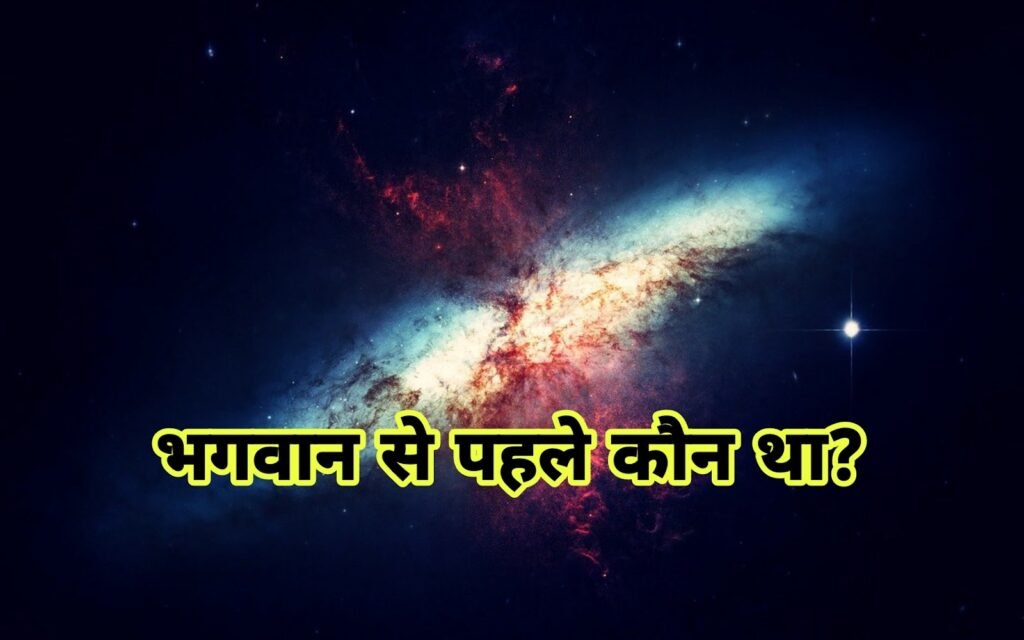
Modern science, as presented in the source, offers the Big Bang account of cosmic origin. On this theory, about 13.8 billion years ago the entire universe was packed into an extremely dense and hot point called a singularity. A vast expansion followed. From that unfolding came stars, galaxies, planets, and later the conditions in which life could appear. The universe, in this picture, has been expanding ever since.
That story is a scientific theory about the physical cosmos. It is not, in the source’s own wording, a direct answer to “who made God.” It tries to describe an early state of matter, energy, space, and time. It does not interview a creator and it does not need a divine name to run its equations. That limit is important. Readers often treat the Big Bang as if it were either a proof of God or a disproof of God. The source does not use it that way. It uses it as the mainstream scientific picture of how the observable universe began to expand.
The striking claim inside that picture is not only “there was a bang.” It is that time and space themselves are said to begin with that event. If that is right, the universe is not an object sitting inside a larger, older room called “time,” waiting for someone to switch on the lights. Time is part of the furniture that appears with the room. That single idea changes the grammar of “before.”
In daily life, “before” is easy. Breakfast comes before lunch. Yesterday comes before today. Those sentences work because a clock is already running. If the clock starts with the Big Bang, then asking what happened “before” the Big Bang is a bit like asking what stands north of the North Pole. The sentence is grammatical. The map may not have that square.
What Science Says About “Before” the Big Bang
Scientists, the source notes, treat “what was before the Big Bang?” as a question that can contradict itself. “Before” is a time-word. If time starts with the expansion, then “before the start of time” may not name a real earlier chapter. That is a conceptual warning, not a laboratory photograph of a previous world.
Some scientists speak of a “void” or shunya. The source is careful here: this is not ordinary “nothing” in the household sense — an empty cupboard, a blank page, a silent room. It is described as a state in which the known rules of physics do not apply. That is still a scientific-style speculation about a regime our current tools cannot describe cleanly. It is not a census of what lived there.
Other ideas appear as hypotheses, and the source labels them that way:
- Multiverse: our universe would be one among many universes.
- Cyclic universe: the cosmos would go through creation and destruction again and again across endless time.
None of these, the source says, has been established as certain fact. No account in the original article claims that researchers have identified who or what “triggered” the Big Bang, or what truly existed prior to it. Science is described as still moving toward the puzzle, while a question such as “who stood before God?” sits outside science’s home ground. Science studies the physical world and its rules. A personal or metaphysical “who” behind God is not the kind of object that a telescope is built to name.
That boundary is not an insult to faith and not a crown for physics. It is a category line. If a claim cannot be tested in the physical arena, science can stay silent without thereby proving a temple story. If a claim is about matter, energy, and expansion, a hymn cannot replace measurement.
FACT BOX
According to the scientific picture used in the source, the universe began expanding from an extremely dense, hot singularity about 13.8 billion years ago, and time and space are said to begin with that event. Ideas such as a physics-breaking “void,” a multiverse, and a cyclic universe are presented as hypotheses, not settled proof. In the Hindu frame given in the same source, the ultimate reality called Parabrahma is described as anadi (without beginning), anant (without end), avyakta (unmanifest and formless), sarvavyapi (present everywhere), and swayambhu (self-existent). Abrahamic traditions in the source likewise call God eternal and uncreated, the maker of time and space, not a being who needed a prior maker.
Hindu Thought: Parabrahma, Anadi, and the Self-Existent Source
Religious and spiritual traditions answer from another dimension. Here “God” is not treated only as a person sitting on a chair above the clouds. In the Hindu account given by the source, Bhagwan or Ishwar is often understood as Parabrahma or Paramatma — the supreme truth, the last reality, and the source of all existence.
That Parabrahma is described with a set of classic marks. It is anadi: it has no beginning. It is anant: it has no end. It is avyakta: unmanifest, unseen, without a fixed form. It is sarvavyapi: present everywhere. It is swayambhu: self-existent, not produced by another maker. These are theological and philosophical claims inside Hindu thought. They are not laboratory findings, and the source does not present them as peer-reviewed measurements.
Anadi and anant do a specific job in this debate. If God is placed beyond the limits of time and space, and if God is called the maker of time itself, then “before God” and “after God” stop behaving like ordinary dates. The tradition says this reality always was and always will be. The sentence is not trying to give God a birthday that happens to be very old. It is refusing the birthday category.
Swayambhu does the next job. It means “that which arises from itself.” In this belief, nobody created God. God is the reason for God’s own being and the root source of all creation. The usual demand — “show me the parent of the parent” — is rejected at the root. The chain of makers is said to stop because the last reality is not an item inside the chain. It is the ground that makes a chain possible.
From this angle, “who was before God?” is not unsolved so much as ill-posed. If the tradition is taken on its own terms, God is the origin of time and existence. A “who” standing earlier than that origin would still need time in which to stand. The tradition says there is no such earlier room.
Kalpa Cycles, Brahma-Vishnu-Shiva, and the Gita’s Cause of Causes
Hindu thought in the source also refuses a one-time, one-direction creation story. Creation is called cyclic and is named kalpa. In one kalpa, Brahma creates, Vishnu preserves, and Shiva dissolves. The cycle is said to run without a final stop. That is a doctrinal picture of cosmic time, not a modern astrophysics paper. It should be read as such.
Even inside that cycle, the source keeps a further layer. Brahma, Vishnu, and Shiva are not treated as the last word. Behind their work stands Parabrahma — the witness and source of the cycles themselves. The gods of creation, upkeep, and ending operate inside the play. The ground of the play is named as something still more basic.
Upanishads and the Bhagavad Gita, in the source’s summary, speak of Parabrahma as the supreme truth beyond name and form. Krishna in the Gita calls himself sarvakaranakaranam — the cause of all causes. The meaning given there is that he is the last source of every arising, and that nothing stands prior to that source. The source also cites the line: “I am the origin of all; from me everything proceeds.” In the original Hindi article that teaching is given through the Sanskrit sentence aham sarvasya prabhavo mattah sarvam pravartate.
Again, this is scripture interpreted as metaphysics. It is not a measurement of the first second after the Big Bang. It answers “who was before God?” by saying the question assumes a vacancy behind the source, while the Gita voice claims there is no such vacancy. All names and forms arise from that source and, in the source article’s closing language, all of them also dissolve back into it.
Readers who do not share this faith can still see the structure. Hindu thought here does not add an older god behind God. It changes the type of thing God is said to be: not the first object in a line of objects, but the condition for the line.
Abrahamic Faiths: An Eternal Creator Who Was Not Made
The source turns next to Abrahamic religions — Islam, Christianity, and Judaism. In these traditions, God (Allah / God) is described as the one, eternal, infinite creator. God is called anadi and anant here as well: without beginning and without end. The universe is said to have been made from “nothing.” God’s existence has no starting point. Nobody created God. God is almighty and all-knowing, and God is the maker of time and space.
These are shared doctrinal claims as the source groups them. The article does not quote a specific Biblical verse, Quranic ayah, or rabbinic text by chapter. It also does not invent extra stories, dates, or census numbers about believers. The common pattern it names is enough for the question at hand: the creator is uncreated.
That pattern meets the same human habit from another door. People imagine an infinite stack of makers: a god who made our God, and another who made that god, and so on. Abrahamic teaching, in this summary, cuts the stack. Creation may come from nothing. The creator does not come from a previous creator. Time is a made thing. The maker of time is not a passenger inside the timetable.
There is a family resemblance with the Hindu language of anadi and anant, and there is also a difference of emphasis the source itself marks. Hindu thought in the article stresses cyclic kalpas and a formless Parabrahma behind the three cosmic functions. Abrahamic thought in the article stresses a single eternal creator and a making of the world from nothing. Both refuse the idea that God is a manufactured object. Both treat “who made God?” as a question that misunderstands what the word God is doing.
Who Was Before God Creation Mystery and the Nature of Time
Philosophically, the who was before God creation mystery rests on a linear picture of time. We line events up like beads: B happened, therefore A must have stood earlier. Every effect wants a cause. Every cause looks like an earlier effect. The mind does not like a first bead with no string behind it.
If God is believed to be the maker of time, that linear habit collides with its own tool. A maker of time cannot be just one more event inside time, the way a potter is one more object inside the workshop. The source asks the reader to imagine time itself as a created thing. Then God’s existence would not be “inside time.” It would be “beyond time.” In that frame, the word “before” is a worldly word that God is said to have made. Using it as a leash on God is like using a ruler to measure the idea of measurement.
This is a philosophical argument, not a new experiment. It does not prove that a particular religion is true. It only shows why, once a tradition calls God the ground of time, the sentence “who existed earlier than God?” may be malformed. “Earlier” needs the very timeline that God is said to originate.
The same logic helps explain why science and faith talk past each other on this point. Physics can describe expansion after a first hot state. It can even say that “before” may not apply. It still does not, according to the source, hand over a person-shaped answer named God. Faith traditions can call God the floor of being. They still do not, in this article, replace the 13.8-billion-year expansion story with a laboratory alternative. Two maps. Two jobs. One human itch to make them into a single street address.
A Search With No One-Word Answer
So who was before God? The source’s conclusion is blunt: there is no simple one-word reply that will satisfy everyone. Science, staying inside its limits, explains the “how” of the universe. Spirituality searches for “why” and for a last truth. Those projects can sit at the same table. They do not have to wear the same uniform.
Most spiritual and religious traditions in this telling agree on a family of claims. God is the supreme reality that is anadi, anant, and swayambhu. God is the maker of time, space, and creation. Therefore the idea of “before” does not land on God the way it lands on a king or a mountain. God is called the root source from which everything arises and into which everything dissolves.
The article also leaves a softer teaching that is not a proof: some mysteries may be lived and felt more than they are fully boxed in language. The question can teach humility. It can wake a sense of scale — the universe is large, and our usual sentences are small. The search itself is called a kind of spiritual movement, a long human journey that keeps pulling the species forward. That last line is an invitation, not a certificate that any one school has closed the case.
Read that way, the useful result is not a new slogan. It is a cleaner set of labels. Big Bang plus 13.8 billion years: scientific theory about physical origin. Void, multiverse, cyclic cosmos: hypotheses. Parabrahma as anadi and swayambhu: Hindu metaphysical belief. Eternal uncreated creator who makes the world from nothing: Abrahamic doctrinal belief. “Before” as a time-word that may not apply at the first source: philosophical caution. Keep the labels and the mystery stays honest. Drop the labels and rumor starts wearing the coat of fact.
FAQ
1. Does science say who existed before God?
No. In the source’s framing, science studies the physical world. The Big Bang account speaks of a dense hot singularity about 13.8 billion years ago and of time and space beginning with that event. It does not identify a person or deity who stood “before God.” Questions of that kind are treated as outside science’s direct scope.
2. If time started with the Big Bang, what was before it?
The source says the question may contradict itself. “Before” needs time. If time begins with the Big Bang, an earlier moment may not be a meaningful physical chapter. Talk of a void where known physics fails, of a multiverse, or of a cyclic universe is presented as hypothesis, not as settled description.
3. In Hindu belief, did someone create God?
On the account given here, no. Parabrahma is called swayambhu — self-existent — as well as anadi and anant. Brahma, Vishnu, and Shiva work inside repeating kalpa cycles, while Parabrahma is named as the source and witness behind those cycles. The Gita language in the source calls that reality the cause of all causes, with nothing standing prior to it.
4. How do Islam, Christianity, and Judaism treat the same question?
The source groups them as traditions that call God the one eternal creator. God has no beginning, was not made by anyone, created the universe from nothing, and is the maker of time and space. “Who made God?” is refused because God is not placed in the class of made things.
5. Why does this question feel unfinished even after all these answers?
Because it mixes several kinds of speech: physical theory, unproven hypothesis, scripture, and the grammar of time. The source’s close is that there is no single word that satisfies every listener, and that sitting with the mystery — without forcing a fake final statistic or a fake final name — is part of the human search itself.
Disclaimer: This article explains a philosophical and religious question using the scope of the Hindi source. Scientific lines above are general public descriptions of theory and hypothesis, not new research claims. Hindu and Abrahamic lines are beliefs and teachings, not laboratory proof. No tradition is declared the single winner, no extra verses or studies are added, and nothing here is a ritual instruction or a demand that the reader accept one faith.