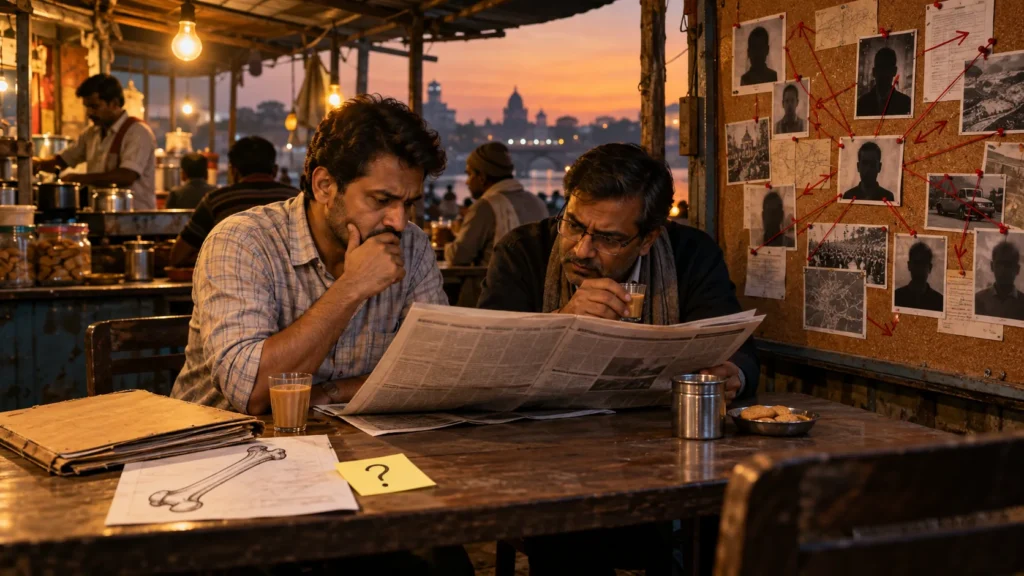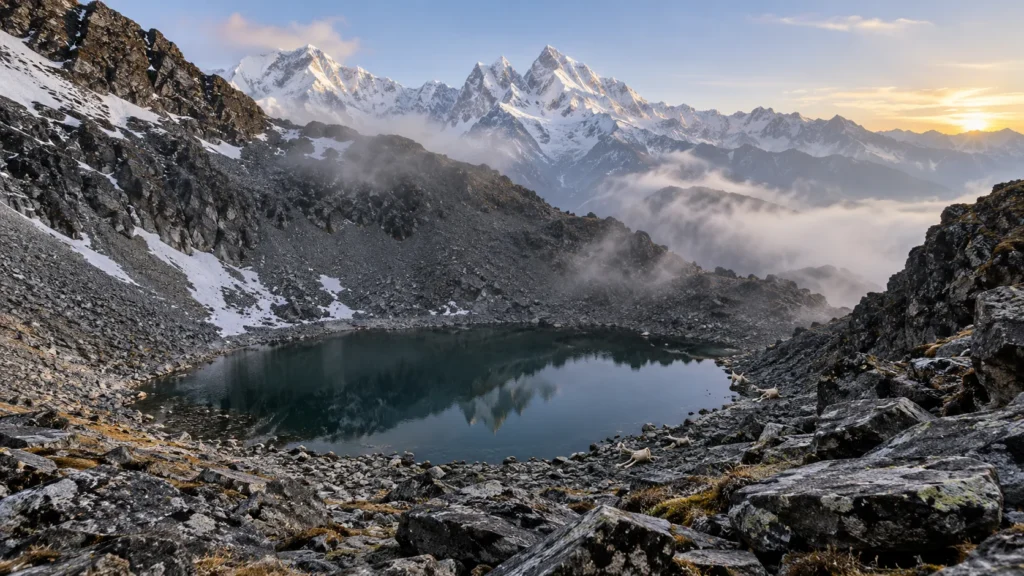
High in Uttarakhand, a small Himalayan lake keeps a grim inventory. When summer melt arrives, hundreds of human bones appear on the shore. For decades the popular story stayed simple: the goddess Nanda Devi struck a disrespectful royal party with iron-hard hail. One night. One curse. One grave.
The bones do not support that single-night script. Genome-wide ancient DNA published in Nature Communications in 2019 shows at least three ancestry groups among the tested remains, and two main deposition windows about a thousand years apart. Folklore explains how the mountain is remembered. Laboratory dates explain that the lake is not one mass grave from one storm.
Where Roopkund sits, and how the bones entered the record
Roopkund is a glacial pond in Chamoli district, tucked between Trishul and Nanda Ghunti. The 2019 paper places it at 5,029 metres. The water body is only about 40 metres across and frozen most of the year. Skeletons show when ice recedes — in the lake and on the surrounding slope.
A British forest ranger’s 1942 patrol is the usual modern starting point for public notice. After that came a parade of guesses: Japanese soldiers from the Second World War, an epidemic, an army column, merchants, pilgrims. The site is not a sealed tomb. Pilgrims and trekkers have moved remains and lifted artefacts. Rockfall and meltwater scatter bone. That disturbance is why a tidy “who died with whom” reconstruction is hard.
How many people? The scientific paper says several hundred. Tourism copy and some news features float 600–800. Those are estimates, not a census. Only a sample has been sequenced. Untested bones could still change the mix.
The curse story, and why it felt plausible
Garhwal oral tradition ties the lake to Nanda Devi. In a widely told version, a king and queen from Kannauj — or their entourage — climb toward the goddess. Music, dancing or arrogance offends her. Hail falls like iron. The party dies on the spot.
The tale sits next to the living Nanda Devi Raj Jat pilgrimage route. Older field notes mention parasols and bangles of the kind associated with that yatra. Early osteology described rounded, unhealed cranial injuries. Local weather can produce violent hail. Put those pieces together and a single catastrophic storm looks neat.
Belief and evidence are different tools. The story tells you what the landscape means to people who walk it. It does not date a femur, read a genome, or prove that every skull on the shore belongs to one insulted court.
What the 2019 genomes actually showed
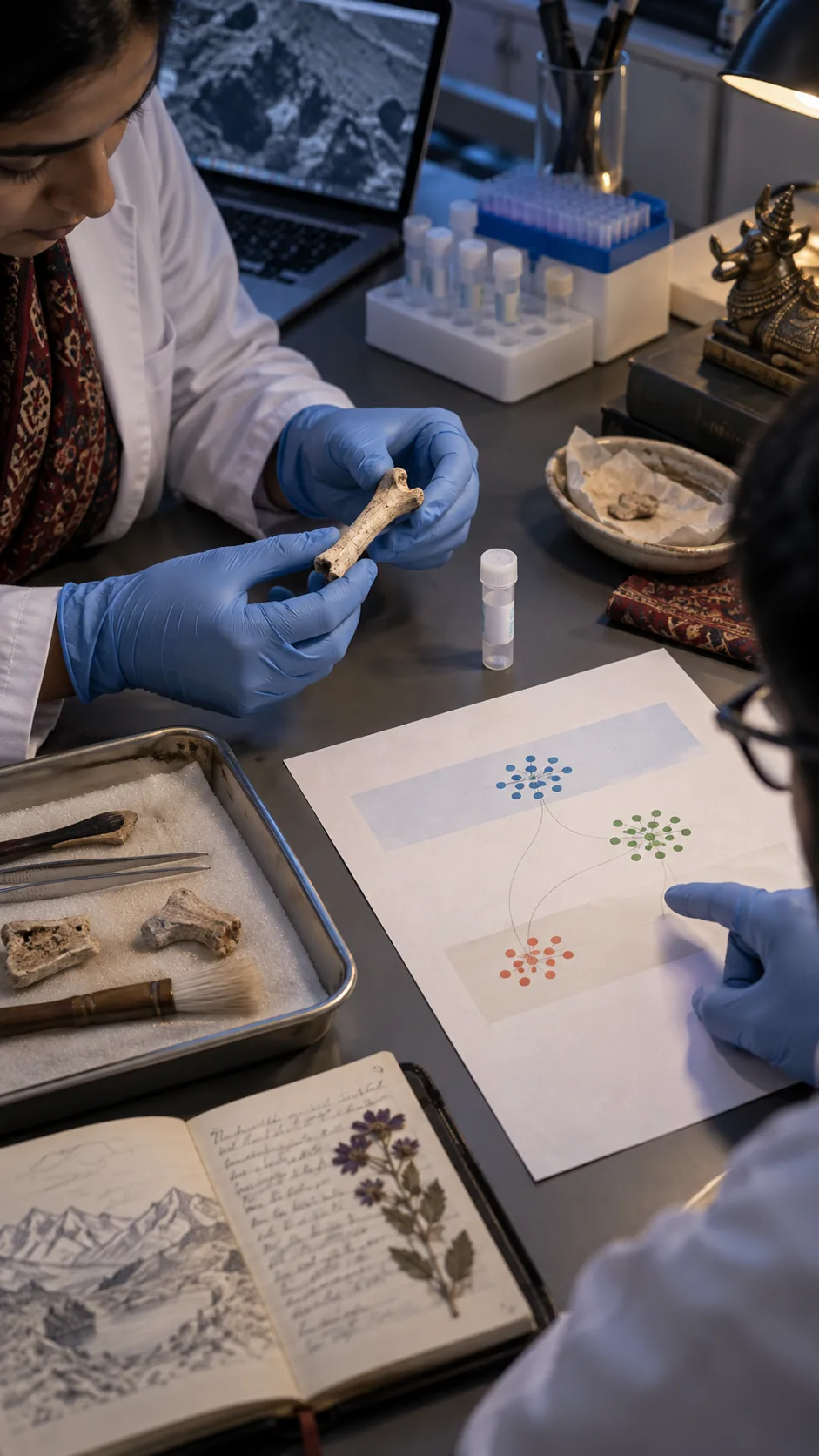
Older radiocarbon work had clustered some samples near 850 CE, which fed the “ninth-century hailstorm” model. The 2019 team — including Éadaoin Harney, Niraj Rai, Kumarasamy Thangaraj and David Reich — generated genome-wide data from 38 individuals. The paper presented this as the first ancient human DNA reported from India. Mitochondrial DNA from 72 skeletons had already hinted at more than one source population. Nuclear genomes made the split unavoidable.
• 23 people (Roopkund A) fall within the range of present-day South Asian ancestry, and not as a single clan.
• 14 people (Roopkund B) carry eastern Mediterranean ancestry, closest among living groups to people from mainland Greece and Crete.
• One person (Roopkund C) has Southeast Asian–related ancestry.
The sampled individuals were unrelated to one another. Men and women are both present. That combination weakens “all-male army” shortcuts. South Asian ancestry in Group A is itself mixed across sources, not one village marching in lockstep.
FACT: Harney et al., Nature Communications (2019): 38 genomes, three clusters. South Asian individuals date to about 800 CE (7th–10th centuries, with signs of more than one event). Mediterranean and Southeast Asian individuals date to about 1800 CE (calibrated range 17th–20th centuries).
Two clocks, two kitchens
Radiocarbon dating broke the single-event idea. Group A sits in the 7th–10th centuries CE. Some 95 percent confidence intervals do not overlap, so even the South Asian deaths may have happened more than once. Groups B and C sit roughly a millennium later. Calibration for 1650–1950 is awkward, so the paper will not pretend it has a birthday. The window is the 17th–20th centuries, often summarised as ~1800 CE.
Stable isotopes split the diets. Group A shows a C3 plus C4 signal consistent with millet and other South Asian staples. Group B shows little millet and a mostly terrestrial C3 profile — not a long-settled Indian kitchen, and not a strongly marine diet either. The authors suggest an inland eastern Mediterranean life before the Himalayan journey. They do not claim to know why the journey happened.
Hail remains a hypothesis, not a verdict
A few crania have unhealed compression fractures. The paper notes three such cases and says a violent hailstorm of the kind known near Roopkund could explain them, while other scenarios remain plausible. That sentence is the honest scientific position. It is narrower than the folk epic and narrower than many documentaries.
Even if hail killed some people, it cannot, on present dating, kill both major genetic groups in one afternoon. An epidemic model also lacks support in the sampled bones, which look broadly healthy aside from those acute injuries. “Everyone died the same way at the same hour” was a story the lake invited. The subsample refuses it.
The live puzzle is the Mediterranean party
South Asian deaths on a Nanda Devi approach route in the early medieval centuries are grim but geographically ordinary. High passes kill pilgrims in any century. Group B is the result nobody budgeted for: unrelated men and women with eastern Mediterranean ancestry, a non-millet diet, and a death horizon around the eighteenth or nineteenth century, lying beside much older South Asian bones.
There is no tidy archival passenger list. Descendants of Alexander’s army are a poor fit: the isotopes look like a recent Mediterranean kitchen, not many generations of Indian millet. Co-author Niraj Rai said the team could map ancestry and still not say why those travellers were at the lake. Reich cautioned against turning “closest match Crete/Greece” into a passport stamp.
Science here did not replace a curse with a complete screenplay. It replaced one catastrophe with at least two periods, three ancestries, and an open question about mobility in the Himalaya.
FAQ
Did a goddess-curse hailstorm kill everyone at once?
Not in the tested sample. Two main groups are separated by about a thousand years. The curse belongs to oral tradition. The dates belong to radiocarbon.
Is hail the proven cause of death?
No. Unhealed cranial compression fractures exist and hail is a local hazard. The 2019 paper treats hail as one plausible mechanism, not the closed case.
Why were eastern Mediterranean people there?
Unknown. Genetics and diet point to an eastern Mediterranean origin and a late arrival. Motive — pilgrimage, trade, escort, accident — is not documented in the paper.
How many skeletons are there?
Several hundred, in the language of the research article. Larger viral numbers are estimates. Thirty-eight individuals provided the headline genomes.
Could they be soldiers or wartime dead?
Mixed sex, mixed centuries and mixed continents do not fit a single military dump. The old Japanese-soldier rumour from the 1940s does not survive the 2019 chronology.
Disclaimer: This article does not mock Himalayan faith and is not a trek guide. Altitude and weather at Roopkund are dangerous. The bones are human remains; moving them for photographs is neither research nor respect. Figures above follow the 2019 published study and public reporting. New samples could revise the picture.