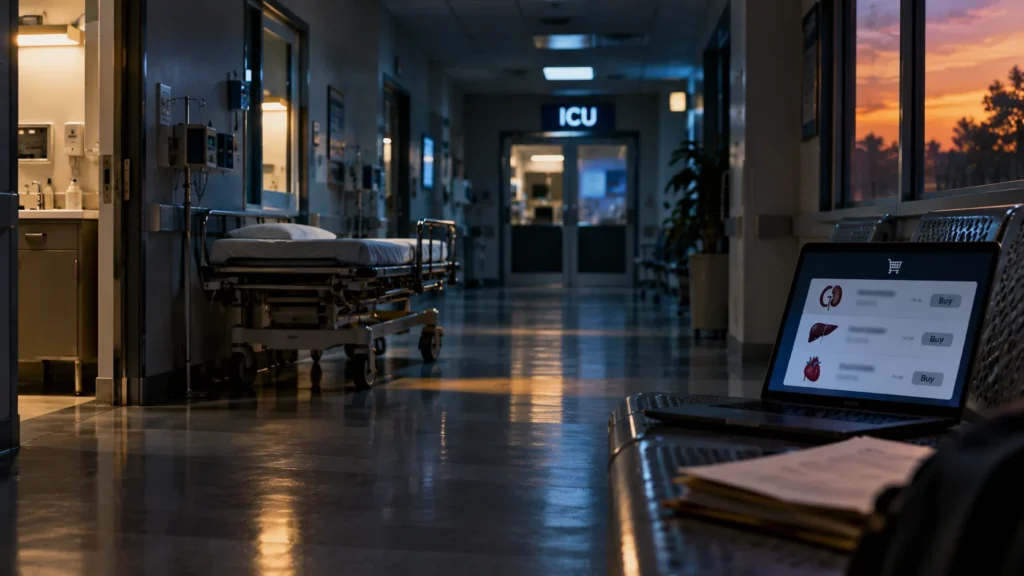
Movies treat the dark web like a catalogue: kidney, heart, liver, add to cart, pay crypto, delivery in two days. The narrower question is simpler. Does a shop page mean an organ will arrive? In the cases researchers and reporters have been able to inspect in public, usually no. The page behaves like an advance-fee trap. Documented illegal transplants, when they reach court, look like broker-plus-clinic networks — not parcel post.
This is not a visit guide, a price list, or a how-to. It is claims versus what sits in open investigations, transplant law, and medical time limits.
The short answer: a listing is not inventory
Pages titled as human-organ shops have circulated for years, sometimes with cart icons and sale tags. On 1 July 2026, India Today’s OSINT team described at least three such pages advertising kidneys, hearts, lungs and livers. One listed a kidney near $85,000, a heart $69,000, a liver $35,000, and a “package” near $50,000 that supposedly bundled donor pay, surgery, hospital stay and airport pickup. A Bitcoin deposit of about $2,000 was demanded to “reserve” a donor. The pitch included two-day delivery, a 24-hour “fresh harvest,” and a matching 24-year-old O-negative donor in Delhi. Chat then moved to Telegram.
That sequence is the scam signature: oversized promise, small irreversible deposit, hospital details after payment, private chat. India Today left the hardest question open — organised trafficking, pure fraud, or both — but noted that several promises collide with Indian transplant protocol. A menu is not a stockroom. The same lesson applies to hitman ads: the form can exist while the service does not.
Illegal organ trade still exists. Where it is evidenced, it usually runs through vulnerable donors, brokers and a medical setting. Holding both facts at once is the point. The cinematic shop is mostly extraction of crypto. The harm that courts have named is interpersonal and clinical, not an add-to-cart flow.
Ice-bath folklore is not the crime that gets prosecuted
Pop culture repeats a bathtub of ice, a stitched scar, a missing kidney. UNODC says that picture muddies the real offence. In reported criminal cases, illegal transplants happened in hospitals or clinics with medical staff involved. Street-snatch-and-courier does not supply blood matching, immunosuppression or post-operative care.
UNODC’s public count is cautious: about 700 identified victims of trafficking in persons for organ removal from 2008 to 2022, with the true scale unknown because victims rarely come forward. Older WHO-linked estimates travel through the press — a 2007-era line that 5–10% of transplants might involve the black market; 2012 coverage of experts speaking of roughly 10,000 illicit kidney operations a year. Those are global estimates, not audits of dark-web storefronts.
Separate the layers. The ice bath is an urban legend. Brokered exploitation — debt, fake kinship papers, a compliant theatre — is a different crime, recorded in several jurisdictions. The shop page sells a third product: hope against a deposit.
Why the shop pages fail a basic medical test
Scam copy sounds like retail, not a theatre list: “cheap and legal,” “waiting lists justify us,” “worldwide shipping,” “money-back.” In 2023 the monitoring firm DarkOwl described stand-alone sites and marketplace posts in this genre. One claimed organs remain viable for a year — medically impossible. Even a kidney on ice, properly perfused, has a window measured in hours to a little over a day, not twelve months. A heart is tighter. A one-year shelf life is a tell that the author needed a screenshot, not a cooler.
DarkOwl also found the same organ photographs reused across sites — a stock-image pattern. A crypto address tied to one site had received about 0.62 bitcoin (on the order of $34,000 at the then conversion) and sat at a zero balance. Most transfers were in the $100–200 range, far below listed prices. The page advertised five-figure organs; the wallet looked like drip deposits. That is advance-fee arithmetic.
India Today’s pages followed the same skeleton: cart, then Telegram. A seller dropped the name of a well-known Mumbai urologist, withheld the hospital and any independent check, and blamed police surveillance for revealing details only after payment. A searchable name is not a booked theatre. What is requested first is always crypto.
FACT
DarkOwl, 2023 public write-up: “viable for one year” is scientifically impossible; repeated stock photos; wallet activity clustered far below list prices. India Today OSINT, 1 July 2026: at least three shop-style pages, ~$2,000 Bitcoin deposit, 24-hour / two-day claims — rejected as incompatible with protocol by a surgeon speaking for the Indian Society of Organ Transplantation.
What Indian law and surgeons actually block
Commercial dealing in human organs is a crime in India. Under the Transplantation of Human Organs and Tissues Act, 1994, as amended in 2011, Section 19 covers paying or being paid for an organ, seeking a paid supplier, offering to supply, negotiating such a deal, and publishing advertisements for it. The amended penalty band is commonly cited as five to ten years in prison and a fine from ₹20 lakh to ₹1 crore. A banner that says “legal package” does not rewrite the statute.
Dr Vikas Jain, vice-president (surgeon) of the Indian Society of Organ Transplantation, told India Today the 24-hour matching-donor story is not possible under the Act. Necessary tests alone can take six to eight hours. Donors and recipients are generally expected to be close relatives; authorisation committees inspect documents, family trees and sometimes DNA. A same-day kidney-plus-discharge product hits that wall. NOTTO exists for lawful allocation, not a crypto cart. Real-world broker fraud in India more often fakes kinship inside hospital paperwork — also a crime, and a different pathway from a hidden shopfront.
Documented trafficking does not look like checkout
When courts get a case, the pattern is usually a poor donor, a broker, and a medical facility. In 2023 the United Kingdom recorded a landmark prosecution: Nigerian politician Ike Ekweremadu, his wife and a broker were convicted of conspiring to bring a man from Lagos to the UK for a kidney. The judge called it treating people and body parts as commodities. That file is cross-border conspiracy, not a dark-web checkout.
Press accounts of surgeon-linked rings in other countries — including 2023 reporting on a Pakistan arrest tied to a “Dr Fawad” and allegations of hundreds of operations — are charges until a court finishes the story. Even in that language the setting is a clinic and a broker, not home delivery. Investigative features repeat the same split of money: the donor receives a sliver; intermediaries and the medical side take the rest.
UNODC notes that recruitment has moved onto social apps and messages. Newsweek and others have described Telegram groups posting organ-style menus. An ad can live on an ordinary phone. An ad is still not a completed transplant. The leap from chat to theatre is what the scammer sells.
The same skeleton as hitman ads
Murder-for-hire storefronts — Besa Mafia is the public example researchers cite — ran on order forms, Bitcoin, then extra fees, with no killing delivered. Organ shops fit the mould. The “goods” are hard to verify and costly to report. The target is already desperate, often a family on a waiting list.
A scammer therefore does not need a surgical team. A page, recycled photos, soothing copy and a wallet that can accept small transfers will do. DarkOwl’s low-value transaction cluster matches that business. Anyone who actually seeks or offers a paid organ in India is already inside THOA’s net — advertisement and negotiation count, not only a finished operation.
Logistics finish the argument. An organ needs matching, cold time and a sterile team. Consumer parcel networks do not supply that. Serious trafficking reports therefore describe the patient or the donor moving to a clinic. A heart at a home address is cinema.
Two truths, one trap
First: illegal organ trade is a real crime fed by shortage and poverty; where proven, it showed brokers and medical complicity. Second: pages that treat a kidney like a phone case match public scam markers — impossible shelf life, reused photos, small crypto hits, a chat pivot, pay first.
Do not fuse them. Paying a deposit because a page “proves a racket” is how the fraud closes. Calling every trafficking file “just dark-web fiction” is how the other harm hides. The documented middle is narrower: treat cinematic shops as suspect; treat paid-organ offers outside registered hospitals as crime; do not promote a screenshot into evidence.
FAQ
### Can you actually buy a kidney on the dark web?
Pages and prices appear. Public probes mostly match scam markers, not completed transplants. Documented illegal surgery sits in broker-clinic cases. A listing is not stock.
### Is the ice-bath kidney story real?
UNODC treats it as a myth that hides how the crime works. Recorded cases involve medical settings, not hotel-room couriers.
### Is buying or selling an organ illegal in India even as an “ad”?
Yes. THOA criminalises commercial dealing, offers, seeking a paid donor and advertising. The amended penalty range includes years in prison and a large fine.
### If a seller names a real doctor, is the offer genuine?
India Today found a recognisable name without a hospital or verification. Surgeons said the 24-hour package contradicts protocol. A name can be bait.
### Does moving the chat to Telegram make it legitimate?
No. Many frauds leave the shopfront and collect a deposit in private messages. Chat is not surgery.
Disclaimer:
This article is not a guide to visit the dark web, find markets, or buy or sell organs or any illegal service. Pages that demand crypto or fees are often scams. Seeking illegal goods is a crime. Lawful transplants happen only through registered hospitals and prescribed procedures. Films and screenshots are not evidence.