
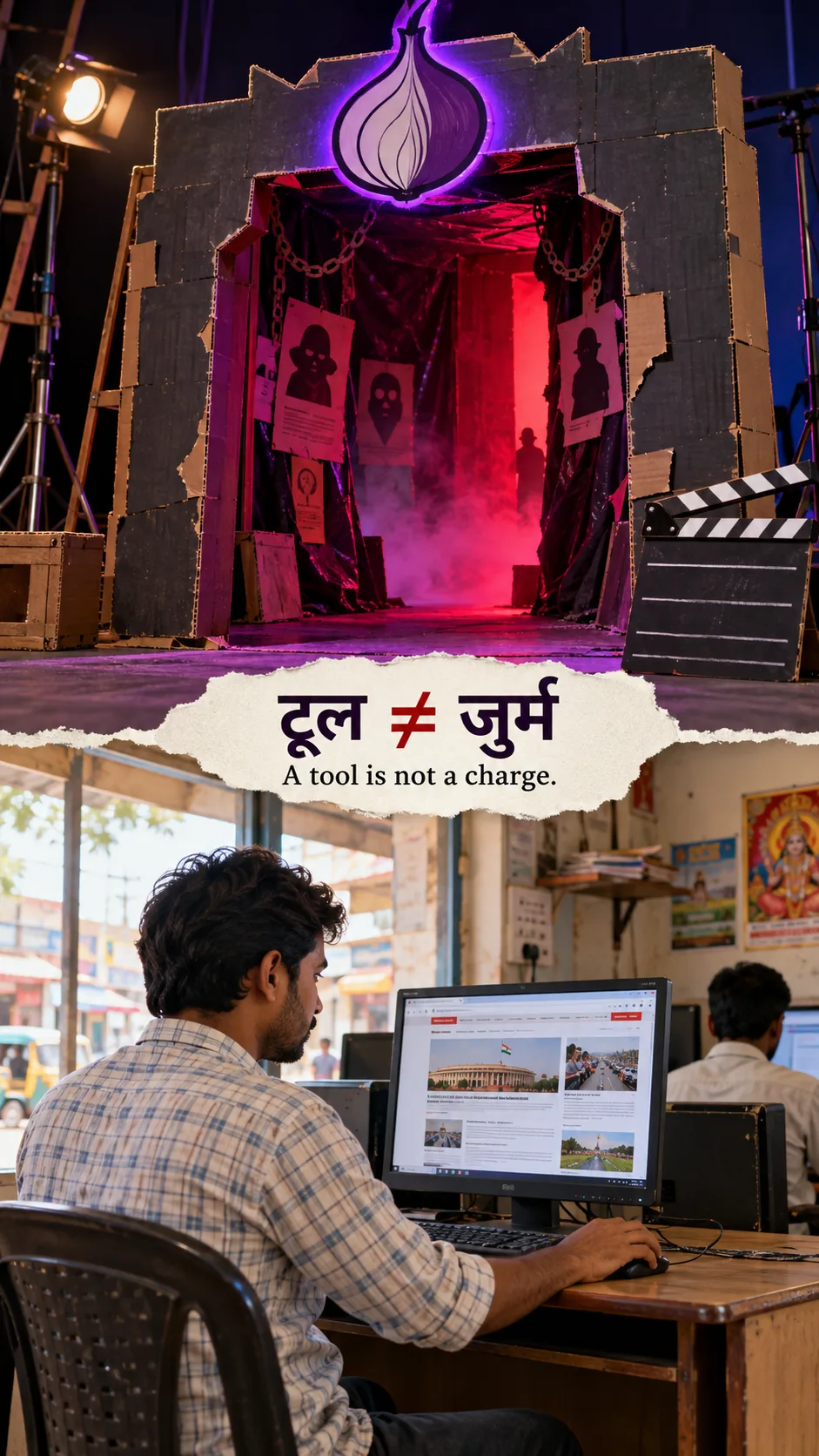
In movies and short videos, Tor is a doorway: hoodie, neon map, “you are now on the dark web.” The real question is smaller. Is Tor Browser a crime machine, or a privacy tool that can also be abused? This is not an install guide. It is an explainer of where Tor came from, what the three hops actually do, and where the film script parts company with public record.
Tor stands for The Onion Router. It is not a secret government crime app, and it is not another name for the dark web. Tor is an overlay network — a routing system that runs on top of the ordinary internet — bouncing traffic through volunteer relays so that no single midpoint can easily see both who you are and which site you want.
Tor Browser is a modified Firefox build that uses that network. Chrome and Edge hand your home IP to the site. A Tor circuit breaks the path. The site typically sees an exit address, not your household address.
The first mix-up is lumping Tor, the dark web, and a VPN into one bag. A VPN is a tunnel through one company’s servers. “Dark web” is a loose label for services that do not sit on normal search indexes. Tor is neither. It is a road. The same road can reach ordinary HTTPS sites and, separately, some hidden services. A road is not a crime.
The second mix-up is thinking the cloak is complete. A real name, the same email, a photo of your wall — those glue identity back on. A tool can hide a path. It cannot hide a person who keeps introducing themselves.
The onion metaphor is about layered encryption. In the classic design a circuit usually uses three relays. Each relay knows only the previous hop and the next hop — not the full map.
The guard sees your IP because it takes traffic from you; it does not see the final site. The middle relay is a buffer: neither home nor destination. The exit node steps onto the clear internet. It can see the destination. If the site is plain HTTP, it may also see content. That is why HTTPS matters at the last hop: the envelope should still be sealed when it leaves the network.
The design refuses to put full trust in one firm. A VPN provider can, in principle, see both your IP and your destination, depending on logs and policy. Tor splits that knowledge. The cost is honest: the path is longer, pages are slower, video often fails, and many sites treat exit IPs as hostile and throw CAPTCHAs or blocks.
Reels also skip this: Tor Browser does not, by default, wrap every app on the device. Traffic that never enters Tor still takes the ordinary road. “I opened Tor, therefore everything is secret” is a movie line, not a protocol guarantee.
FACT
Onion routing was researched in the mid-1990s at the U.S. Naval Research Laboratory by David Goldschlag, Michael G. Reed and Paul Syverson. The Tor network people use today was deployed in October 2002 under a free-software licence. In 2004, Roger Dingledine, Nick Mathewson and Paul Syverson published the design paper at USENIX Security. The Tor Project, Inc. became a 501(c)(3) nonprofit in 2006. That is a public timeline, not an underground legend.
Cinema treats Tor as a hatch. One click and you are on a “lower level” — red rooms, hitman shops, the Marianas Web meme. Technically, launching Tor does not drop you into an illegal market. Ordinary sites can be reached on the same network. Hidden services (the .onion style of address) are a different class; they do not rain onto a search homepage.
The “Level 1, 2, 3… Marianas” poster grew out of early-2010s internet memes and later add-ons. Official Tor design documents do not list those government basements. The old Hidden Wiki was never an official directory — mirrors, hacks, bait. Treating an iceberg image as a manual is like treating a Hollywood server-room glow as a real data centre.
Red-room and “rent-a-hitman” stories sit in the same family. Public reporting and police work have repeatedly found fee pages, crypto demands, then silence — scams, sometimes stings. Films such as Unfriended: Dark Web are entertainment. Tor is not the villain of that script; the script put a monster mask on a routing tool.
The tea-stall version in India often collapses to “Tor = crime.” The same logic would condemn knives, motorcycles, and encrypted chat. Using a tool is not automatically a case. Ordering illegal goods, running a fraud, planning violence — those are crimes with or without Tor.
The Tor Project’s own public pages describe users beyond the hoodie stereotype: journalists, activists, readers behind national blocks, and people who simply want less tracking. That list is not an instruction to copy them. It is a check on a one-note picture.
Newsrooms talk publicly about SecureDrop — a way for sources to send files without a transparent email trail. The Freedom of the Press Foundation and many outlets describe the system on the record: The New York Times, The Washington Post, The Guardian, ProPublica and others. ProPublica is widely cited as the first major newsroom to ship an official .onion edition, in 2016. The BBC and other broadcasters published alternate routes for audiences in censored markets. Facebook announced an official Tor service in October 2014 so the product could remain reachable where the usual domain was blocked. Those are press and corporate facts, not market links.
The censorship angle is equally plain. Some states block news and social platforms. Tor’s many-relay design tries to make a single-IP ban less tidy. That is not a blessing to break every local rule, and this article does not teach a bypass. It only notes the origin story: an NRL research question about hiding who talks to whom, later sustained by open source and civil-liberties funding. The Electronic Frontier Foundation’s support around 2004 is on the public record, not a conspiracy subtitle.
Law enforcement sits in the same messy picture. The same properties that shield a source can shield a suspect. The policy fight is real. The reel that says “only criminals need this” is not a technical paper.
A VPN is a rented tunnel: faster, often device-wide, trust parked at one company. Tor is a slow alley of volunteer bridges: split knowledge, browser-centred, an exit weakness on plain HTTP. The dark web is not a browser. It is a label for services off the normal index. Tor has been a common road toward some of those services. Opening Tor is not the same as touring them.
The deep web is another box again. Around 2001, Michael Bergman used “deep web” for pages search engines did not list — mailboxes, bank logins, paywalls. That estimate later collapsed into the meme that “90 percent of the internet is dark.” Films thickened the mix. Tor inherited the confusion: people hear “hidden path” and picture a bazaar.
Speed punctures the movie too. A reel opens a red room in two seconds. Real circuits crawl, CAPTCHAs pile up, streams die. Volunteer bandwidth is not a boutique shop. Pages that sell a “live show” for a crypto fee are usually landing-page scams, not a product line from the Tor Project.
The legal contrast is not magic either. A court can subpoena a VPN firm. Tor relays are volunteers in many countries; no single office holds the full diary. That does not place Tor above the law. The original Silk Road case is the public reminder: marketplace from 2011 until October 2013, Ross Ulbricht arrested on 1 October 2013, convicted in February 2015 on seven counts, sentenced on 29 May 2015 to life plus a forfeiture order in the hundreds of millions of dollars. The network did not vanish the defendant.
The exit node is the easy weakness to explain. A hostile exit, plus a site without HTTPS, can read or even alter traffic. Security writing repeats one architectural limit: pulling files from an unencrypted HTTP site is a risk. Newer Tor Browser versions lean on HTTPS-Only policies so plain HTTP survives less often. Still not a spell.
The human layer is larger. The same social account, the same face in a photo, a unique window size — circuits cannot wash those. Tor Browser tries to make users look alike. A person who customises until they look unique steps out of the crowd. That is a limit, not a tutorial.
Timing correlation is the research-level limit. A powerful observer watching both the home link and the destination can, in theory, match flows by time. The Tor Project does not claim a perfect shield against a global passive adversary. “Fully gone” is poster copy.
On the legal side, states have prosecuted people who used Tor when a separate crime was proved — markets, fraud, violent plots. Naming the tool is not proof, any more than naming a knife. The reverse is also true: wearing Tor does not soften drug law or fraud law. In India, illegal goods, scams, and child-sexual-abuse material remain crimes on any channel. This is not legal advice. It is a refusal to give cinema the last word.
Every strong privacy tool draws the same charge — if a good person can hide, a bad person can too. Encrypted calls, door locks, cash, even a paper envelope take the same hit. Policy debate is fair. Myth begins when the tool becomes a synonym for the offence.
Tor’s origin is not an underworld pitch deck. It is a research question: can we build a path where a midpoint cannot easily say who is talking to whom? Open source and civil-liberties groups later kept that question in public software. Criminals picked the same software up. Both sentences can be true. Erasing one does not explain the other.
Silk Road is the example that cuts both ways. Yes, the original site ran as a Tor hidden service. No, Tor did not write the owner out of court. A later “2.0” site is a separate chapter. Political arguments about the sentence belong in another article. The technical moral is short: a network is a curtain, not armour.
Pages that now sell hitmen or red-room tickets usually want a fee and a disappearance. Police warnings and fraud cases keep finding that pattern. Fear is light. Evidence is heavy. The rest of this cluster on Vista Hub makes the same bargain: call a film a film, a docket a docket, and a tool a tool.
Is Tor Browser the dark web? No. Tor is an overlay network and a browser. The dark web is a loose label for hidden services. Ordinary sites can be reached over Tor. Mixing the two is the most common error.
Do only criminals use Tor? Public record also lists journalists, activists, readers under censorship, and ordinary privacy users. Criminals can pick up tools too. Use does not rewrite the invention story.
How is Tor different from a VPN? A VPN is typically one company’s tunnel — faster, often whole-device. Tor uses volunteer relays, is slower, splits knowledge, and mainly covers browser traffic. Different job, different risk.
Does Tor make someone fully anonymous? No. Exit nodes, plain HTTP, logins, photos, mistakes, and timing correlation are documented limits. “Vanished” is a reel caption.
Is using Tor itself a crime? Holding a tool and committing an offence are not the same act. Illegal goods, fraud, and violence break the law on any channel. This article is not legal advice.
Disclaimer: This is not a guide to visit Tor or the dark web. It does not include install steps, bridges, markets, or .onion addresses. Pages that demand crypto or fees for hidden shops, red rooms, or hitmen are often scams. Seeking illegal goods is a crime. Do not treat films or memes as evidence.