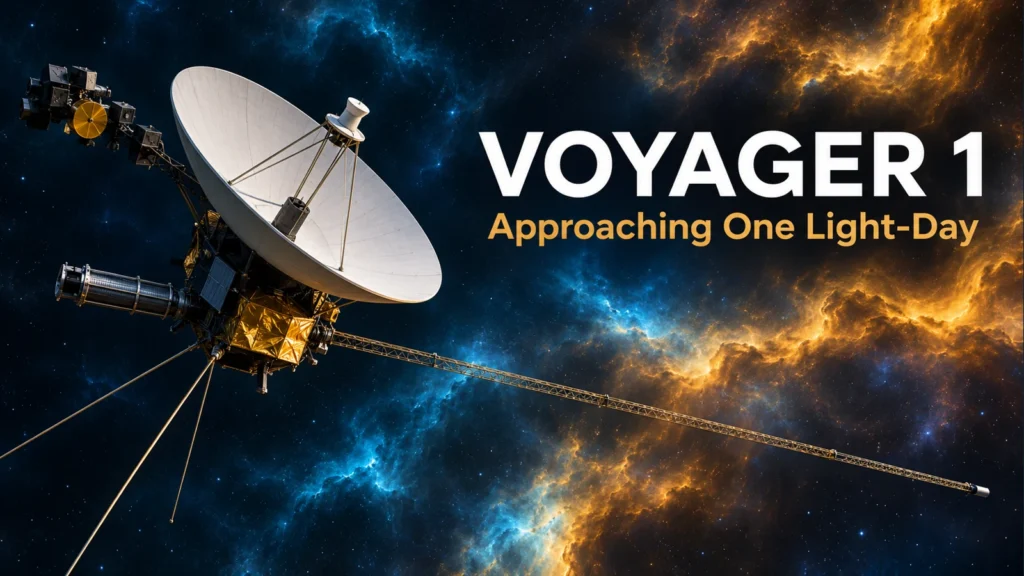
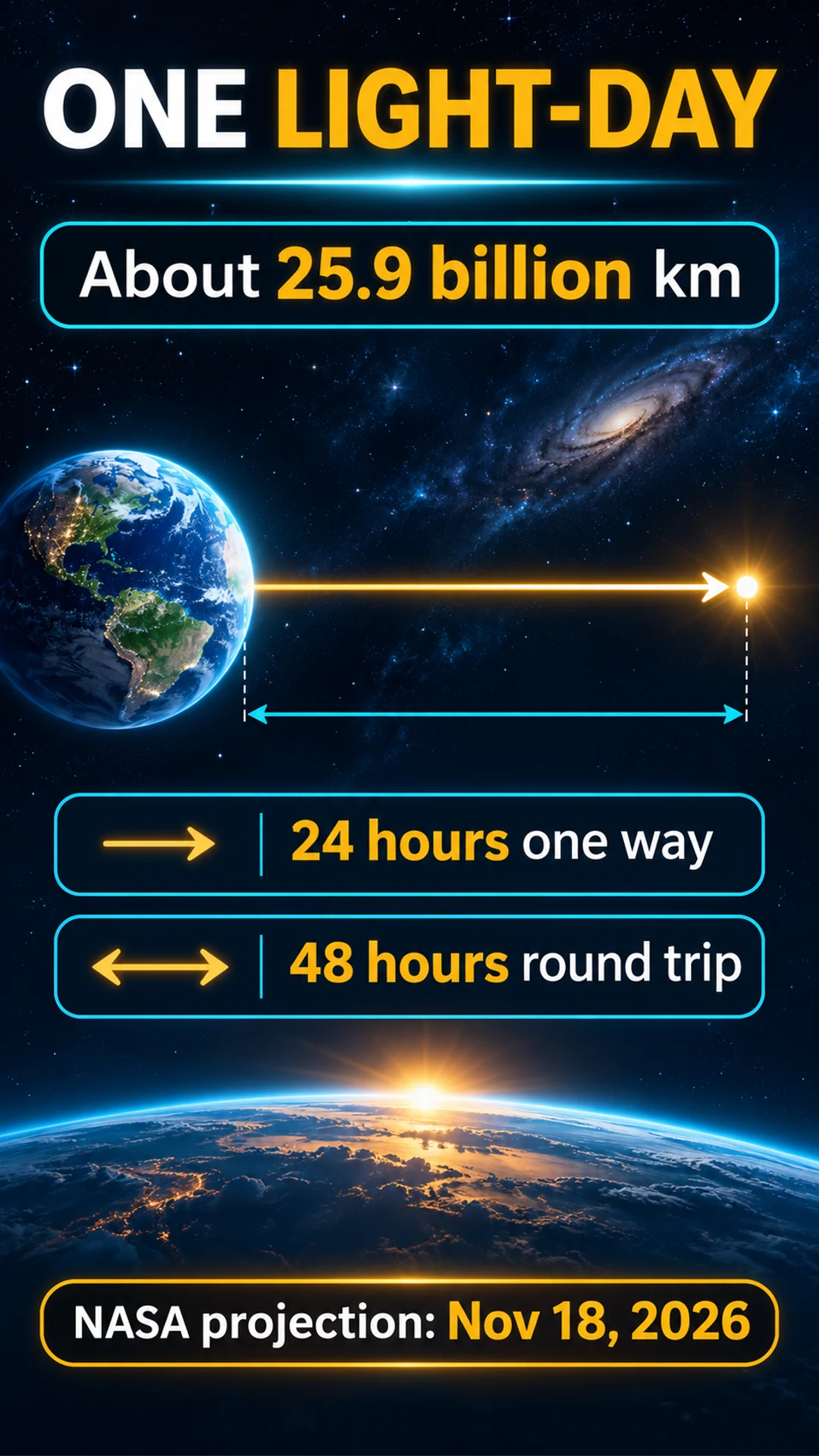
Voyager 1 is in interstellar space, beyond the boundary of the bubble formed by the solar wind. NASA’s tracker viewed on November 4, 2026 put it roughly 25.87 billion kilometres from Earth. JPL puts its speed at about 61,000 km/h. NASA projects that the probe will reach a distance of one light-day from Earth on November 18, 2026.
Voyager 1 and Voyager 2 launch dates
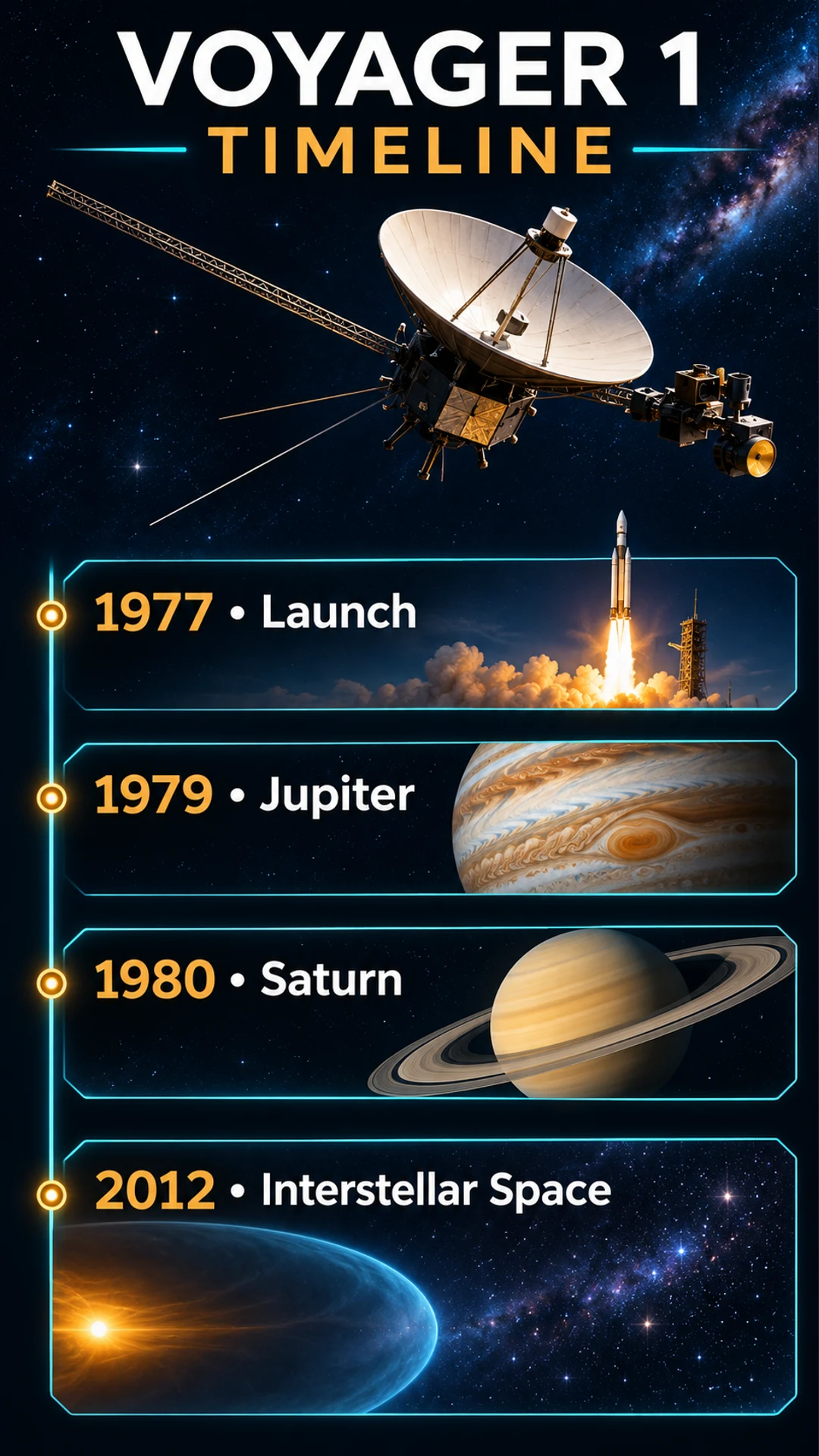
Voyager 1 launched on September 5, 1977. Voyager 2 left first, on August 20, 1977. Voyager 1 took the faster route to the outer planets and overtook its twin. It flew past Jupiter in 1979 and Saturn in 1980. Voyager 2 went on to visit Uranus and Neptune as well, making its route different from Voyager 1’s.
Voyager 1 and 2 distance from Earth
The NASA table showed roughly 173 astronomical units for Voyager 1 and 145 AU for Voyager 2. Those values correspond to approximately 25.87 billion km and 21.64 billion km. An astronomical unit is roughly the average Earth–Sun distance. Check the Earth-distance row for communications and the Sun-distance row for a heliocentric reference. Earth’s orbit changes the first figure throughout the year.
What is one light-day?
A light-day is the distance light travels in 24 hours, about 25.90 billion km. NASA’s projected crossing time is November 18 at 5:16 a.m. EST, approximately 3:46 p.m. in India. A radio command would take about a day to arrive at that distance, and its reply about another day to travel back. That two-day figure is the propagation time, before any additional time needed to process or schedule a reply.
How fast is Voyager 1 travelling?
JPL reports about 38,000 mph, or roughly 61,000 km/h. That is around 17 km per second. NASA’s tracker lists velocity relative to the Sun. The rate at which Earth-distance changes is a different measurement because Earth also moves. A probe can maintain a high speed while the distance from a moving observer changes at a varying rate.
Voyager 1 power source and instrument trade-offs
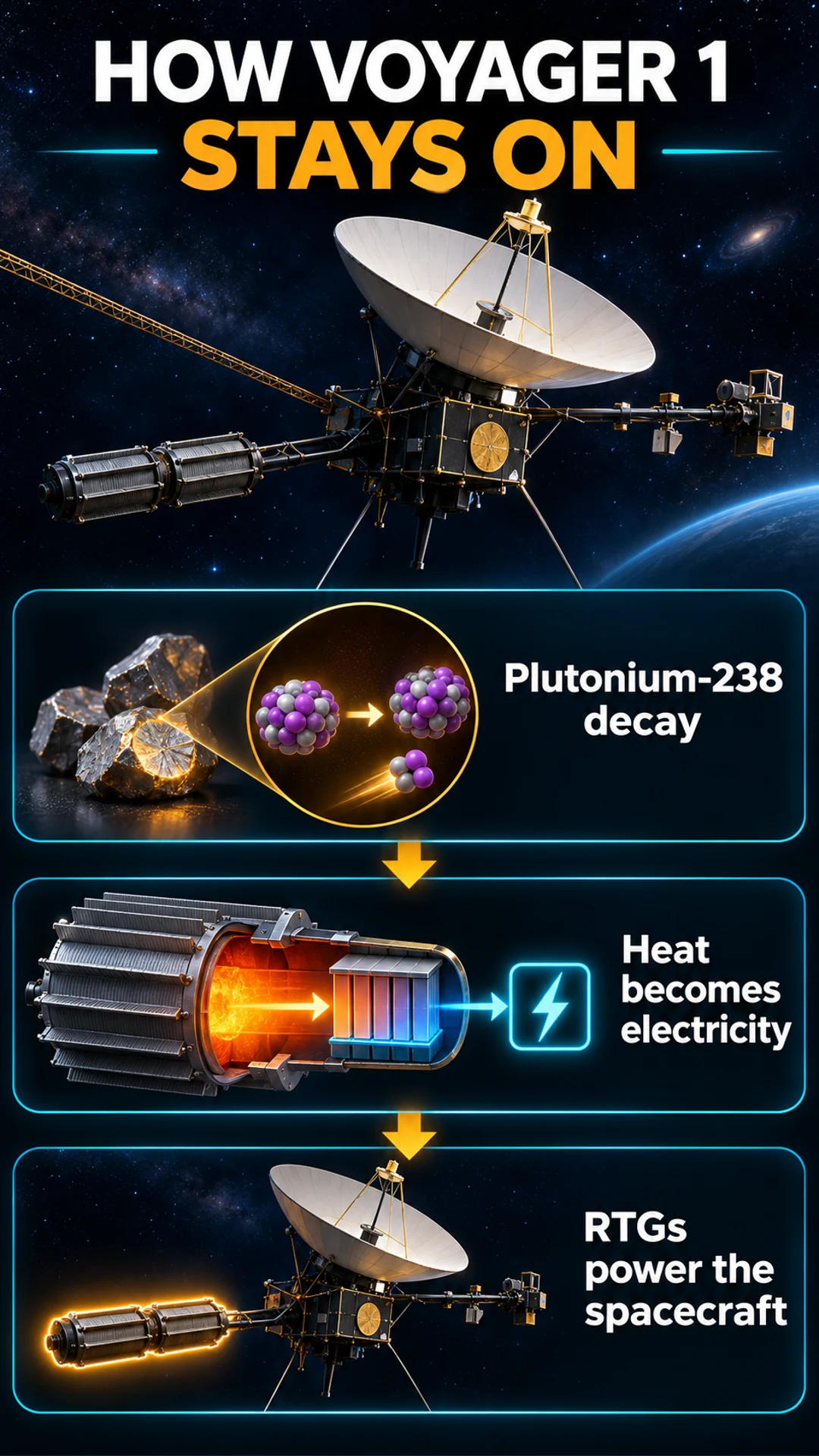
Radioisotope thermoelectric generators use the heat from plutonium-238 decay to produce electricity for spacecraft systems. Both probes lose about four watts of available electrical output each year. In October 2026, JPL reported that the team had switched Voyager 1 to three lower-power alternatives in September. Saving electricity helps the team keep selected science instruments working longer while maintaining operating temperatures.
Is NASA still communicating with Voyager 1?
JPL reported a roughly 48-hour communications interruption in October and a return of the signal on October 20. NASA uses the Deep Space Network to receive faint radio signals and send commands. The one-light-day milestone is a measure of separation from Earth. Voyager 1 crossed the heliopause in August 2012, so the upcoming milestone is distinct from its entry into interstellar space.
Frequently asked questions
When was Voyager 1 launched? September 5, 1977.
Which Voyager is farther away? Voyager 1 is farther from Earth.
How long does a signal take? Near the milestone, about 24 hours each way. NASA’s table shows the changing delay.
Does Voyager 1 use solar panels for power? Its onboard electricity comes from RTGs.
Where can I check the current position? Use NASA’s mission tracker and compare the Earth-distance, Sun-distance and light-time rows.
Official sources — NASA Live Tracker · NASA Light-Day · JPL Update · Voyager 1 · Voyager 2