 Vista

Quick answer: A paper in Evolutionary Anthropology (DOI 10.1002/evan.70051), by researchers at Tel Aviv University and Oxford, proposes that early humans in the Levant may have collected and kept unusual objects as keepsakes around 500,000 years ago. The authors say these objects could have worked like “external memory” aids. They explicitly call this a hypothesis. It is not proof that any particular stone was a souvenir.
Who Made the Claim?
The authors include Yoav Ram (zoology), Ran Barkai and Ella Assaf (archaeology), Liad Mudrik (psychology) at Tel Aviv University, and Bar Efrati at Oxford. The mix of disciplines is the point of the paper: archaeology supplies the objects, while psychology and neuroscience supply ideas about memory and the sense of self.
What Objects Are We Talking About?
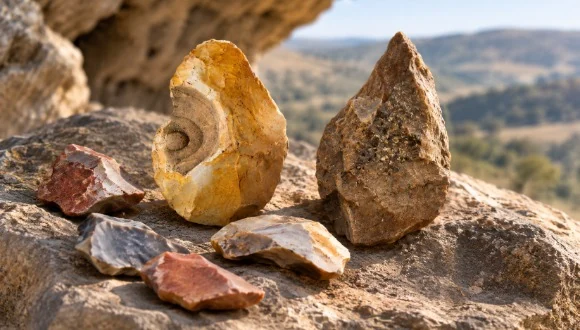
All the sites mentioned in the release are in Israel. The objects fall into three groups:
| Site | Objects described |
|---|---|
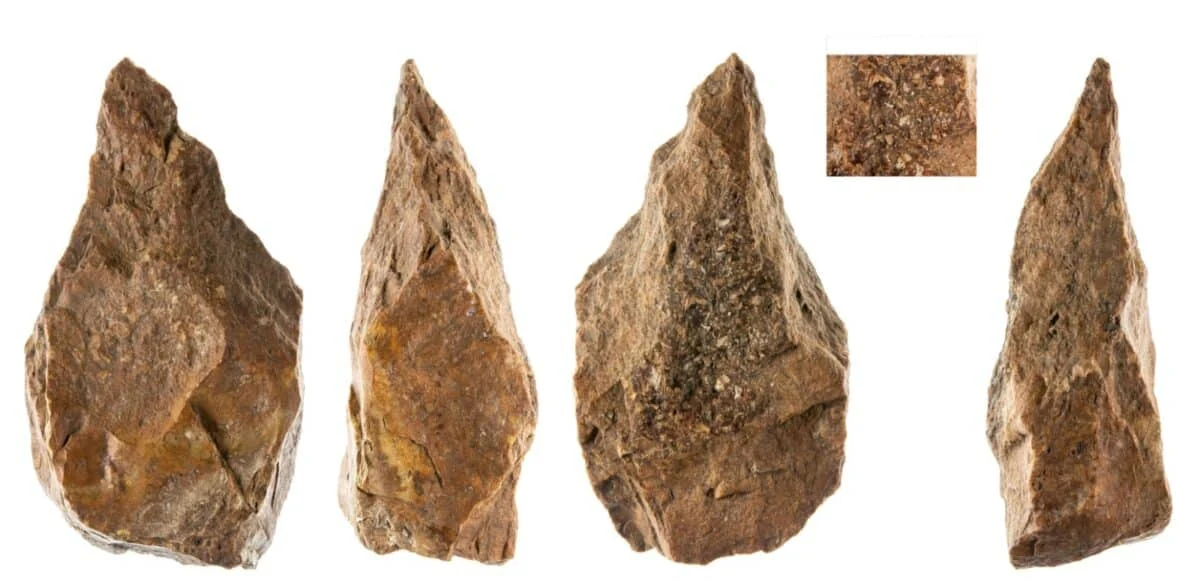
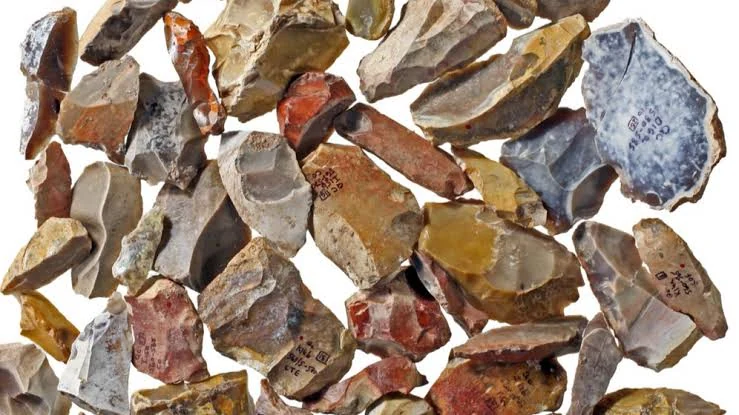
| Qesem Cave | Small, colourful pebbles brought from various places, with no identified practical use. Also old flint tools collected from outside the cave and resharpened, mostly keeping their original outline and weathered surface. |
| Sakhnin Valley | Handaxes made from flint containing fossils or unusual geological formations, with those features preserved at the centre of the stone. |
| Revadim and Jaljulia | Old flint tools gathered after their surfaces had weathered. |
What is documented is the objects themselves. What they meant to their owners is interpretation.
Key Terms in Plain Words
| Term | Meaning |
|---|---|
| Levant | The eastern Mediterranean region that includes present-day Israel |
| Acheulean | A long-lasting stone-tool tradition best known for teardrop-shaped handaxes |
| Handaxe | A hand-held stone tool shaped on both faces |
| Patina | The weathered surface that forms on old flint over time |
| Hypothesis | A proposed explanation that still needs testing |
| External memory | An object that helps a person remember something, working outside the brain |
| Autobiographical memory | Memory of one’s own life experiences |
How Old Is “500,000 Years”?
The release says the practice goes back approximately half a million years and that the sites date to hundreds of thousands of years ago, without more precise dates. This period is usually called the Late Acheulean in the region, the time of handaxe-making hominins. Treat “500,000” as a rounded figure, not an exact measurement for every object.
Which Humans Were They?
The press release does not name a species and refers only to “early humans”. It is tempting to say Homo erectus or a related Acheulean-era population, but that is a reasonable guess, not a statement in the source. Mark it as uncertain.
The Hypothesis in Plain Words
- Keepsakes helped people recall places and experiences.
- Their look and feel could help an owner tell first-hand experience from stories heard or imagined.
- Carrying and showing them may have made personal accounts more credible, which matters for cooperation, trust and remembering alliances.
- Over many generations this may have shaped brain mechanisms for judging where a memory came from and how reliable it is, contributing to autobiographical memory and a sense of self.
- Barkai links this to environmental change: the loss of large animals such as elephants may have forced people to learn new hunting grounds, and objects from those places could have kept the connection alive.
Proposed vs Proven
| Statement | Status |
|---|---|
| Unusual pebbles with no obvious use were brought into Qesem Cave | Documented finding |
| Some old flint tools were collected and reused, keeping their patina | Documented finding |
| These objects were keepsakes or souvenirs | Proposed interpretation |
| They acted as external memory and shaped human memory | Proposal, not established |
| Environmental change drove the practice | Proposal by one author, not established |
| Every unusual stone was a keepsake | Explicitly not claimed |
How Archaeologists Judge “Meaning” in Ancient Objects
Archaeology deals with things people left behind, not with what they thought. To move from object to meaning, researchers usually look for several kinds of support rather than a single clue. This is general method, not a description of how this particular team reasoned.
- Context: Where was the object found, and what was it found with?
- Selection: Was it chosen on purpose, or is it the kind of stone found everywhere nearby?
- Transport: Was it carried from a distant source, which suggests intention?
- Modification or wear: Does it show handling, reuse or deliberate change?
- Repetition: Does the same pattern appear at several sites and times?
- Alternatives: Can a practical explanation account for it equally well?
The more of these lines point in the same direction, the stronger an interpretation becomes. A single odd pebble proves little. A repeated pattern of selected, carried and kept objects is more persuasive, though it still falls short of a direct window into minds.
Why Scientists Might Disagree
Archaeologists often debate meaning-making in the deep past. An odd pebble might have been a tool blank, a curiosity, a decoration, or simply carried by accident. The word “souvenir” is itself an interpretive label borrowed from modern life. The authors argue that it is reasonable to assume such objects mattered, because objects tied to memory appear throughout the record from half a million years ago to today. Critics could reply that continuity of behaviour does not prove continuity of meaning. Both views are legitimate and the paper invites that debate.
What Would Strengthen or Weaken the Idea?
- Finding the same pattern at more sites and in layers with solid dates.
- Showing that the distance to the source of unusual stones was large enough to make accidental collection unlikely.
- Checking wear traces to see whether objects were handled and carried over time.
- Ruling out functional uses for the pebbles.
Evidence Strength at a Glance
| Link in the argument | How solid is it? |
|---|---|
| The objects exist and were found at these sites | Strong: physical finds |
| People brought them to the cave deliberately | Plausible: depends on source distance and context |
| They were kept as keepsakes | Interpretation: cannot be observed directly |
| They helped separate real from imagined memories | Speculative: a psychological model |
| They shaped the evolution of human memory | Speculative: long-term and hard to test |
Why This Story Resonates
Most of us keep a shell, ticket or stone from a trip that carries a memory. Seeing a hint of that habit in a very ancient world feels human. That emotional pull is also the reason to stay careful: a charming story is not the same as a tested one.
If you enjoy deep-time human stories, see our related explainers on ancient artifacts and how to read museum labels.
How to Read Headlines About Prehistoric Behaviour
- Look for words such as “may”, “could” and “suggests”. They signal a hypothesis.
- Find out whether the article names a journal and a date.
- Separate what was found from what the authors think it meant.
- Be cautious when a headline gives a precise date for something that is only roughly dated.
- Check whether independent researchers have commented.
Frequently Asked Questions
Did early humans really collect souvenirs?
It is a hypothesis. The objects are real, but calling them souvenirs is an interpretation.
Where were the objects found?
At sites in Israel, including Qesem Cave, Sakhnin Valley, Revadim and Jaljulia.
Which species made them?
The release does not say. It speaks only of early humans.
What does “external memory” mean here?
An object that helps a person recall a place or event, working like a physical memory aid outside the brain.
Is this peer-reviewed?
It was published in Evolutionary Anthropology, a scholarly journal.
Does it prove that all unusual stones were keepsakes?
No. The authors explicitly say it does not.
How old are the objects?
Described as about half a million years old, within hundreds of thousands of years, without finer dates in the release.
Conclusion
The keepsake idea is an interesting way to link archaeology with the psychology of memory. Keep the line clear: the objects are evidence, the “souvenir” reading is a proposal, and the brain-evolution story is a further, untested step.
Sources
- EurekAlert news release 1151072, Tel Aviv University, November 2026
- Ram, Barkai, Assaf, Mudrik and Efrati, Evolutionary Anthropology, DOI 10.1002/evan.70051
- Archaeology Magazine coverage, 16 November 2026
























Share Your Opinion
Comments are closed on this post.