 Vista
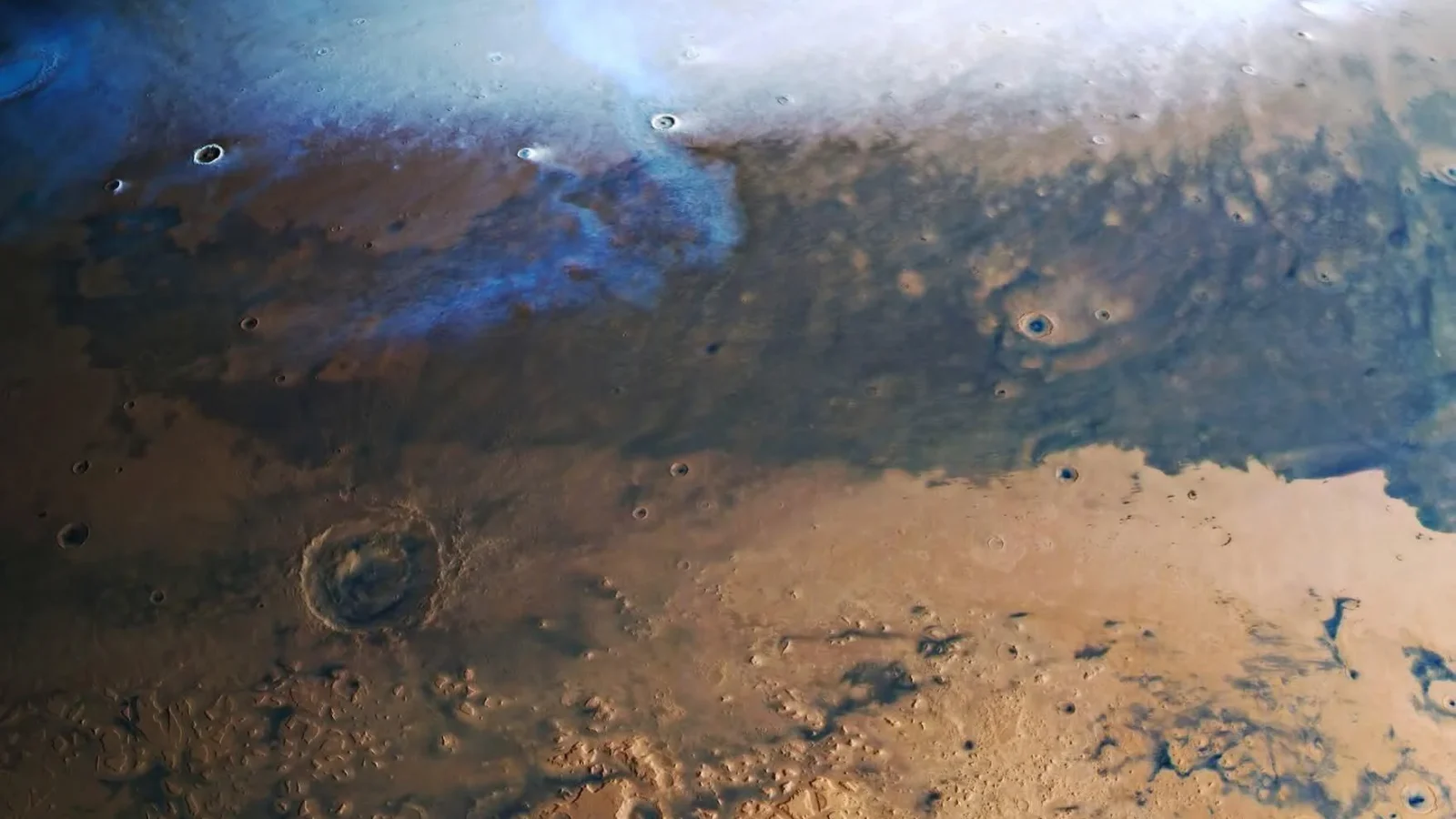
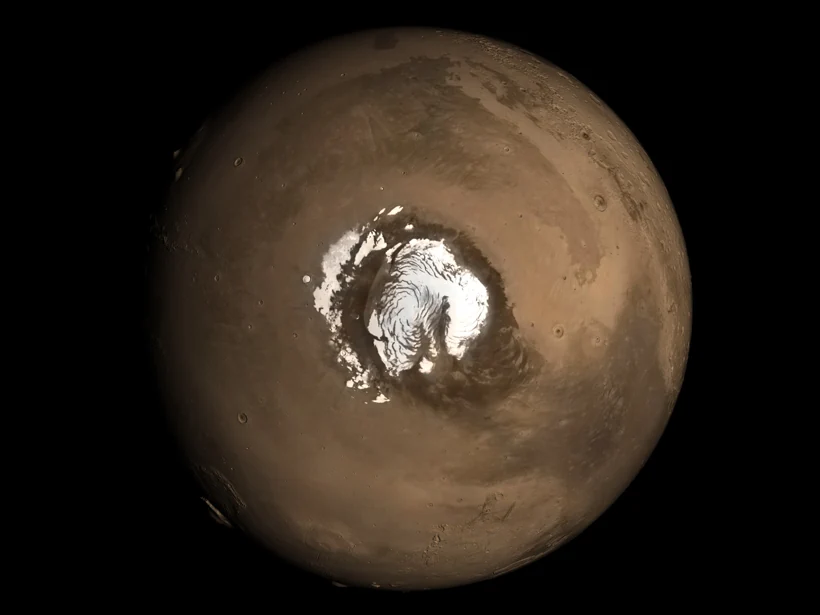
Quick answer: A study by Aditya Khuller and Pari Mohan, published in npj Space Exploration on 8 September 2026, concludes that the exposed water ice near Mars’s north pole contains only about 3% dust by mass. Earlier estimates suggested the top layer could be up to 25% dust. The result changes how scientists read the polar ice as a climate record. It does not mean Mars has drinkable water ready to use, and it does not show life.
What the Study Found
The research team, linked to the University of Washington, re-examined how dusty the bright, exposed ice at Mars’s north polar region really is. Their answer was a dust fraction closer to 3% by mass, much lower than the earlier ceiling of about 25%. Dust matters because it darkens ice. Darker ice absorbs more sunlight, warms faster and vaporises sooner, so the dust level feeds directly into models of how the polar caps grow and shrink.
| Item | Earlier view | New study |
|---|---|---|
| Dust in exposed north-polar ice | Up to about 25% by mass | About 3% by mass |
| Method basis | Approach developed for lunar soil | Snow-and-ice physics developed for Earth |
| Data | Orbital observations | Orbital observations plus data from the 2008 Phoenix lander |
| Where | North polar region | North polar region only |
What 3% Versus 25% Means in Everyday Terms
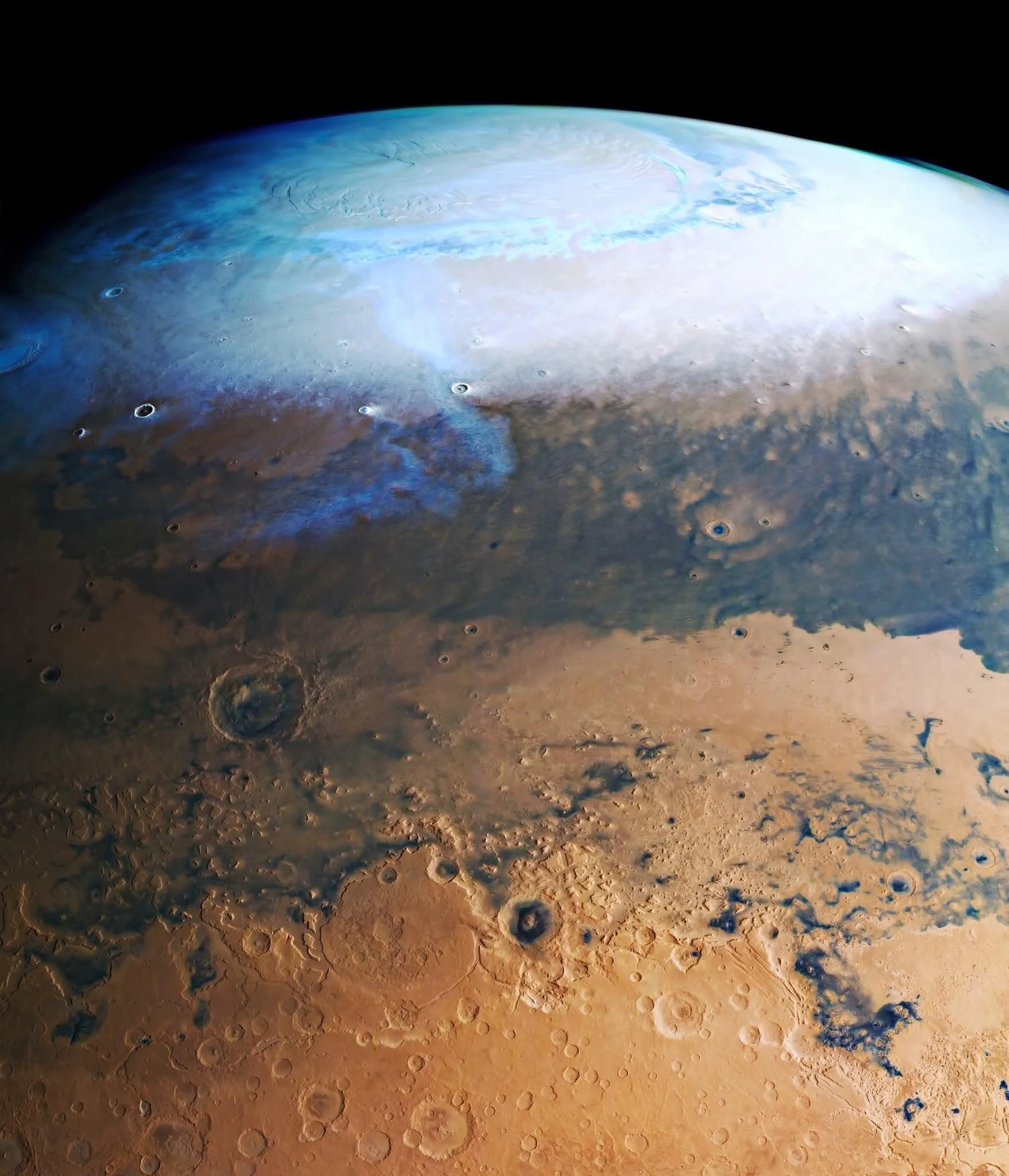
Percent by mass is the share of the weight that is dust. At about 3%, a 100-kilogram block of this ice would hold roughly 3 kilograms of dust and 97 kilograms of water ice. At 25%, the same block would hold about 25 kilograms of dust. The two pictures look very different. The first is a fairly clean, bright ice. The second is a distinctly dirty ice. That gap is why the difference matters to scientists, even though both numbers sound small.
Think of snow on Earth. Fresh snow is bright and reflects most sunlight. Snow with soot or dust on it looks grey and melts faster, because the dark particles absorb heat. The same basic logic applies on Mars, only with much colder temperatures and dust blown in from the surrounding plains.
How the Scientists Did It (and Why It Is Not Radar)
This is the point many summaries get wrong. The study did not use radar. It used brightness. The team adapted a physically based model, originally built by UW professor emeritus Steve Warren for snow and ice on Earth, that links how bright a surface looks to how much dust is mixed in. By tracking how surface brightness changes over time, they could separate seasonal frost from older ice and estimate dust content. The earlier estimates relied on a technique designed for lunar soil, which Khuller found did not behave well when tested on Earth.
So the key idea is simple: ice that reflects more light is cleaner. With a better model of how light interacts with ice grains and dust, the same satellite and lander measurements give a lower dust number.
Step by Step: From Brightness to a Dust Number
- Spacecraft record how bright the polar surface looks across seasons.
- Seasonal frost brightens the surface in winter and disappears in summer, exposing older ice.
- The team compares the brightness of the exposed ice with what a physical model predicts for different dust amounts.
- Data from the 2008 Phoenix lander act as a ground-level reality check.
- The best-fitting dust amount is reported, here about 3% by mass.
Because the result is inferred from a model, it carries model uncertainty. That is normal in planetary science, but it is a reason to describe the number as an estimate.
How Radar Detects Water Ice on Mars (A Different Technique)
Because radar often appears in Mars-ice headlines, it helps to know how it differs. Orbiting radar instruments such as SHARAD and MARSIS send radio waves toward the surface. Waves pass through ice and dust and reflect at boundaries between materials, so scientists can see buried layers and estimate thickness and, indirectly, composition. Radar is strong at seeing below the surface. The new study is about the exposed surface layer and what its brightness says about dust. The two methods complement each other, but this paper does not claim a radar result.
| Technique | What it senses | Best for |
|---|---|---|
| Brightness modelling (this study) | Sunlight reflected from the surface | Dust content of exposed ice |
| Orbital radar (SHARAD, MARSIS) | Radio echoes from buried boundaries | Layer thickness and subsurface structure |
| Lander measurements | Direct sampling at one site | Ground truth for a single location |
The “Ice-Cream Sandwich” Layers
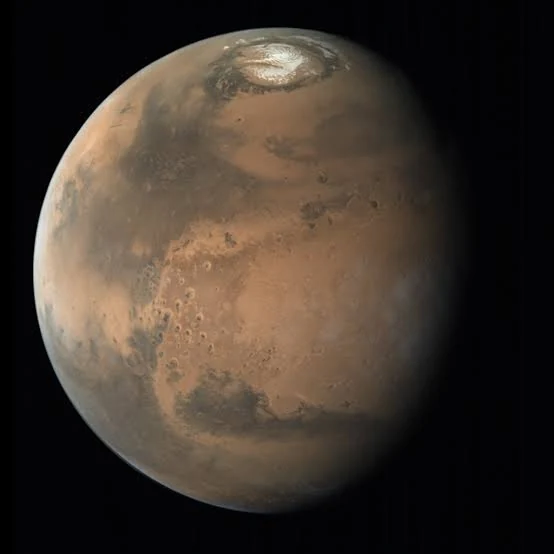
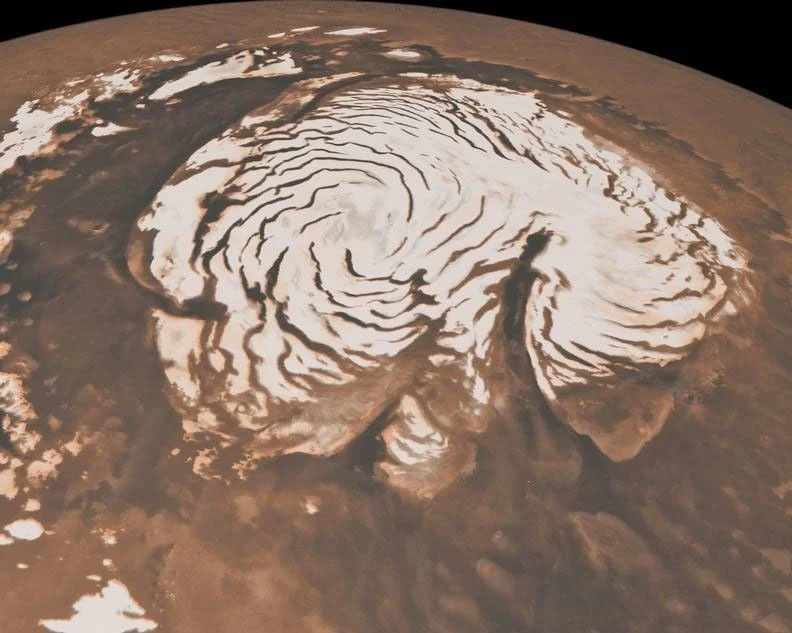
The polar ice is layered, with dustier layers sitting between cleaner ice, which researchers describe as like an ice-cream sandwich. Each winter a dusty frost forms and then disappears in summer, exposing older and cleaner ice underneath. Those layers may record climate swings from thousands of years ago. Mars has had major ice ages that left shallow ice across roughly a third of the planet, and its two small moons do not stabilise its tilt, which contributes to those large swings.
Why a Lower Dust Number Matters
- Climate models: cleaner ice reflects more light, so older models may have overestimated how fast it warms and vaporises.
- Reading the record: if layers are cleaner than assumed, scientists can interpret dust bands as real climate signals more confidently.
- Future work: the methods can be tested elsewhere on Mars, which the authors identify as future work.
What the Study Does Not Say
| Claim you may see online | Reality check |
|---|---|
| Mars has huge new reserves of drinking water | Not claimed. The paper concerns dust content, not volume. |
| This proves life existed on Mars | No. Whether Mars hosted life is unresolved. |
| Astronauts can use this ice easily | Not discussed as a resource finding in the university report. |
| It applies to all of Mars | No. Results cover the north polar region. |
| Dust can be measured directly from orbit | It is inferred from brightness changes, so it depends on the model. |
A related, earlier study by the same group floated the idea that dust-ice layers could form meltwater pockets that might host microbes. That is presented as a possibility, not a finding, and it is not part of this paper’s result.
Limits and Caveats
The dust estimate depends on inferring dust from brightness, so it is only as good as the physical model and the calibration data. The Phoenix lander gave a rare ground-level check near the pole, but a single landing site cannot represent an entire cap. Independent teams will probably test the numbers with other data and methods.
Why Mars’s Poles Are Worth Studying
Earth’s ice sheets preserve past climate in their layers, and scientists drill cores to read them. Mars cannot be sampled that easily, so orbital and lander data are the main tools. The polar caps are the largest known reservoirs of exposed water ice on the planet, and their layers may preserve a history of how Mars’s climate has changed. Understanding how dusty those layers are is a basic step before anyone can read that history reliably.
The poles also matter for planning future missions, because knowing where and in what form water ice exists shapes decisions about where to land. That is general context, not a finding of this paper.
Where This Fits in Mars Science
Mars research moves in small steps, from rover chemistry to orbital mapping. For a different kind of Mars clue, see our explainer on the Perseverance silica-rich rock discovery.
Frequently Asked Questions
How much dust is in Mars’s north polar ice?
The new estimate is about 3% by mass for the exposed ice, versus earlier estimates of up to 25%.
Who ran the study?
Aditya Khuller and Pari Mohan, with a University of Washington connection. It was published in npj Space Exploration on 8 September 2026.
Did they use radar?
No. They modelled surface brightness over time. Radar is a separate technique used by orbiters like SHARAD and MARSIS.
What spacecraft data were used?
Orbital observations and data from the 2008 Phoenix lander. The university report does not list the specific orbiters.
Does this mean Mars has water we can drink?
No. The study addresses dust content in ice, not how much water is available or how to use it.
Does it prove life on Mars?
No. Whether Mars ever hosted life remains an open question.
Will the number change?
Possibly. Other teams may test it with different methods and data.
Conclusion
The study’s strongest message is methodological: a better snow-and-ice model suggests Mars’s north polar ice is much cleaner than a lunar-soil-based method implied. That helps climate scientists, but it is a refinement of a number, not a discovery of new water or life.
Sources
- University of Washington News, “The north pole of Mars is less dusty than scientists thought”, 29 September 2026
- Khuller and Mohan, npj Space Exploration, 8 September 2026 (DOI 10.1038/s44453-026-00054-9)
Mohan and Khuller: original study

























Share Your Opinion
Comments are closed on this post.