 Vista
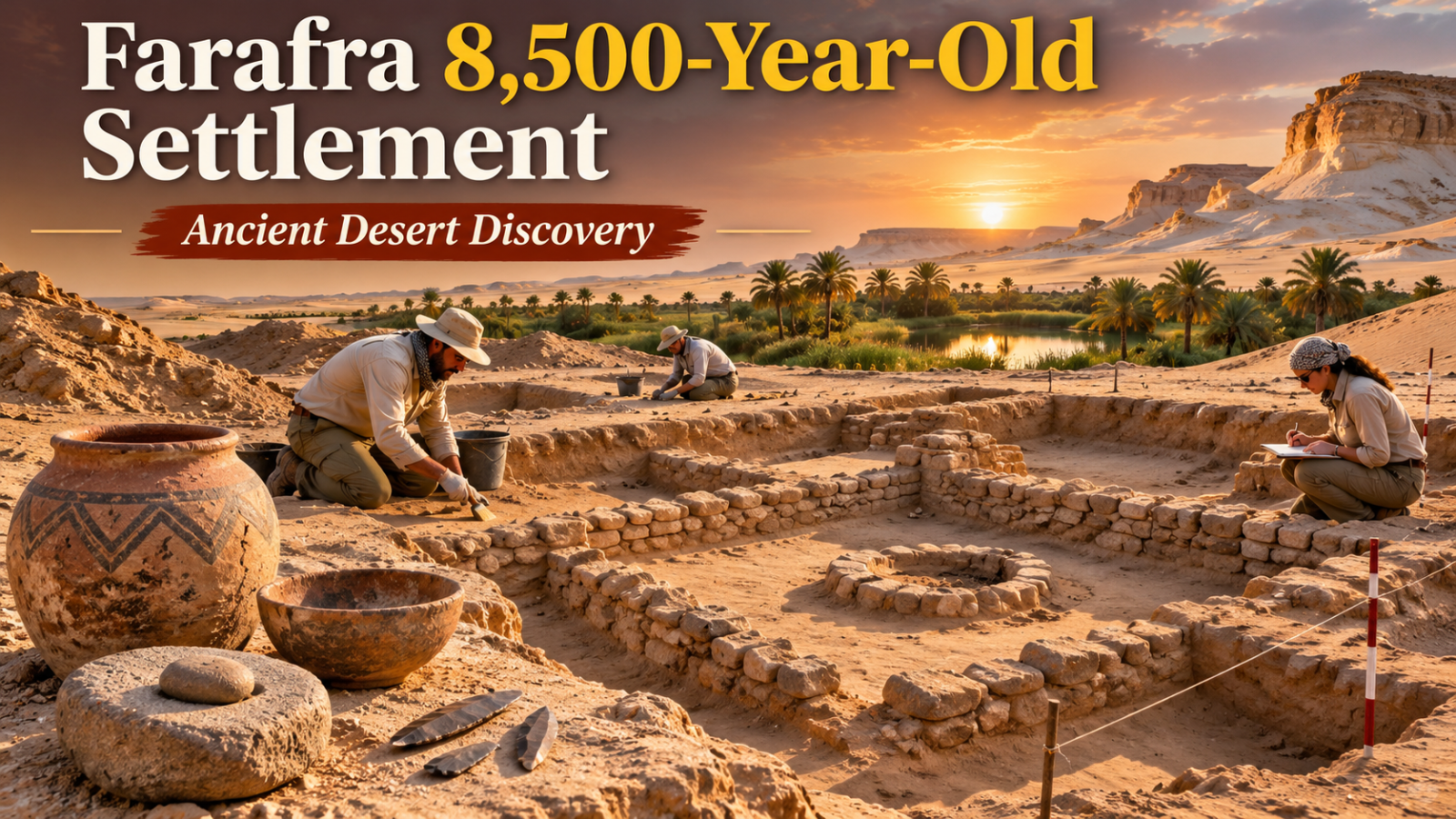
Quick answer: On 29 November 2026 Egypt’s antiquities authorities announced that an Egyptian-Italian mission had found a large prehistoric settlement on the Rajeh (also spelled Rajih) Plateau, on the eastern edge of the Farafra Depression in Egypt’s Western Desert. The site, called “Site 1”, has about 200 archaeological features such as stone structures, hearths and dense scatters of stone tools. It is tentatively dated to the Middle Holocene, roughly 8,500 years ago. The date and the interpretation are preliminary and have not yet appeared in a peer-reviewed paper.
What Was Announced About the Farafra Discovery
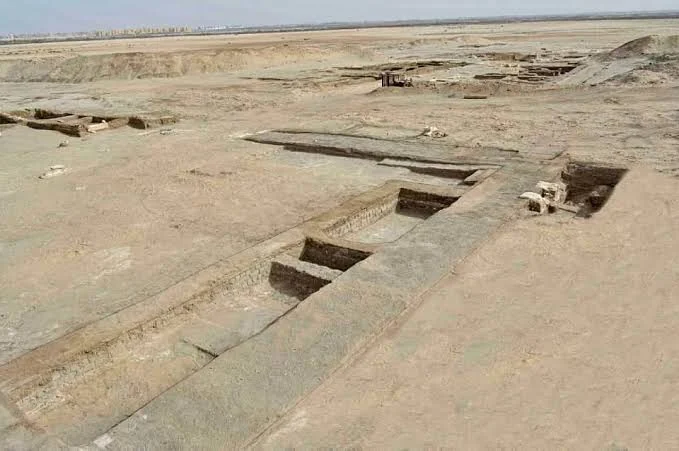
The announcement was reported on 29 November 2026 by Ahram Online and picked up by other outlets. The work was done by the Farafra Oasis Prehistoric Project (FOPP), a joint Egyptian-Italian mission working with Egypt’s Supreme Council of Antiquities. The reports describe an organized settlement, not a short-lived camp, and one of the larger prehistoric settlements known in the Western Desert.
Because this is a press announcement, treat every number as a field estimate. Final counts, radiocarbon dates and maps usually change after laboratory work and publication.
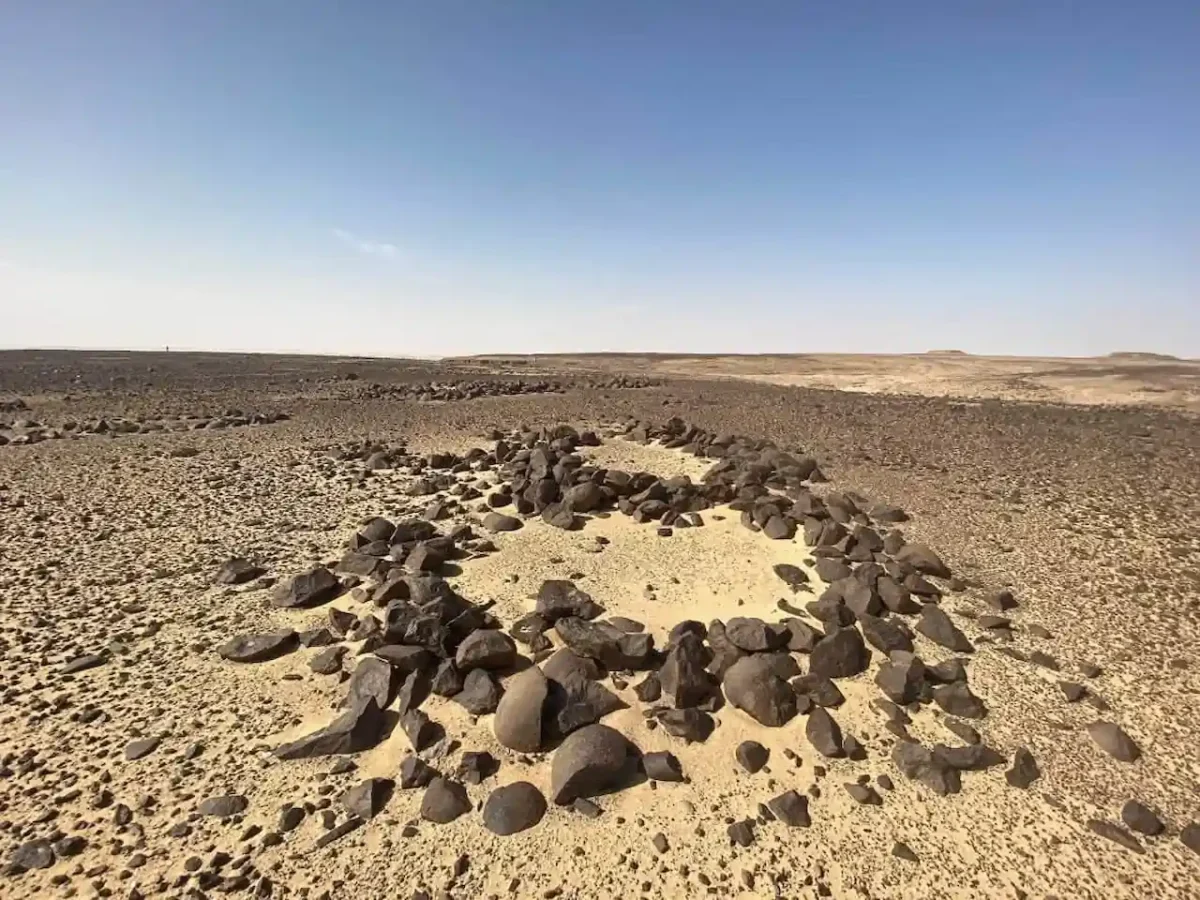
Where Is the Rajeh Plateau?
Farafra is the smallest of Egypt’s main Western Desert oases and sits roughly between Bahariya and Dakhla. The Rajeh Plateau lies on the eastern margin of the Farafra Depression. English-language reports spell the name Rajeh or Rajih; one outlet printed “Ragheb”. Until the mission publishes official transliterations, the spelling may vary.
| Item | Reported detail | Status |
|---|---|---|
| Announcement date | 29 November 2026 | Confirmed (press reports) |
| Team | Egyptian-Italian Farafra Oasis Prehistoric Project with the Supreme Council of Antiquities | Confirmed (press reports) |
| Location | Rajeh/Rajih Plateau, eastern Farafra Depression | Confirmed |
| Site name | “Site 1” | Confirmed |
| Features | About 200 (stone structures, hearths, dense stone-tool concentrations) | Reported count, preliminary |
| Age | Middle Holocene, about 8,500 years ago | Tentative |
| Human remains | Not reported | Do not assume |
What “About 200 Archaeological Features” Really Means
Archaeologists use the word “feature” for any non-portable trace of human activity: a hearth, a line of stones, a pit, a built circle or a patch of ground full of flaking debris. A feature is not automatically a house. Some of the stone structures may have been dwellings, windbreaks, storage places or work areas, but the reports do not say which, and excavation is needed to tell.
That is why careful readers should avoid headlines that say “200 houses” or “a lost city”. What the evidence supports is a dense, repeated use of one place over time, with built elements and fire use.
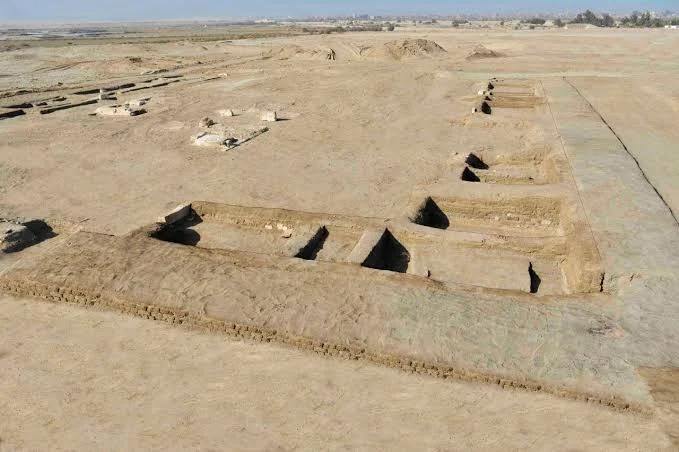
Archaeology Vocabulary Used in This Story
| Term | Plain meaning |
|---|---|
| Feature | A fixed trace of activity such as a hearth, pit or stone setting |
| Artefact | A portable object made or used by people, such as a stone blade |
| Scatter | An area where many artefacts lie spread over the ground |
| Hearth | A place where fires were lit, often with charcoal and burnt stones |
| Holocene | The current geological epoch, covering about the last 11,700 years |
| Radiocarbon dating | A method that dates organic material such as charcoal |
| Survey vs excavation | Surface study of a site versus controlled digging |
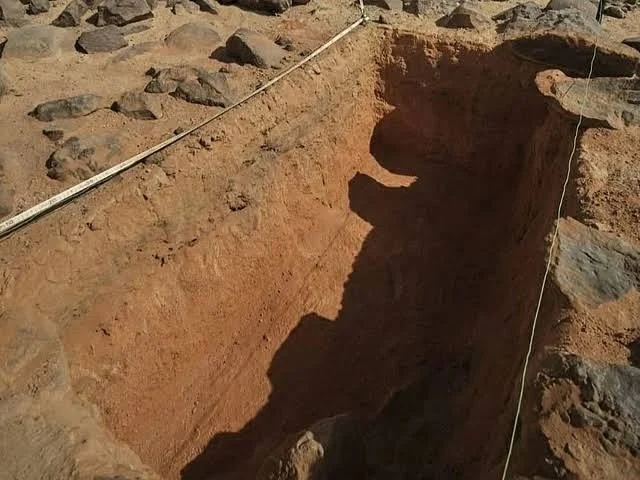
How Old Is It? Why 8,500 Years Is Only a Working Date
The Middle Holocene is the stretch of the current geological epoch from roughly 8,200 to 4,200 years ago. A date of about 8,500 years ago puts the settlement at the early edge of that window. The mission describes the age as tentative, which usually means it comes from artefact styles and surface evidence rather than a full series of radiocarbon dates. Expect the figure to be refined, narrowed or even revised once samples such as charcoal from hearths are dated.
The Climate Background: A Greener Sahara
Between roughly 11,000 and 5,000 years ago North Africa went through the African Humid Period, when monsoon rains reached much further north than today. Lakes, grasslands and seasonal water existed in places that are now hyper-arid. Earlier research in Farafra and nearby areas documented prehistoric lake and spring settings and village-like sites, which is why a settlement here fits the wider picture. The new site adds a very large example, not a surprise in kind.
It is a hypothesis, not a finding, that the Rajeh Plateau settlement relied on a specific water source or on herding. The announcement does not confirm either, and those questions are exactly what the next seasons of fieldwork should address.
Why Dense Stone-Tool Scatters Matter
Stone-tool concentrations tell researchers about daily life: what rock people chose, how they made blades and scrapers, and whether toolmaking happened on site. Compared across sites, tool styles also help link communities and trace movement. A large concentration, together with hearths and built structures, is what lets the team argue for a repeatedly used, organized place rather than a one-night stop.
What Evidence Would Show an “Organized Settlement”?
The announcement uses the language of organization, but that word needs support. In general archaeological practice, researchers look for several kinds of evidence before calling a place a settlement. The list below describes what teams usually look for. It is not a statement about what this mission has already shown.
| Kind of evidence | What it can tell us |
|---|---|
| Repeated hearths | Fires used again and again, suggesting longer stays |
| Built stone structures | Investment in shelter, storage or work areas |
| Dense tool debris | Regular toolmaking and use |
| Animal or plant remains | Diet, hunting, herding or gathering |
| Grinding stones or containers | Food processing and storage |
| Layering over time | Occupation across several phases |
| Nearby water sources | Why people chose the place |
Surface survey can show some of these. Others, such as diet and layering, usually need excavation. That is why the later fieldwork matters.
Confirmed, Hypothesis, Unverified
| Claim | Category |
|---|---|
| A joint Egyptian-Italian mission announced a settlement at Rajeh/Rajih on 29 Nov 2026 | Confirmed by multiple reports |
| About 200 features including hearths and stone structures | Reported, preliminary |
| Age near 8,500 years (Middle Holocene) | Tentative estimate |
| It was a permanent, organized community | Interpretation, not yet proven |
| Houses, graves, rock art or human remains at the site | Not reported; unverified |
| It rewrites Egyptian prehistory | Overstatement; needs publication and peer review |
What Happens Next
Typical next steps are detailed mapping, systematic surface collection, test excavation, radiocarbon and possibly optically stimulated luminescence dating, and analysis of animal and plant remains if any are preserved. Only after that does a technical paper usually appear. Watch for official statements from Egypt’s Ministry of Tourism and Antiquities and from the Italian team’s institution.
Why the Western Desert Matters for Prehistory
Most people link Egyptian archaeology with the Nile Valley, pharaohs and pyramids. The Western Desert tells an older and different story. Before the region dried out, people lived, hunted and herded in areas that now look empty. Studying them helps explain how communities adapted to a changing climate and how some later moved toward the Nile. A site like Rajeh adds a data point to that long story. It does not replace the Nile Valley narrative, and it should not be treated as the “origin” of pharaonic Egypt, which would be an overreach.
How to Read Archaeology News Safely
- Check whether the number is a count of features, sites or objects.
- Look for the word “tentative”, “preliminary” or “suggests”.
- Separate what was found from what the team thinks it means.
- Wait for a peer-reviewed paper before treating a date as settled.
For more Egyptian archaeology on this site, see our guide to ancient Egyptian artifacts and our explainer on what scanners have found inside the Great Pyramid of Giza.
Frequently Asked Questions
Where is the Farafra settlement?
On the Rajeh (Rajih) Plateau, at the eastern edge of the Farafra Depression in Egypt’s Western Desert.
How old is it?
The tentative estimate is about 8,500 years, in the Middle Holocene. This may change after scientific dating.
Who found it?
A joint Egyptian-Italian team, the Farafra Oasis Prehistoric Project, working with the Supreme Council of Antiquities.
Were houses or skeletons found?
The reports mention stone structures, hearths and stone tools. Houses and human remains were not reported, so do not assume them.
Is it the largest prehistoric settlement in Egypt?
It is described as one of the largest in the Western Desert. A ranking for all of Egypt has not been established.
Can tourists visit the site?
No public access has been announced. Active archaeological sites are normally closed until authorities say otherwise.
Where can I read the official report?
There is no scientific paper yet. Follow Ahram Online and Egypt’s Ministry of Tourism and Antiquities for updates.
Does this change what we know about ancient Egypt?
It adds detail about prehistoric life in the Western Desert. Claims that it rewrites Egyptian history are premature.
Conclusion
The Rajeh Plateau find is a promising and genuinely interesting prehistoric site, but today it is a field announcement, not a finished study. Hold on to the solid points (location, team, around 200 features) and treat the date and the “organized settlement” reading as working hypotheses until the data are published.
Sources
- Ahram Online, report by Nevine El-Aref, 29 November 2026
- Gulf News and other outlets reporting the same announcement
- Background: published research on prehistoric Farafra (Barich and colleagues)
























Share Your Opinion
Comments are closed on this post.