 Vista
The “Zeptoverse” is an informal name for the world of distances around one zeptometre, which is a billionth of a trillionth of a metre (10⁻²¹ m). It is not a separate universe and not a formal scientific term. The word entered the news after the LHCb experiment at CERN reported, on 3 November 2026, evidence of an extremely rare particle decay that could help physicists search for unknown particles and forces at those tiny scales. This article explains the zeptometre in simple language, what LHCb actually found, what it does not prove yet, and why such tiny measurements matter.
What Is the Zeptoverse?
“Zeptoverse” is a shorthand coined by scientists and science writers to describe phenomena that occur at distances of the order of a zeptometre. Dr Paula Collins, deputy spokesperson of the LHCb experiment, has described it as a billionth of a trillionth of a metre, roughly 100 billion times smaller than an atom. For comparison, it is about a million times smaller than a proton.
It is important to be precise about what the word means. The Zeptoverse is not a parallel universe, a hidden dimension or a formally recognised branch of physics. It is simply a convenient label for the smallest distance scales that today’s particle colliders can probe, indirectly, through the behaviour of particles. Think of it as “the realm of the very, very small”, the way “the microworld” is used for things seen under a microscope.
Zeptoverse Particle Physics Discovery
On 3 November 2026, the LHCb Collaboration presented a result at a seminar at CERN and posted a preprint on arXiv. The preprint has not yet gone through peer review. The team reported evidence of a decay in which a particle containing a beauty quark, known as a B⁰ meson, turns into a pair of muons. Muons are heavier cousins of the electron.
This decay is expected to happen only about once in every 10 billion B⁰ particles. Physicists had been searching for it for more than four decades. The signal was reported at about 3.2 sigma, which scientists call “evidence” rather than a formal “discovery” (the usual discovery threshold is 5 sigma). The collaboration also released a more precise measurement of a sibling decay of a related particle, which had already been observed before.
| Question | Answer |
|---|---|
| Who announced it? | The LHCb Collaboration at CERN |
| When? | 3 November 2026 |
| What was seen? | Evidence of B⁰ meson decaying into two muons |
| How rare? | About 1 in 10 billion B⁰ particles |
| Strength of result | About 3.2 sigma (evidence, not a 5-sigma discovery) |
| Peer reviewed? | Preprint on arXiv; not yet peer reviewed |
So the careful headline is: physicists have found evidence of a very rare decay that gives them a new way to test the Standard Model. It is not proof of new physics. The measured rate so far does not clearly contradict the Standard Model, and more data are needed.
What Is a Zeptometer?
A zeptometre (spelled zeptometer in American English, symbol zm) equals 10⁻²¹ metre. The prefix “zepto” comes from the SI system and means one sextillionth, or 0.000000000000000000001. In other words, one metre is 10²¹ zeptometres. Hindi readers often search for it as “जेटोमीटर” or “ज़ेप्टोमीटर”.
Zeptometer Scientific Notation
Scientific notation keeps these tiny numbers readable. 1 zm = 1 × 10⁻²¹ m. A human hair is roughly 70 micrometres wide, so it is tens of thousands of trillions of times thicker than a zeptometre.
From Human Scale to the Subatomic World
| Unit | Value in metres | Typical example |
|---|---|---|
| Metre (m) | 1 | A child’s height is about 1 m |
| Nanometre (nm) | 10⁻⁹ | DNA’s width is about 2 nm |
| Picometre (pm) | 10⁻¹² | Atom sizes are tens to hundreds of pm |
| Femtometre (fm) | 10⁻¹⁵ | A proton is about 1 fm across |
| Attometre (am) | 10⁻¹⁸ | Scales where no internal structure of quarks has been seen |
| Zeptometre (zm) | 10⁻²¹ | The “Zeptoverse”; probed only indirectly |
Nanometer vs Picometer
A nanometre is a thousand times larger than a picometre. Chip makers work in nanometres, while chemists describing atoms and bond lengths use picometres.
Femtometer vs Attometer vs Zeptometer
Each step down is a factor of 1,000. Nuclear physicists use femtometres for protons and nuclei. An attometre is a thousand times smaller than a femtometre, and a zeptometre a thousand times smaller again. This is the answer to the common search “attometer vs zeptometer”: a zeptometre is 1,000 times smaller than an attometre.
One important caution: nobody can place a ruler or see an object that small. Colliders reach these scales indirectly. In quantum mechanics, probing smaller distances needs higher energy, and the LHC’s energies correspond to distances of around 10⁻¹⁹ metre and below, while very rare decays are sensitive to effects that come from even heavier unseen particles.
Quarks and Rare Particle Decay
Beauty Quark Explained
Protons and neutrons are made of smaller particles called quarks. There are six types: up, down, strange, charm, bottom (also called beauty) and top. The beauty quark is heavy and short-lived, and it appears in particles such as B mesons. LHCb is built to study these particles because their decays are sensitive to tiny quantum effects.
Why is the B⁰ to two muons decay so rare? According to the Standard Model, the direct route is blocked, so the decay can only happen through a quantum “loop” process in which short-lived virtual particles briefly appear and disappear. That makes it extremely unlikely, but it also makes it sensitive. If an unknown heavy particle exists, it could join those loops and change how often the decay occurs. Measuring the rate precisely is therefore a way of looking for hints of new physics without producing the new particle directly.
Standard Model of Particle Physics
The Standard Model is the current best theory of the known particles and three of the four fundamental forces (it does not include gravity). It has passed many tests, including the 2012 discovery of the Higgs boson. Yet it cannot explain dark matter, dark energy or why the universe contains more matter than antimatter. That is why physicists keep testing it with rare processes.
Matter and Antimatter
The early universe should have produced equal amounts of matter and antimatter, yet today we live in a universe made almost entirely of matter. LHCb studies small differences in how matter and antimatter particles behave. Researchers hope results like this one may eventually help address that puzzle, though this particular finding does not solve it.
For related research into matter at very small scales, read about the boron–oxygen triple-bond discovery.
CERN and the LHCb Experiment
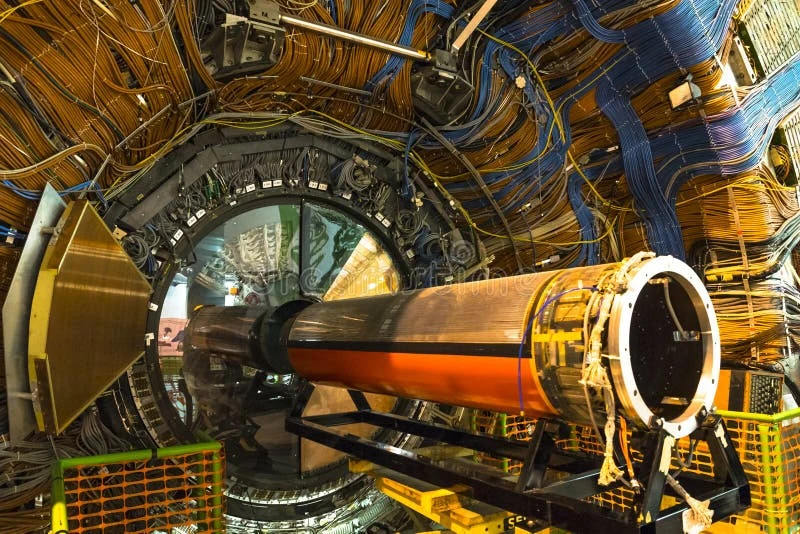
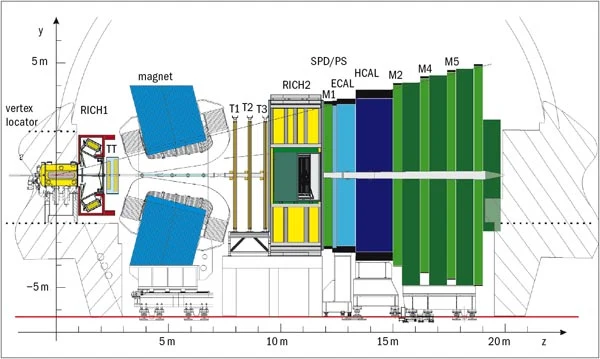
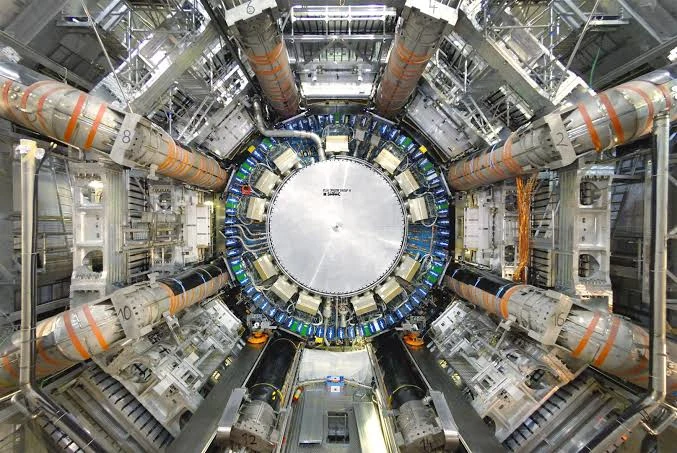
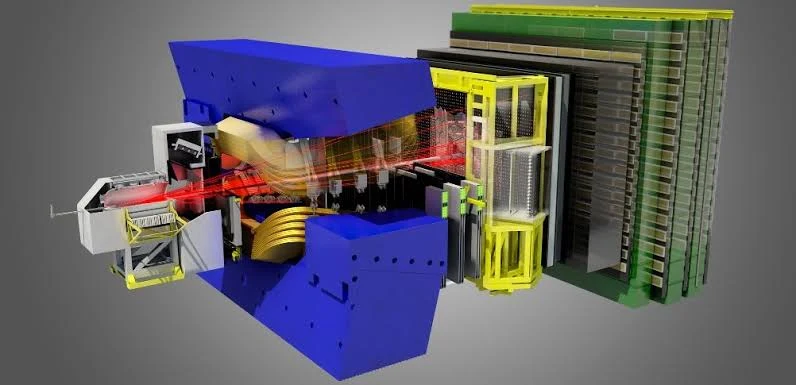
CERN, the European Organization for Nuclear Research near Geneva, operates the Large Hadron Collider (LHC), a 27-kilometre ring in which protons collide at nearly the speed of light. LHCb is one of its main experiments. Unlike the general-purpose ATLAS and CMS detectors, it is a “forward spectrometer” that focuses on particles flying close to the beam line to study beauty and charm quarks. Its silicon Vertex Locator sits only a few millimetres from the beams, which lets it pinpoint where particles are produced and decay. A major upgrade allows LHCb to collect data at up to five times its earlier rate, which helped make this measurement possible.
How Scientists Study Subatomic Particles
Scientists collide particles, record trillions of events and use computers to hunt for the few that match a pattern. They then compare the number of observed events with predictions, apply statistical tests and repeat the work with independent checks. Publication in a peer-reviewed journal, replication by other analyses and more data are what finally turn evidence into an accepted result.
Why Ultra-Small Measurement Scales Matter
Small-scale physics has repeatedly changed everyday life. Quantum theory underpins semiconductors and computers, and particle detectors led to medical imaging tools. More importantly, exploring smaller scales is how humanity learns whether our current picture of nature is complete. A deviation from the Standard Model at the zeptometre scale could point to dark matter candidates, new forces or new symmetries. Even if nothing new appears, tighter limits tell scientists where not to look and sharpen the next experiments.
Frequently Asked Questions
1. What is the Zeptoverse in simple words?
It is an informal name for the tiniest distance scale physicists can explore, around a billionth of a trillionth of a metre. It is not a separate universe.
2. What did CERN’s LHCb find?
Evidence of a very rare decay of a B⁰ meson into two muons, reported on 3 November 2026.
3. Is it a confirmed discovery?
Not yet in the strict sense. The result is about 3.2 sigma, below the 5-sigma standard for a discovery, and the paper is a preprint awaiting peer review.
4. How small is a zeptometer?
1 zeptometre equals 10⁻²¹ metre, about a million times smaller than a proton.
5. What is the difference between an attometer and a zeptometer?
An attometre is 10⁻¹⁸ m and a zeptometre is 10⁻²¹ m, so a zeptometre is 1,000 times smaller.
6. Does this prove new physics exists?
No. It provides a precise new test of the Standard Model. New physics would show up only if future measurements differ clearly from the predictions.
7. What is a beauty quark?
It is one of six quark types, also called the bottom quark. It is heavy and unstable and forms particles such as B mesons.
Conclusion
The Zeptoverse headline is exciting, but the science is steady and careful: LHCb has found evidence of a decay that happens once in about 10 billion cases, and it opens a sensitive window onto the Standard Model. Treat it as an important step, not a final answer, and wait for peer review and more data before drawing big conclusions.
Sources consulted: LHCb Collaboration and CERN seminar of 3 November 2026; reporting by Live Science, ScienceAlert and the universities involved.






















Share Your Opinion
Comments are closed on this post.