 Vista
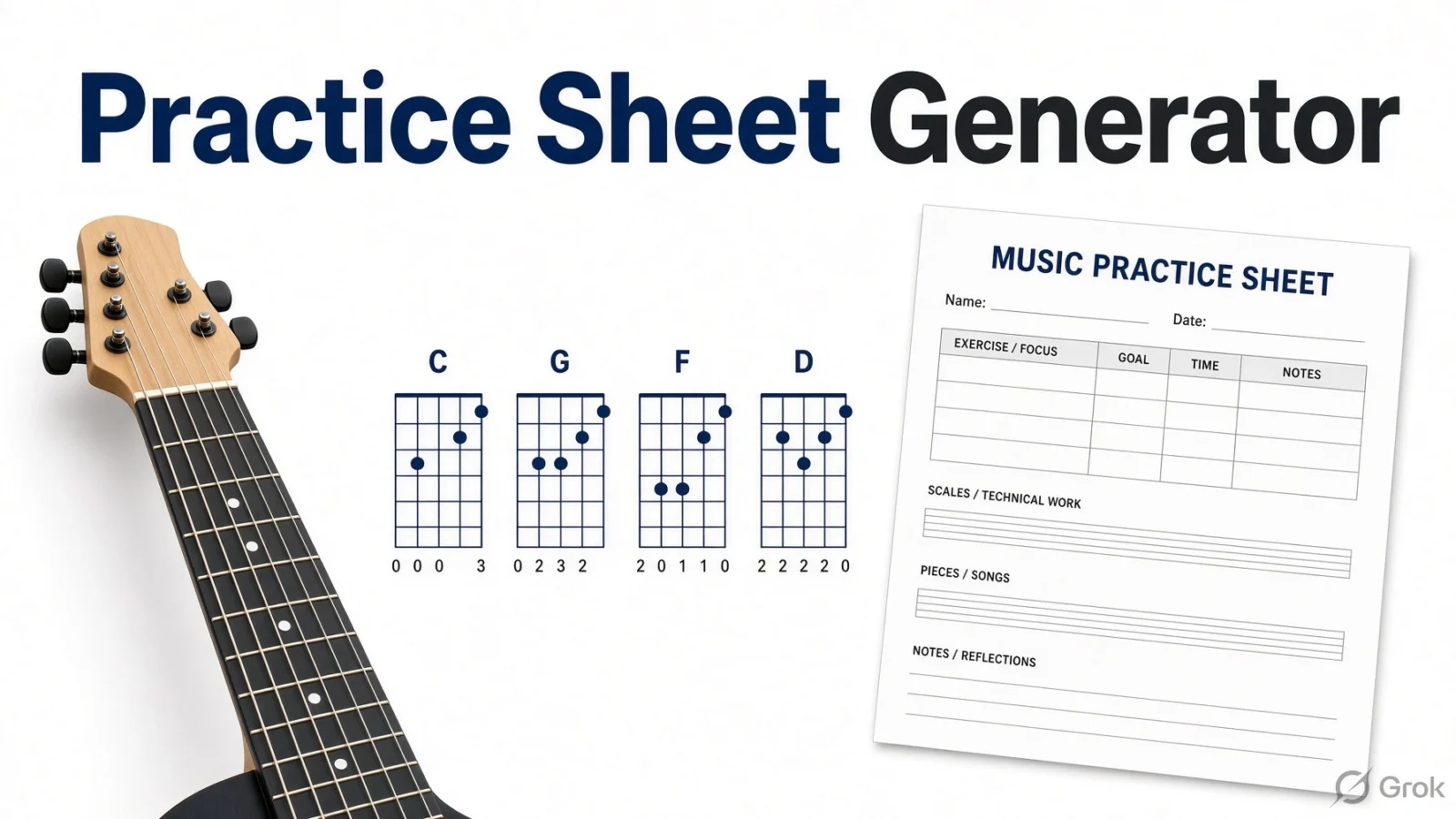
If you are searching for a blank guitar fretboard chart PDF, printable ukulele chord sheets or a simple guitar chord diagram generator, you probably want the same thing: paper you can write on. Writing a chord shape, a riff or a note name by hand fixes it in memory far better than only looking at it on a screen, and a printed sheet fits neatly in a lesson folder or on a music stand. This guide shows how to make custom guitar practice sheets, how to read each layout, and how guitar and ukulele strings are arranged. It uses no copyrighted songs: only blank layouts and short original practice ideas you can write yourself.
Choosing a guitar or ukulele practice layout
Start by deciding what you want to practise, because each sheet type does a different job. Blank chord boxes are for learning and memorising shapes. Blank tab staves are for writing riffs, exercises and melodies. A fretboard note map is for learning where each note lives on the neck. Many learners print one of each and keep them in a folder, so a lesson can move from chords to a short riff to a note quiz without searching for paper.
Strings, frets and common tunings
| Instrument | Strings | Standard tuning (as used on the sheets) |
|---|---|---|
| Guitar | 6 | E A D G B E, lowest to highest |
| Ukulele (soprano, concert, tenor) | 4 | G C E A, with the G tuned high |
The ukulele’s usual tuning is called reentrant, because the G string is pitched higher than the C string beside it, so the strings do not climb steadily from low to high. Baritone ukuleles are normally tuned D G B E, and some tenor players use a low G, so always check your own instrument before copying a chart. Frets are numbered from the nut: the first space after the nut is fret 1, and an open string is written as 0. The top four strings of a guitar are D G B E, which is different from a standard ukulele’s G C E A, so chord shapes do not transfer directly between them (a baritone ukulele does match those four guitar strings).
How to read chord boxes and fretboard diagrams
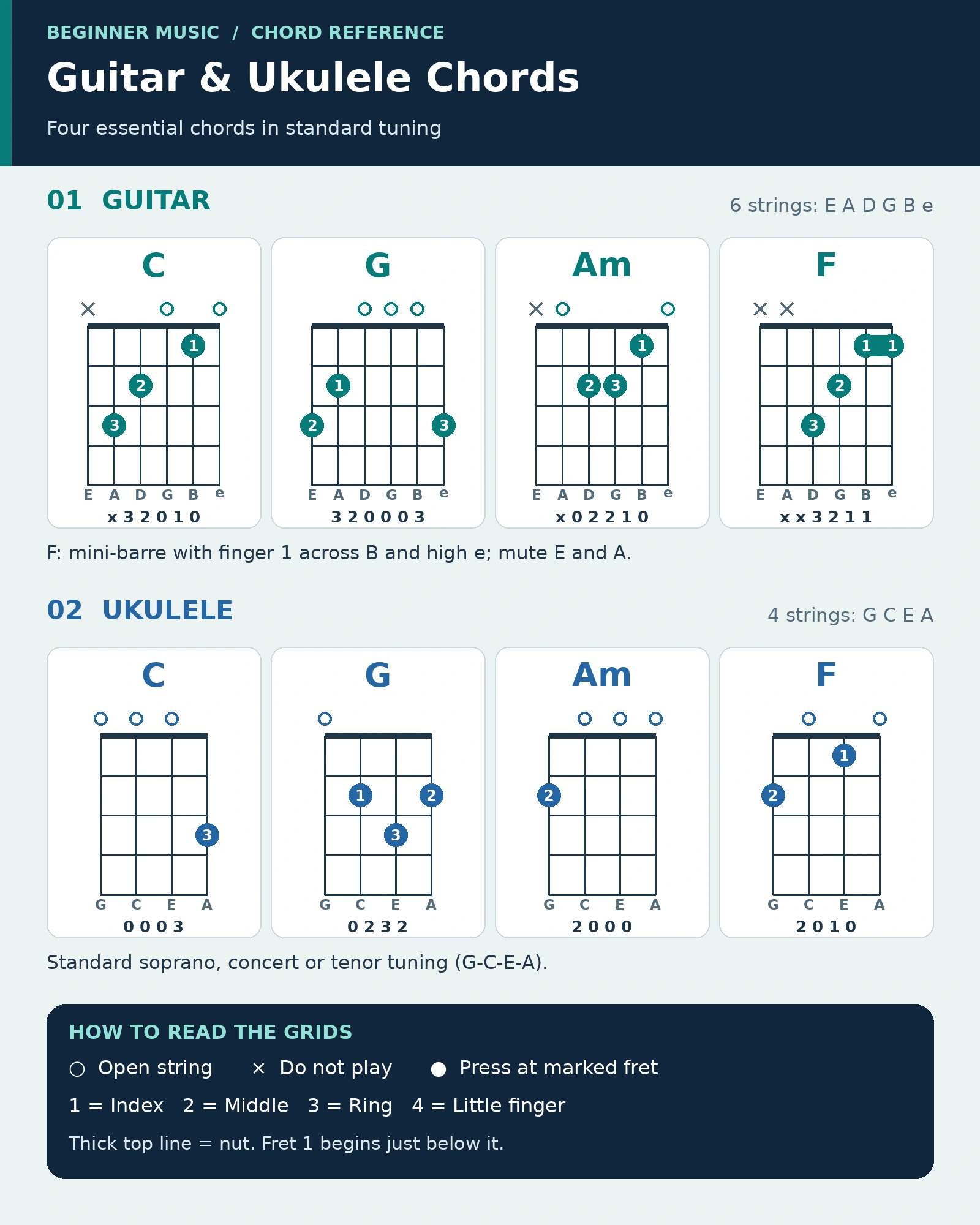
A chord box (also called a chord diagram or chord chart) shows the neck as if you were facing the instrument. Vertical lines are strings and horizontal lines are frets. On a guitar box the leftmost line is the lowest string. A thick line at the top marks the nut, and the chord name is written above the box. A typical box shows about five frets, which is enough for most beginner chords. On the ukulele the box has four vertical lines instead of six.
Finger positions and open or muted strings
- A dot on a string between two fret lines means press that string in that fret space.
- An O above a string means play that string open; an X above it means do not play it (muted).
- Small numbers under a box, when given, show which finger to use: 1 index, 2 middle, 3 ring, 4 little finger.
- If a chord starts higher up the neck, a number beside the box shows the starting fret, and then the top line is not the nut.
- A chord box shows shape only. It does not show rhythm, so write the strumming pattern next to it.
Blank tabs and fretboard exercises
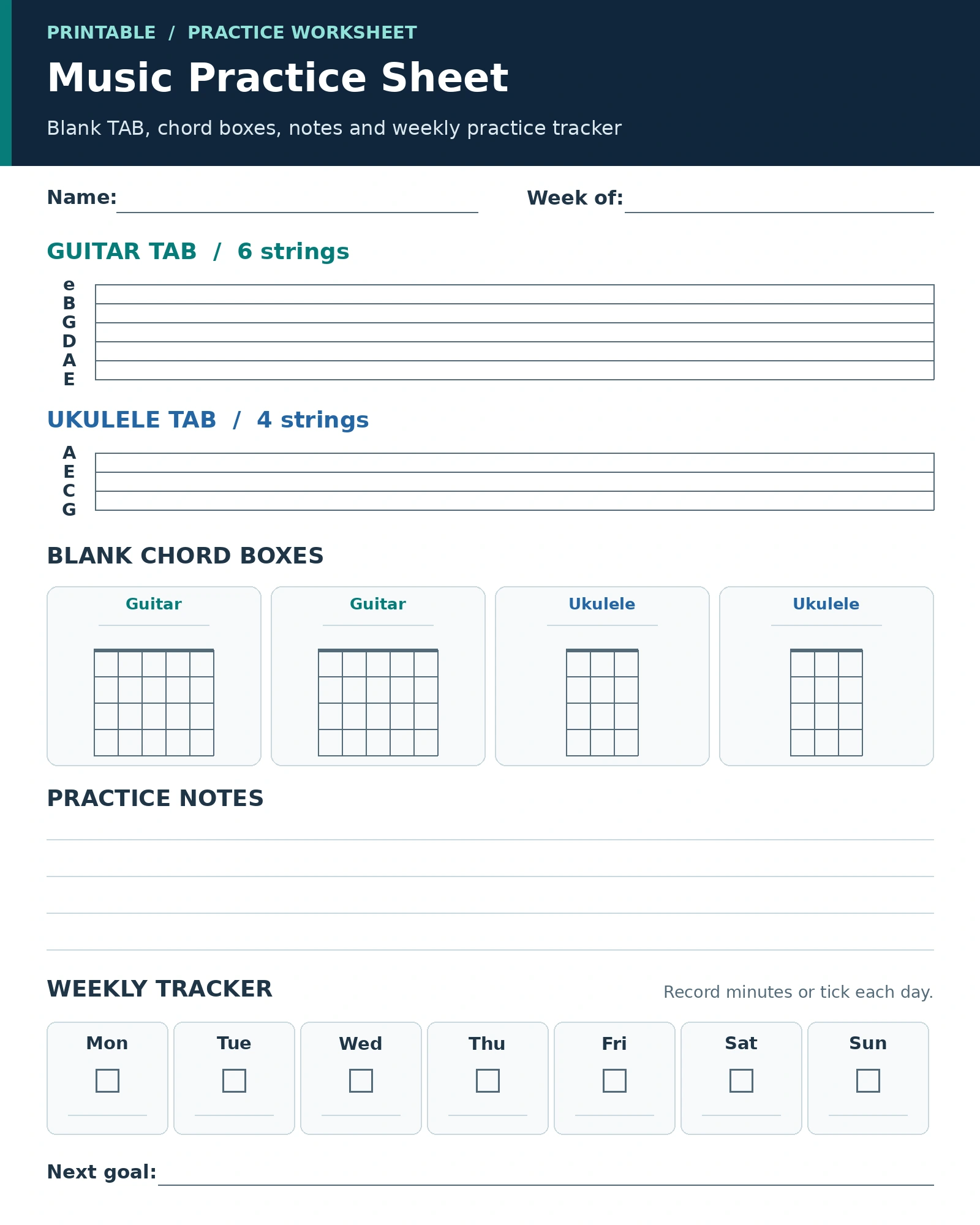
Tab (tablature) uses one horizontal line per string and a number for the fret. On guitar tab the top line is the highest string, the high e, and the bottom line is the lowest, the low E, so a tab reads like the neck seen from above. A 3 on the second line from the bottom means fret 3 on the A string, and a 0 means the open string. On a ukulele staff the lines read A, E, C and g from top to bottom, where the small g marks the high G. Tab shows which string and fret to use, but not the rhythm, so add note lengths or counting above the staff if you need them.
Scales, chords and song practice examples
- Scale practice: write a one-octave scale of your own choosing along one string, then repeat it on the next string. Compare the fret numbers to see the pattern.
- Chord practice: fill a row of blank chord boxes with the chords you are learning this week, one shape per box, and add the name above each.
- Riff notebook: use blank tab lines to jot down a short riff or melody you have composed, so you can check it later and spot mistakes.
- Note quiz: print the fretboard note map blank, fill in the notes from memory, then compare with the version that has the names filled in.
- Chord change drill: write two chords you find hard to switch between, side by side, and count how many clean changes you can make in a minute.
For song practice, keep copyrighted material out of sheets you share. Write your own exercises, or note only chord names and a strumming pattern for songs you have the right to use. That keeps the sheet useful to you and safe to hand to a student or friend.
Using the practice sheet generator
The generator makes a blank page in three steps. Choose the instrument (guitar or ukulele), choose the sheet type (blank chord boxes, blank tab staves or a fretboard note map), and set how many you want on the page. Press Generate to see a preview, then download a PDF or print directly. For the fretboard map you can choose whether the note names are filled in or left blank for quizzing. Open the free tool (English) to try it. Note that it makes blank chord diagrams for you to fill in; it does not supply finished chord shapes.
Custom A4 layouts and print checks
- Counts per page: up to 20 chord boxes; up to 8 guitar or 10 ukulele tab staves; up to 4 guitar or 5 ukulele fretboards.
- The sheets are laid out for A4 paper. If you print on US Letter, you may need to scale the page and check that nothing is cut off at the edges.
- Print at 100 percent scale, not “fit to page”, so the boxes keep their intended size.
- Do a test print first, and use a pencil so you can erase and reuse the sheet.
- Black-and-white printing is fine because the sheets use black lines and text only.
Worked examples, practical checks and limitations
Here is the logic behind the note map. Each fret raises a note by one semitone, and the twelve note names repeat in the order C, C#, D, D#, E, F, F#, G, G#, A, A#, B. On the guitar’s A string, three frets up gives A, A#, B, C, so fret 3 is C. On the high e string, count E, F, F#, G, G#, A, so fret 5 is A. On a ukulele, the A string at fret 2 is B, and the E string at fret 1 is F. The sheets use sharps only, so a B-flat appears as A#.
- The generator draws blank chord boxes; it does not give chord shapes. Use a trusted chord book or a teacher for shapes.
- Only standard tuning is covered. Capos and alternate tunings change the note names.
- The fretboard map shows 12 frets with even spacing, so it is a learning diagram, not drawn to scale; real frets get closer together up the neck.
- Check string order and tuning on your own instrument before trusting any chart, especially for baritone or low-G ukuleles.
Common mistakes and when to seek expert confirmation
The usual errors are reading a tab upside down, mixing up string order on a ukulele, and assuming every ukulele is tuned G C E A. Another is counting the nut as fret 1 instead of fret 0. If a shape hurts your hand, or you are unsure about posture and technique, ask a music teacher rather than pushing through; good technique prevents strain.
Frequently asked questions
How do I make custom guitar practice sheets?
Pick the instrument and sheet type in the generator, choose how many boxes, staves or fretboards you want, then download the PDF or print it on A4 at 100 percent scale.
Where can I get a blank guitar fretboard chart PDF?
Choose “Fretboard note map” in the generator, set note names to blank, and download the PDF. You can print a version with the names filled in to check your answers.
Can I print ukulele chord sheets?
Yes. Select ukulele and “Blank chord boxes”. You get four-string boxes to fill in with your own chord shapes.
What is the standard tuning of a guitar and a ukulele?
Guitar: E A D G B E from lowest to highest. Ukulele (soprano, concert, tenor): G C E A with the G tuned high.
Which line is which string on guitar tab?
The top line is the high e string and the bottom line is the low E string.
Does it work for baritone ukulele or alternate tunings?
No. The sheets assume standard tuning, so note names will not match baritone or alternate tunings.
Conclusion
A few blank sheets, a pencil and short daily practice are often enough to make chord shapes and note names stick. Print only what you need, label each page with the date, and keep your own exercises together in one folder so you can see your progress over weeks.
Sources
- Fender: How to Tune a Ukulele
- Fender: How to Read Tabs
- Berklee Online: Guitar notation basics (notation, tab and chord diagrams)
- Stringed instrument tunings (Wikipedia)
















Share Your Opinion
Comments are closed on this post.