 Vista
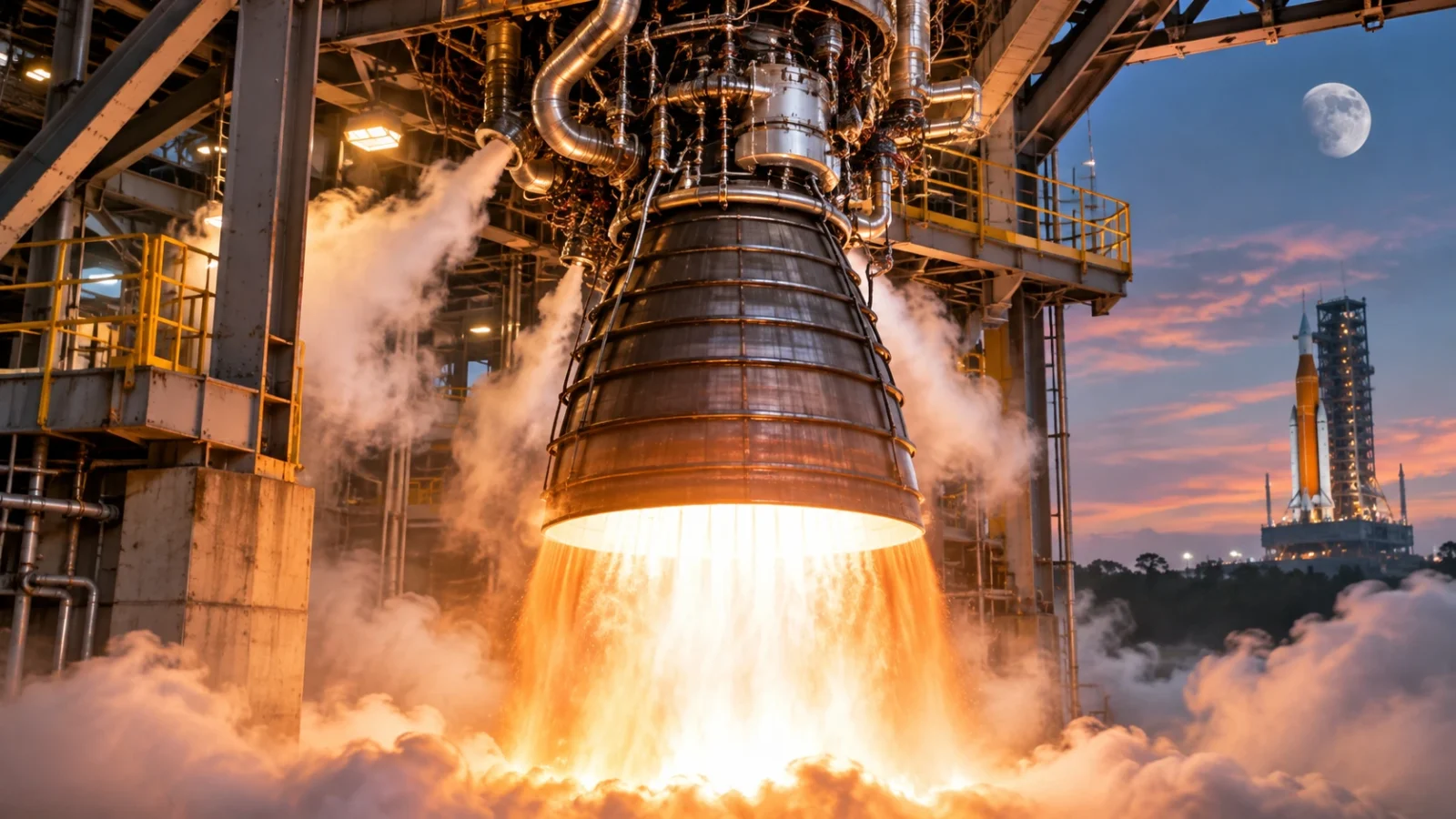
NASA tested developmental RS-25 engine No. 10001 for a planned 200 seconds on 18 November 2026 at the Fred Haise Test Stand in Mississippi. The announcement appeared on NASA’s website on 19 November. It was a ground-based hot-fire experiment lasting three minutes and 20 seconds, not an Artemis rocket launch. NASA says this particular development engine will never fly; its measurements support reliability and performance work on engines intended for future Space Launch System missions.
Updated: 23 November 2026 | Test: 18 Nov | NASA report: 19 Nov 2026
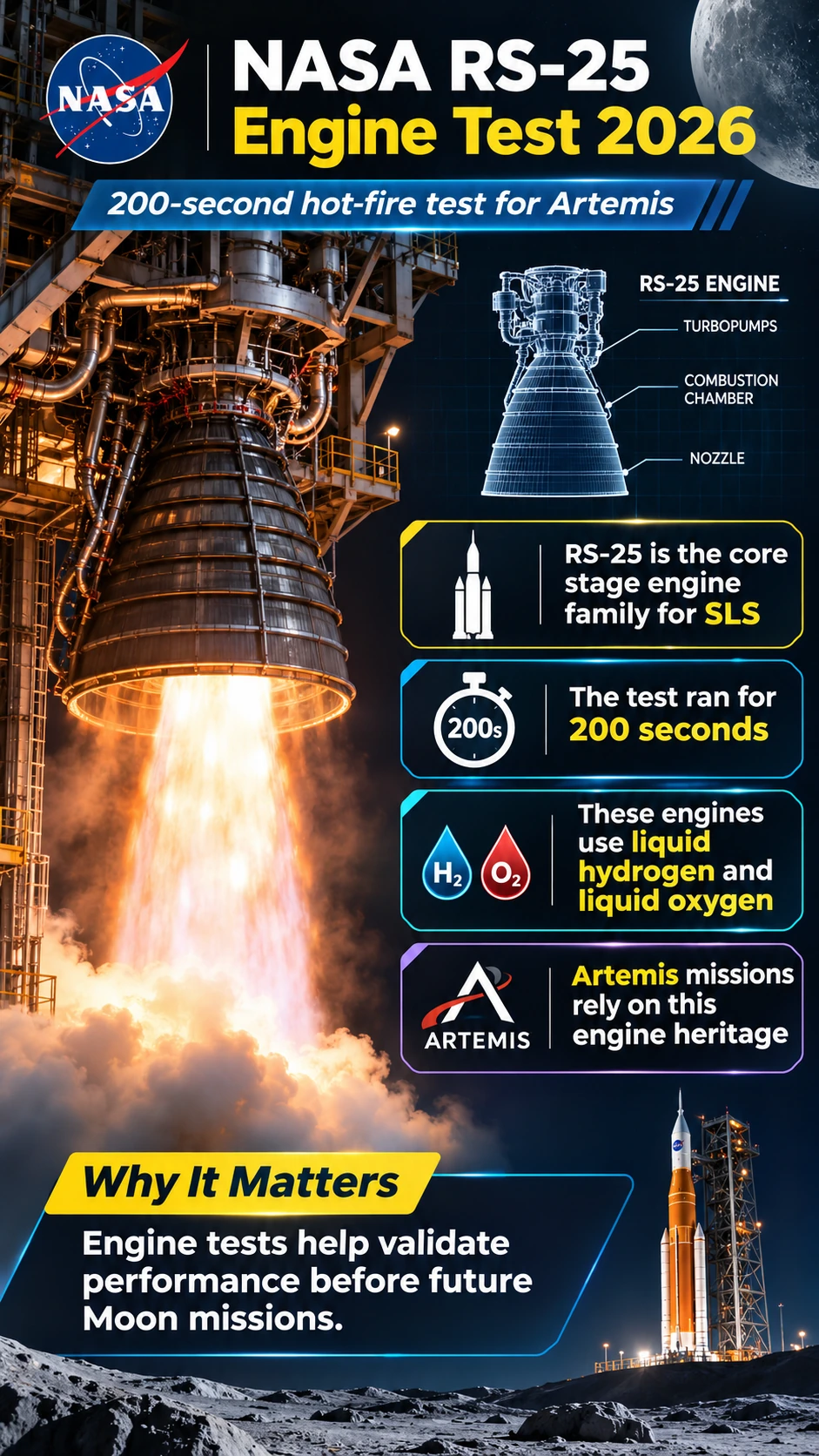
NASA RS-25 hot-fire test: date, place and verified result
The latest engine firing occurred at NASA’s Stennis Space Center near Bay St. Louis, Mississippi, rather than at Kennedy Space Center, Florida. Test operators ran RS-25 No. 10001 on the Fred Haise Test Stand for its scheduled 200 seconds. The large structure holds an engine securely while operators and sensors collect data on performance under active combustion conditions. An enormous plume of hot exhaust emerges, making dramatic photographs possible without any spacecraft lifting off. NASA credited its actual test photography to Danny Nowlin. The distinction between a test-stand image and a rocket-launch image matters because videos often circulate with the wrong mission name. The 18 November event was explicitly described as a planned developmental test, not an emergency firing or a launch attempt that was stopped early. Its duration was the planned duration reported by NASA.
Why burn a rocket engine for only 200 seconds?
A rocket engine operates as a complex system. Fuel delivery, turbomachinery, valves, combustion, cooling and electronic control must work together under extreme conditions. Engineering teams can learn from a short precisely configured firing because sensors record changes through the operating interval. Every test has its own objective: examining operating points, checking hardware behaviour, collecting performance data or verifying planned changes. The publicly reported duration of this November run was 200 seconds, substantially shorter than an approximately 500-second full-duration firing. That difference does not, by itself, make the November test unsuccessful. It is inappropriate to infer a failure because a video ends after three minutes. NASA says the team fired the engine for the intended period. Detailed results and measured parameters may be reviewed internally even when a brief public report does not list them.
What is the RS-25 rocket engine?
RS-25 is a high-performance liquid-propellant engine related to hardware originally developed for the Space Shuttle programme and adapted to NASA’s Space Launch System. It is designed to work in a rocket core stage rather than on the lunar surface. Its propellants are cryogenic liquid hydrogen and liquid oxygen, meaning they are stored at extremely low temperatures. When combustion releases energy, the exhaust accelerates through the nozzle to create thrust. Four RS-25 engines sit at the base of an SLS core stage and function together during the powered ascent, alongside solid rocket boosters. The engines do not carry astronauts themselves: they are one part of a launch system that includes propellant tanks, guidance, structures, boosters, Orion and ground equipment. That broader context prevents a misleading impression that a single engine firing constitutes a Moon mission.
Four RS-25 engines and two million pounds of thrust
NASA states that the four RS-25 engines of an Artemis SLS launch provide up to roughly two million pounds of combined thrust. Thrust is a force measured in pounds-force or newtons, not the mass of the rocket or the volume of the exhaust cloud. The rocket’s full liftoff force also includes the solid rocket boosters, which are separate from that quoted combined RS-25 figure. It is easy to make a misleading infographic by labeling the engine-only figure as the total thrust of the complete vehicle. An accurate visual distinguishes the RS-25 core engines from the boosters. Similarly, engine output and the time spent firing serve different functions. A short test at a certain operating condition cannot be translated into a distance travelled, because the engine remains on the test stand throughout the procedure.
Developmental No. 10001 is not a flight engine
The most overlooked fact in the NASA announcement is that engine No. 10001 will not be used for an Artemis flight. It is developmental hardware, enabling teams to study configurations, performance changes and reliability without needing to allocate a flight engine for every experiment. Engines selected for launch must go through the required readiness and testing processes before integration. NASA says all flight RS-25 engines are tested and proven flightworthy at Stennis before use. The research value of No. 10001 lies in the data it can generate for later engines. Headlines claiming ‘the engine for the Artemis IV Moon landing has launched’ conflate ground testing and mission execution. Even a very successful propulsion test cannot certify the readiness of Orion, landing equipment, the full SLS stack or mission operations by itself.
November 200 seconds versus October 500 seconds
NASA also reported a separate RS-25 firing of approximately 500 seconds in October 2026. That longer event should not be treated as the same test as the 200-second run of 18 November. Search results for ‘RS-25 engine test 2026’ can place older Stennis photographs and videos next to the November report without clear dates, so cross-check any clip against its original caption. An engine can be tested for a full ascent-duration operating sequence during one campaign and a shorter targeted development interval during another. Length is selected because of the information engineers want to gather, not to provide the most dramatic video. If a social account says the latest engine burned for 500 seconds, check whether it has mistaken the October event for the newer November test. Correct date labeling improves both news accuracy and image-search usefulness.
Artemis IV, Orion and the Moon connection
NASA connects its RS-25 testing work with future Artemis missions and describes Artemis IV as a lunar-landing mission targeted for 2028 in the November 19 announcement. The plan involves the SLS launch vehicle carrying astronauts in Orion from Kennedy Space Center, while lunar operations require other mission components. The RS-25 engines provide propulsion during the core-stage ascent phase; they are not the lunar lander that touches down at the south pole. A test at Stennis is therefore an important preparatory step, but it does not prove that the entire 2028 landing architecture is complete. Launch and landing schedules remain subject to technical readiness and agency decisions. Rather than interpreting a hot-fire photo as a promise of an exact date, readers should follow subsequent NASA mission updates and major integration tests.
What NASA and partners can learn from the firing
Hot-fire instrumentation can provide readings related to temperature, pressures, vibration, valve operation, flow and control-system response. Engineers compare measurements to expected ranges and inspect components after a run to see whether adjustments are required. NASA says the test supports its work with primary contractor L3Harris Technologies to improve future engine performance and reliability. Nova Space Solutions is among the organisations involved in test operations. The short public news release does not disclose a complete performance data table, so inventing precise temperatures, chamber pressure values, fuel consumption or percentage gains would be irresponsible. A bright exhaust plume alone is not a scientific performance rating. The documented milestone is that a developmental engine was fired for 200 planned seconds, supplying test data for engineering evaluation.
Official RS-25 test photograph versus the illustration here
The NASA original report provides actual photographs of the engine on the Fred Haise Test Stand on November 18. Our existing OG featured picture and vertical RS-25 informational poster are AI-created conceptual artwork used to explain rocket testing. They should not be described as direct evidence of the particular test. When checking dramatic space-news images, look for four details: whether the hardware is attached to a stationary stand, where the scene was recorded, which engine number is mentioned, and the date printed in the original source caption. A ground-test plume can resemble a launch close-up even though the engine does not move. View NASA’s credited photographs for the documentary scene and use labelled diagrams for the engineering explanation. Keeping that boundary clear helps prevent fake launch claims.
Frequently asked questions
What date was the 200-second RS-25 firing?
18 November 2026; NASA published the report on 19 November.
Where was the test conducted?
Fred Haise Test Stand, NASA Stennis Space Center, Mississippi.
Was the test engine meant to fly?
No. No. 10001 is a developmental engine that will not fly.
How many RS-25 engines are on SLS?
Four RS-25 engines operate on the SLS core stage.
How much thrust do the four engines generate?
NASA says up to approximately two million pounds of combined thrust.
Why are there also reports of a 500-second test?
NASA reported a separate approximately 500-second run in October 2026.
Conclusion
The verified event is a planned engine ground test, not a rocket launch. Future mission readiness relies on much more than one firing.




























Share Your Opinion
Comments are closed on this post.