 Vista

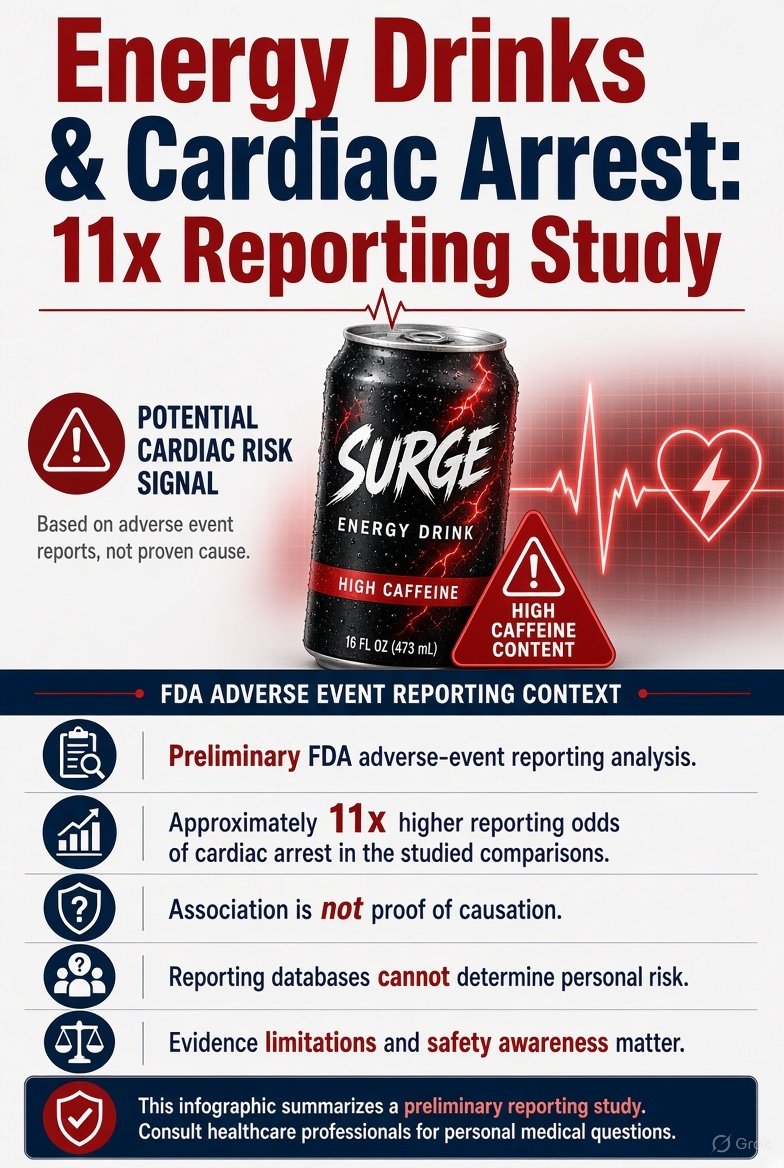
Energy drinks and cardiac arrest: the 2026 11× claim explained. A preliminary American Heart Association analysis of 28,345 FDA adverse-event reports found disproportionately frequent mentions of cardiac arrest with caffeine- and stimulant-containing products. The 11× figure describes reporting odds, not an elevenfold increase in actual risk.
FACT CHECK: 11× reporting does not equal 11× real-world cardiac risk, and this analysis cannot establish causation.
Reviewed 22 November 2026 | AHA release 2 November; Scientific Sessions 6–9 November
Energy drinks and cardiac arrest: what did the 2026 study really find?
An American Heart Association (AHA) research summary published 2 November 2026 describes a preliminary analysis of voluntarily submitted United States Food and Drug Administration (FDA) adverse-event reports. Among those reports, mentions of cardiac arrest appeared approximately 11 times more often in the group associated with caffeine- or stimulant-containing energy products than in the comparison group. The researchers also identified disproportionately frequent reporting of other heart-related outcomes.
The most important part of the finding is often missing from viral headlines: 11× is a reporting comparison, not an elevenfold increase in a drinker’s actual chance of cardiac arrest. The database does not tell us how many people consumed the products without experiencing problems. Nor can a voluntarily submitted report demonstrate that the product caused the reported medical event. The work, abstract MDP0323, was presented in the context of AHA Scientific Sessions 2026 and was considered preliminary rather than a full peer-reviewed journal paper.
This article explains what was measured, what was not measured, how caffeine affects the body and what a consumer can reasonably do. It does not label a particular drink brand as responsible for any individual case.
28,345 FDA reports: how the study was designed
Investigators at the University of Virginia examined 28,345 reports of suspected adverse events in an FDA safety database covering 2017 through 2025. Of these, 854 reports involved products containing caffeine or certain other stimulants, including energy drinks and dietary supplements. The remaining 27,491 reports involved comparison products without those stimulants, including products such as soft drinks and other foods or supplements.
The researchers searched for reported cardiovascular events including cardiac arrest, myocardial infarction (heart attack), abnormal rhythms, palpitations, rapid heart rate, chest pain and fainting. The study included reports submitted by people aged 13 or older, but those reports are not a representative random sample of every consumer. Reports can come from consumers, clinicians or manufacturers, and reporting behaviour varies substantially.
The analysis classified exposure by ingredient groups rather than independently proving what one manufacturer put into one can. It included caffeine and methylxanthine-containing products as well as other stimulants such as synephrine and yohimbine. This broad grouping complicates any attempt to blame caffeine alone or to rank individual beverages from most to least dangerous.
What does 11× reporting odds actually mean?
The result is described as a reporting odds ratio or disproportionately frequent mention of a specific event among submitted adverse-event reports. The comparison asks how frequently cardiac arrest was named within one set of reports relative to another. That is different from the question a consumer cares about: ‘If one million people consume this product, how many will experience cardiac arrest compared with people who do not?’
To estimate a real-world incidence rate or relative risk, investigators would need a reliable count of exposed and unexposed people, information about the quantity and frequency consumed, an appropriate comparison population and safeguards against confounding. The FDA report collection lacks those denominators. In the analysis reported by medical publications, the cardiac-arrest reporting odds ratio was about 11.15, with substantial statistical uncertainty; the headline rounds it to 11.
Imagine that an event is unusually likely to be reported when it follows a highly publicised energy drink. The reports could rise without the event becoming equally more frequent in the entire population. Conversely, some serious events might never be reported. A reporting signal justifies further investigation; it is not a personalised probability calculator.
Heart attacks, palpitations and chest pain: the other reported numbers
The AHA summary also reported that heart attacks were mentioned approximately 4.5 times as frequently in the stimulant-associated reports. Ventricular arrhythmias and heart palpitations were each mentioned about four times as often; a faster heart rate roughly three times; chest pain 2.71 times; and fainting approximately twice as often. Each number refers to the pattern within safety reports, not the risk measured in a controlled trial.
Cardiac arrest, heart attack and heart palpitations are different conditions. Cardiac arrest means the heart suddenly stops pumping blood effectively and is an immediate emergency. A heart attack usually occurs when blood flow to part of the heart muscle is blocked. Palpitations describe awareness of an unusual heartbeat, which has many potential causes and can be benign or serious depending on symptoms and underlying health.
Combining these conditions into a headline such as ‘energy drinks cause 11 times more heart attacks’ would change the study’s outcome and mislead readers. It is also wrong to apply the cardiac-arrest number to every cup of coffee or every dose of caffeine.
Why did adults aged 18–34 appear so prominently?
Approximately 45% of the reports involving caffeine- or stimulant-containing products and cardiovascular outcomes referred to adults aged 18 to 34. That is an age distribution within a selected group of reports. It does not establish that 45% of all young energy-drink users will have heart disease or that young adults are at elevenfold absolute risk.
Potential explanations include frequent consumption among younger adults, combining energy drinks with pre-workout supplements, consuming large quantities before strenuous exercise, mixing stimulants with alcohol or other substances and previously undiagnosed heart conditions. These possibilities were discussed by the research team; the analysis did not prove which one explains individual cases.
For young readers, the sensible question is about actual exposure and symptoms. An energy shot, strong coffee and pre-workout powder consumed within hours of one another can contribute to a large total stimulant dose even if no single product seems excessive. Tracking the full daily amount is more informative than counting only cans.
Caffeine dose: how much is generally considered safe for adults?
The FDA and the AHA’s 2026 scientific statement cite up to 400 milligrams of caffeine per day as an amount generally not associated with negative effects for most healthy adults. That is not a recommendation to consume 400 mg, a target to reach or a guarantee that everyone will tolerate that amount. Pregnancy, medications, heart conditions, individual sensitivity and other circumstances can require different limits.
Energy drinks and concentrated energy shots may deliver considerably more caffeine per fluid ounce than ordinary brewed coffee. However, caffeine content varies enormously by brand, can size and serving. One large container may include more than one labelled serving. To calculate intake, add milligrams from each serving, then include tea, coffee, cola, chocolate, pre-workout mixes and caffeine tablets consumed the same day.
For example, a hypothetical 160 mg can plus a 100 mg coffee and a 200 mg pre-workout serving totals 460 mg, exceeding the general 400 mg adult reference point. The figures are illustrative, not a statement about a named brand. Never infer that staying below 400 mg makes any combination automatically harmless, especially when the product includes multiple pharmacologically active stimulants.
Why energy drinks are not the same as coffee or water
The caffeine effects of regular coffee have been studied extensively, and the AHA’s 2026 statement describes a different evidence profile for moderate coffee intake than for concentrated energy products. Some energy drinks include caffeine plus guarana, other botanicals, sugars or stimulant combinations, while energy shots and pre-workout powders can vary further. A report grouping all of them does not make them biologically identical.
Label transparency also matters. A serving-based number can conceal the total in a large package if someone drinks the whole container. A ‘zero sugar’ claim says nothing on its own about caffeine, yohimbine or other stimulant content. Likewise, labels such as ‘natural’, ‘sports’, ‘focus’ or ‘vitamin enriched’ are not medical safety assessments.
Healthy hydration is a separate question: water is normally more appropriate for routine fluid replacement, particularly during ordinary activity. Strong caffeine products should not be treated as medicines, treatments for fatigue caused by illness or substitutes for sleep. Where relevant, an athlete should check the actual ingredients and the rules governing stimulant use in their sport.
What did the researchers and the supplement industry disagree about?
The AHA press release characterised the analysis as a possible safety signal deserving systematic monitoring and better research, rather than proof of direct causation. AHA volunteer cardiologist Gregory Marcus explicitly cautioned that other factors could explain the associations. The original report was a conference abstract and not a completed peer-reviewed clinical study.
The US Council for Responsible Nutrition, an industry organisation, challenged the analysis because it combined highly different drinks, energy shots and supplements. Its response emphasised missing dosage data, different ingredient mixes and the absence of any count of people who used these products without adverse effects. Those criticisms are methodologically relevant, while the council also represents commercial interests in the supplement sector.
Both points can be true: an association from an imperfect database may deserve attention, and the resulting number still cannot quantify the risk to a person buying an energy drink. Good health reporting neither dismisses a possible signal merely because an industry group disagrees nor exaggerates preliminary evidence into a settled causal finding.
India readers: labels, imported products and caffeine checks
This American analysis used a US FDA database, so it should not be described as a measured Indian population risk. India has its own food labelling and product-category requirements under the Food Safety and Standards Authority of India (FSSAI). Readers should check the actual caffeine amount per serving, serving size and warning language on the package sold locally, rather than assume US and Indian formulations always match.
FSSAI’s caffeinated-beverage regulations include category-specific composition and labelling provisions, including a daily-consumption advisory on qualifying products. Those provisions are regulatory product standards, not a personalised medical threshold for everyone with a heart condition. Imports and supplement powders may need different category checks. A trustworthy retail label does not prove a product could never be associated with an adverse event.
One practical habit is to photograph or retain the ingredient and caffeine label if an unexpected reaction occurs, especially when several stimulant products are being used. A clinician can consider the exact amount, timing, medicine interactions, health history and symptoms; the brand name alone is rarely enough to establish the cause.
Who should be more cautious, and when is medical help urgent?
Children and teenagers should generally avoid energy drinks, according to guidance cited by the FDA and the American Academy of Pediatrics. Pregnant people and those with known arrhythmias, poorly controlled blood pressure, certain structural heart disorders or medications that interact with stimulants should seek individual medical advice rather than use the general adult caffeine figure as personal clearance. A history of fainting, unexplained palpitations or chest discomfort deserves professional assessment.
If someone develops severe chest pain, trouble breathing, collapse, loss of consciousness, persistent new irregular heartbeat or sudden severe symptoms, seek emergency medical services immediately. Do not wait to see whether the symptoms pass after the drink wears off. If someone is unresponsive and not breathing normally, a bystander should activate emergency response and follow CPR/AED instructions where trained and available.
Milder concerns such as persistent jitteriness, sleep disruption or racing heart after caffeine also warrant cutting off further stimulant intake and discussing repeated episodes with a healthcare professional. Do not treat suspected cardiac symptoms with self-prescribed supplements or home remedies.
How to assess your own energy drink and pre-workout habits
Start with the number of milligrams of caffeine rather than slogans on the front of the can. Check whether the product lists multiple servings, count other caffeine sources during the day and take note of stimulant names such as guarana, synephrine and yohimbine. Read warnings about age, pregnancy and underlying conditions. Avoid stacking multiple concentrated products simply because each advertises ‘focus’ or ‘energy’.
Next, look at the context in which you use the product. High-intensity exercise, dehydration, sleep loss, some recreational substances and alcohol can complicate the picture. The 2026 study did not assign a separate causal risk to every one of these factors; nevertheless, clinicians may ask about them when investigating episodes of palpitations or fainting.
Finally, seek medical assessment rather than experimenting with higher doses if symptoms recur. Sharing the timing, amount and ingredients of products can be more useful to your clinician than telling them only that you had an energy drink. If a suspected adverse event is reported, the reporting system helps identify signals but does not itself adjudicate causation.
Fact-check and future search questions about the 11× claim
The following claims are not equivalent: ’11 times more cardiac arrest reports in a selected FDA database’, ’11 times higher risk of cardiac arrest in all energy-drink consumers’, and ‘a named brand caused a cardiac arrest’. Only the first describes this particular preliminary comparison; the latter claims require much stronger evidence. Similarly, the 4.5× figure refers to reporting of heart attacks, not a universal product-associated incident rate.
Useful reader questions include ‘AHA energy drinks 11 times cardiac arrest real risk’, ‘energy drink reporting odds ratio explained’, ‘28,345 FDA adverse events 2026 abstract’, ‘energy drink vs coffee 400 mg caffeine’, ‘pre-workout heart palpitations warning’, and ‘energy drink cardiac arrest India fact check’. These are anticipated information needs, not invented Google Trends volumes.
The reliable takeaway is proportional: know your caffeine and stimulant exposure, treat new heart symptoms seriously, and read the research for what it actually measured. The original AHA release states the study’s limitations clearly, making it a much stronger source than a shortened viral screenshot.
Energy Drinks and Heart Health: FAQs
Do energy drinks make cardiac arrest eleven times more likely?
This preliminary FDA-reporting analysis did not calculate consumer risk. Its elevenfold figure is a difference in reporting odds within submitted reports, not an incidence rate.
How many FDA reports were analysed?
28,345 reports from 2017–2025, including 854 mentioning caffeine or stimulant-containing energy drinks or supplements and 27,491 comparison reports.
Was the 2026 American Heart Association study peer-reviewed?
The AHA specifically called it a preliminary conference abstract, not a peer-reviewed full journal manuscript.
Is 400 mg caffeine a safe target for everyone?
No. It is a general amount considered tolerable for most healthy adults, not a daily goal or guarantee for pregnancy, heart disease or individual sensitivities.
Does the research identify a dangerous energy drink brand?
No. Products were grouped by ingredient classes; brand-by-brand safety or causation cannot be established from this study.
What symptoms need emergency care after a stimulant product?
Severe chest pain, breathing difficulty, collapse, loss of consciousness or major sudden cardiac symptoms require immediate emergency assessment.
Conclusion, official sources and safety note
The study is a preliminary safety signal, not a calculated risk increase. Check total caffeine exposure, take symptoms seriously and seek urgent medical care for potentially serious cardiac signs.
- American Heart Association – preliminary energy drink and cardiac reporting study, 2 November 2026
- American Heart Association – Caffeine and Cardiovascular Disease, 2026 scientific statement
- US FDA – Spilling the Beans: How Much Caffeine Is Too Much?
- American Academy of Pediatrics – caffeine and children’s health
- Council for Responsible Nutrition – critique of the preliminary reporting analysis
Medical disclaimer: General health information only, not a diagnosis or personalised treatment recommendation. Seek professional medical assessment for symptoms.






















Share Your Opinion
Comments are closed on this post.