 Vista

Westminster Abbey Roman Sarcophagus 2026: new archaeological research reinterprets a Roman coffin excavated in 1869. Its surviving skeleton is medieval (radiocarbon AD 987–1052), and Abbot Ælfwig is the leading—but not definitive—identification; Abbot Wulnoth remains possible.
Updated: 22 November 2026 | Original research: October 2026
Westminster Abbey Roman coffin mystery: what was discovered in 2026?
The mystery is not about a newly unearthed coffin. A limestone Roman sarcophagus had already been excavated in 1869 on the North Green beside London’s Westminster Abbey. What changed in 2026 was the interpretation of the human remains inside. A new scholarly analysis by the Abbey’s consultant archaeologist Professor Warwick Rodwell, published online in October 2026, argues that the later occupant was probably an important Anglo-Saxon abbot rather than the Roman-era man named on the container.
The Abbey’s official announcement dated 21 October 2026 says the likely candidate is Abbot Ælfwig, who died around AD 1020. His successor Wulnoth, who died in 1049, remains another plausible candidate. The distinction is crucial: researchers have demonstrated that the coffin was reused centuries after its original construction, but they have not identified the skeleton by a surviving named DNA record or contemporary inscription.
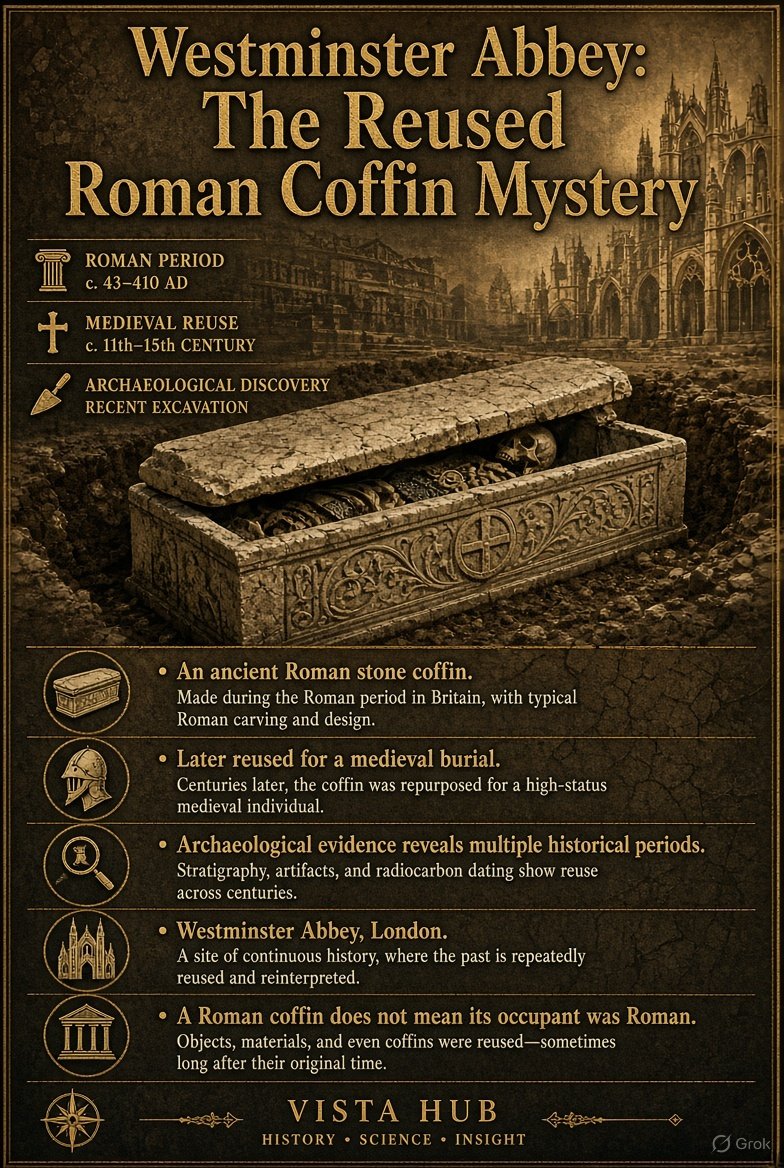
This is a story about an old object being given a new meaning by a later community. The Roman stone coffin, its inscribed name, a Christian cross cut into the lid, radiocarbon-dated bones and medieval architecture each document a different stage of that history.
Roman sarcophagus, medieval body: why the two dates differ
The sarcophagus bears a Latin inscription commemorating Valerius Amandinus, a prosperous person associated with Roman London between roughly AD 300 and 400. Its limestone body therefore belongs to the late Roman period. The lid, however, displays a large Latin cross associated with the tenth or eleventh century, suggesting modification during Anglo-Saxon Christian use.
A bone sample from the human remains was radiocarbon dated by the Scottish Universities Environmental Research Centre to a range of AD 987–1052. That range places the burial in the late Anglo-Saxon period, hundreds of years after the original Roman monument was created. Radiocarbon testing dates the biological material in the skeleton; it does not date the carving of the sarcophagus or reveal a person’s name.
Many viral retellings say ‘Roman skeleton found in a 1,000-year-old coffin’, which reverses the chronology. The physical coffin is Roman; the bones now linked with it are medieval. Recognising two distinct periods is the key to understanding why researchers call this an example of funerary reuse.
Who was Valerius Amandinus, and was he inside?
The Latin text on the side of the stone coffin refers to Valerius Amandinus. Scholars interpret the inscription as evidence that the object was first prepared to commemorate a man who lived in Roman Britain. That information tells us something about the monument’s original identity and the Roman funerary landscape of London, but it cannot establish that the skeleton recovered in 1869 is his.
Because the later skeleton dates to around the turn of the eleventh century, the best evidence shows that the Roman inscription and recovered bones do not represent the same individual’s original burial. Archaeologists do not yet know exactly where the sarcophagus was first erected, where its earliest remains went or how many times the monument may have moved before being placed at Westminster.
The inscription is part of the evidence for reuse, not proof that the deceased had two names. A Roman memorial could remain valuable to medieval custodians because of the strength, beauty and prestige of an already carved stone burial container.
How the 1869 discovery became a 150-year archaeological puzzle
Work on the north side of Westminster Abbey brought the sarcophagus to investigators’ attention in 1869. The location was a former sacristy-yard area associated with medieval Abbey buildings. Nineteenth-century observers noticed the apparent clash between the Roman inscription and a more recent Christian cross, and discussions about who lay inside continued for generations.
Knowledge did not advance in one straight line. The coffin was reported, studied, moved and preserved; later excavations and documentary research revisited the setting. Specialists reassessed the remains with more reliable biological techniques and better knowledge of Westminster’s early monastic history. The new 2026 publication pulls these separate lines of investigation together.
Calling it a ‘newly discovered Roman tomb in 2026’ would be inaccurate. A search-friendly explanation should give both key dates: 1869 for the original excavation and October 2026 for the fresh research interpretation.
What the skeleton analysis found about the deceased man
Human bone specialist James Young Langthorne of Pre-Construct Archaeology assessed the surviving remains. The Abbey says the individual was a man who died between approximately 35 and 49 years old and stood around 5 feet 9 inches tall. The new assessment differs from nineteenth-century descriptions that considered the man younger and somewhat shorter.
These estimates derive from the bones and accepted bioarchaeological methods; they are not a photograph or exact medical file. Because the skeleton has been disturbed, conclusions require particular care. The dates and physical characteristics help narrow a field of historical candidates without uniquely identifying one by themselves.
The strongest inference comes when the biology is combined with the special quality of the burial and with the identities of monastery leaders known to have died at Westminster in the relevant period. That is why the paper discusses high-ranking religious individuals instead of claiming that bone shape alone reveals their occupation.
Why Professor Rodwell favours Abbot Ælfwig over Wulnoth
Two abbots fit the likely period: Ælfwig, who served from AD 993 to about 1020, and Wulnoth, who succeeded him and died in 1049. Both deaths are compatible with the radiocarbon age range, and neither has a definitively documented birth year that could eliminate the other from an adult-skeleton profile.
Professor Warwick Rodwell judges Ælfwig more likely because he had already been a Westminster monk before becoming abbot, while Wulnoth is not equally supported by that local background. The unusual honour of burial inside a substantial Roman sarcophagus also suits an important religious figure. But this is a historically reasoned preference, not a laboratory identification with 100 percent certainty.
The responsible answer to ‘whose bones are in the Roman coffin?’ is thus: probably an Anglo-Saxon abbot, possibly Ælfwig, with Wulnoth another candidate. A definitive personal identity remains unproven. A headline that says a named monk was conclusively identified would overstate the research.
Wooden coffin, lime and the reused Roman stone container
Rodwell’s reconstruction suggests that the individual was originally placed in a wooden coffin surrounded by lime, and that this wooden container was then enclosed within the older stone sarcophagus. The timber has since decayed, so this part of the reconstruction depends on archaeological clues rather than an intact wooden box visible today.
The sarcophagus was an impressive and durable object for a high-status burial. The older inscription remained on its side, while a large cross carved onto the lid signalled Christian use and new commemorative meaning. Such reuse illustrates how medieval communities sometimes incorporated prestigious material from Roman buildings and monuments into their own sacred spaces.
Lime used around a burial should not be sensationalised as evidence of poisoning, a secret plague or some forbidden ritual. Archaeologists consider burial practices, preservation and physical context before proposing why material was present. There is no basis in the 2026 announcement for a supernatural explanation.
Where was the coffin buried, and why was it moved?
The paper proposes that the later burial may originally have been placed in an important part of the early Anglo-Saxon Abbey, possibly its eastern arm. It was later relocated into the sacristy-yard area, where the Roman coffin remained beneath medieval ground level until nineteenth-century works exposed it.
Westminster Abbey underwent substantial changes during the Middle Ages, including rebuilding programmes associated with King Henry III. Reconstructing where earlier graves were situated is difficult because later floors, walls and construction work altered the original landscape. Research therefore compares buried architecture, records of Abbey construction and the coffin’s physical position.
These details matter because an important ecclesiastical burial could be moved respectfully as the building changed. The burial’s later location is not, by itself, the place where the first Roman occupant was interred, nor does it prove a dramatic theft of ancient remains.
What is radiocarbon dating, and what can AD 987–1052 prove?
Radiocarbon dating measures the remaining carbon-14 in organic material. In bone, its results are interpreted against calibration datasets to obtain a probable calendar-date range. The Westminster result of AD 987–1052 strongly supports a person from the Anglo-Saxon period, around the era of the two proposed abbots.
The technique does not determine the stone container’s quarry date, the precise date the lid cross was cut or a person’s occupation. It can also have inherent uncertainties, so presenting a single year such as ‘buried in 1020 exactly’ would not be justified merely by the carbon test.
To move from a scientific date to a historical name, archaeologists must combine context, documentary evidence and plausible biography. This is a good general lesson in how archaeological evidence works: a clear test result can answer one question while leaving another unresolved.
Can visitors see the Roman coffin at Westminster Abbey today?
Westminster Abbey says the sarcophagus is on permanent display in the Queen’s Diamond Jubilee Galleries, the Abbey’s museum spaces in London. Visitors interested in the Roman inscription or later Christian decoration can consult the official Abbey website for current opening hours, access rules and any separate gallery-ticket arrangements.
The object is much more useful to study when its two historical layers are recognised. The Roman text reflects the earlier memorial tradition, while the altered lid and the medieval skeleton connect it to Westminster’s Benedictine community centuries later. A single archaeological object can record multiple periods of British religious and urban history.
Do not confuse the Abbey with Westminster Cathedral: they are different London churches. The 1869 find and the 2026 paper concern Westminster Abbey.
Why this discovery matters beyond the name of a monk
Finding a probable occupant of the sarcophagus helps archaeologists think about how Westminster’s early monastic community honoured senior leaders, how Roman materials were reused and how religious spaces developed before the Abbey took its better-known later form. The research also shows the benefit of retaining objects that could not be fully understood when first excavated.
Scholarly revision does not mean archaeologists originally invented the story. Different generations had different evidence and analytical tools. Old excavation notes, a surviving coffin, modern bone analysis and historical interpretation are all valuable because they can be tested against one another.
A practical fact-check list for readers is: inscription to Valerius Amandinus; Roman stonework around the fourth century; nineteenth-century excavation in 1869; medieval Christian cross; skeletal age range AD 987–1052; Ælfwig as leading candidate; Wulnoth as alternative. None of these facts individually proves an exact historical identity.
Roman coffin pictures and future reader questions
The featured image and the infographic on this page are educational illustrations prepared to explain the archaeological story. They should not be presented as authentic photographs of the 1869 excavation or the actual skull. For verified object photographs and the original research, use Westminster Abbey’s official announcement and the scholarly paper.
Useful next-search questions include ‘Westminster Abbey Roman coffin who was buried’, ‘Ælfwig vs Wulnoth skeleton’, ‘Valerius Amandinus inscription meaning’, ‘Westminster Abbey coffin radiocarbon 987 1052’, and ‘Queen’s Diamond Jubilee Galleries sarcophagus’. These are anticipated reader questions rather than claims about measured keyword volumes.
The conclusion is simultaneously exciting and limited: the coffin’s medieval reuse is strongly demonstrated, and a high-ranking abbot is a compelling identification. The exact man’s name remains a reasoned historical hypothesis.
Frequently Asked Questions
Who was found inside Westminster Abbey’s Roman coffin?
Researchers favour a high-ranking medieval abbot, with Ælfwig the leading candidate and Wulnoth another possibility; personal identity is not definitively proven.
When was the Roman sarcophagus discovered?
It was excavated on Westminster Abbey’s North Green in 1869, not newly found in 2026.
Whose name is written on the coffin?
The Roman Latin inscription commemorates Valerius Amandinus, associated with fourth-century Roman London.
What age did the carbon test give for the bones?
Approximately AD 987–1052, supporting a late Anglo-Saxon burial much younger than the Roman stone coffin.
Where can visitors see the sarcophagus?
Westminster Abbey says it is on permanent display in the Queen’s Diamond Jubilee Galleries; verify current access and opening hours.
Did DNA testing identify Abbot Ælfwig?
No. The suggested identification combines dating, archaeological context and historical evidence rather than a named DNA comparison.
Conclusion and original research sources
The coffin’s Anglo-Saxon reuse is strongly supported; Ælfwig remains a historical likelihood rather than a confirmed personal identification. Original Abbey and scholarly sources provide the most reliable interpretation.
- Westminster Abbey: official October 21, 2026 archaeological announcement
- Warwick Rodwell (2026), Westminster Abbey’s Roman Sarcophagus and its Afterlife — original scholarly paper
- Pre-Construct Archaeology: analysis of the Roman sarcophagus
- Smithsonian: why a Roman coffin was reused in medieval Westminster
Historical interpretation note: identity is provisional. Featured and infographic visuals are illustrations, not authenticated original object photographs.

























Share Your Opinion
Comments are closed on this post.