 Vista
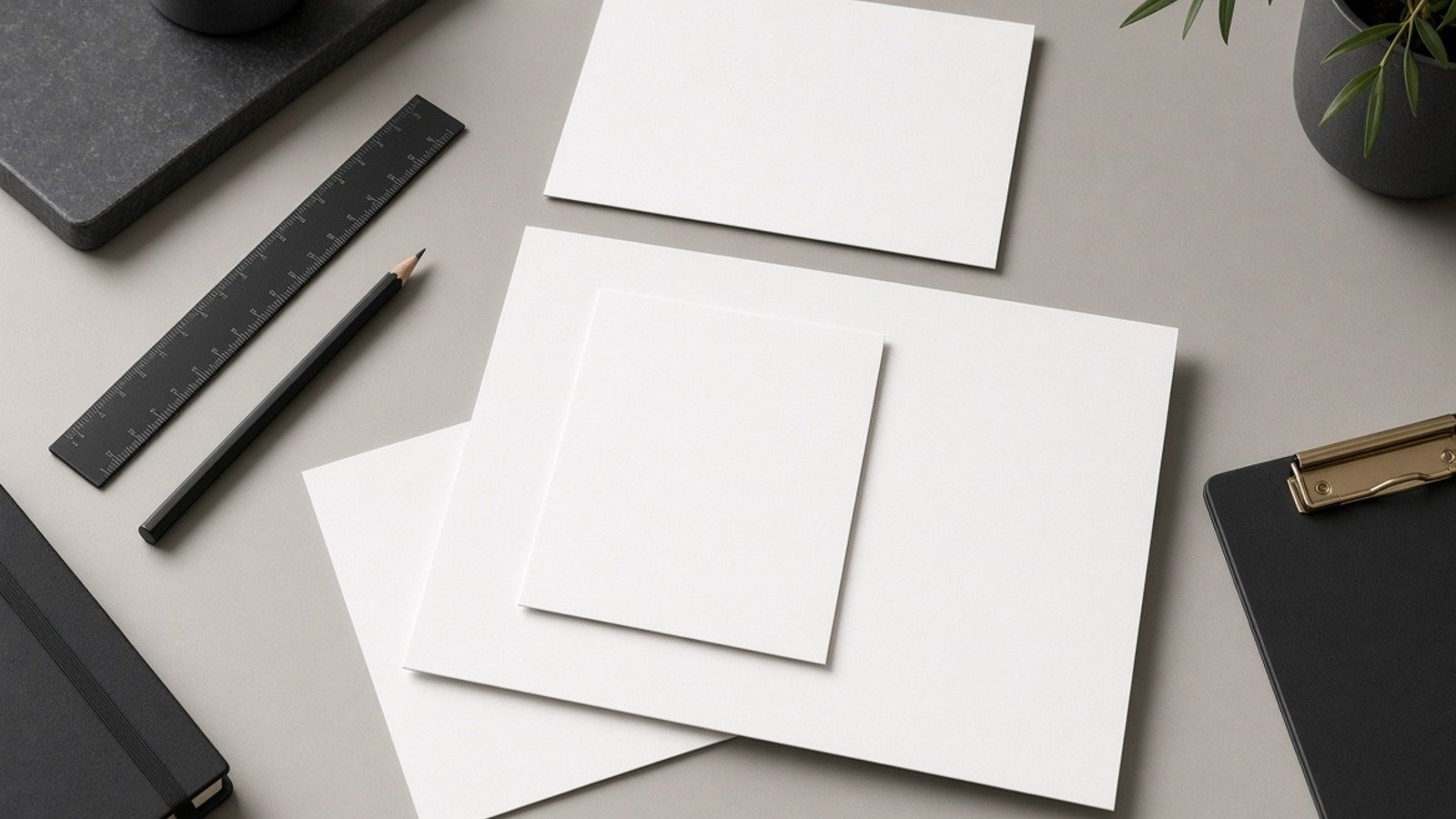
Quick answer: ISO A4 paper is 210 × 297 mm (8.27 × 11.69 inches), A3 is 297 × 420 mm, and A0 is 841 × 1189 mm. The A and B trimmed-sheet series are defined in ISO 216, while the related C labels are widely used for envelopes. The A series approximately maintains a 1:√2 aspect ratio as each size is halved.
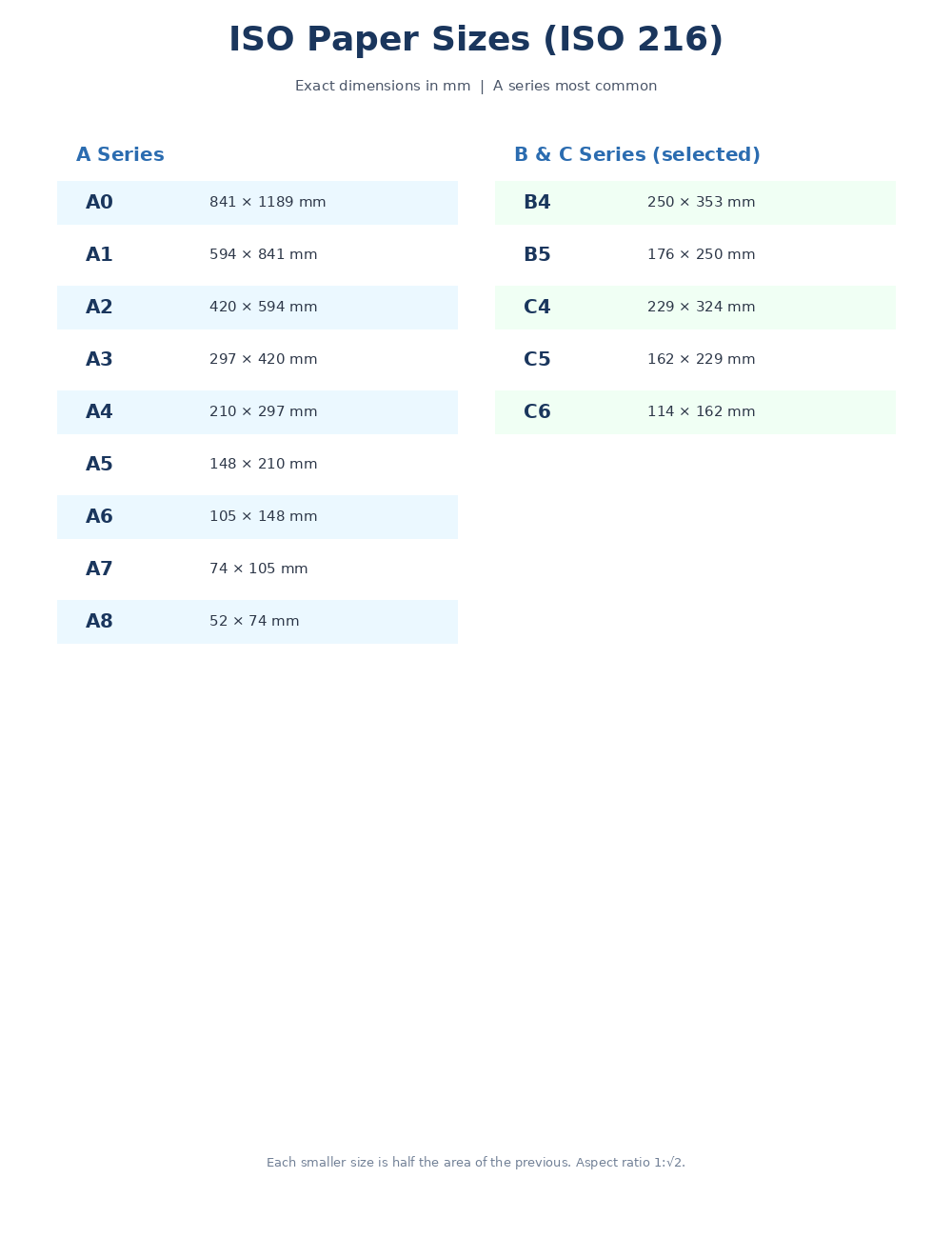
Updated: 21 November 2026. All inch values are approximate; dimensions are nominal.
Complete ISO A, B and C paper-size dimensions: mm and inches
| Format | Size in mm | Size in inches (approx.) |
|---|---|---|
| A0 | 841 × 1189 | 33.11 × 46.81 |
| A1 | 594 × 841 | 23.39 × 33.11 |
| A2 | 420 × 594 | 16.54 × 23.39 |
| A3 | 297 × 420 | 11.69 × 16.54 |
| A4 | 210 × 297 | 8.27 × 11.69 |
| A5 | 148 × 210 | 5.83 × 8.27 |
| A6 | 105 × 148 | 4.13 × 5.83 |
| A7 | 74 × 105 | 2.91 × 4.13 |
| A8 | 52 × 74 | 2.05 × 2.91 |
| A9 | 37 × 52 | 1.46 × 2.05 |
| A10 | 26 × 37 | 1.02 × 1.46 |
| B0 | 1000 × 1414 | 39.37 × 55.67 |
| B1 | 707 × 1000 | 27.83 × 39.37 |
| B2 | 500 × 707 | 19.69 × 27.83 |
| B3 | 353 × 500 | 13.90 × 19.69 |
| B4 | 250 × 353 | 9.84 × 13.90 |
| B5 | 176 × 250 | 6.93 × 9.84 |
| B6 | 125 × 176 | 4.92 × 6.93 |
| B7 | 88 × 125 | 3.46 × 4.92 |
| B8 | 62 × 88 | 2.44 × 3.46 |
| B9 | 44 × 62 | 1.73 × 2.44 |
| B10 | 31 × 44 | 1.22 × 1.73 |
| C0 | 917 × 1297 | 36.10 × 51.06 |
| C1 | 648 × 917 | 25.51 × 36.10 |
| C2 | 458 × 648 | 18.03 × 25.51 |
| C3 | 324 × 458 | 12.76 × 18.03 |
| C4 | 229 × 324 | 9.02 × 12.76 |
| C5 | 162 × 229 | 6.38 × 9.02 |
| C6 | 114 × 162 | 4.49 × 6.38 |
| C7 | 81 × 114 | 3.19 × 4.49 |
| C8 | 57 × 81 | 2.24 × 3.19 |
| C9 | 40 × 57 | 1.57 × 2.24 |
| C10 | 28 × 40 | 1.10 × 1.57 |
Understanding the ISO A, B and C paper-size systems
The familiar A4 sheet is part of the ISO 216 A series used in many countries for printing, writing and office work. ISO 216:2007 covers A and B trimmed paper sizes. The C format family is conventionally associated with envelope sizes and the historic ISO 269:1985 envelope designation system; ISO 269 is now withdrawn, so it should not be presented as a current revision of ISO 216. The three families have related size geometry but different intended applications.
The core idea is a rectangle whose longer side divided by its shorter side is approximately the square root of two, or 1.414. Halving a sheet along its longer side produces a smaller sheet with the same proportion, allowing artwork and documents to be enlarged or reduced with relatively little waste. Dimensions are rounded to whole millimetres, so multiplying printed sizes does not always recover exactly the ideal mathematical value. A reliable reference displays the standard dimensions and mentions rounding.
A0 to A10 dimensions in millimetres and inches
The A series begins with A0 at 841 × 1189 mm, which has an ideal area of approximately one square metre. A1 is 594 × 841 mm, A2 is 420 × 594 mm, A3 is 297 × 420 mm and A4 is 210 × 297 mm. Smaller formats include A5 at 148 × 210 mm, A6 at 105 × 148 mm and A10 at 26 × 37 mm. Width is listed before height in portrait orientation; rotating a page exchanges those dimensions without changing its size designation.
For international reference, divide any dimension in millimetres by 25.4 to convert it to inches. For example, A4 is approximately 8.27 × 11.69 inches and A3 is about 11.69 × 16.54 inches. A digital image displayed at 100% on a phone does not automatically reproduce these physical dimensions. If you are ordering a frame or document folder, rely on the physical size in millimetres rather than measuring pixels on the screen. The full table below gives A0 through A10 and the B/C counterparts.
B0 to B10: uses and how B differs from A
The B series is a second range of standardized trimmed paper sizes. B0 measures 1000 × 1414 mm, B1 measures 707 × 1000 mm, B2 is 500 × 707 mm and B5 is 176 × 250 mm. B sizes are positioned between comparable A sizes, offering an alternative for publishing, printing and specialty stationery. Although both A and B use a related aspect-ratio principle, the nominal dimensions are not interchangeable.
The label B5 needs care because the Japanese JIS B series uses different dimensions from ISO B series. In India and global online shopping, a notebook advertised simply as ‘B5’ might follow a regional market convention. To prevent disappointment, insist on the actual millimetre measurements. A4 paper is 210 × 297 mm, while ISO B4 is 250 × 353 mm; this is not a tiny rounding difference. The same caution applies to paper cutters, laminators, book covers and pre-cut packaging materials.
C0 to C10 envelopes and what the C4 designation means
C-series sizes are widely referenced for envelopes. A C4 envelope measures 229 × 324 mm and is designed to accommodate an unfolded A4 sheet of 210 × 297 mm. C5, at 162 × 229 mm, suits an A4 sheet folded once; C6, at 114 × 162 mm, can contain an A4 folded twice in the conventional way. The envelope is slightly larger than the sheet so the paper can be inserted rather than wedged into an exact-fit sleeve.
The whole C0–C10 series appears in the comparison table, but not every size is equally common at retail. A manufacturer may sell envelopes with windows, gussets or nonstandard dimensions while using familiar marketing descriptions. Check the finished inner usable space and whether a thick document bundle will fit. Since ISO 269 has been withdrawn, it is best to describe the C family as a conventional envelope dimension scheme rather than imply that every modern C-series packet carries a current ISO 216 certificate.
A4 vs Letter and Legal: why American documents may not fit
ISO A4 is 210 × 297 mm, whereas US Letter is 8.5 × 11 inches, approximately 215.9 × 279.4 mm. Letter is wider but shorter than A4. A design that fits one may lose margins or content when automatically printed on the other. US Legal is 8.5 × 14 inches, approximately 215.9 × 355.6 mm, and should not be confused with A4 or the Indian market’s sometimes differently labelled legal-size sheets.
Always look at the size settings inside the actual document and printer driver. ‘Scale to fit’, ‘actual size’, bleed, borderless printing and margins can change the resulting physical output. For administrative forms, admit cards and certificates, follow the issuing institution’s specified size rather than relying on the country’s most common default. Do not assume that digital PDF page dimensions will match a sheet selected in the printer tray; preview first to detect unwanted scaling.
How to choose paper for posters, books and invitations
A0 and A1 can be practical for large drawings and posters, while A2 or A3 may work for classroom displays. A4 is standard for many office documents, and A5 or A6 often suits small notebooks, brochures and postcards. For printing books or invitations, B series sizes may suit a particular design better, and corresponding C envelopes can simplify mailing. However the preferred size is a layout decision, not a sign that one paper family is superior for every task.
Before you print a large poster, decide how far away it will be viewed. Text that is readable on an A4 handout may be tiny on an A1 poster if its layout is not redesigned. Paper thickness is measured separately from dimensions, often in grams per square metre (gsm). An A4 sheet of 80 gsm and one of 200 gsm are both A4 but feel very different. For professional print work, consider bleed, trim tolerances, substrate quality and available printer capabilities.
What the 1:√2 aspect ratio does for resizing
A-series sheets form a nested family because each ideal size has the same ratio. When you enlarge an A4 page onto A3, the linear scale factor is approximately the square root of two, or 141.4%. Conversely A3 reduced to A4 is about 70.7%. The area doubles or halves as you move one size step. Small rounding differences in the nominal millimetre dimensions are expected and usually irrelevant to normal page copying.
This proportional relationship is not shared by every page format worldwide. US Letter, many photographic formats, business cards and digital display aspect ratios differ. An image designed for a 16:9 screen will crop or leave whitespace when printed full-bleed on A4 unless the layout is adjusted. A modern content creator should distinguish page aspect ratio from pixel resolution. A good reference chart gives the shape and physical dimensions, not an arbitrary ‘recommended pixel count’ without a printer resolution assumption.
Print setup: converting paper size to pixels at a chosen DPI
Pixels are not an inherent attribute of an A4 sheet. A file prepared at 300 pixels per inch requires roughly 2480 × 3508 pixels for A4 because 210 and 297 millimetres correspond to about 8.27 and 11.69 inches. At 150 pixels per inch, the pixel requirement is about half on each axis. These are design-target calculations and do not alter the actual paper dimensions.
Different print processes need different resolution targets. Vector artwork can scale without the same pixel constraints as a raster photograph, while text legibility depends on font size and viewing distance. For professional print jobs, confirm the required colour mode, bleed and crop marks with the printer. Avoid assuming that downloading a 1600-pixel-wide internet poster guarantees sharp A0 printing. Proper file preparation and physical paper measurements should be decided together.
Paper-size mistakes to avoid in online charts
A common infographic error is calling a C4 envelope the same size as an A4 sheet; it is slightly larger so the paper can fit. Another is giving a B5 dimension without stating ISO B versus JIS B. A third is presenting US Letter as a metric A4 equivalent. Errors can also enter when a diagram is generated by a model that draws nested rectangles by eye without preserving true proportions.
For school charts, show the exact A, B and C millimetre values and give inches as rounded conversions. Ask readers to use the tabular reference for measurements rather than drawing a ruler against a decorative image. The ISO standard page is authoritative for the paper family; external educational dimension tables are useful for the C envelopes and JIS comparisons. For costly printing, confirm current stock and sizes with the printer or manufacturer.
Frequently asked questions about ISO paper sizes
What is A4 paper size in inches?
Approximately 8.27 × 11.69 inches, corresponding to 210 × 297 mm.
Is B5 always 176 × 250 mm?
That is ISO B5; Japanese JIS B5 uses different dimensions, so check the specific product.
Which envelope fits an unfolded A4 page?
A C4 envelope, commonly 229 × 324 mm.
Does ISO 216 include the C envelope series?
No. ISO 216 covers A and B trimmed paper. C envelope sizes are associated with a separate historical ISO 269 designation system.
Why do A4 and A3 resize neatly?
They use an approximately 1:√2 aspect ratio, so halving the longer dimension preserves proportion.
Is 300 DPI part of A4’s official physical size?
No. DPI affects raster image pixel counts, not nominal sheet dimensions.
Conclusion
For reliable print and stationery decisions, use the exact physical millimetre dimensions, verify whether B refers to ISO or JIS, and choose a matching C envelope when required. A visual size chart is useful for scale; the table is the dependable measurements reference.
Sources and standards
- ISO — ISO 216:2007 official standard
- ISO catalogue — paper and envelope standard status
- University of Cambridge — international paper dimensions
- Adobe — global paper-size overview



















Share Your Opinion
Comments are closed on this post.