 Vista
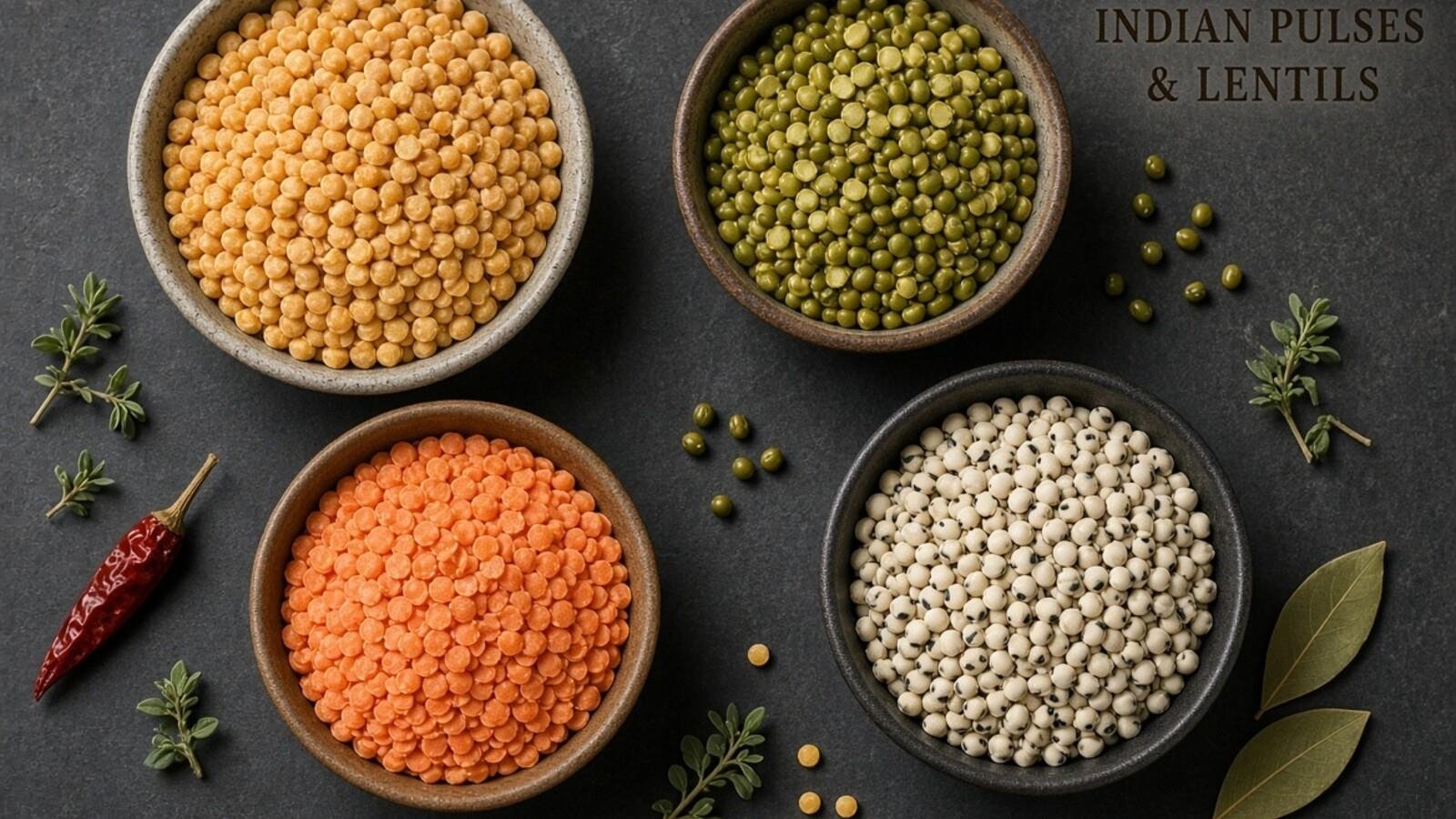
Quick answer: An Indian pulses and lentils chart helps distinguish pigeon pea or toor dal, moong or mung beans, masoor or lentils, urad or black gram, chana dal and other common legumes. The colour and shape of a dal change after splitting, dehulling, polishing or roasting. A trustworthy comparison shows English crop names alongside Hindi and regional names rather than treating every yellow or orange split pulse as identical.
Updated: 21 November 2026.
Indian dal names in English and Indian languages
| English crop | Hindi | Marathi | Bengali |
|---|---|---|---|
| Pigeon pea | Toor/Arhar | तूर/अरहर | তুর/অড়হর |
| Mung bean | Moong | मूग | মুগ |
| Lentil | Masoor | मसूर | মুসুর |
| Black gram | Urad | उडीद | কলাই/বিউলি |
| Chickpea | Chana | हरभरा | ছোলা |
| Field pea | Matar | वाटाणा | মটর |
Pulses, lentils, legumes and dal: the difference
Legumes are the wider plant family; pulses are dried edible seeds of certain leguminous crops, while dal often refers in Indian kitchens to dried pulses that are split, dehulled or cooked into a dish. Lentil specifically denotes Lens culinaris, although ‘lentils’ is sometimes used loosely for all dal in English. Fresh green peas and dried peas may be classified differently in food and trade contexts. Understanding the labels prevents confusion when a recipe says ‘red lentils’ or ‘yellow dal’ without the actual crop name.
One difficulty with English food searches is that ‘lentil’ may be used generically for Indian dals even when the crop is not Lens culinaris. A grocery reference should tell readers both the trade name and the biological crop. Split chickpea, pigeon pea and lentil have different cooking behaviour. This distinction matters more than whether a food photograph happens to show yellow or orange seeds.
Toor or arhar dal: pigeon pea
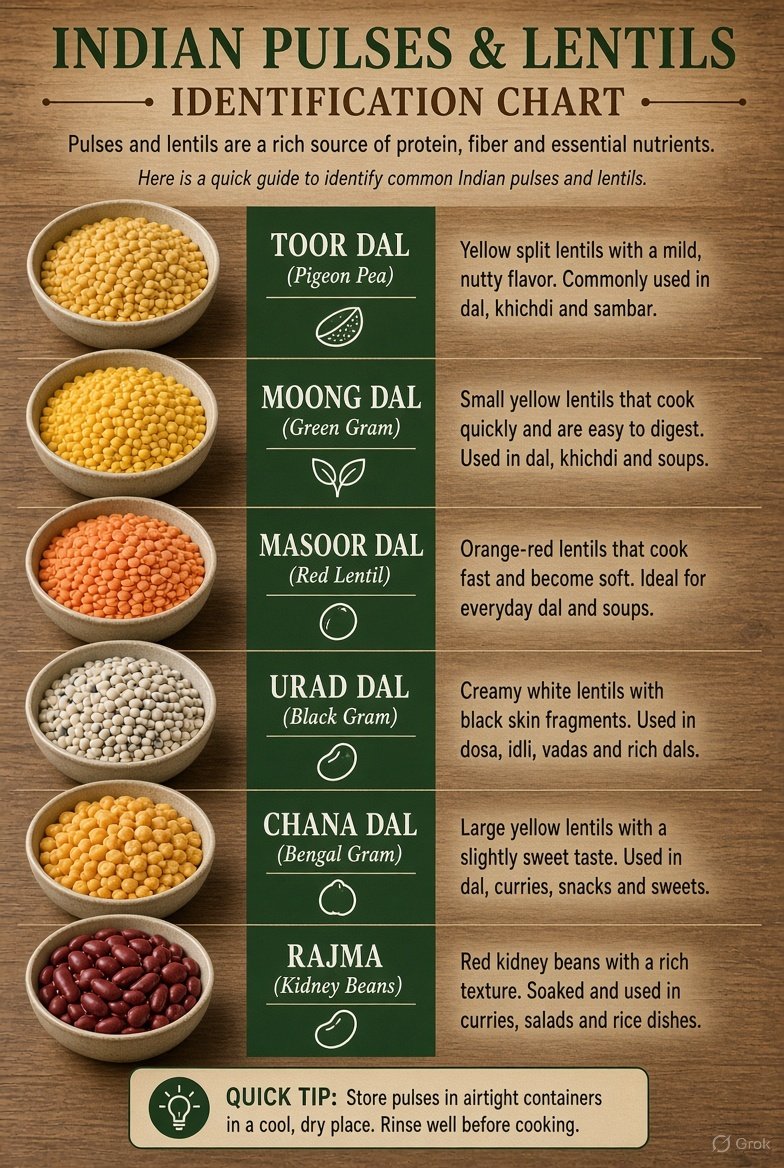
Toor, tur and arhar commonly refer to pigeon pea, Cajanus cajan. Its dehulled split grains are yellow and appear in everyday dal, sambhar and other regional meals. A bright yellow bowl does not uniquely identify toor because split moong and chana may also look yellow. Toor grains are often thicker than dehulled moong, but size varies by variety and processing. For confident identification read the product label or compare against a well-sourced seed sample.
Toor dal may be sold as arhar in North India and tur in Maharashtra. It is used in several regional preparations, with a different texture from many faster-cooking split pulses. When comparing toor to yellow moong, inspect seed size and shape, but do not assume a universal diameter; crop varieties and polishing change the appearance. An actual labelled sample is stronger evidence than a generated bowl image.
Moong dal: whole green versus split yellow
Moong or mung bean is Vigna radiata. Whole green moong has a green seed coat; split moong with coat shows green and yellow surfaces, while fully dehulled split moong appears yellow. The same crop therefore produces several visually distinct products. Sprouting needs particular hygiene because raw sprouts can carry microbial risks. Cooking whole moong and yellow split moong requires different times; do not assume every legume softens at the same speed.
Whole green moong, moong with skin and dehulled yellow moong can look like three unrelated groceries. They are processed forms of the same mung bean crop. This is useful for explaining why cooking time, colour and texture change. Sprouting creates a different food-handling issue: seeds need careful sanitation and vulnerable individuals may need to avoid raw sprouts. Cooking guidance for yellow split dal should not be copied directly onto raw sprouts.
Masoor dal: brown whole lentils and red split lentils
Whole masoor may appear brownish or green-brown, whereas the dehulled split form is commonly orange-red. Both are lentils, Lens culinaris. The bright colour of split masoor can fade with cooking; that is not evidence of a different species. Some supermarkets market the split form as ‘red lentils.’ For recipes, check whether they require the skin-on whole seed or the smaller split grain, because texture and cooking times differ substantially.
Masoor provides a particularly clear example of how processing changes an image. Whole lentil seeds may be brown while split dehulled masoor is often orange-red. When cooked, colour can fade and the dal may break down into a smooth consistency. A reader using an English recipe that says ‘red lentils’ should check whether split masoor is intended rather than replacing it with red kidney beans or another red-coloured crop.
Urad dal: black gram, white split urad and whole urad
Urad comes from black gram, Vigna mungo. Whole seeds are often dark-coated, while dehulled split urad appears pale cream or white. The difference is important for idli, dosa, vada and thick dal preparations, where the skin and grinding method affect the mixture. Black gram is not the same crop as the green mung bean despite the similarity of their English trade names. Label ‘whole black gram’ and ‘green gram’ separately in every chart.
Black gram’s dark seed coat and pale inner part explain why whole urad and washed white urad look dramatically different. Grinding dehulled urad into batter changes texture again, an important reason it is used in idli, dosa and vada preparations. Confusing it with green mung bean can affect taste and fermentation. Identify the crop through its actual label rather than translating every ‘gram’ word as if it described the same species.
Chana dal, chickpeas, peas and other beans
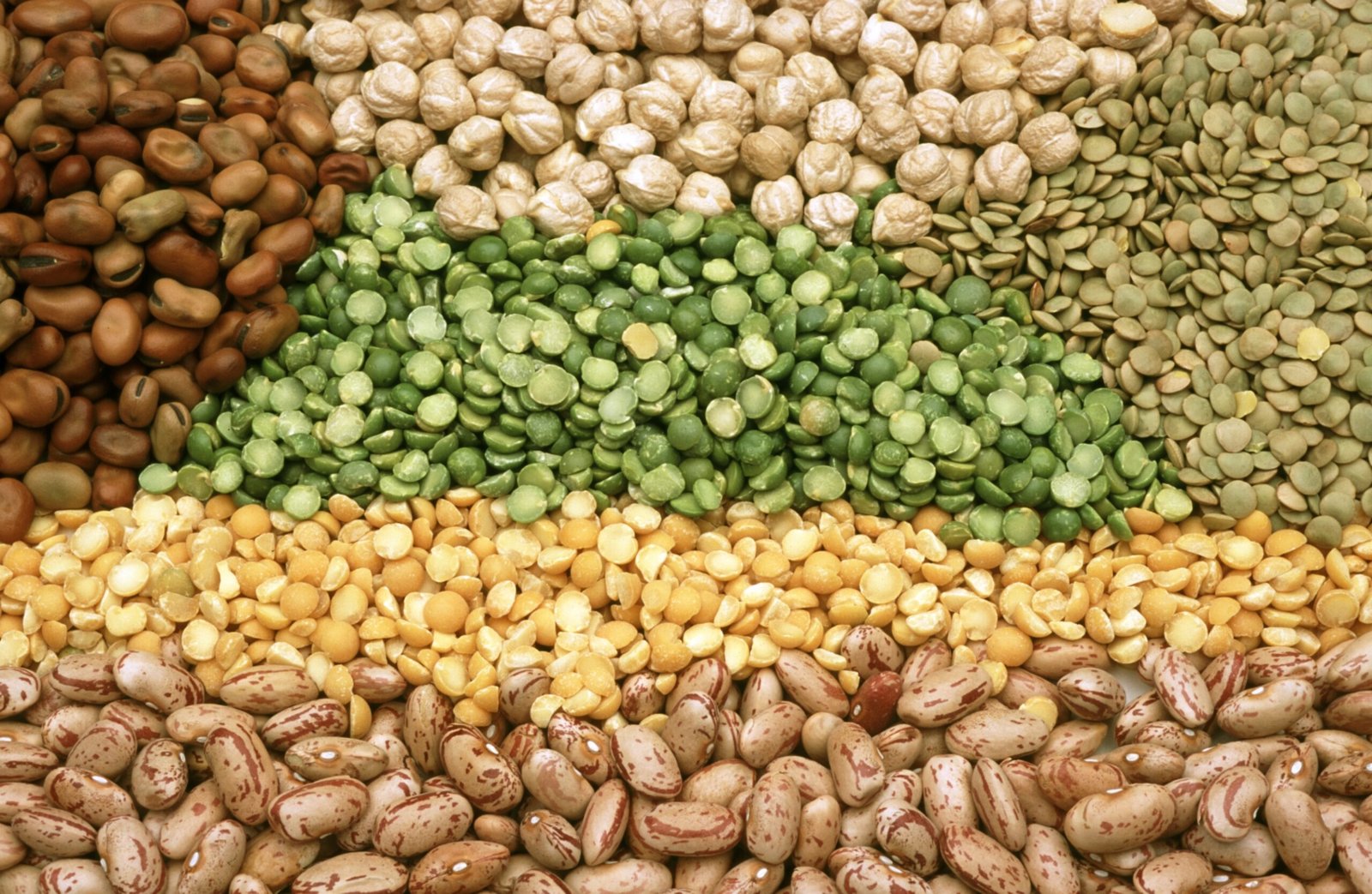
Chana dal is usually split desi chickpea, Cicer arietinum, and should not be confused with yellow split peas, which are a different crop. Whole kala chana and larger kabuli chickpeas also differ in variety and use. Dried matar or field peas, rajma beans and lobia are also common legumes but not interchangeable with one another. A carefully prepared table distinguishes the species rather than grouping all yellow rounds as ‘chana.’
Chana dal is derived from chickpea, while yellow split field peas come from a separate species and may have a different shape and cooking behaviour. Whole desi chickpeas, larger kabuli chickpeas and split chana are related but not identical retail products. If a recipe names Bengal gram, check whether it expects flour, split dal or whole seed. Chickpea flour and yellow split pea flour can also be visually similar after grinding.
Cooking, soaking, food safety and storage
Inspect pulses for stones, insects, mould and excess moisture before cooking. Rinse and use suitable soaking where the recipe requires it. Kidney beans in particular need adequate cooking to reduce natural lectin hazards; never suggest that slow, undercooked beans are safe merely because they have been soaked. Split moong may cook more quickly than whole chickpeas or rajma. Follow package and authoritative food-safety directions, cool cooked dal promptly and refrigerate leftovers appropriately.
Some dried legumes, notably kidney beans, can contain natural lectins that must be reduced through correct preparation. Soaking alone is not a safety guarantee, and cooking methods should follow authoritative food-safety advice for the exact beans. For ordinary dal, check for stones and insects before rinsing, use a clean cooking vessel and refrigerate leftovers in a timely manner. Do not use an approximate colour chart to determine safe cooking durations.
Nutrition, protein and common identification mistakes
Pulses provide plant protein, carbohydrate, fibre and several micronutrients, but cooked servings depend on water content, preparation and the wider diet. They are not a medical cure or an identical protein substitute by weight for every other food. Misleading infographics often label split moong as toor, red masoor as another bean, or whole urad as green moong. Use real labelled specimens, clear regional names and responsible captions. Look at grain size, shape, coating and whether it is whole or split rather than colour alone.
Protein comparisons between dry and cooked dal must be on the same basis. Dry pulses absorb water, so a hundred grams of cooked dal will not contain the same quantity of ingredients as a hundred grams of dry seed. Additions of butter, oil and salt also affect the dish. A picture guide should teach identification, not claim that one coloured dal is automatically the best remedy for a medical condition. Variety is valuable in an everyday diet.
Frequently asked questions
Is toor dal the same as moong dal?
No. Pigeon pea and mung bean are different species.
Is red masoor the same crop as whole brown masoor?
Yes, they are forms of lentil with different processing.
Why does urad look black or white?
The dark seed coat may be retained or removed.
Is chana dal the same as yellow split peas?
No, these come from different crops.
Can I identify dal by colour alone?
No. Check species and processing form.
Conclusion
The same pulse may appear whole, with seed coat, split, polished or as flour. Identify the crop and the processing form separately. If a seller’s bowl is unlabelled, comparison by colour and size alone can be unreliable. Ask for an ingredient list and check actual cooking guidance. Never assume that an attractive image is independent proof of food authenticity.
Sources / References
- APEDA — Pulses in India
- Government of India — Pulses terminology
- ICAR — National Agricultural Research
General food education; follow safe cooking advice and individual dietary guidance when relevant.

















Share Your Opinion
Comments are closed on this post.