 Vista
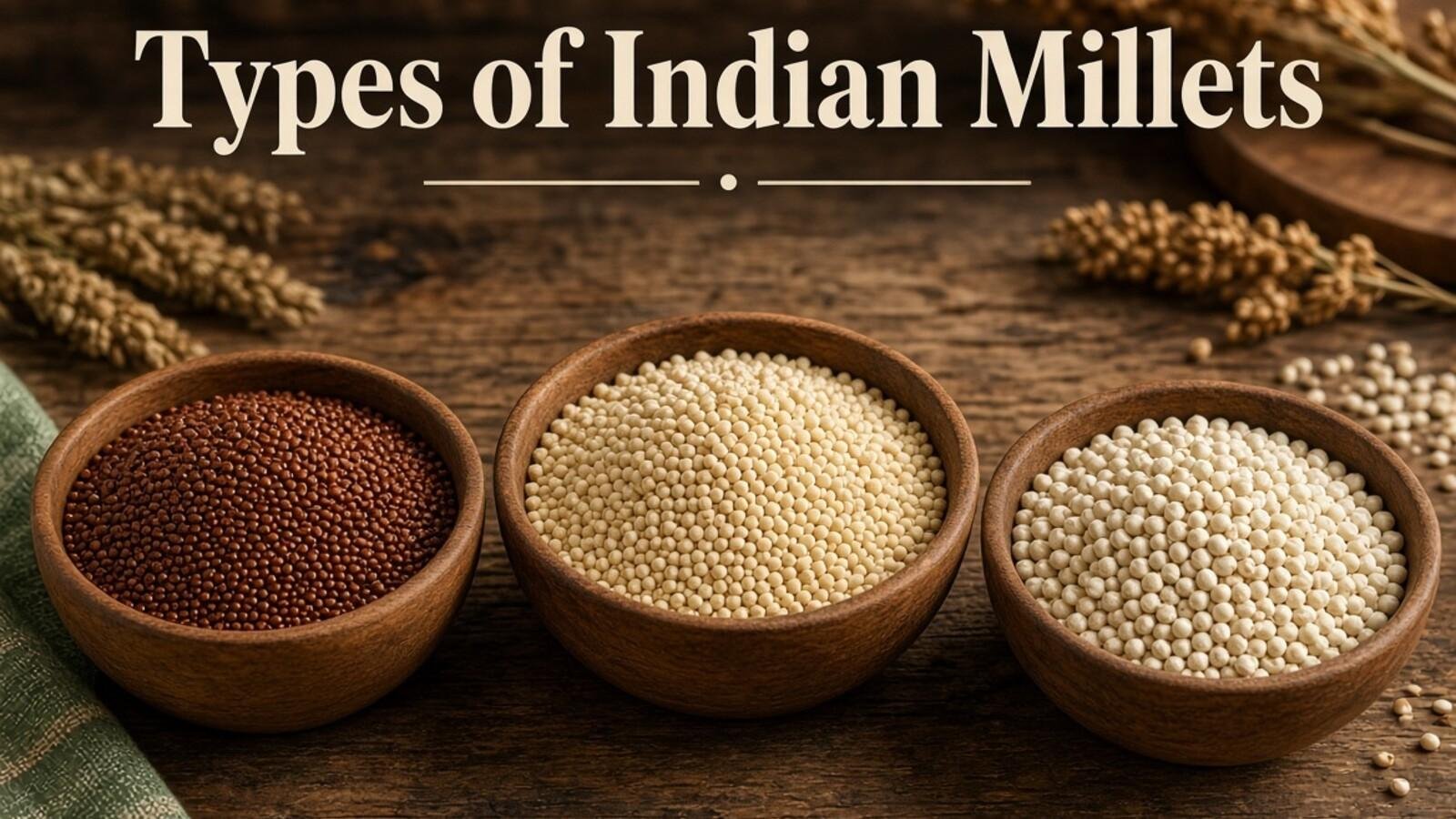
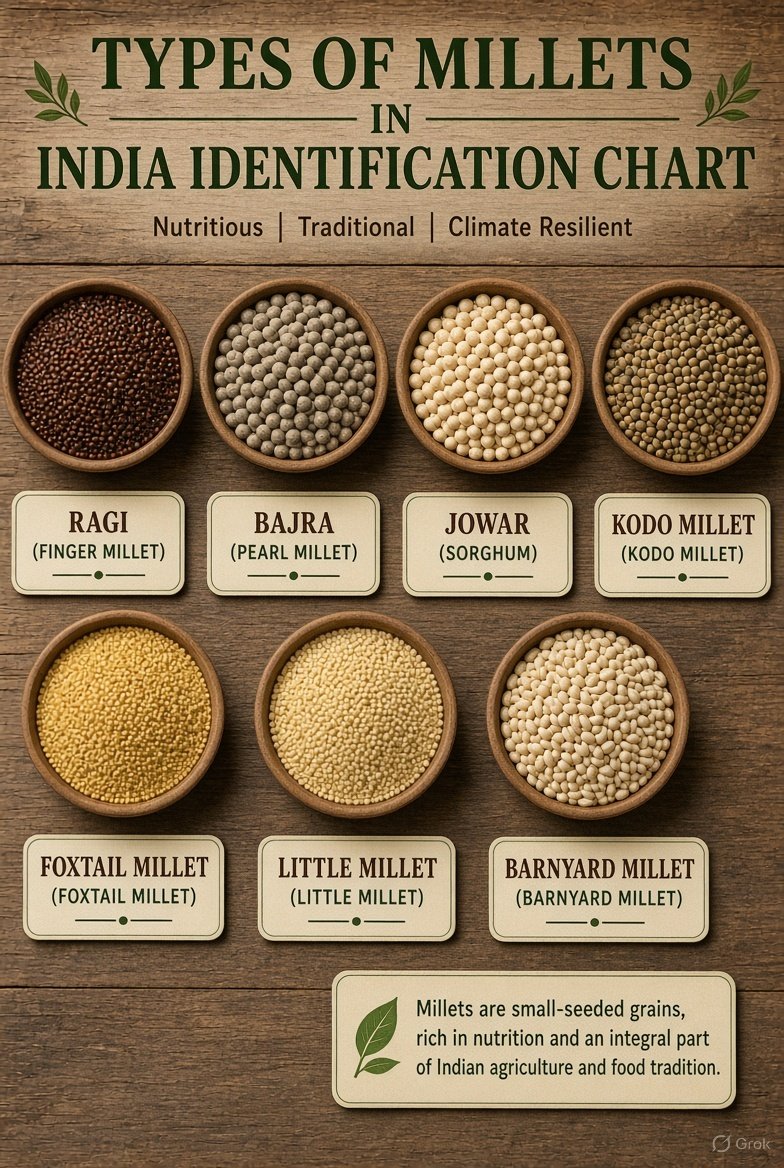
Quick answer: India’s millets include familiar grains such as bajra (pearl millet), jowar (sorghum) and ragi (finger millet), alongside smaller varieties such as foxtail, kodo, little, barnyard and proso millet. The same grain can have several Indian-language names. A trustworthy millet identification chart connects the English species name, local name, raw-grain appearance and cooking form without treating every tiny round grain as interchangeable.
Updated: 21 November 2026.
Millet names in Indian languages
| English | Hindi | Marathi | Tamil | Telugu | Kannada |
|---|---|---|---|---|---|
| Sorghum | Jowar | Jwari | Cholam | Jonna | Jola |
| Pearl millet | Bajra | Bajri | Kambu | Sajjalu | Sajje |
| Finger millet | Ragi/Mandua | Nachni/Nagli | Kelvaragu/Ragi | Ragulu | Ragi |
| Foxtail millet | Kangni/Kakun | Rala/Kang | Thinai | Korra | Navane |
| Kodo millet | Kodo | Kodra | Varagu | Arikelu | Harka |
| Little millet | Kutki | Sava/Halvi | Samai | Samalu | Same |
| Barnyard millet | Sanwa/Jhangora | Regional names vary | Kuthiraivali | Udalu | Oodalu |
| Proso millet | Cheena | Vari (varies) | Panivaragu | Variga | Baragu |
Millets in India: major and small grain families
India’s official Shree Anna or nutri-cereals programmes commonly group sorghum, pearl millet and finger millet with several smaller millet grains. In botanical discussions, sorghum’s relation to other cereal grasses can be described precisely, while policy classifications may group it among millets. Buckwheat and amaranth sometimes appear in promotional millet lists, but they are pseudocereals, not true millet grasses. The key to a useful chart is explaining its classification rather than silently mixing unrelated plants.
An official nutrition programme might group sorghum with millets for practical crop policy, while a botanist may use a more exact grain-family description. This is not a contradiction so much as a difference in purpose. When writing a visual guide, identify whether the list is intended for agriculture, shopping or strict botanical classification. Separating true millets from pseudocereals such as amaranth avoids turning an education chart into a misleading catch-all.
Bajra, jowar and ragi: the familiar major grains
Bajra is pearl millet, widely associated with bajra roti and semi-arid farming. Jowar, or sorghum, is used for flatbreads and other traditional foods. Ragi is finger millet; in Maharashtra it is also known as nachni and in Kannada-speaking regions as ragi. Each has different grain size, colour and processing requirements. A red-brown ragi seed is not identical to a dark jowar kernel, though photos and lighting can make both appear similar.
Sorghum kernels are often larger than the smaller grains of finger millet, and pearl millet can have a distinctive rounded greyish appearance. Yet variety, maturity and processing influence all these traits. A photograph of flour cannot reliably identify its source plant. A useful cooking guide compares grain form and recipes: flatbread dough behaves differently from porridge or a steamed dehulled grain, so one millet should not be swapped into another recipe without adaptation.
Foxtail, kodo, little and barnyard: identify them carefully
Foxtail millet is known as kangni or kakun in parts of India, thinai in Tamil and korra in Telugu. Kodo millet is commonly called kodo or kodra; little millet is kutki in some Hindi regions and samai in Tamil; barnyard millet may be called sanwa or jhangora. These common names can overlap between markets. Before selling or cooking an unfamiliar bag, check a reliable botanical or product identification rather than trusting a social-media grain photo.
Foxtail, kodo, little and barnyard millets are separate crops, even though their dehulled kernels can look similar in a pantry. Market names overlap in some regions; ‘sama’ or ‘vari’ may not refer to exactly the same crop across districts. This is a reason to label a chart with the English species name and a verified regional equivalent. Purchasing a labelled product is especially valuable when recipes depend on specific texture or cooking time.
English to Indian-language millet name table
The reference table below compares English names with widely used Hindi, Marathi, Tamil, Telugu and Kannada names as reported by the Indian Institute of Millets Research. It is a starting point, not a claim that every village uses one uniform name. Transliteration may produce multiple spellings, and packaged products can use regional market terms. A scientific name and trustworthy manufacturer label can resolve ambiguity when two local words are used for different millets.
A Tamil shopper might recognise thinai for foxtail millet, while a Telugu shopper looks for korra and a Kannada shopper asks for navane. Those are useful local keywords, but a chart should not treat different spellings as different biological species. Transliteration into English may vary and packaging may simplify names. For a school presentation, include the official crop name so students can cross-check the same plant across regions and agriculture reference books.
Whole grain, dehulled millet, flour and polished grain
A crop’s unprocessed seed, cleaned edible grain, dehulled or polished grain, and ground flour can look extremely different. Some small millet seeds require removal of an inedible husk before cooking. Highly polished samples may lose visible colour and become hard to tell apart from another grain. A flour photo cannot establish which plant produced it. For food photography, label each bowl from a verified bag and avoid guessing from a pile of white granules.
Dehulling, polishing, grading and milling are distinct processing steps. A small millet grain may have an outer hull that is not suitable to eat and must be removed before cooking. Mechanical processing can change colour and fibre distribution, and a product sold as ‘millet rice’ may be a cleaned edible grain rather than a different crop. Check the ingredients before assuming an apparently white product is an unrelated grain.
Cooking millet safely: washing, soaking and water ratios
Rinse grains where the pack advises and inspect for stones or debris. Soaking can change cooking time, but does not have one mandatory duration for all millets. Boiling-water ratios vary with species, whether the hull was removed, grain age and cooking method. Follow the product’s instructions and test a small batch first. Whole sorghum may need a different process from dehulled little millet, while ragi flour is prepared in yet another way. Cooked food should be cooled and stored safely.
Recipe guides should explain that moisture absorption depends on grain size, age, polishing and cooking equipment. A fixed ratio that works for foxtail millet in a pressure cooker may fail with whole sorghum in an open pan. Cook a small sample first and follow product instructions. Keep utensils and storage containers clean, cool cooked leftovers promptly, and avoid holding cooked grain in hot weather for long periods without safe storage.
Nutrition and blood sugar: no miracle claims
Millets can contribute carbohydrates, fibre, protein and micronutrients to a varied diet, but amounts vary between species and processing methods. Saying all millets cure diabetes, guarantee weight loss or have the same glycaemic response is misleading. Portion size, recipe ingredients, degree of polishing and a person’s overall diet matter. Most pure millet grains are naturally gluten-free, but people requiring strict gluten avoidance should look for cross-contact controls and appropriate product labelling.
A millet product can contribute to a balanced meal without providing an automatic medical benefit. Added sugar in a millet biscuit, large portion sizes or aggressive milling can change its nutritional profile. Compare the whole food, not a front-of-pack slogan. People with coeliac disease should check whether the processor prevents wheat cross-contact. No single food replaces the professional dietary advice required for individual medical conditions.
Shopping checklist and visual authenticity test
Read the English name, local name, ingredient list, processing form and best-before information. Avoid mouldy, damp or insect-infested grain, and store clean dry millets in appropriate containers. If a photograph labels kodo and foxtail seeds, compare it with verified agricultural references; AI illustrations may invent shapes. Use the chart as a memory aid and the real credited grain photo as a separate visual context, not as a promise that every grain in a bowl has been individually lab-identified.
When evaluating grain photographs, look for a documented source, clear label, processing state and realistic scale. Even licensed photos may show a mixed assortment without individual species validation. Store grains dry, check for insects and musty odours, and rotate stock according to product guidance. Readers benefit when images are candidly labelled as illustrative and the text explains how to verify an unknown millet at a trusted supplier or extension service.

Frequently asked questions
Is jowar counted among Indian millets?
Yes. Official Indian nutri-cereals classifications include sorghum.
Are ragi and finger millet the same?
Yes; ragi and nachni are common names for finger millet.
Is little millet the same as barnyard millet?
No. They are different crops despite some overlapping market names.
Do millets cure diabetes?
No. Diet needs are individual and portion sizes and preparation matter.
Can a grain photo confirm the species?
Not reliably; check product identification and agricultural sources.
Conclusion
Choose the millet that suits your recipe and preferences, but check exact species, processing, storage and nutrition claims rather than trusting a marketing label or AI illustration.
Sources
- ICAR Indian Institute of Millets Research — Regional Names
- APEDA — Indian Millets
- NITI Aayog — Millets in India
General nutrition information, not personal medical advice.














Share Your Opinion
Comments are closed on this post.