 Vista
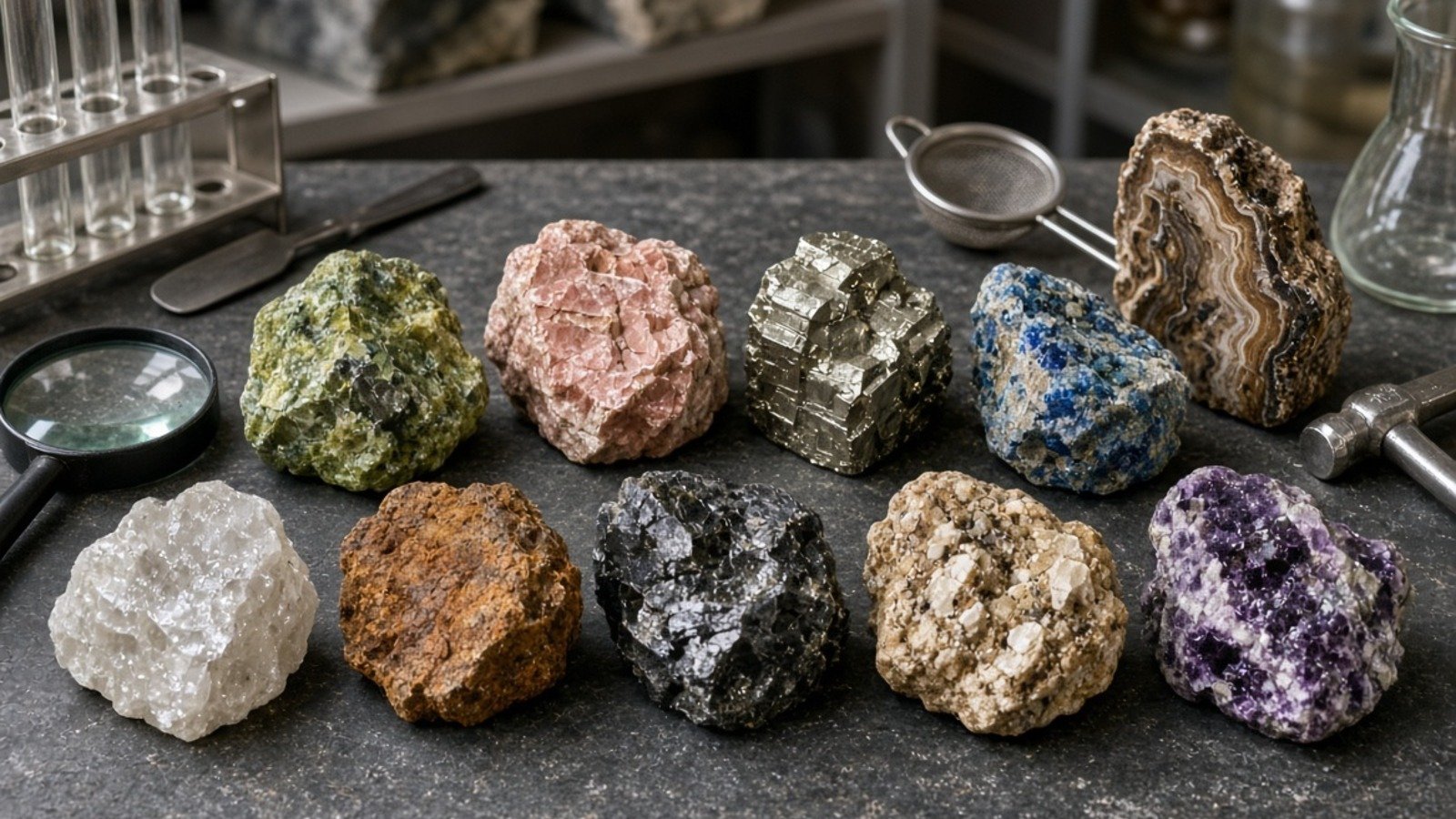
Quick answer: The Mohs hardness scale ranks ten reference minerals from talc (1, softest) to diamond (10, hardest). It measures resistance to scratching, not toughness, impact strength or absolute hardness. If a clean mineral sample scratches another, the first is harder in the tested direction, but colour and crystal shape alone cannot establish the mineral’s identity.

Updated: 21 November 2026.
The verified Mohs 1–10 table
| Mohs | Reference mineral | हिंदी नाम |
|---|---|---|
| 1 | Talc | टैल्क |
| 2 | Gypsum | जिप्सम |
| 3 | Calcite | कैल्साइट |
| 4 | Fluorite | फ्लोराइट |
| 5 | Apatite | एपाटाइट |
| 6 | Orthoclase feldspar | ऑर्थोक्लेज फेल्डस्पार |
| 7 | Quartz | क्वार्ट्ज |
| 8 | Topaz | टोपाज़ |
| 9 | Corundum | कोरंडम |
| 10 | Diamond | हीरा |
Mohs hardness scale 1 to 10: exact mineral sequence
The standard sequence is Talc 1, Gypsum 2, Calcite 3, Fluorite 4, Apatite 5, Orthoclase feldspar 6, Quartz 7, Topaz 8, Corundum 9 and Diamond 10. These numbers are ordinal ranks, not equal intervals in physical hardness. Treat a labelled image as a learning guide; a mineral’s appearance varies with impurities and growth conditions.
To learn the ranking without relying on a single illustration, copy all ten names into a notebook and practise predicting which reference mineral could scratch the next. A rank indicates relative resistance to scratching under appropriate conditions. It does not say that specimens of one mineral always have the same appearance or that their crystal faces are identical. A museum specimen photographed in studio light can look very different from a rough field sample.
Why Mohs hardness does not measure strength
A diamond can scratch many materials yet can fracture if struck along a vulnerable direction. Toughness describes resistance to breakage, while hardness here describes scratching resistance. Saying a 10 is exactly twice as hard as a 5 is incorrect. Instrumental Vickers or other indentation measurements use different units and are not interchangeable with an ordinal mineral chart.
In a practical materials discussion, compare hardness with toughness and cleavage. Glass may be scratched by a hard mineral, yet a ceramic can fracture under impact. The same stone can contain flaws that affect breaking behaviour without changing its broad scratch-resistance category. Jewelry appraisals and industrial tool selection therefore need additional tests. This distinction prevents the misleading conclusion that a higher Mohs number makes a tool or gemstone unbreakable.
Scratch test procedure: observe a groove, not powder
Choose a clean inconspicuous surface, take a known reference mineral, press lightly and observe whether a permanent groove has formed. Wipe away loose powder before deciding: a softer object may leave a streak that looks like a scratch. Compare with reference samples from both sides of the suspected range, where safe. Do not scratch valuable jewellery or museum specimens.
Choose test surfaces carefully: a weathered, coated or dirty surface may not reflect the underlying mineral. Minerals can leave streak powder without cutting a groove. Use a magnifier and wipe residues gently to see whether a true depression remains. Repeat with another known reference only where sample damage is acceptable. Record positive and negative comparisons rather than declaring a precise number based on one uncertain contact.
Common field comparisons: fingernail, copper and glass
A fingernail is approximately 2–2.5, many copper items around 3, and ordinary glass often around 5–6, but actual material compositions differ. Steel nails and blades vary widely with treatment and alloy; their hardness is not one fixed universal number. Use purpose-made test kits or properly identified references rather than claiming a kitchen object provides laboratory precision.
A fingernail, copper coin or glass plate is convenient for teaching, but composition and treatment vary. Modern coins can be plated alloys, and a steel file is not a universal reference of precisely one hardness. Everyday comparisons should be labelled approximate and never combined into an inflexible conversion chart. A calibrated or documented geology test kit is preferable when identifying an unfamiliar specimen beyond a classroom demonstration.
Talc, gypsum, calcite and fluorite: the softer group
Talc may feel soapy, gypsum is used in plaster products, calcite forms much limestone and marble, and fluorite can form vivid crystals. None can be identified reliably by colour alone. Fluorite and calcite both occur in multiple colours and forms; cleavage, streak, reaction and context also matter. For beginner geology, place samples on a labelled tray and keep detailed notes.
The first four minerals can be differentiated with several clues. Talc often has a greasy or soapy feel; calcite may show characteristic cleavage, while fluorite sometimes forms cubic crystals. None of these clues is conclusive alone. Study known samples and observe how surfaces reflect light. Colour is especially unreliable because impurities and inclusions can give one mineral several appearances. Avoid licking, tasting or grinding unidentified mineral specimens.
Apatite, feldspar and quartz: the middle group
Apatite at 5, orthoclase feldspar at 6 and quartz at 7 make a useful progression for practice. Quartz is common in many rocks and may appear as clear crystal, milky material or colourful varieties. The scratch sequence can distinguish otherwise similar-looking samples, but must be interpreted with surface weathering and contaminants in mind. Avoid assuming all shiny stones are quartz.
Apatite, feldspar and quartz are useful practice materials because their scratch strengths increase through the middle of the sequence. Feldspar is common in many rocks, while quartz occurs as grains and crystals in varied settings. Check that a sample is truly identified before using it as a reference: a lookalike stone may give a misleading result. Geological setting and other mineral properties help confirm the candidate after a scratch comparison.
Topaz, corundum and diamond: the harder group
Topaz has a Mohs value of 8, corundum 9 and diamond 10. Ruby and sapphire are coloured corundum varieties; the words describe jewellery categories rather than separate Mohs reference ranks. Hardness does not make these materials indestructible. Valuable stones should only be examined using appropriate non-destructive professional identification methods rather than deliberate scratch testing.
Gemstones deserve a different level of care from inexpensive practice specimens. Ruby and sapphire are varieties of corundum, but their commercial value depends on characteristics beyond hardness. Diamond is very hard against scratching, while still possessing cleavage and possible internal weaknesses. Scratching a polished valuable stone can cause permanent damage; certified laboratories use suitable non-destructive instruments and documented methods for identification.
How to use a Mohs kit and verify an image
Keep samples physically separate, labelled and free from dust transferred from harder stones. Inspect reference specimens with a magnifier and test on unimportant edges when appropriate. If a generative image shows spectacular crystals, treat it as illustrative; the exact morphology may not match a certified specimen. Include text-based 1–10 tables, record the mineral source and consult museum or geological references before identifying an unknown sample.
When storing a Mohs kit, use separate labelled compartments so harder fragments cannot accidentally mark softer reference minerals. Clean away dust between tests, since loose quartz grains could create a scratch attributed to another sample. Keep a record of the original supplier and the approximate condition of each reference. An authentic photograph documents an actual kit; an AI illustration is useful as a visual concept but cannot certify the underlying specimens.

How to record a scratch test properly
A simple laboratory worksheet should include the specimen ID, where the sample came from, the test reference, the surface tested and the observation after wiping away streak powder. A result such as “harder than calcite but softer than fluorite” is more useful than pretending a casual scratch test produced an exact laboratory reading. Rough weathered surfaces can behave differently from a fresh mineral face. Keep a separate column for uncertainty and do not mix unknown samples with an unlabelled kit.
Note that mineral identification requires more than hardness. Cleavage, crystal system, streak, lustre, density and geological occurrence can help distinguish candidates. Some minerals show hardness variations with direction or purity. Hardness testing may permanently mark a specimen, so never perform it on valuable jewellery, private collections or protected geological material without permission. In a school exercise, trained supervision and proper sample handling matter more than achieving a dramatic scratch.
FAQs
What is the softest mineral on Mohs scale?
Talc has a reference value of 1.
Which mineral is Mohs 7?
Quartz.
Can diamond break despite hardness 10?
Yes. Scratch hardness and impact toughness are different properties.
Does Mohs 10 mean twice as hard as Mohs 5?
No. The ranking is ordinal and the physical hardness gaps are not uniform.
How is a scratch test checked?
Look for a permanent groove after wiping away loose streak material, ideally using known reference samples.
Conclusion
The Mohs scale is best used as a scratch-resistance comparison, not a universal material-strength measure. Learn the exact sequence, check test marks carefully and use specialist advice for valuable specimens.
Sources
- US National Park Service — Mohs Scale
- Mineralogical Society of America
- Oxford University Natural History Museum
Educational reference, not a recommendation to damage valuable gemstones.









Share Your Opinion
Comments are closed on this post.