 Vista
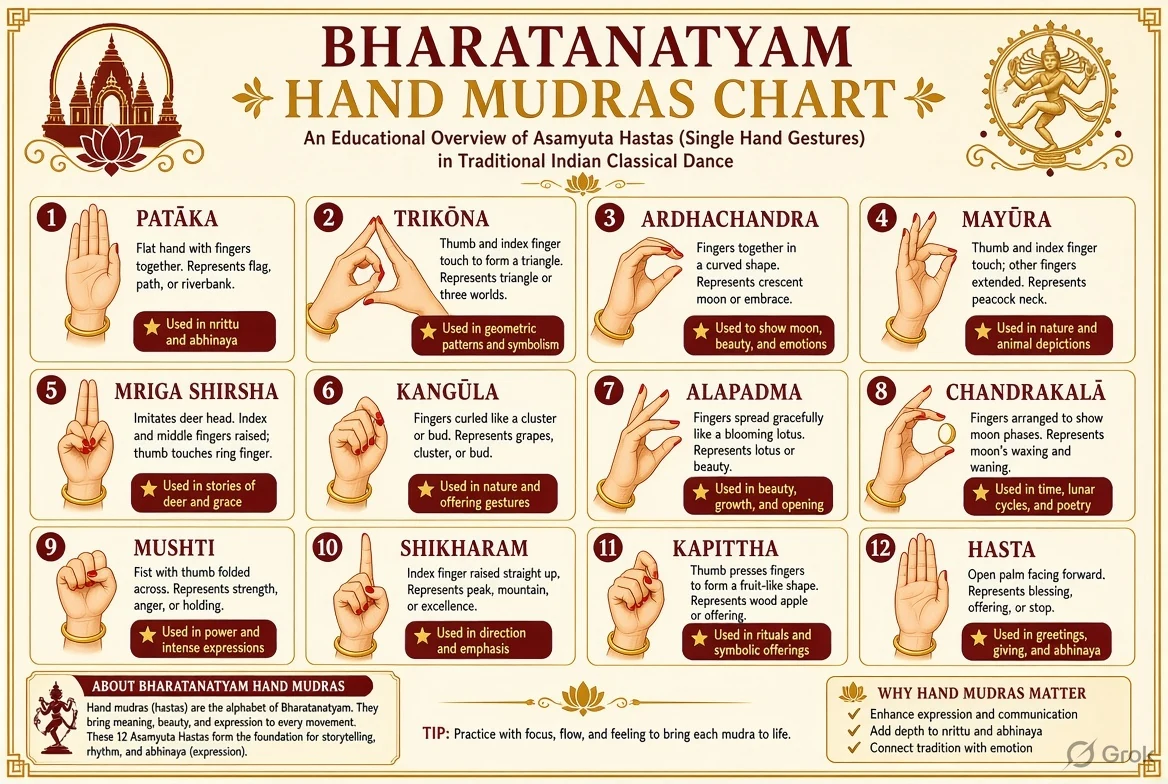
Direct answer: Bharatanatyam hand mudras are named hastas used for dance movement and expression. Asamyuta Hasta means single-hand gestures and Samyuta Hasta means combined two-hand gestures. Abhinaya Darpana-based teaching commonly lists 28 and 24 respectively, though versions differ. These five visual charts explain names and finger positions without pretending one gesture always has one meaning.
Updated 21 November 2026. Educational diagrams; qualified dance training remains essential.
Bharatanatyam hand mudras chart: five illustrated guides
Bharatanatyam mudras: hands as part of the dance language
Bharatanatyam hand mudras, more precisely called hastas, are codified hand shapes used in the classical dance tradition strongly associated with Tamil Nadu. The hands support rhythmic passages and the expressive communication of stories, characters and natural imagery. Many teachers use the Abhinaya Darpana attributed to Nandikeshvara as a reference for naming and studying these shapes. Yet an illustrated finger chart cannot fully explain a dancer’s meaning without the surrounding face, eye movements, footwork, music and dramatic context.
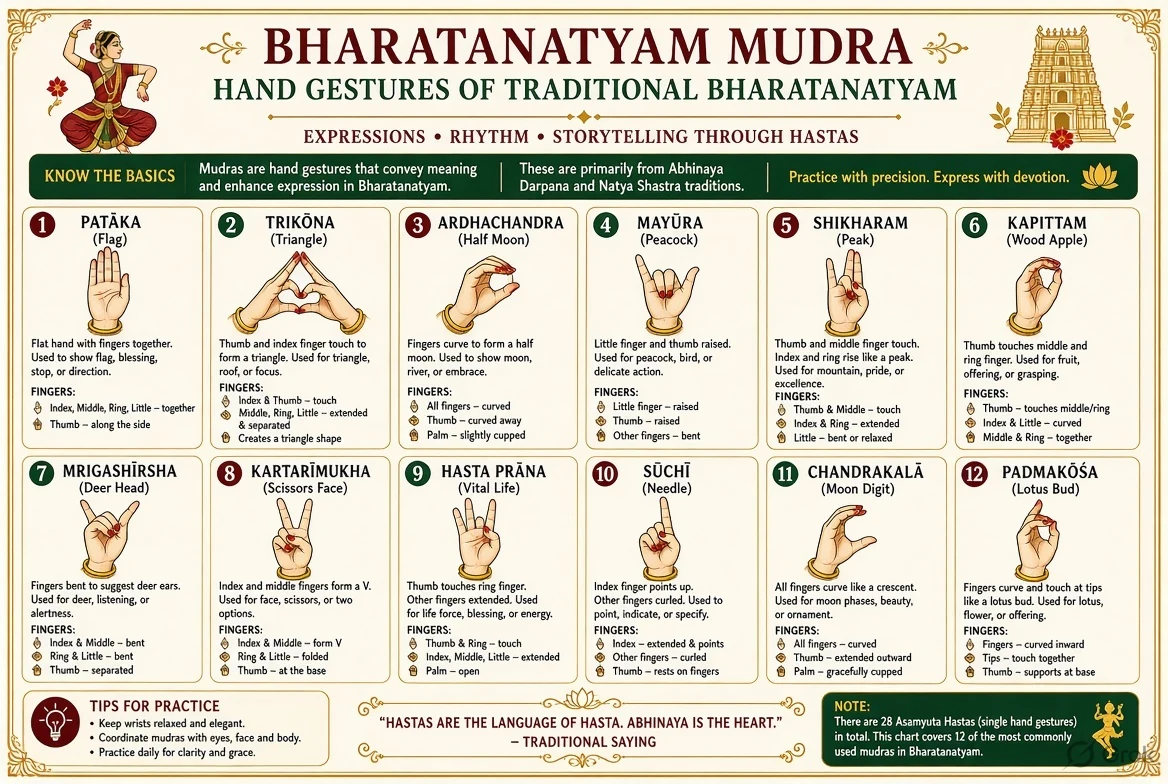
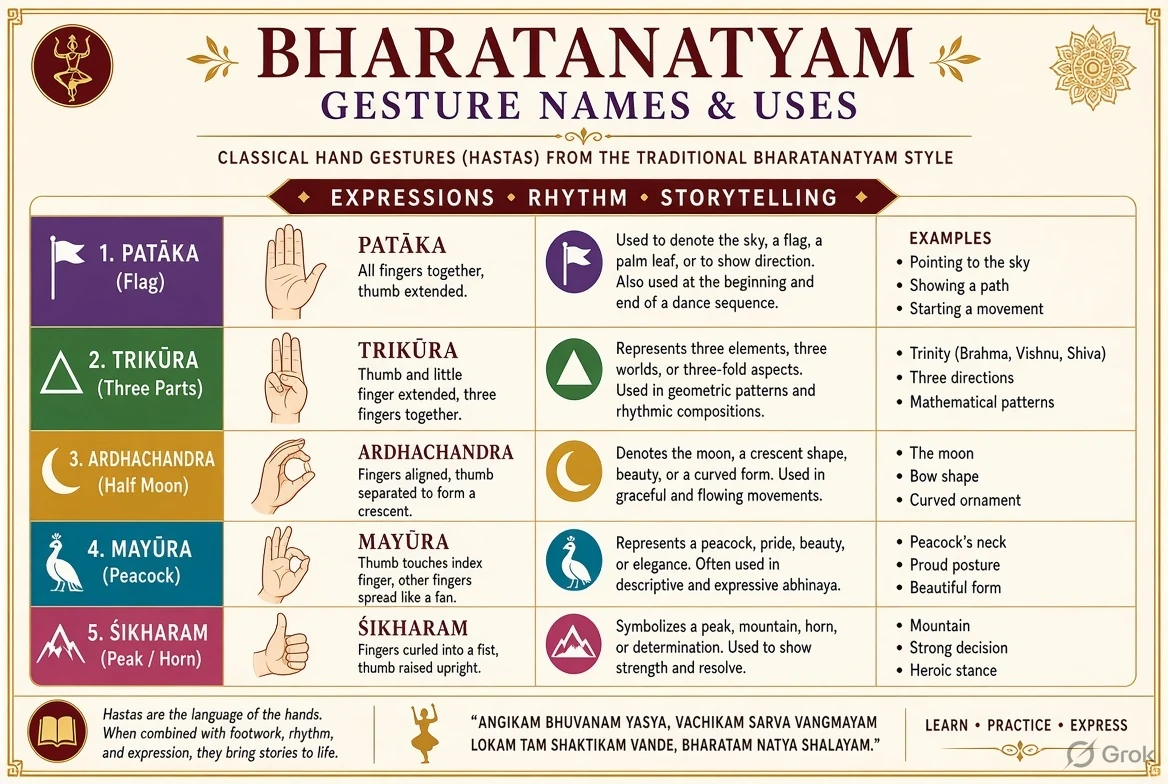
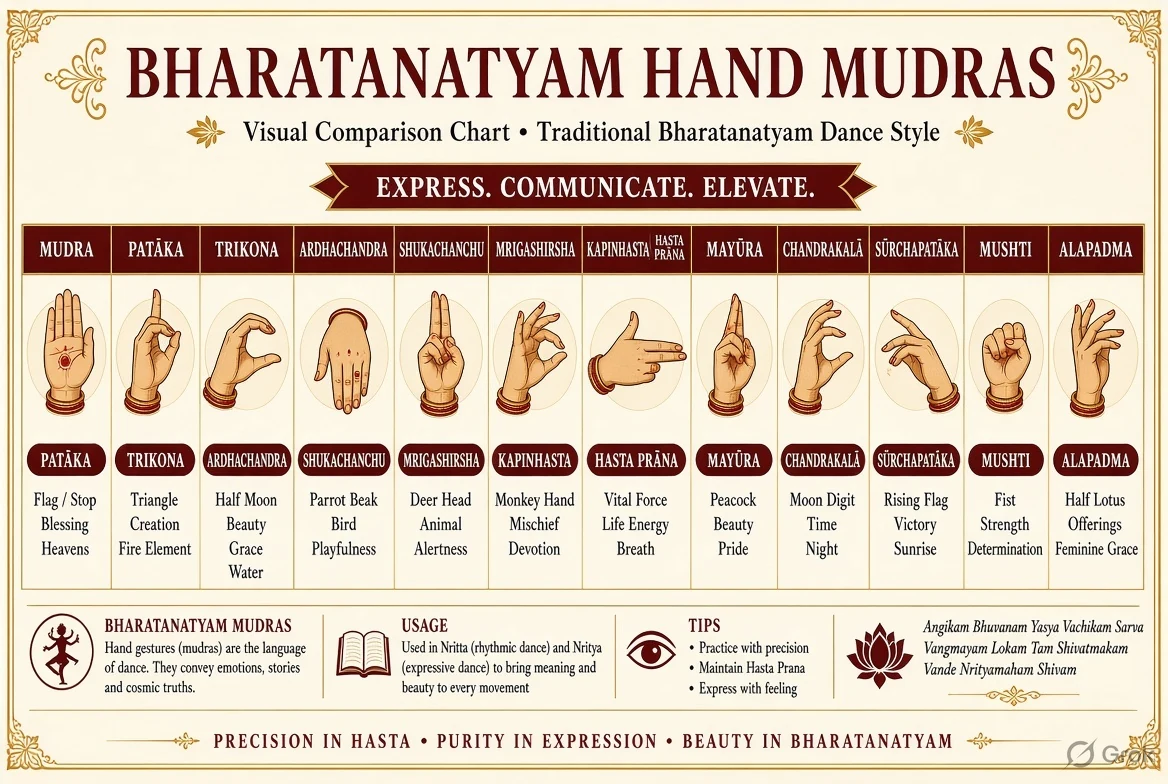
A commonly taught classification distinguishes Asamyuta Hasta (single-hand gestures) from Samyuta Hasta (combined or two-hand gestures). Bharatanatyam pedagogical resources often enumerate 28 single-hand and 24 double-hand forms in a commonly taught Abhinaya Darpana list; particular textual traditions, school syllabi or variants may count and spell items differently. The five charts here introduce the categories, finger positions and selected names. They are educational drawings rather than a substitute for in-person training or an exhaustive authoritative list for every bani and syllabus.
Asamyuta Hasta: the single-hand category
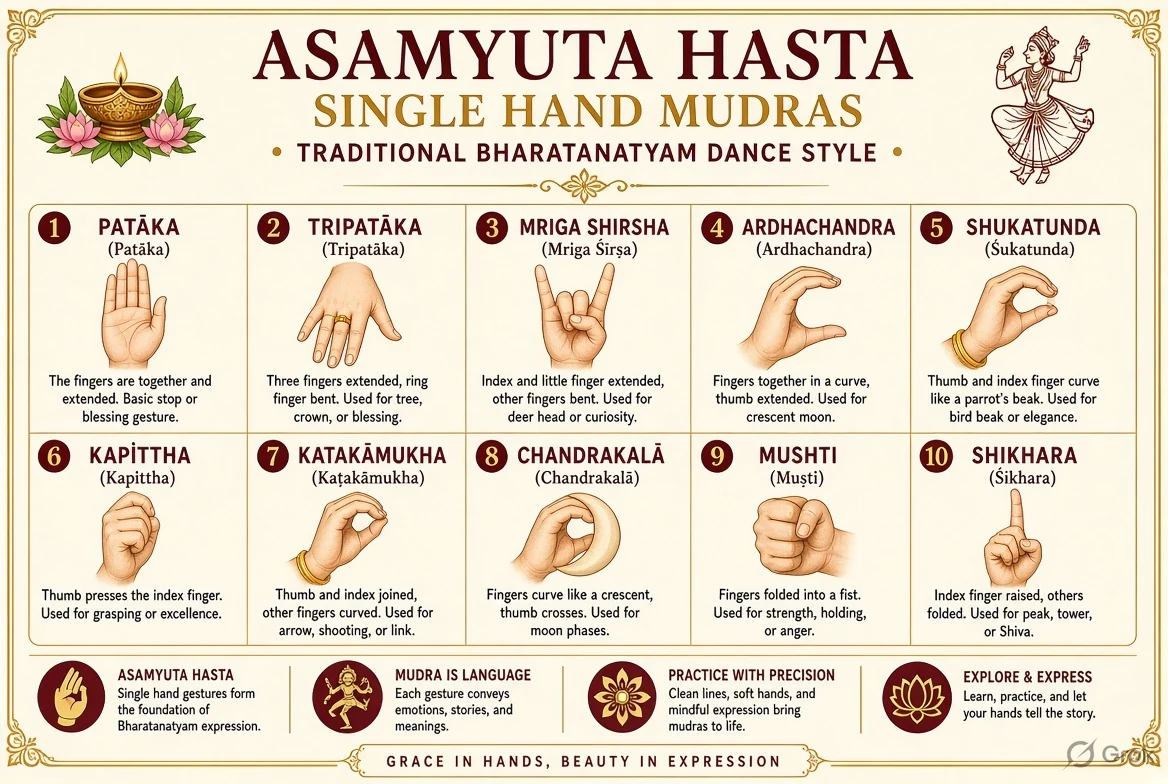
Asamyuta Hasta means a gesture performed with one hand. Examples in frequently taught lists include Pataka, Tripataka, Ardhapataka, Kartarimukha, Mayura, Ardhachandra, Arala, Shukatunda, Mushti, Shikhara, Kapittha, Katakamukha, Suchi, Chandrakala and Padmakosha. Some of the names may be taught with slight spelling differences in Tamil transliteration and English. Understanding the category is more useful than memorising an image without knowing where the fingers are placed.
For example, Pataka is generally taught with an open hand in a defined alignment; Tripataka changes an appropriate finger position from the related flat-hand shape. But an internet chart can misdraw small thumb positions or conceal the hand’s angle. Our single-hand comparison is a visual starting point. A dancer should check the accepted shape against the instructor’s demonstration and the specific dance curriculum. Applying force to the finger joints in search of a perfect photograph shape is unnecessary and may be uncomfortable.
Samyuta Hasta: combined-hand forms and uses
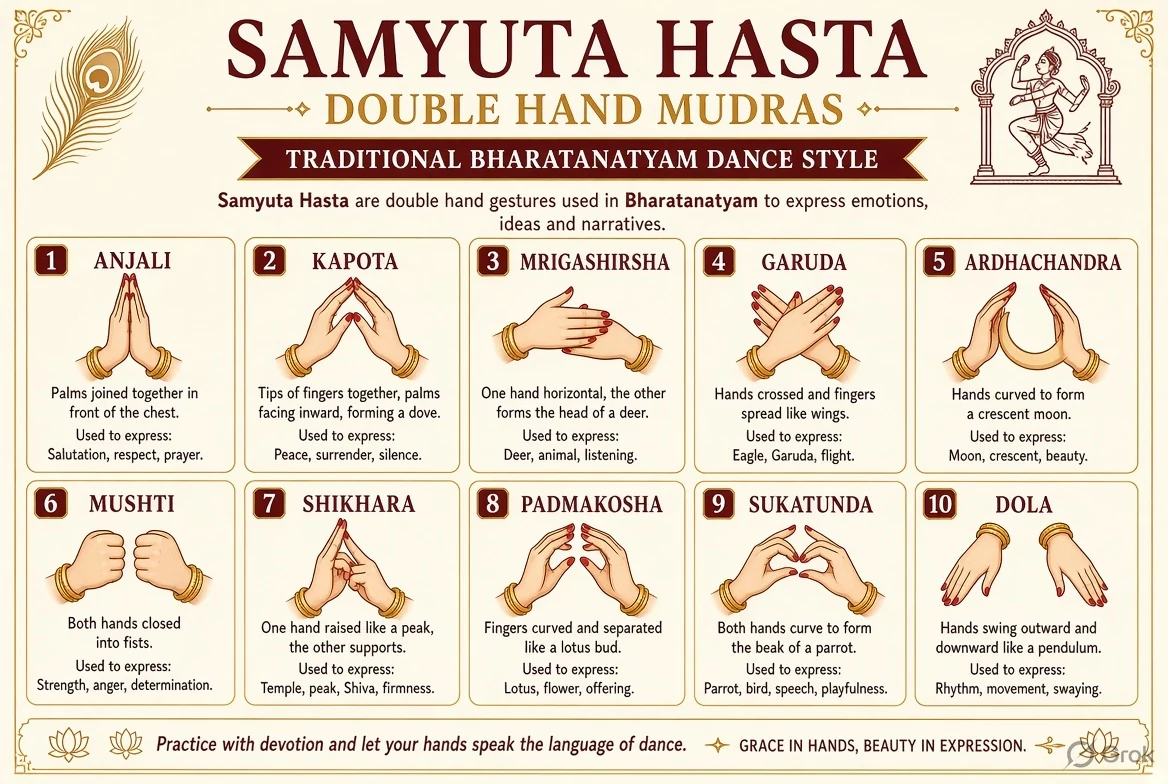
Samyuta Hasta uses both hands as one expressive configuration. Commonly listed forms include Anjali, Kapota, Karkata, Svastika, Dola, Pushpaputa, Utsanga, Shivalinga, Shankha, Chakra, Matsya, Kurma and Garuda. The two hands may touch, overlap or adopt related but different orientations. One of the most recognisable examples, Anjali, places the hands together in a form associated with respect or salutation in certain contexts. Other two-hand gestures can depict objects, creatures or actions in a dramatic passage.
The viniyogas, or uses, are not a one-to-one code. A combined gesture can carry multiple associations when an artist changes its timing, gaze, movement and narrative setting. The Abhinaya Darpana provides conventional applications, while a teacher determines how to practise and interpret them in a particular repertoire item. Do not assume a generic image of two crossed hands is sufficient to identify a whole scene. The second chart illustrates broad category differences; detailed choreography needs contextual instruction.
Pataka, Tripataka and Ardhapataka finger positions
Three popular searches are Pataka mudra, Tripataka mudra and Ardhapataka mudra. They can look similar in simplified cartoons because the overall hand remains extended, while particular fingers bend in different ways. That makes close inspection of the ring finger, little finger and thumb important. A photograph taken from the wrong angle may make one form appear to be another. The basic distinction should be learned by comparing several views under a qualified instructor, not by copying a single black silhouette.
In practice, wrist position, elbow support, hand direction and transitions between gestures matter just as much as the individual fingers. A student’s hand may need time to develop coordination, and forcing extreme flexibility can create strain. Our detailed-finger illustration is useful for revision but should not be treated as medical or ergonomic guidance. If a movement is painful, stop and ask the teacher for an appropriate adjustment. Fluid execution is more important than holding a tense static hand pose for a photograph.
Why one hasta can have several different meanings
A frequent query asks for a Bharatanatyam mudras meaning chart in which each symbol corresponds to one word. That approach can help remember a familiar association, but it is incomplete. Gesture meanings are created through abhinaya, including the eyes, expression, body direction and the story being enacted. A Pataka-shaped hand can be used in distinct situations rather than permanently translating to “flag” in every performance. The same named hasta can also look different when carried through space.
The instructor may teach a particular set of viniyogas for each named gesture. These uses should be learned with example phrases or episodes instead of treating them as an alphabet with fixed signs. In a visual article, say “selected uses of Anjali or Pataka” and explain context rather than declare universal meanings for all icons. A school assessment may ask for textbook applications; there, the student’s specific syllabus is the relevant authority. This distinction avoids confusing the technical name of a hand shape with its function in a complete performance.
Mudras in Nritta and Nritya
Nritta refers to pure dance patterns that emphasise rhythm, movement and form, while Nritya involves expressive dance and storytelling. Hastas can appear in both. In an adavu, a hand position may structure movement and complement the rhythmic footwork without narrating a literal animal or object. In an expressive padam or other narrative work, similar hands may form part of a gesture sequence that communicates emotion or action. These artistic differences are central to reading a Bharatanatyam video accurately.
A still chart does not tell you whether the artist is using a gesture for rhythmic decoration or acting out a particular line of poetry. Watch the body orientation and facial expression, and listen to the music or spoken lyric when possible. This is why an online lesson with only the hand names should not claim to teach the complete meaning of a whole dance. The first goal is correct recognition; deeper interpretation comes from the choreography and the tradition in which it is performed.
Learn the mudras safely: shape, hand transitions and practice
For a structured Bharatanatyam mudra practice, begin with a few commonly used single-hand shapes. Learn their names aloud, compare the fingers in a mirror and confirm them with a teacher. Then practise moving from one hasta to another while keeping shoulders comfortable and wrists aligned. Only after shape recognition should you work on matching gesture sequences to particular words or dramatic themes. Repeat slowly and favour relaxed control over maximum speed.
A beginner may create two columns in a notebook: Sanskrit name and a carefully sourced photo or drawing. Add the pronunciation used by the teacher and a few example applications from that syllabus. Avoid memorising every chart found online, because errors in the ring finger, hand orientation or transliteration can spread easily. Use the fifth comparison chart to practise recognising one-hand versus two-hand forms; it is a reference rather than a replacement for instruction and correction in real time.
Bharatanatyam versus Kuchipudi and other dance mudras
Indian classical dance forms share elements of a broader gestural vocabulary and textual sources, but their movement styles and performance conventions differ. Kuchipudi dancers also employ hastas within a distinct Andhra Pradesh performance tradition. Odissi draws upon its own posture vocabulary, with strong attention to Chowka and Tribhangi, while Kathak emphasises rhythm and footwork alongside narrative expression. Recognising the same hand name in multiple traditions does not establish that the accompanying body position or dramatic use is identical everywhere.
For SEO classification, a chart showing Pataka and Anjali can be useful to readers of several dance forms, but its title should state the specific teaching context. A computer illustration of a hand should not be captioned “authentic Bharatanatyam performance photograph.” For technical accuracy, distinguish school exercises from the gestures used in a fully choreographed item. Readers can then compare related traditions without losing the regional styles and specific pedagogical practices of their teachers.
Bharatanatyam hasta FAQs
What is the difference between Asamyuta and Samyuta Hasta?
Asamyuta uses one hand; Samyuta combines both hands into a gesture.
How many single-hand mudras are commonly taught?
Many Abhinaya Darpana-based syllabi teach 28, though other textual lists and conventions can differ.
Are all Bharatanatyam mudras fixed sign-language words?
No. Their uses change with narrative, movement, gaze and expression.
Is Pataka the same as Tripataka?
No. The hand shapes have different finger configurations.
Can I learn mudras from a chart without a teacher?
A chart helps recognition, but an instructor is recommended for correct positions, movement and expression.
Conclusion: names and uses are different things
A gesture diagram is a useful memory aid, but its meaning comes from the full performance. Use names accurately and learn finger alignments, transitions and abhinaya with a qualified teacher.
Training and cultural references
Akademi: Illustrated Asamyuta Hasta study; SVYASA Bharatanatya syllabus: Abhinaya Darpana hastas; Pustakalaya: Hastas, names and applications; Mayura Natyalaya: hasta reference.



















Share Your Opinion
Comments are closed on this post.