 Vista

Direct answer: Uttarakhand Aipan Art is a traditional Kumaoni floor-and-wall painting practice known for red geru and white biswar rice paste. Its motifs include Lakshmi Chowki, Lakshmi footprints, circles, squares and Vasudhara borders. These four charts introduce the shapes and occasions without claiming a single compulsory ritual rule for every family.
Updated 21 November 2026. Educational designs, not certified photos of specific sacred patterns.
Uttarakhand Aipan Art motifs: four visual charts
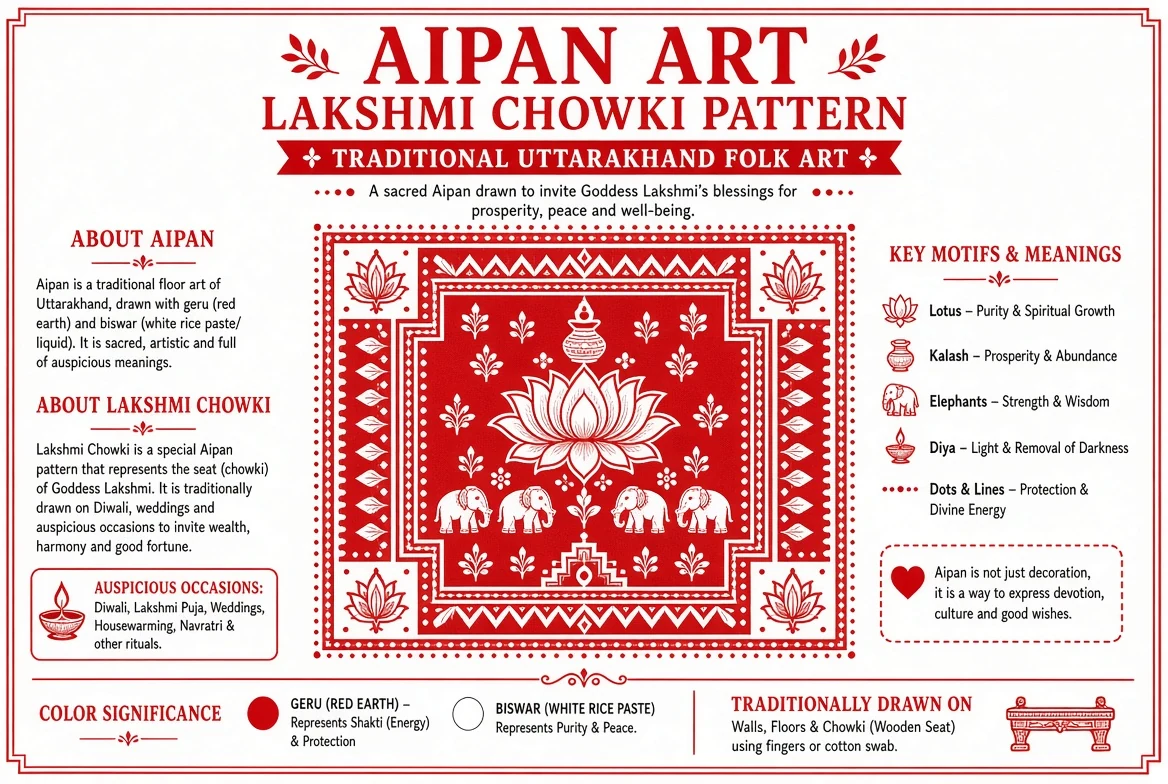


What is Uttarakhand Aipan art?
Aipan Art is a traditional painting and floor-drawing practice strongly associated with the Kumaon region of Uttarakhand. Its familiar visual contrast is a red ochre or geru background carrying white lines made with a paste of rice, often called biswar. Circles, squares, radiating lines, footprints, patterned borders and named chowkis can feature in designs used on doorways, walls and spaces of worship. Many accounts emphasize the roles of women in creating and passing down these designs through daily and festive life.
The craft organisation AIACA and the Asia InCH cultural encyclopedia describe Aipan as a living ritual and decorative tradition. Its forms vary with occasion and household, and a new digitally drawn design should not be presented as a certified ritual illustration. These four charts introduce Lakshmi Chowki, footprints, geometric patterns and borders as reference examples rather than an exhaustive dictionary of spiritual meanings. The strongest identification combines the material, regional setting and the actual name of the composition.
Lakshmi Chowki and other named chowki patterns
Lakshmi Chowki Aipan is a familiar search phrase because a decorated seat or central floor area can be prepared for worship, especially around festive observances. A chowki may include a bordered square or another organised central arrangement of marks. Local references also list Saraswati Chowki, Nav Durga Chowki and other named forms. These are not merely interchangeable shapes: specific compositions belong to distinct religious and household settings.
For an educational picture guide, describe the visible lines, centre and border before assigning a meaning. If a diagram is newly designed, label it a Lakshmi-Chowki-inspired example unless a cultural source confirms that the exact figure reproduces a named traditional form. Treating any red square as an authentic ceremonial Lakshmi Chowki would be misleading. The first visual chart helps learners understand the geometric structure, but the proper practice and significance of any ritual version are best learned from local knowledgeable makers.
Lakshmi Padchinh: traditional Aipan footprint motifs
Small Lakshmi footprints in Aipan are documented as part of festive decoration, often associated with the idea of welcoming the goddess during Diwali and related occasions. The marks can appear near the entrance or along a path toward the place of worship. Their outline may be shown in a simple stylised way rather than as a realistic footprint. The local household decides how and where these forms are arranged. It is not accurate to publish a universal directional rule as though all Kumaoni families must follow it identically.
Observe the footprint pattern closely: the paired small shapes may be repeated between borders or incorporated into a larger central design. A generic website image showing two white feet cannot by itself establish the date, festival or ritual identity of a scene. Ask for the maker and event when describing a real photograph. In a classroom sketch, use the footprint figure as an example of a familiar motif and clearly distinguish it from an actual worship ceremony performed by a community practitioner.
Geru and biswar: why Aipan has a red and white look
The striking Aipan red-and-white palette comes from the use of geru, a red earth or ochre ground, and biswar, a white rice paste. Asia InCH lists these and other locally available ritual materials in its overview of Aipan painting. White paste applied by fingers or simple tools makes lines stand out against the prepared surface. Its thickness, the ground’s absorbency and the artist’s touch influence the final look. A perfectly uniform vector drawing should not be mistaken for an ancient original just because it uses the same two colours.
Contemporary Aipan artists may use safe paints on paper, wood, cloth or everyday objects, especially for handicrafts and workshops. These adaptations can sustain the art and introduce it to new audiences. Still, a student exercise using red chart paper and white acrylic paint is better described as Aipan-inspired craft rather than a historically exact ritual practice. When writing descriptive captions, identify which material was actually used instead of inventing geru or rice paste for a computer illustration.
Aipan geometric symbols: circles, squares and triangles
Aipan geometric designs may combine squares, concentric shapes, circles, triangles, lines and small filling details. The geometric organisation provides balance within a chowki or border and can be visually linked to the decorated space. Some documented ritual forms are described through concepts such as peeth and yantra, but identifying a generic set of intersecting lines as a particular authorised sacred diagram requires stronger evidence than visual similarity. A chart cannot replace the traditional context in which a pattern was learned and used.
When studying the third image, look first at the central axis, the outer frame and repeated units. A square can anchor the overall drawing while nested shapes and line patterns create depth. The composition may have reflection symmetry but does not require every handmade stroke to be mechanically precise. If you are designing an educational figure, avoid asserting that each triangle guarantees one effect or that there is a universal count of mandatory strokes. Accuracy matters more than attaching sensational claims to an attractive shape.
Vasudhara and border patterns at the threshold
Vasudhara Aipan is a named motif mentioned in regional accounts, often described as vertical white lines drawn near entrances and associated with festive or domestic floor-decoration practices. Other patterns may frame a chowki with repeating white leaves, strokes or linked curves. Their function may be architectural as well as ceremonial: they organise the floor or wall space visually and draw attention to a central design.
The border reference chart helps learners see the difference between repeated edge decoration and a named central figure. A border should not automatically be called a Nav Durga Chowki or a Lakshmi Chowki merely because it uses the same red and white pigments. When photographing authentic Aipan, include the relationship of the pattern to the entrance, prayer space or household surface. That context often explains much more than an isolated crop showing five parallel lines. Local artisans should be credited when their designs are published.
Diwali, wedding rituals and regional variations
Aipan art can be connected with festivals, weddings and other household ceremonies, with specific patterns chosen for different moments. Diwali is a widely mentioned occasion for Lakshmi-related motifs; other observances may call for other chowki designs. The broader Kumaon region contains multiple local communities, and households may vary in materials and arrangement. Declaring that every authentic Aipan must be completed using one rigid step-by-step method would erase that variety.
Public cultural projects and contemporary craft businesses have widened the places where Aipan appears, including framed artwork, souvenirs and school workshops. Those new contexts need clear description. A diagram showing a festive centre is useful for art students but does not certify that a ritual occurred. If an image is from a genuine marriage or household ceremony, obtain appropriate permission to publish it. When interpreting its significance, use the maker’s account or a credible cultural reference rather than random internet captions about supernatural rewards.
Aipan vs Alpana, Mandana and Rangoli
Floor decorations across India may share shapes, but regional practices remain distinct. Uttarakhand Aipan is well known for red geru with white biswar and named chowki patterns. Bengali Alpana traditionally uses white rice-paste drawing on household surfaces, often with lotus or footprint motifs. Mandana in Rajasthan and parts of Madhya Pradesh uses its own floor-and-wall geometric tradition and red-white treatments. Rangoli is a broader term used for diverse Indian floor arts, often employing coloured powders.
A white lotus or red floor is not enough to assign an artwork to one category. Check region, materials and context. Likewise, using the label “Himalayan ancient magic symbols” to describe an unverified Aipan infographic is misleading. A practical image ALT might say “Kumaoni Aipan Lakshmi Chowki red geru white rice paste reference” when the subject is indeed that motif. Clear labels benefit readers researching regional art and preserve the identity of the artisans involved.
Aipan art FAQs
What is the traditional material used in Aipan?
Red geru as the ground and white biswar rice paste for the design are widely documented.
Where is Aipan art from?
It is closely associated with the Kumaon region of Uttarakhand.
What is Lakshmi Chowki in Aipan?
A named Aipan composition linked with Lakshmi worship and festive household settings.
Are Lakshmi footprints common in Aipan?
Yes, especially in some Diwali and Lakshmi-related floor-decoration practices.
Is Aipan exactly the same as Bengali Alpana?
No. Their regions, typical materials and named compositions are different even when some motifs overlap.
Conclusion: distinguish art study from ceremonial use
Aipan combines recognisable geru-and-biswar geometry with community and household knowledge. Identify the design carefully, acknowledge the maker and avoid presenting a new decorative drawing as an authenticated ritual.
Sources
AIACA: Aipan Art in Kumaon; Asia InCH: Aipan ritual floor painting; Apna Uttarakhand: Aipan, Chowki and Vasudhara.





















Share Your Opinion
Comments are closed on this post.