 Vista
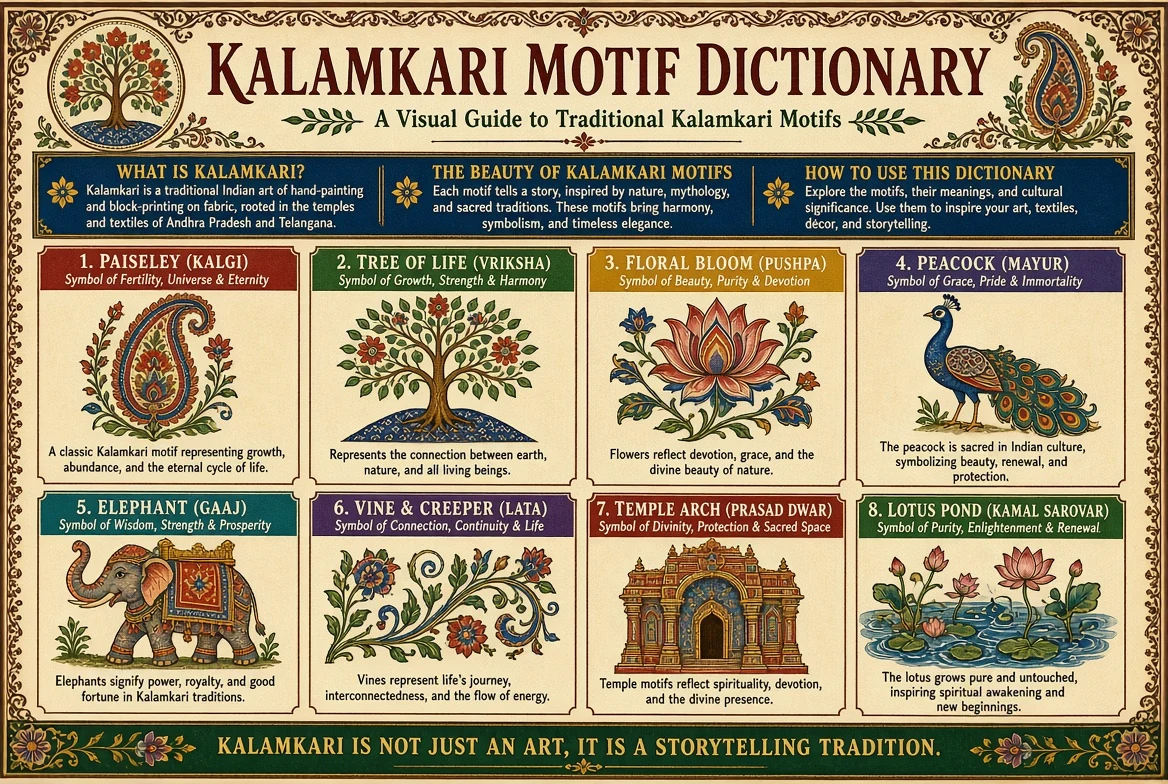
Direct answer: Kalamkari motifs include flowers, lotus, leaves, Tree of Life, birds, vines and narrative figures. Srikalahasti Kalamkari is strongly associated with hand-painted storytelling using a pen; Machilipatnam/Pedana is renowned for hand-block printed textiles and repeating decorative designs. Four charts explain the visual difference and how to distinguish a real craft from a digital print.
Updated 21 November 2026. Illustrations are educational references, not authentic textile certificates.
Kalamkari motif dictionary: four illustrative design charts
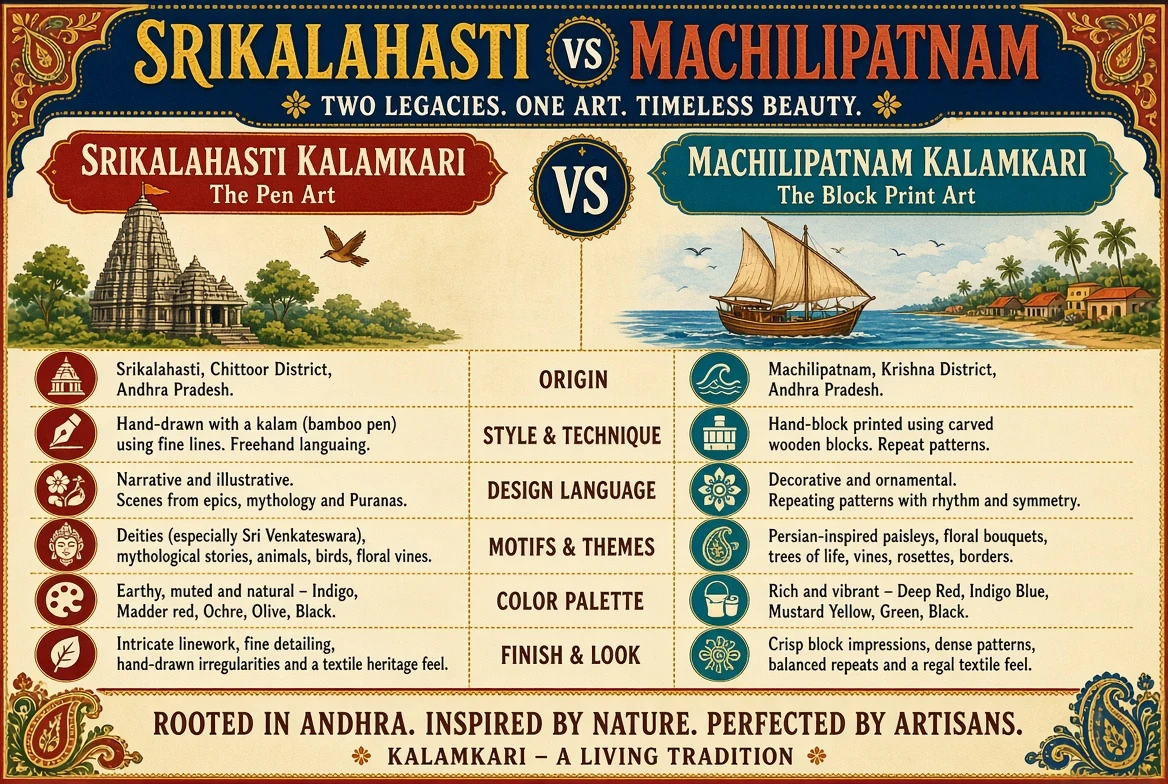
Kalamkari motifs: Andhra Pradesh’s textile storytelling art
Kalamkari is a group of traditional Indian textile arts associated especially with Andhra Pradesh, where designs are hand-painted with a pen-like tool or applied by hand-carved printing blocks. The word is commonly linked with the idea of work performed with a kalam, or pen. Both the Srikalahasti and Machilipatnam/Pedana traditions use elaborate floral, natural or narrative designs, but their production practices and historical visual vocabularies have distinct emphases. A single digital paisley graphic is not proof of being an authentic handcrafted Kalamkari textile.
The Government of India’s ODOP pages recognise Srikalahasthi Kalamkari and Machilipatnam Kalamkari as identifiable regional products. In the hand-painted tradition, artists may draw mythological scenes and figures; block-printing workshops can create repeated vines, floral patterns and decorative borders. The four charts here compare those motifs visually. They are educational illustrations, not reproductions of a named artisan’s historic textile or a certified demonstration of a real dye process.
Srikalahasti versus Machilipatnam: hand painting and block printing
Srikalahasti Kalamkari is especially associated with drawing freehand using a pen or kalam, often to construct narrative scenes. Machilipatnam Kalamkari, including the Pedana craft area, is strongly associated with woodblock printing and repeat-based textile designs. Both traditions are rooted in craft knowledge developed over time, and actual workshops can use more than one process. Nevertheless, this distinction is useful for answering the popular query “Kalamkari hand painted vs block printed”.
A block print may show repeated sections and registration choices, while a hand-painted panel can follow a continuous narrative drawn specifically for that cloth. Neither technique automatically makes every item more or less valuable. Artisan skill, material, provenance and the actual workmanship matter. The national GI Registry has records for both Srikalahasthi Kalamkari and Machilipatnam Kalamkari, but a seller’s printed tag is not enough to establish the origin of one fabric. When comparing a shirt or saree, inspect the print, ask about its maker and check whether it is original handcrafted work or a digitally printed imitation.
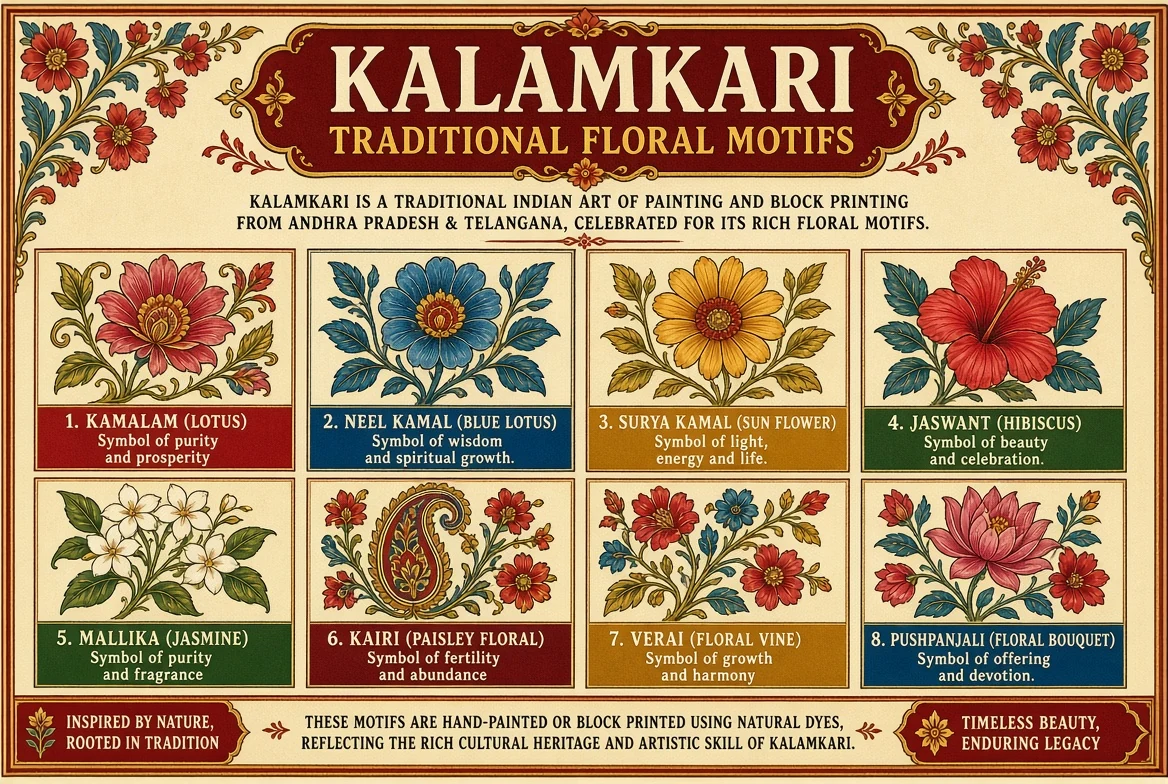
Floral motifs: lotus, petals and flowering creepers
Kalamkari floral motifs can range from a central lotus to elaborate vines, buds, leaves and repeating flower clusters. Many Machilipatnam block-printed patterns are known for flowing vegetal forms, including Persianate decorative influences shaped by historic trade. A flower in a repeating all-over design serves a different visual purpose from one appearing beside a mythological figure in a temple-story panel. Therefore a generic chart should identify the floral shape and layout instead of assigning every lotus or petal a single spiritual interpretation.
For learning purposes, observe how the main flower connects to stems and smaller leaves. In block printing, each motif must fit into the repeat and its border; in pen-painted work, the line can turn more freely around a figure. The floral illustration is a reference for recognising those design features. If sharing a real artisan’s textile photograph, credit the maker and distinguish it from a new digital illustration based on the broader style.
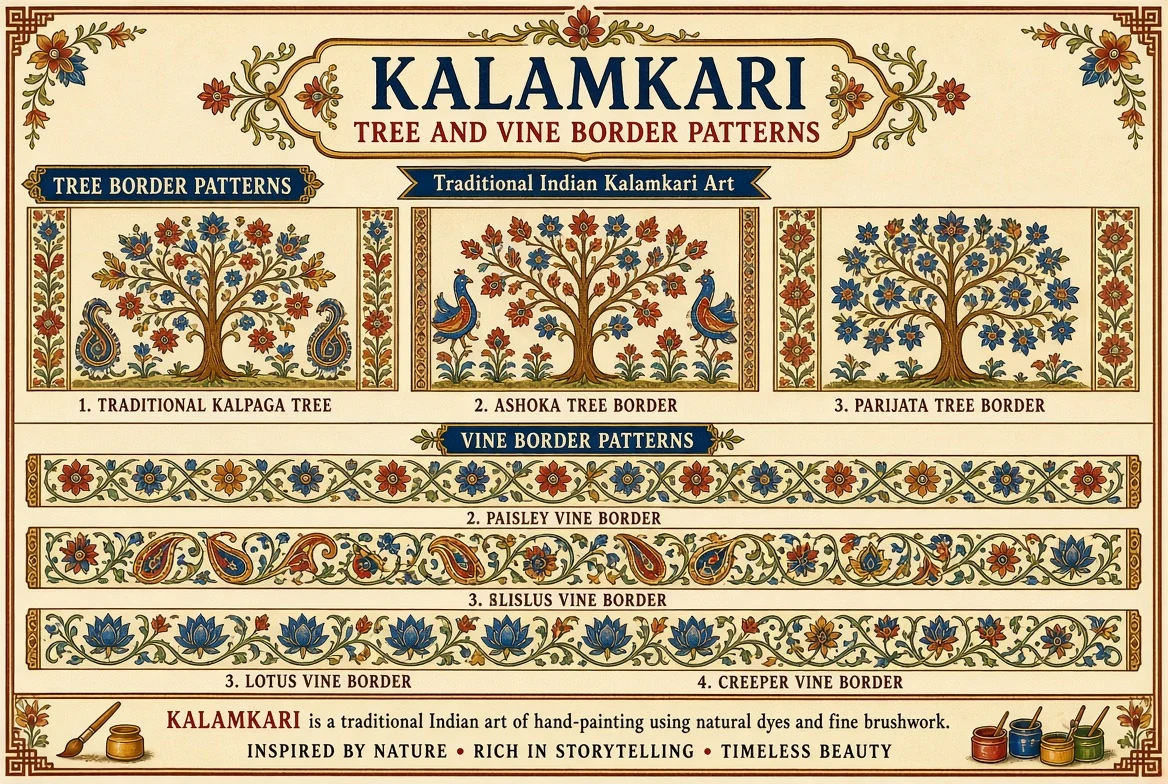
Tree of life, vines and borders in Kalamkari cloth
The Kalamkari tree of life is a widely discussed textile motif. A central trunk may branch into flowering vines, leaves and birds, creating a balanced composition that can cover a hanging or wall textile. Border bands can frame a central panel or organise repeated designs on fabric. The tree need not always carry the same one-sentence religious meaning: it may play a decorative role in a textile created for a particular market or a narrative role in a specific hand-painted composition.
Workshop and museum documentation helps explain the historical relationship between textile trade, decorative vines and story panels. Some designs incorporate motifs drawn from Persianate and Indian visual sources. Our border chart allows students to compare vine repeats and branch shapes without declaring any single “official pattern” required by all Kalamkari artisans. The distinction between a drawn reference and an authentic dyed textile remains important for shoppers, educators and image-based SEO.
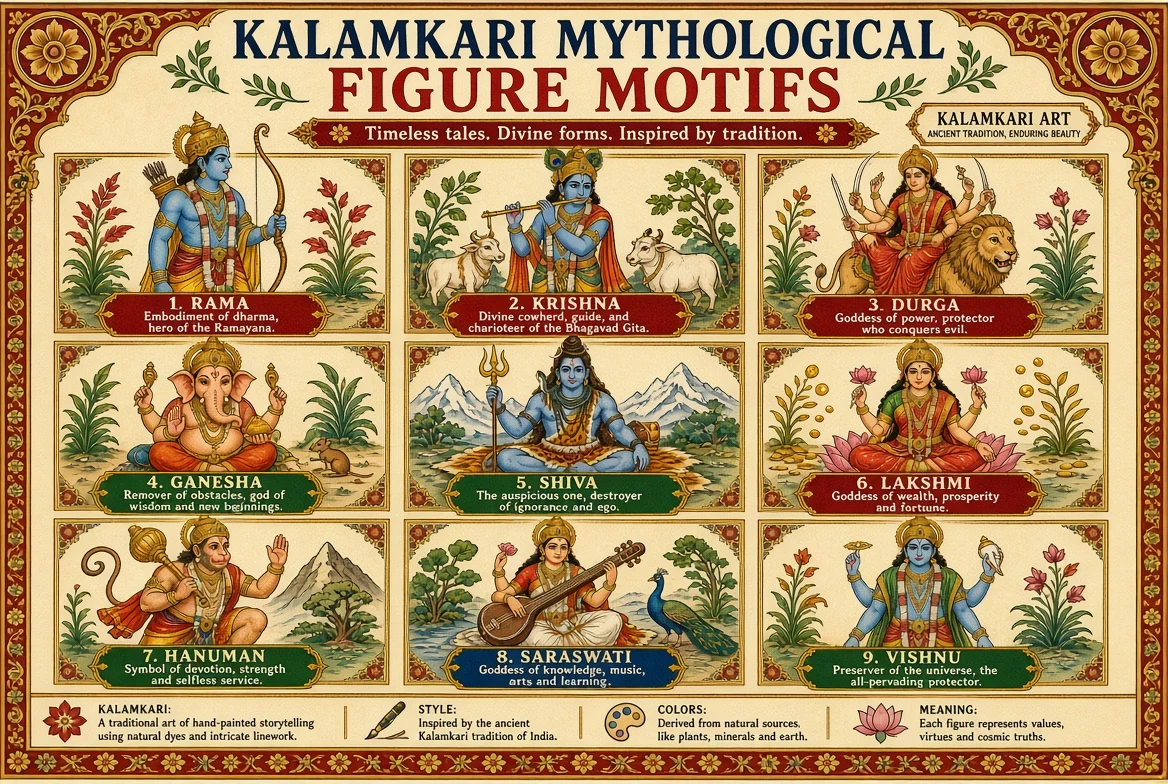
Mythological figures and narrative panels
In the Srikalahasti tradition, artists have historically painted panels illustrating stories from Hindu epics and other religious narratives. Such compositions may include gods, devotees, vehicles, trees, captions and sequences of events. Some accounts of Kalamkari textiles describe Telugu captions near narrative scenes, showing how drawing and storytelling can work together. But it would be wrong to say every Kalamkari print depicts a deity: decorative floral and geometric pieces are also significant, particularly in block-printing traditions.
When describing a figure, verify the actual story rather than identifying every person with a bow as Rama or every peacock as a particular divine mount. A named artisan or credible catalogue can explain the scene. A modern teaching poster of generic mythological figures should not be sold as an authentic temple hanging or an antique. Readers searching “Kalamkari goddess images” benefit more from correctly sourced interpretation than from confident guesses attached to an unverified picture.
Natural dyes, mordants and handcraft process
Traditional Kalamkari production is associated with natural dyes, resist and mordant processes, washing, drawing or block printing and repeated treatment of cotton cloth. The results depend on specialist technical knowledge, water quality, fabric preparation and available pigments. Different dye baths can produce different colours depending on the mordant used. An artisan may use several steps before and after applying a visible pattern. An online “draw it in five minutes” shortcut cannot recreate this textile chemistry.
The Ministry of Culture’s documentation discusses rich natural colours and penwork, while artisan sources describe the painstaking preparation needed for a colourfast fabric. Modern products labelled “Kalamkari print” sometimes use machine or digital printing; they may be attractive consumer fabrics but should not be confused with hand-painted natural-dye work. Avoid performing unfamiliar chemical dye processes at home without safety and waste-handling information, especially when using mordants or iron mixtures. A craft workshop led by experienced artisans is the better route for learning actual production.
Kalamkari GI recognition and buying original textiles
India’s GI Registry identifies Srikalahasthi Kalamkari and Machilipatnam Kalamkari separately. These entries are useful for distinguishing regional handicraft identities. Yet the existence of a GI registration does not authenticate any random online fabric listing. To assess a particular purchase, ask whether the work is hand-painted, block printed or digitally printed, where it was made and who produced it. Labels such as “handcrafted” should be supported by the seller’s reliable documentation.
Look closely at the backside of the fabric, the distribution of pigment and the consistency of repeats, but do not claim that one visible irregularity is an infallible authenticity test. Traditional craft can include both repeated and freehand elements, and skilled imitations exist. The artistic value also depends on the artisan’s design and the object itself. Buy from trustworthy workshops or documented artisan channels when provenance matters, and avoid paying a premium merely because a computer-printed motif is advertised as an ancient hand-painted original.
Kalamkari compared with Madhubani, Gond and Pithora
Different Indian art forms can all show flowers, birds, trees and mythological subjects, but they use distinct artistic contexts and materials. Kalamkari is especially a textile drawing and printing tradition; Madhubani or Mithila painting often has dense linework and borders linked with Bihar; modern Gond painting is known for patterned animal silhouettes from central India; and Pithora relates strongly to Rathwa ritual wall murals. A tree in an image does not automatically tell you which tradition it belongs to.
Accurate classification begins with materials and maker information. A block-printed cotton cloth made in a Machilipatnam workshop is not the same object as a Gond painting on canvas. If discussing images, record whether the visual shows a real textile, an artisan’s original composition or an educational diagram. Mislabelled images might attract clicks but give readers false history and fail the purpose of a useful search reference.
FAQs about Kalamkari design patterns
What is the difference between Srikalahasti and Machilipatnam Kalamkari?
Srikalahasti is strongly associated with pen-painted narrative panels; Machilipatnam/Pedana with hand-block printing.
Are lotus and vine designs typical of Kalamkari?
Yes, floral and tree-vine motifs are important in several Kalamkari textile traditions.
Does every Kalamkari design depict mythology?
No. Repeated flowers, trees and decorative patterns are also common.
Is machine-printed Kalamkari the same as hand-painted Kalamkari?
No. The manufacturing process and provenance are materially different.
Are both main Kalamkari regions listed in India’s GI Registry?
Yes. Separate records exist for Srikalahasthi and Machilipatnam Kalamkari.
Conclusion: provenance and technique matter
Kalamkari is a textile craft shaped by artists, regional techniques and historical design exchanges. Learn the motifs while distinguishing genuine hand-painted and block-printed products from generic digital reproductions.
Official and artisan references
National Portal of India: Srikalahasthi Kalamkari; National Portal of India: Machilipatnam Kalamkari; GI Registry: Srikalahasthi Kalamkari; GI Registry: Machilipatnam Kalamkari; Andhra Pradesh crafts: hand-painted and block-printed textiles.























Share Your Opinion
Comments are closed on this post.