 Vista
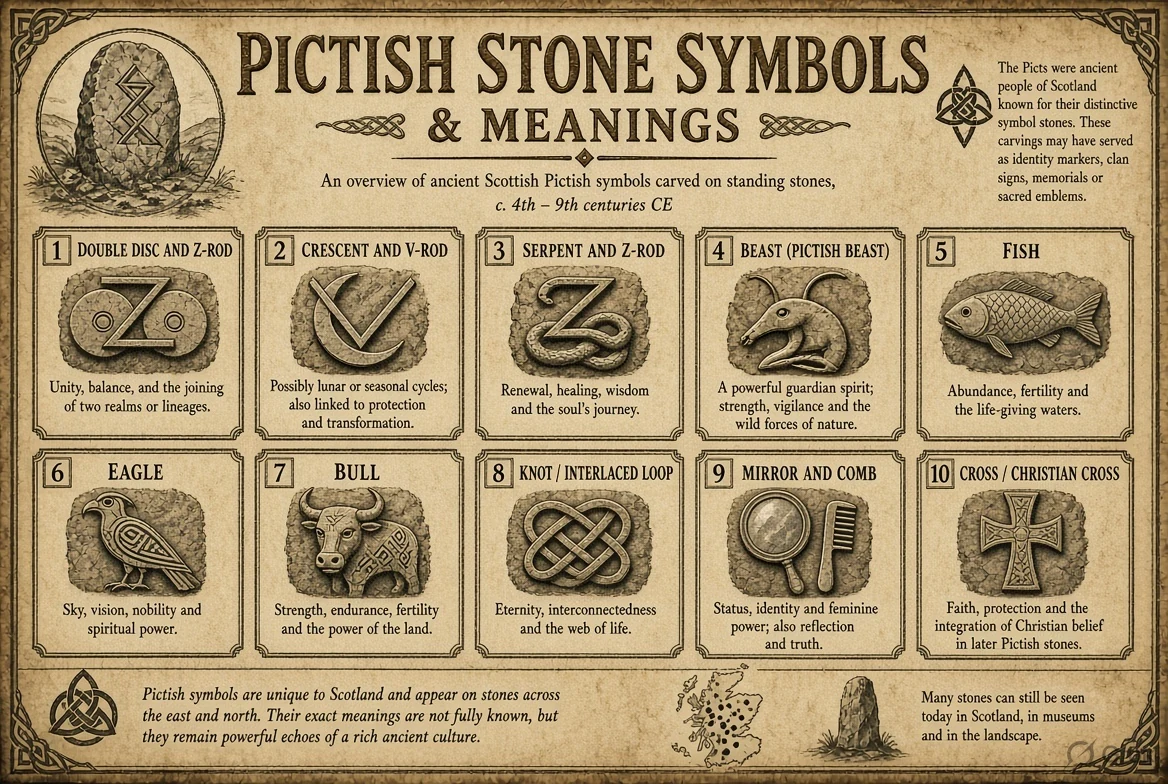
Direct answer: Pictish stone symbols and meanings are best explained as documented historic carvings whose full symbolic language has not been definitively decoded. The crescent and V-rod, double-disc and Z-rod, and stylised animals are recurring forms on Scottish monuments. Our three pictorial guides help you recognise them without claiming invented exact translations.
Updated 20 November 2026. Educational illustrated representations, not copies of a specified archaeological stone.
Pictish stone symbols and meanings: three reference charts
Pictish stone symbols and meanings: what is actually known
Pictish stone symbols are distinctive carved designs found on monuments in what is now Scotland, particularly in the north and east. They include geometric forms such as the crescent and V-rod or double-disc and Z-rod, as well as animals and other figures. These carvings are tangible archaeological evidence for the Pictish past, but historians have not reached a universal, confirmed translation of their precise meanings. Any confident “Pictish symbols dictionary” that gives one-word definitions for every sign is therefore presenting interpretations rather than settled knowledge.
Modern readers often ask whether these symbols are tribal names, clan badges, religious marks or an early form of writing. Scholars have proposed different explanations, and recurring pairs of motifs make the question interesting. Yet repeated use alone does not tell us how people at the time read them. Understanding the stones requires identifying a real monument, its archaeological context, the style of carving and the date proposed by specialists. An isolated digital outline cannot supply those details, though it can help recognise a sign in a photograph.
Crescent and V-rod: the familiar curved Pictish sign
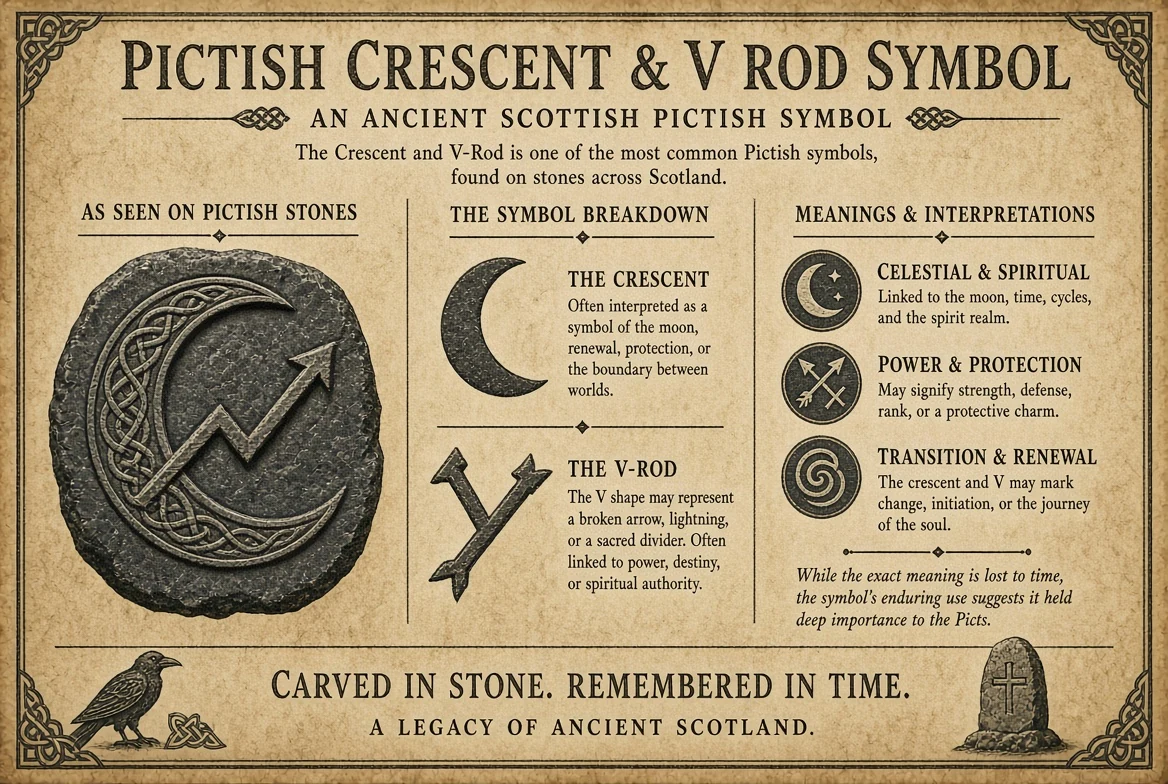
The crescent and V-rod is one of the most recognisable Pictish symbols. In outline, it combines a curved crescent shape with an angled rod-like element that intersects or overlays it. The crescent may include internal decoration and the rod can have carefully carved terminals. Examples occur on symbol stones, sometimes alongside other marks. The repetition of the design across monuments strongly suggests that it carried a recognised function, even though its specific meaning remains debated.
Popular websites offer quick answers such as “moon and lightning,” “warrior’s arrow,” or “royal badge”. These are possibilities or modern readings, not confirmed translations. Even when a feature resembles a crescent moon, it is not enough to establish that the full design named a lunar deity. When using the visual panel here, notice the two distinct components instead of relying on a single spiritual phrase. Archaeological records from Historic Environment Scotland provide documented monuments on which these forms can be examined.
Double-disc and Z-rod: why it is hard to interpret
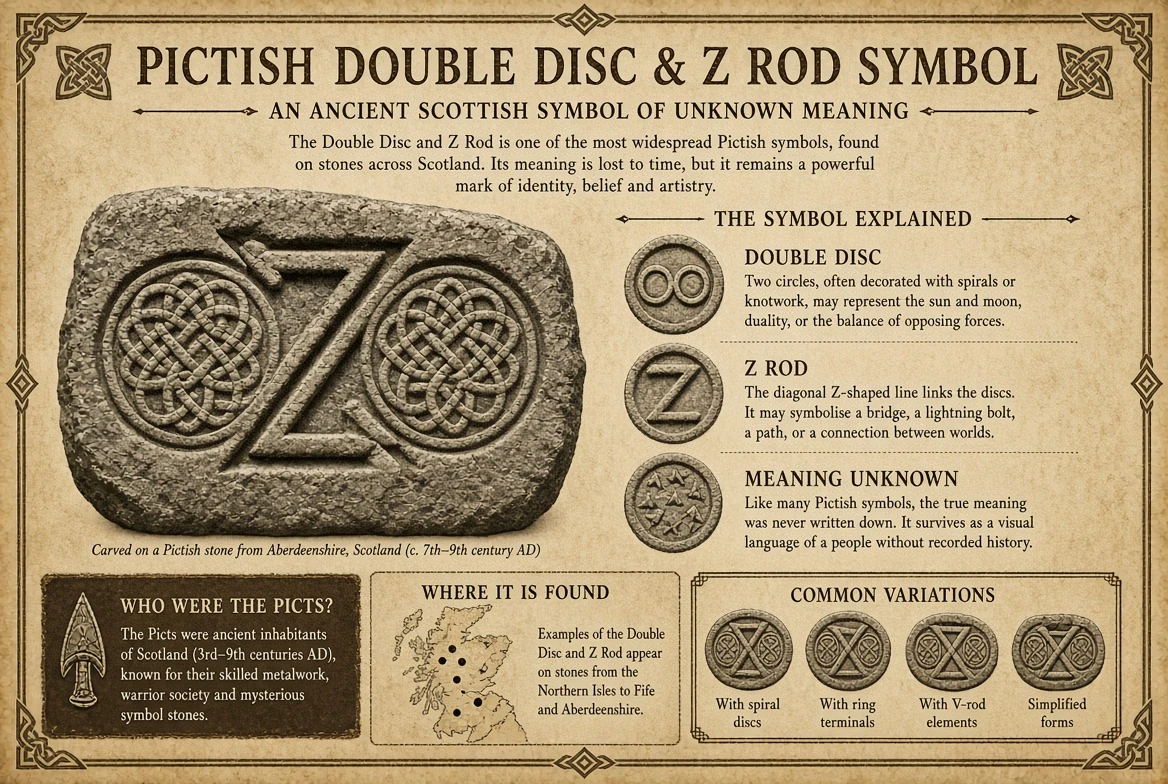
The double-disc and Z-rod combines two rounded elements joined by a central connection, with an angular line crossing the motif. The geometric structure gives it a recognisable silhouette that appears on several recorded stones. The Picardy Symbol Stone and Dyce Symbol Stones are useful documented examples. Some discussions suggest interpretations involving authority, weapons, celestial ideas or identities. Those explanations can be studied as hypotheses, but there is not enough evidence to treat any one as a dictionary entry.
Readers should also distinguish a plain double-disc motif from a double-disc-and-Z-rod combination. The presence or absence of the angular component matters when recording what a monument actually shows. Similarly a damaged carving may make a Z-shaped line appear incomplete. Good documentation records the location and physical condition of the stone rather than automatically digitally repairing a missing line. Even a carefully redrawn chart can hide surface details and therefore must not replace a photograph, drawing or published excavation report.
Pictish beast, eagles, fish and other animal carvings
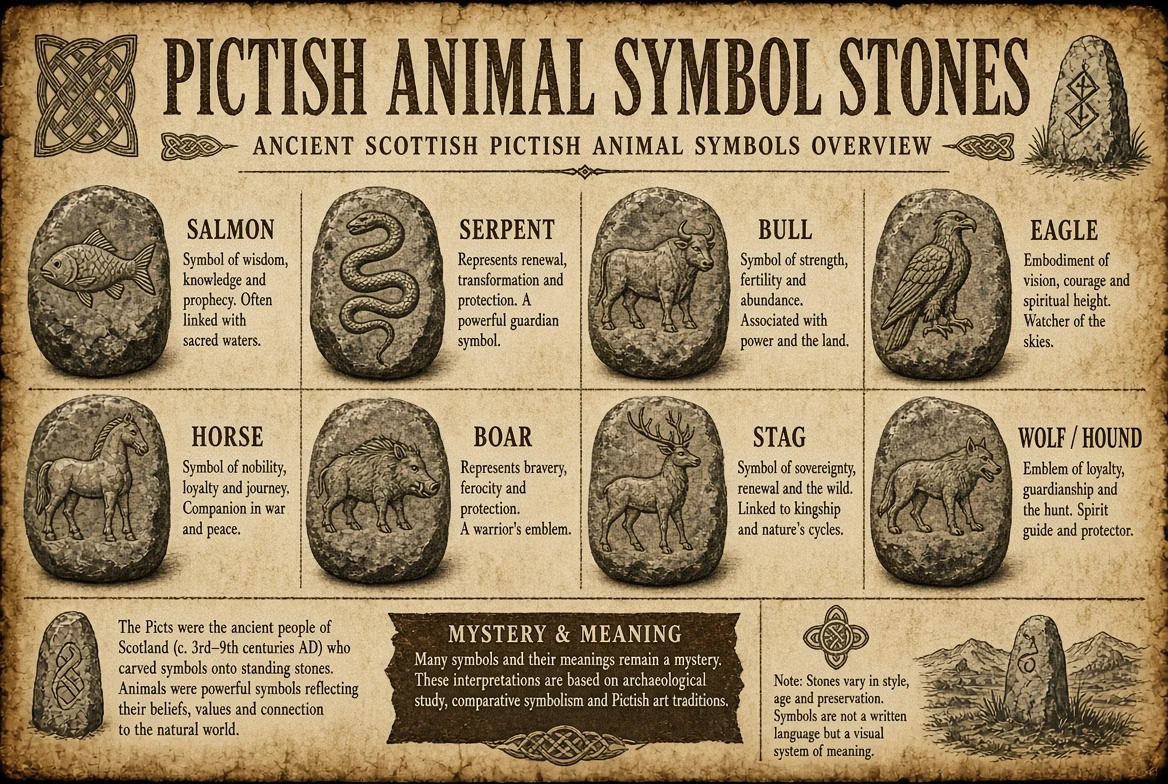
Pictish animal symbols include fish, birds, serpents and quadrupeds, alongside the curious figure often called the Pictish beast. This last creature has a highly stylised outline, and attempts to identify it as a specific familiar animal remain controversial. Modern viewers may compare it with a dolphin, an elephant-like form or a fantastical creature. It is best to use the established descriptive name while acknowledging that the species or intended symbolic identity has not been securely demonstrated.
Other carved creatures may be easier to recognise as a bird, boar, fish or horse, though damaged features create uncertainty. Recognising the animal does not automatically explain its social meaning. An eagle in a later coat of arms can be associated with one set of traditions, while a similar shape on a Pictish monument belongs to a different context. Avoid applying generic heraldry tables to these earlier carvings. The group image in this guide is an identification aid, not an exact inventory of all animal examples known from Scottish archaeology.
Class I, II and III Pictish stones: understanding the labels
Older scholarship often groups Pictish stone monuments into three broad classes. Class I generally refers to stones bearing incised Pictish symbols without a Christian cross. Class II commonly describes dressed stones with relief-carved decoration, including crosses and Pictish symbols. Class III is a more disputed grouping applied to certain Christian monuments without the earlier symbols. The classification is a useful introductory vocabulary but is not a definitive description of all artistic and chronological variations.
Different stones can be reused, moved, broken or reinterpreted across centuries. As a result, class labels should not be read as an effortless exact date or an unbroken historical sequence. Check the information recorded for the individual monument. A carving in a modern churchyard may not stand where it was originally erected. Museum collections and heritage records sometimes distinguish the findspot from the present display site. Those distinctions are essential when comparing historical evidence with an internet image of a seemingly anonymous slab.
Could the Pictish symbols be a writing system?
The patterns on some stones, including recurring combinations, have encouraged theories that Pictish signs may encode information such as names or social identities. Researchers have also investigated the statistical behaviour of symbol sequences. Such approaches are legitimate scholarly questions, not proof that a complete translation has been recovered. No universally accepted key converts each carved symbol into an English letter or a fixed modern word. If a website offers to write a full sentence in “Pictish hieroglyphs”, verify whether it is a fictional modern substitution table.
Some stones also bear Ogham inscriptions, a distinct historical letter system, or later written texts in other scripts. This coexistence should not be treated as evidence that Pictish motifs and Ogham letters are the same thing. Archaeologists can read an inscription and still be uncertain about a neighbouring crescent-and-rod mark. A better visual guide labels both independently. It also avoids asserting that a familiar knot or stone motif must be the “oldest alphabet of Scotland” without showing a documented linguistic basis.
Where to see authentic Pictish symbol stones in Scotland
Historic Environment Scotland documents a number of standing or displayed Pictish stones, including the Picardy Stone and Dyce Symbol Stones. Museums and local heritage collections also hold important carved fragments and complete monuments. The Aberdeenshire Pictish Stone Trail provides a useful regional framework for recognising the stones in their landscapes. Before planning a visit, consult the current institution or site listing for access conditions and conservation restrictions.
Good field observation begins with photographing the whole stone before zooming in to one symbol. Record both sides where permitted, because crosses, animals and inscription details may appear on different surfaces. Look at the texture of the carving: incised lines, shallow relief and later damage may be difficult to distinguish in a tiny screenshot. Use the images in this article to know what to look for, but follow the heritage authority’s measured description when assigning a stone’s date, class and artistic features.
Pictish tattoos and merchandise: label reconstructions responsibly
Contemporary artists use Pictish motifs in tattoos, pendants, prints and graphic identity. A bold crescent-and-rod or stylised beast can work effectively as design, and its connection to Scottish heritage may be personally meaningful. But manufacturers should not market a sign with a fabricated exact meaning such as “guaranteed protection” or “this is the clan of every person with surname X.” Such claims go beyond the archaeological evidence. A more accurate product caption says “modern design inspired by Pictish carved stones” and names the recognisable motif.
For permanent art, use a well-documented example rather than a heavily reworked anonymous illustration. Confirm that the chosen drawing reproduces a real design or is explicitly identified as an artistic adaptation. If there are religious associations or personal heritage reasons for choosing the image, describe them as your interpretation. Avoid taking stones or making rubbings where heritage authorities forbid disturbance. The best visual project respects both the appeal of the pattern and the limitations of our historical knowledge.
FAQ: the meaning of Pictish stones
What does the Pictish crescent and V-rod mean?
Its exact historical meaning is still uncertain. Several hypotheses exist, but none is a universally established translation.
What is the double-disc and Z-rod symbol?
A recurring Pictish geometric carving made from paired rounded forms and an angular rod; its original purpose remains debated.
What animal is the Pictish beast?
It is an enigmatic stylised animal. Claims that it definitely represents one particular species are not securely established.
Are Pictish symbols Celtic runes?
No. The carved motifs, Ogham inscriptions and Germanic runes should not be conflated.
Can historians translate every Pictish symbol?
No. Scholars can catalogue and compare forms, but no generally accepted complete translation system exists.
Conclusion: recognition is possible even without a definitive translation
The Pictish stones are compelling precisely because we can identify recurring patterns while still asking what those motifs meant to the people who carved them. Learn the shapes, compare actual monument records and distinguish research hypotheses from demonstrated readings. Treat every confident one-word “Pictish translation” with caution.
Sources
Historic Environment Scotland: Dyce Symbol Stones; Historic Environment Scotland: Picardy Symbol Stone; Groam House Museum: Designs and Symbols; Historic Environment Scotland: The Pictish Stones.




















Share Your Opinion
Comments are closed on this post.