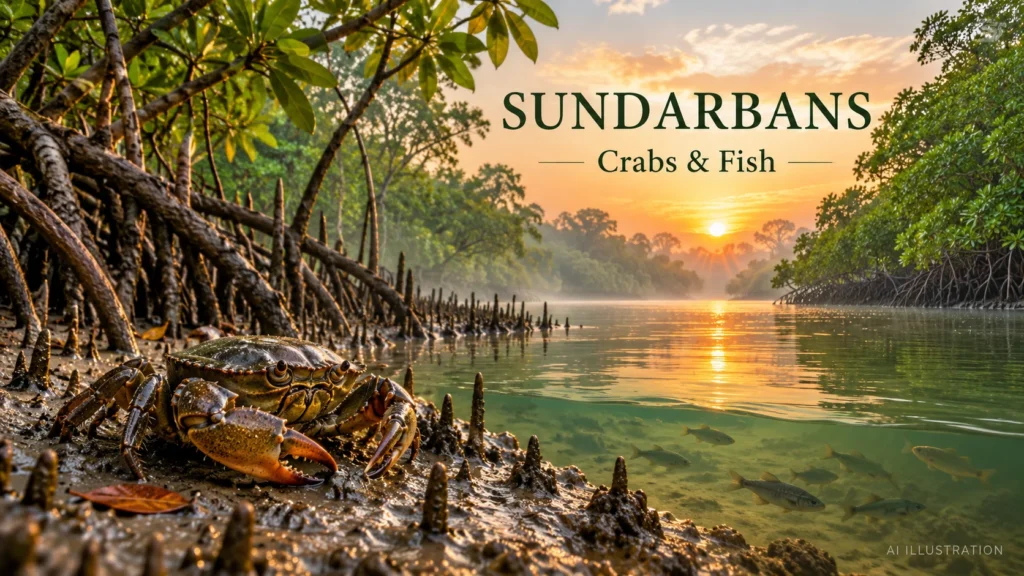
Sundarbans crabs and fish: look beyond the tiger
A Sundarbans riverbank has stories at a much smaller scale than its famous tiger. When water recedes, burrows appear in the mud, crabs move beside roots and an unusual fish may shuffle along the edge. Why does one crab carry an oversized claw? And how can a fish move outside the water?
Start with the connection between trees, mud and tidal water. The Sundarbans landscape spans India and Bangladesh, with different habitats and records within it. The animals discussed here are regional examples, not a checklist of guaranteed sightings on a particular boat trip.
All three pictures in this article are conceptual AI illustrations. They are not original Sundarbans photographs, documented encounters or reliable species identification plates.
A habitat that changes with the tide
Tidal channels connect the forest with rivers and the sea. A margin covered by water at one point can become an exposed mudflat later. A photograph captures one moment in that changing setting rather than a permanent arrangement of dry land and water.
An estuary is where seawater mixes with freshwater from the land. Many animals reproduce or spend early life stages in estuarine habitats. Calling such an area a nursery describes an ecological function; it does not mean an artificial hatchery operates beneath every tree.
The mangrove setting includes roots, surrounding water and life on the bottom. Look at the whole scene instead of treating an animal as a decorative object separated from its habitat. A small movement beside a root can be more informative than a tightly cropped portrait.
Mud crabs and fiddler crabs are different examples
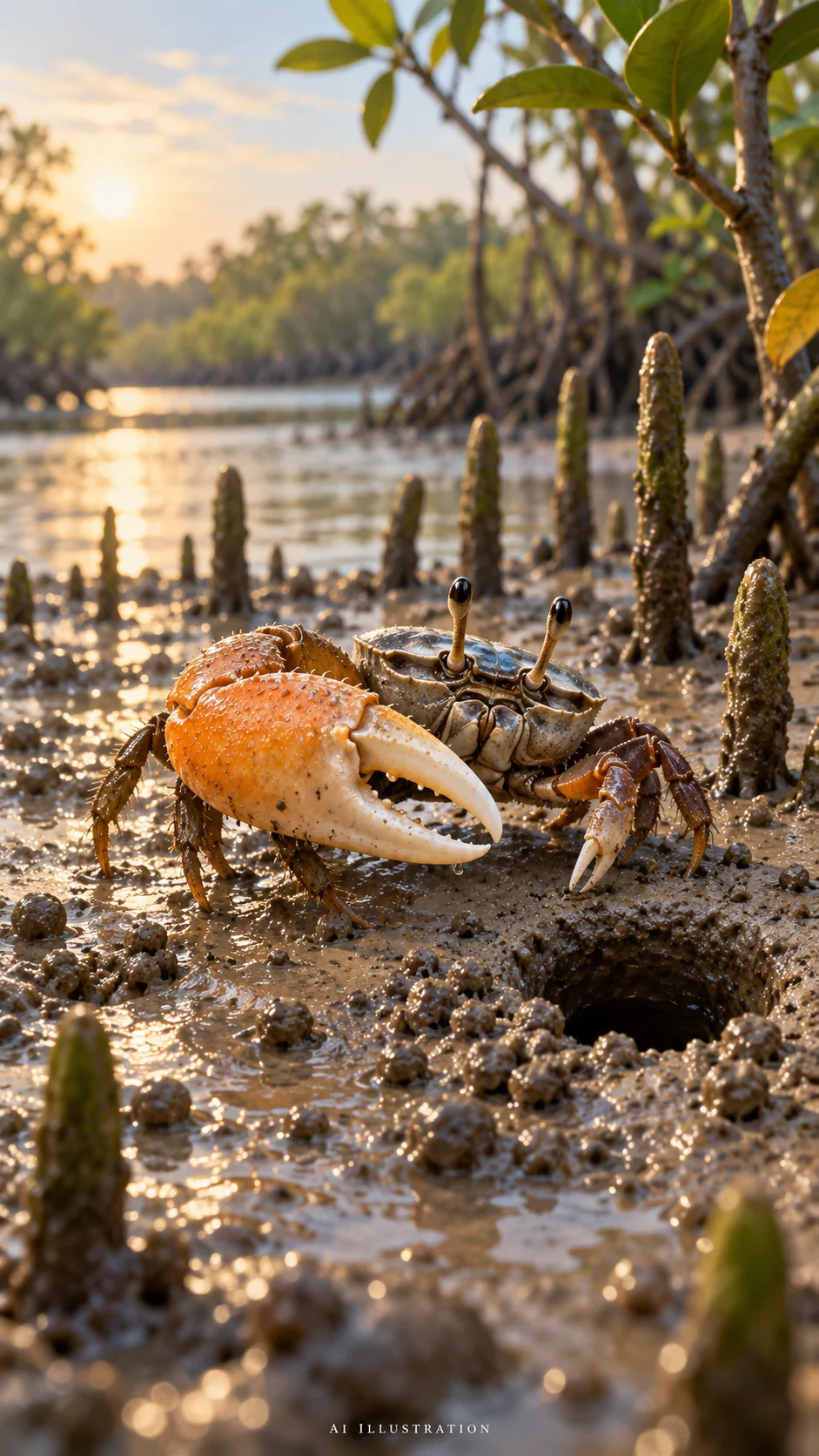
West Bengal’s government coastal resource describes mud crabs among the region’s aquatic resources. That does not make every crab on a muddy bank the same species. Local names, colour and apparent size are useful context, but they do not replace a supported identification.
Male fiddler crabs can have one much larger claw. Smithsonian explains that this claw is used in displays to females, threats to other males and contests. The asymmetry alone is not evidence of injury, disease or an unusual mutation.
A mud crab and a fiddler crab should not be presented as interchangeable portraits of one animal. If you cannot identify a photograph, a caption such as “mangrove crab; species unconfirmed” communicates the uncertainty clearly.
The fish moving on mud is still a fish
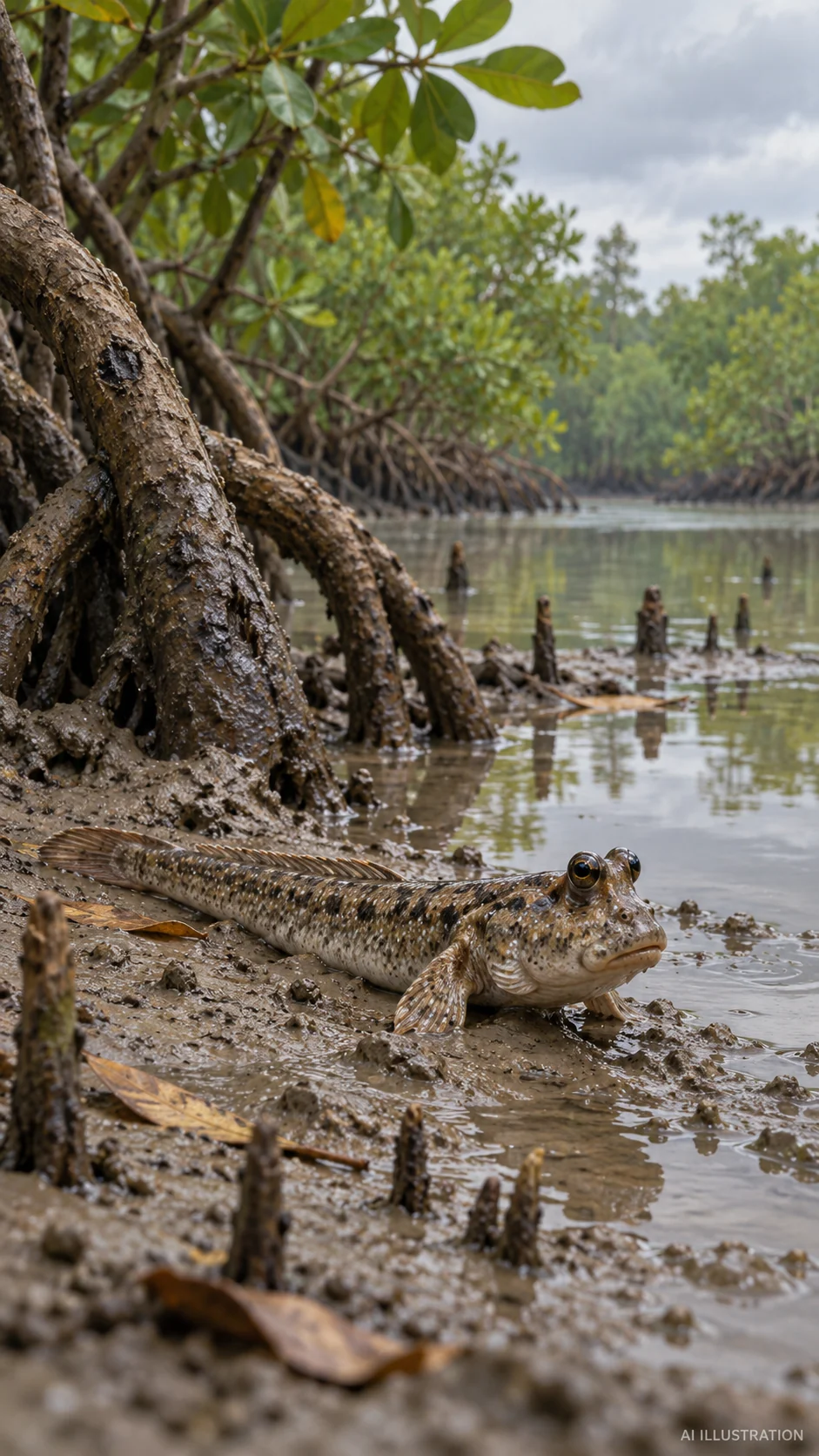
A mudskipper can look surprising when it moves over a muddy surface. It remains a fish. Experimental research has examined its movement using the pectoral fins and additional tail assistance when the substrate makes ordinary movement less effective.
The Sundarban Tiger Reserve website includes mudskippers among animals associated with its muddy margins. This supports the regional example; it does not identify an unfamiliar photograph to species. Seeing movement outside water also does not mean unlimited survival on dry ground.
Observe without picking the animal up, relocating it or chasing it to make a video. A short clip of undisturbed behaviour is more useful than a dramatic scene created by interfering with the subject.
Bhetki, parshey and hilsa: read names in context
Regional government and reserve accounts mention fish known locally as bhetki, parshey and hilsa. A familiar market name is a starting point, not automatic proof of exact species, catch location or the river where an individual fish lived.
A record from the wider Sundarbans aquatic landscape does not show that every fish lives permanently in every small creek. Place, season and life stage matter when reading a list. This article does not assign one shared life cycle to all fish in the region.
The government coastal resource lists bhetki as Lates calcarifer. Do not transfer that name to an unknown image just because it looks silvery. For a photograph that needs identification, a clear full-body view and reliable location context are better starting material than a close crop of one fin.
FACT: why species totals need a boundary
A Journal of Threatened Taxa checklist of fishes in the Bangladesh Sundarbans combined primary observations and published information to report 322 species. That is a study result with a defined setting, not a live count of the entire India–Bangladesh landscape.
Other reports can cover different boundaries, dates or animal groups. Adding their totals would create an unsupported new number. Before sharing a statistic, check where the research was done, when it was done and what was counted.
Advice: keep a useful record without disturbing wildlife
For your own photograph, retain the date, broad location and tidal context where known. Clearly distinguish a field photograph from an edited image or an AI illustration. Do not present the conceptual scenes on this page as evidence of your own visit.
Stay on authorised routes and follow local arrangements and guides. Do not step from a boat onto an unfamiliar mudflat just for a close-up. This article does not establish current entry times, tickets, night access or fishing permissions.
Keep plastic and line out of the water. Do not probe burrows, damage roots or hold up an animal for a portrait. An observation should help explain what the animal does in its habitat rather than manufacture an entertaining performance.
Five questions about Sundarbans aquatic life
Does every crab have one giant claw? No. The male fiddler-crab example is not a rule for all crabs.
Is a mudskipper really a fish? Yes. Moving on mud does not turn it into a frog or lizard.
Are bhetki and hilsa mentioned in regional sources? Yes, but a regional record does not guarantee a sighting at a particular place.
Can these AI pictures identify a species? No. They are illustrations, not authenticated specimens or field records.
Is this a fishing or food guide? No. Do not use the pictures to decide edibility, collection rights or local permissions.
Sources and illustration disclosure
Disclaimer: general nature and image-literacy information. All three pictures are AI-generated illustrations, not actual sightings, authenticated species records or collection permission. Sources checked: 25 October 2026.
- UNESCO: Sundarbans National Park — mangrove landscape and ecological role
- UNESCO: The Sundarbans, Bangladesh — site boundary and habitats
- Sundarban Tiger Reserve: fauna and regional fish names
- Government of West Bengal: coastal habitats and aquatic resources
- Smithsonian Ocean: The Design of a Beautiful Weapon — fiddler-crab claw
- NOAA Fisheries: Estuary Habitat
- Journal of Threatened Taxa: fishes of the Sundarbans, Bangladesh
- Ramesh et al., research preprint: mudskipper movement on wet mud
Read next: Bhimashankar glowing mushrooms