Can you get a passport with a pending FIR or criminal case?
Your police verification is adverse because an FIR appears against your name. First establish whether the matter is still under investigation or criminal proceedings are pending after the court has taken cognizance. Those situations differ. Obtain the relevant court permission where required, submit the complete record to the RPO and respond to notices within their deadlines.
The direct answer is that acquittal is not an absolute prerequisite in every case. However, section 6(2)(f), bail conditions, court orders and other statutory grounds must be examined. The Passport Authority issues the passport; an appropriate criminal-court order addresses the relevant legal restriction under conditions. Neither an application nor an informal police assurance guarantees issue.
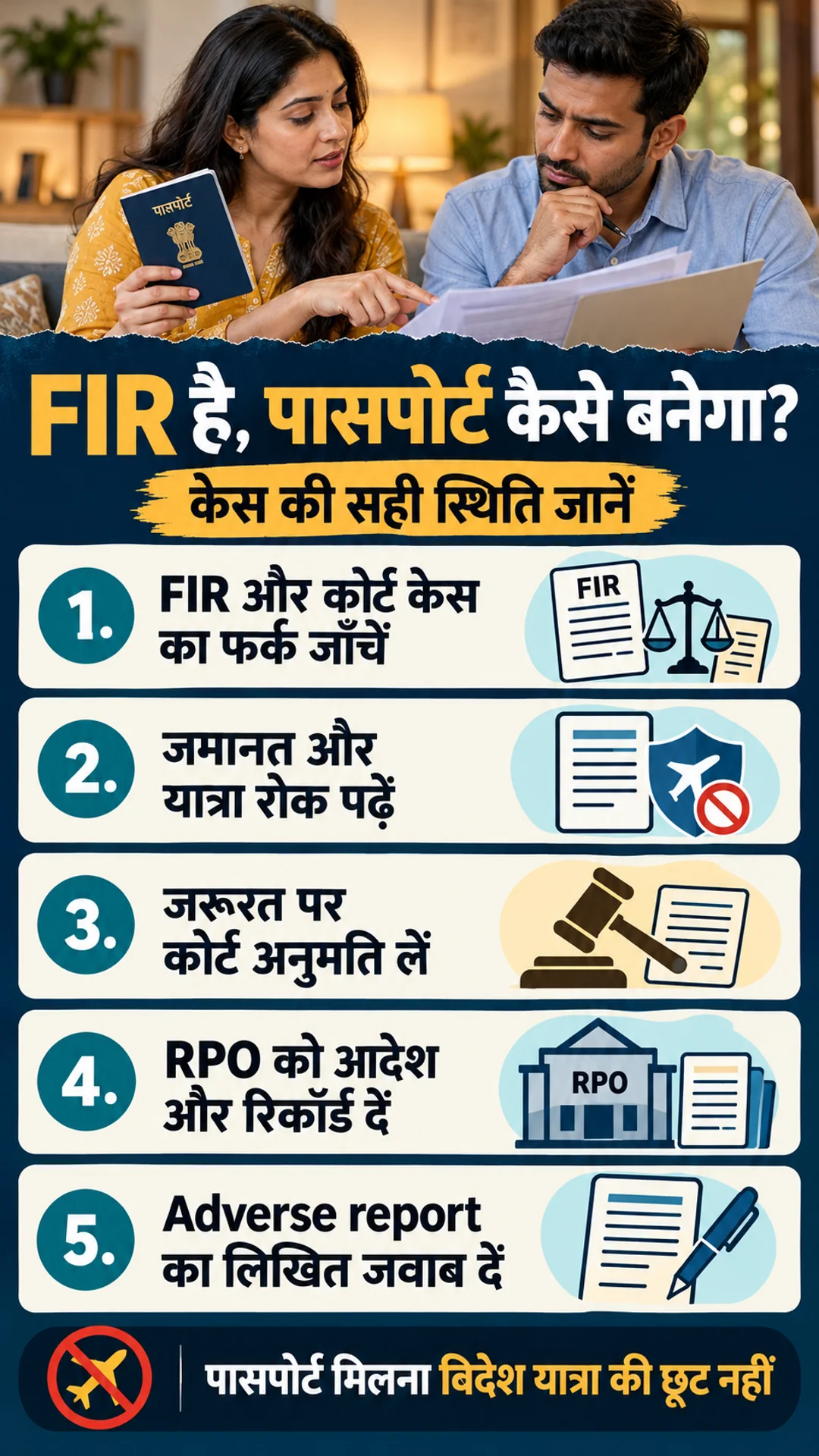
- Obtain the current FIR, charge-sheet and cognizance status.
- Read bail, passport-deposit and foreign-travel conditions.
- Seek specific permission from the competent criminal court where required.
- Submit the order, undertaking and complete case details to the RPO.
- Respond to adverse reports/notices and use the proper remedy for a formal refusal.
An FIR under investigation is not the same as court pendency
Section 6(2)(f), Passports Act, 1967 addresses criminal proceedings pending before a court. The judicially reproduced clarification in MEA’s Office Memorandum of 10 October 2019 distinguishes an FIR/investigation from a case registered before a court where cognizance has been taken. Establish the actual procedural stage rather than treating every police record as identical.
Cognizance means judicial cognizance of the offence. It is not simply an FIR number, police diary entry or a complaint being sent somewhere. Examine the FIR, charge-sheet and order-sheet with a lawyer. A direct criminal complaint can also lead to court proceedings; absence of a police charge-sheet is not universally proof that no criminal case exists.
This distinction is not permission to conceal information. Answer the actual application questions accurately and provide requested details. Calling an FIR false does not make its existence disappear. If the report misstates the procedural position, seek correction with documents. Suppression or a material false statement can create a separate passport problem.
Bail, warrants and travel restrictions require separate review
Section 6(2)(g) concerns court summons/warrants and orders prohibiting departure, while section 6(2)(e) has a separate conviction-related ground. Do not describe the GSR 570(E) route for clause (f) as an automatic exemption from every other ground. Conviction, a pending appeal, suspension of sentence and a stay of conviction are different legal states.
Comply with bail conditions requiring prior travel permission or deposit of the passport. Permission to re-issue does not automatically remove them. An LOC or immigration restraint needs separate examination before the appropriate authority/court. Holding a valid passport is not a guarantee of airport clearance or permission to leave India.
Disclose all relevant criminal cases and orders, including applicable appeal proceedings. Do not submit only the most convenient court’s NOC while ignoring another restriction. Orders from different courts may need to be read together; seek clarification of conflicting terms. An ordinary civil property suit should not simply be equated with criminal-court pendency.
GSR 570(E) and the Supreme Court’s December 2025 ruling
GSR 570(E), dated 25 August 1993, provides a conditional exemption from section 6(2)(f) under section 22. The concerned court’s order and an undertaking to appear when required are central. A letter from an unrelated magistrate is not a universal substitute, and pending proceedings do not create an unconditional entitlement.
FACT: In Mahesh Kumar Agarwal v. Union of India & Anr., 19 December 2025, 2025 INSC 1476, the Supreme Court distinguished passport renewal from permission for each foreign journey. Criminal courts can permit renewal while retaining control through separate travel permission or redeposit conditions. Lack of a presently authorised, specifically dated trip was not treated as an absolute bar to every renewal.
The ten-year re-issue directed in that case rested on its facts and the relevant court orders read together. It is not an automatic ten-year entitlement for every accused applicant. The order’s wording, validity, other statutory grounds and ordinary procedural requirements still matter. This distinction helps frame a precise application rather than asking for vague blanket relief.
Which court and which documents should you approach with?
Through your lawyer, seek the appropriate order from the concerned criminal court or relevant appellate/bail court. Disclose all cases, bail conditions and passport status. If you have applied already, attach the ARN/file reference and RPO notice. A government employee’s departmental requirements may be additional; departmental NOC and criminal-court permission are different documents.
- FIR/complaint, charge-sheet and relevant order-sheets.
- Bail, appeal, travel-restraint and passport-surrender orders.
- Existing passport, expiry, application/ARN and RPO notice.
- A court-wise list of all pending cases and next hearings.
- The genuine purpose; if travel is sought, itinerary, supporting reason and return information.
Specify whether you request issue/re-issue, what validity you seek and whether permission for an actual trip is requested too. Do not invent tickets when no trip is planned. Retention of an existing requirement for separate future travel permission can be proposed; the court decides. The application itself is not a variation of bail or permission to travel.
The court may examine attendance, flight risk, allegations, procedural stage and the stated reason. Support genuine employment, study or treatment needs with documents. Obtain an authenticated/certified order and understand compliance directions. If the passport is held by a court, request appropriate release/redeposit directions rather than assuming access follows automatically.
Adaptable court application and RPO representation
These are general drafting aids, not prescribed court forms. Have local headings, verification and procedure checked. Use only accurate statements; relief is not guaranteed.
1. Application to the concerned criminal court
Before [competent court], [place]
Case/FIR No. [ ], parties [ ]
Application for permission / clarification for passport issue or re-issue
1. Proceedings against the applicant are [cases, stage and next dates]. Other pending cases are [complete list].
2. Existing bail/travel/passport-deposit directions are [dates and exact conditions].
3. Passport status is [new application/number and expiry], ARN [ ]. The RPO raised [notice/objection].
4. The passport is required for [genuine reason]; requested validity is [ ].
5. [If travel is requested: destination, dates, purpose, return and evidence. Otherwise: no immediate trip permission is requested in this application.]
6. The applicant undertakes to attend when required and obey all applicable conditions. Appropriate relief under GSR 570(E), applicable law and judgments is requested.
Prayer: Permit issue/re-issue and clarify validity, release/redeposit and travel conditions. Add actual trip relief only if sought.
Date/signature; annexures and verification under local rules.
2. Reply to the RPO about a report or notice
To: Regional Passport Officer, [place]
Subject: ARN/File [ ] — response concerning criminal-case report
My relevant case details are [complete list]. The present stage is [investigation / proceedings after cognizance / other accurate position], supported by the attached records.
[Investigation only: Please reassess the section 6(2)(f) court-pendency issue under the MEA OM dated 10 October 2019 with the enclosed status records.]
[Court order: Order dated [ ] permits passport issue/re-issue on [exact terms and validity]. Orders from all relevant proceedings and the applicable GSR undertaking are enclosed.]
Please reconcile the records and decide the application under applicable law. Identify any remaining legal obstacle or necessary document in writing.
Name, safe contact, date; orders, undertaking, case list and notice attached.
Use the official Passport Seva undertaking where applicable. It requests all pending-case details, the court/investigating agency and hearing information. The representation above does not replace it. Avoid posting passport, identity or case documents in open social-media groups; submit them through official channels.
One year or ten years, and what to do after an adverse report
The GSR framework gives importance to a court-specified passport period. If neither passport validity nor travel period is specified, the default is generally one year. If permitted travel is shorter than one year and passport validity is unspecified, it is one year; if travel exceeds one year with no specified passport validity, the travel period guides validity. Read the actual order and current applicable instructions together.
Extension/re-issue of a short-validity passport is not automatic. The original clause, court order, use of travel permission and later orders affect the next step. Review requirements before expiry. Do not assume a one-year document meets every visa-validity requirement or make non-refundable plans merely because an application has been filed.
An adverse police report is not itself the final rejection order. Respond to the RPO’s notice with accurate status evidence and request appropriate reassessment/secondary verification. Relevant court permission and the undertaking must be considered under the applicable framework; a separate address, identity or other lawful objection still needs its own answer.
For a formal refusal, impounding or revocation, preserve the reasons and communication date. Section 11 provides an appeal route for eligible orders, and Passport Seva describes the Log appeal option. Check the applicable limitation, fees and order-specific process promptly. A routine grievance does not automatically suspend the appeal deadline. Obtain advice about the appropriate judicial remedy if required.
Advice, related reading and five FAQs
Advice
Keep one accurate case timeline and consistent details across the form, police verification and undertaking. Contest a false allegation through lawful proceedings; do not erase it from passport documents. Recheck bail, travel and redeposit terms after permission. Passport issue, visa approval and permission to depart are separate questions.
WhatsApp chats as evidence: keeping records
Does every FIR automatically stop a passport?
Investigation and court cognizance differ, but other statutory grounds and restrictions still require examination.
Must I wait for acquittal?
Not in every case. Appropriate court orders and the conditional GSR route may be available.
Does a court NOC guarantee ten years?
No. Wording, validity and facts matter; the 2025 ruling is not a universal guarantee.
Can I travel once the passport arrives?
First comply with any prior-permission or travel-restraint conditions.
Does adverse police verification end the file?
Not automatically. Examine the notice and decision; a representation and an appeal against a formal order are different steps.
- Passports Act, 1967 — official statute
- Supreme Court: Mahesh Kumar Agarwal, 19 December 2025
- MEA OM: criminal-court pending passport applications
- Passport Seva: official GSR undertaking
- Karnataka High Court: FIR/cognizance clarification, 25 April 2026
- Passport Seva: appeal FAQ
Disclaimer: General legal information for India. Case stage, bail/court orders and passport requirements affect individual advice. Fact-checked: 13 October 2026.