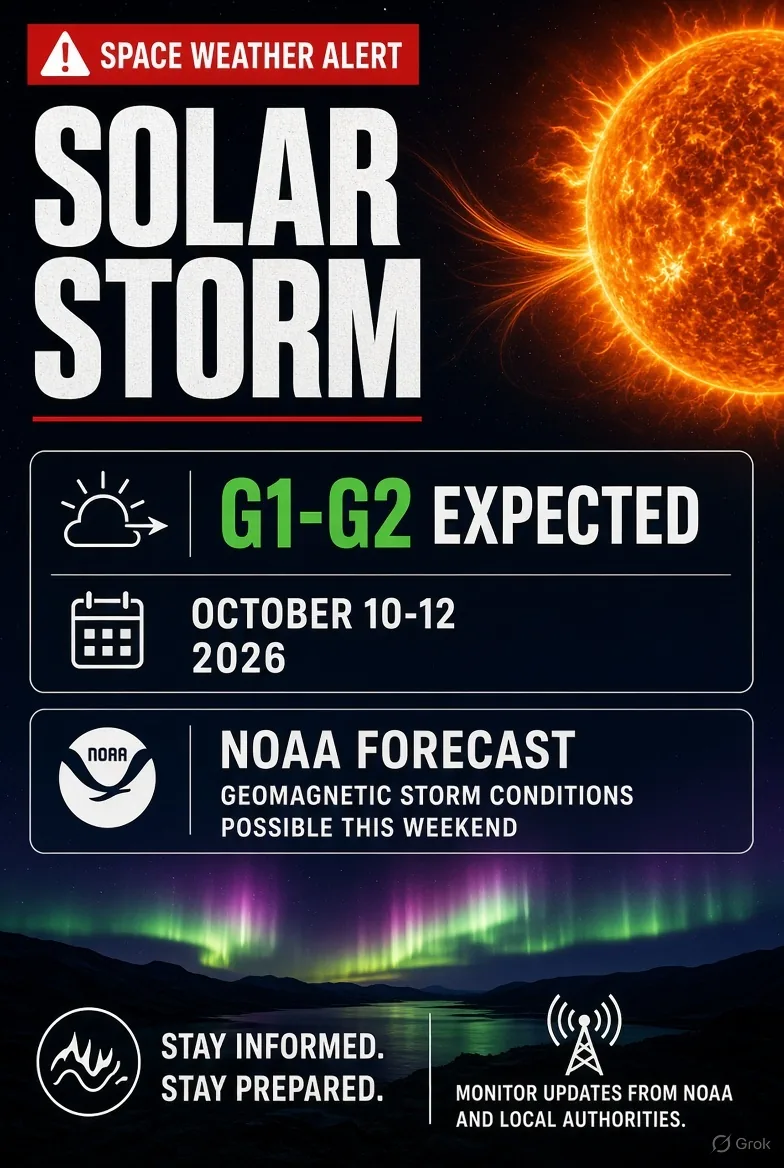
Solar storm is trending right now. NOAA’s Space Weather Prediction Center has forecast G1 to G2 geomagnetic storm conditions between 10 and 12 October 2026. This means material from the Sun may disturb Earth’s magnetic field.
In simple terms, charged particles from the Sun can reach Earth and cause a temporary disturbance in the magnetosphere. Most of the time the effects stay mild, but aurora can become visible and some systems may see minor impacts.
What is a solar storm?
The Sun is constantly active. Sometimes it produces flares and coronal mass ejections (CMEs). A CME is a cloud of plasma and magnetic field released from the Sun. When one heads toward Earth, it can trigger a geomagnetic storm.
NOAA measures these on the G-scale. G1 is minor and G2 is moderate. The current forecast is in the G1-G2 range. This is not considered a severe event, but it is worth monitoring.
What is the current forecast?
According to the NOAA SWPC 3-day forecast, G1 conditions are possible late on 10 October and on 11 October. G1-G2 conditions are expected on 12 October. The cause is CMEs that left the Sun on 7 and 8 October. The faster one may merge with the slower one on the way to Earth.
The Kp index is expected to reach around 5 to 6. Kp 5 corresponds to G1 and Kp 6 to G2. Aurora may be visible at high latitudes.
What effects are possible?
At G1-G2 levels, effects are usually limited:
- Aurora (northern or southern lights) can appear at high latitudes.
- Some satellites may need orientation corrections.
- High-frequency radio communication can experience mild fading.
- Power systems at high latitudes may see voltage alarms.
Countries closer to the equator, including India, normally see little to no direct impact. Aurora is not visible here and major power or radio problems are not expected.
Impact on India
For India this solar storm is not an alarm. Our geomagnetic latitude means G1-G2 storms have minimal effect. Mobile networks, internet and electricity are not at risk from this level of activity.
People in northern countries may get a chance to see aurora. For everyone else it is mainly an interesting space weather update.
Advice:
There is no need to worry. You can check NOAA updates if you are interested. People in India will not face any direct impact. Those at high latitudes may see aurora, but serious system problems are not expected. Stick to official sources for information.
FAQ
How strong is the solar storm today?
G1 to G2 conditions are forecast, which is minor to moderate.
Where can aurora be seen?
Mainly at high latitudes such as northern North America, Europe and southern Australia.
Will India be affected?
No significant direct impact is expected.
Will mobile or internet stop working?
No. This does not happen at G1-G2 levels.
How long will it last?
Main activity is expected around 10 to 12 October 2026.
Sources: NOAA Space Weather Prediction Center, SpaceWeatherLive.
Space weather scientists continuously monitor the Sun. The exact arrival time of a CME can shift slightly because the path from the Sun to Earth is not empty. Forecasts are therefore updated regularly.
If you are at high latitude and want to see aurora, choose a place with clear skies and low light pollution. At G2 levels the aurora can reach a bit farther south than usual.
Remember that solar storms are different from earthquakes. They come from solar activity and usually produce controlled effects. Official agencies such as NOAA keep monitoring them.