What is antimatter in simple words?
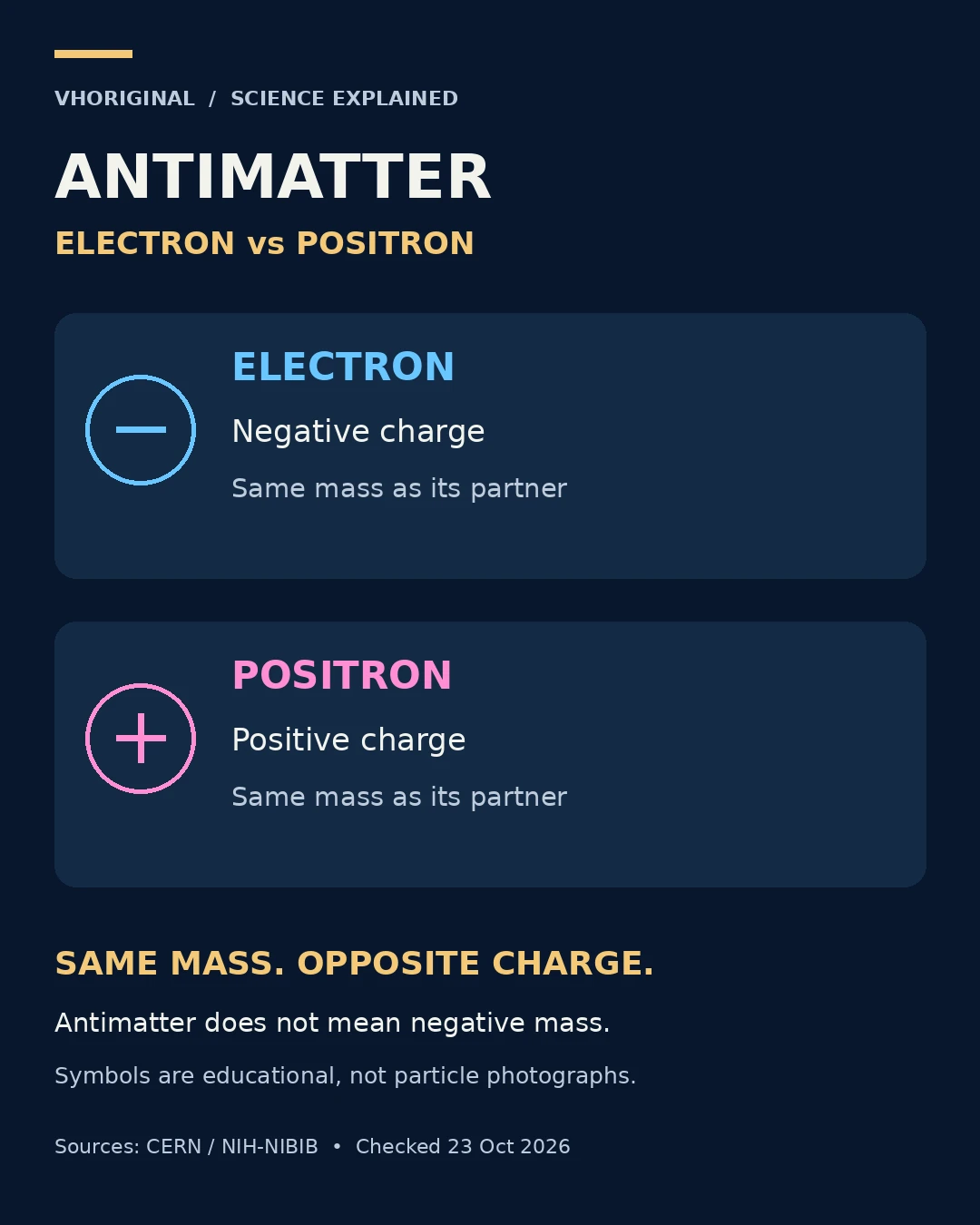
Antimatter consists of antiparticles corresponding to ordinary matter particles. A simple example is the positron, the electron’s antiparticle: it has the same mass as an electron but positive electric charge instead of negative charge. “Anti” does not mean negative mass.
These particles are experimentally observed physics rather than a fictional disappearing material. Treat viral one-gram price claims carefully: an estimate of production cost is different from a normal retail price. This guide separates the basic science, recent research and cost claims. Information checked on 23 October 2026.
What did the October 2026 experiment achieve?
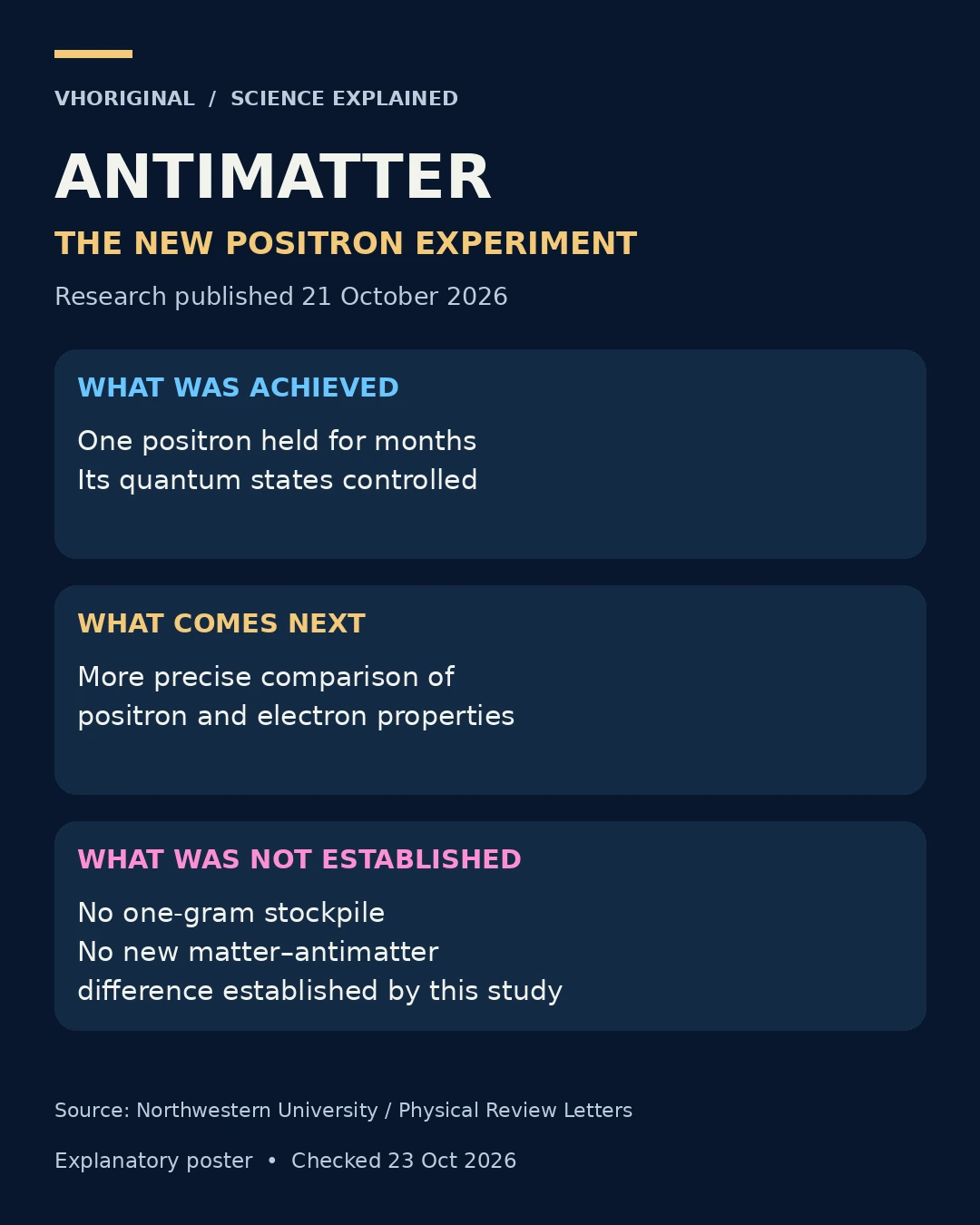
In its 21 October announcement, Northwestern University described trapping a single positron for months and controlling its quantum states. The work appears in Physical Review Letters.
A trap here is not an ordinary container. Carefully arranged electric and magnetic fields hold the particle in a near-empty space, away from ordinary matter. Controlling tiny changes in its energy allows researchers to examine its behaviour precisely.
Key distinction: this is control of one particle, not the storage of a gram of antimatter. The approach opens a route to a more precise comparison of positron and electron magnetic properties. It does not report that a new difference has already been found or that the matter–antimatter mystery is solved.
How much does one gram of antimatter cost?
Searching “antimatter price per gram in rupees” returns spectacular numbers. First distinguish a calculated cost of production from a sale price for a traded substance. We are not presenting any single number as a verified current retail quotation.
A meaningful estimate needs context: which antiparticle, which year, which production efficiency and which operating or facility costs are included? Converting an old dollar figure into rupees does not make it today’s verified price.
Production, capture, slowing and containment are difficult. Extrapolating from a tiny experimental quantity to one gram does not demonstrate that a facility can actually supply that gram. Claims about buying countries are attention-grabbing comparisons rather than a useful scientific measure.
How is antimatter produced and stored?
CERN’s Antiproton Decelerator explanation describes a proton beam striking a metal target and producing secondary particles, including antiprotons. The antiprotons are subsequently slowed and controlled for experiments. Different antimatter experiments use different antiparticles.
Charged antiparticles can be confined with electric and magnetic fields. Neutral anti-atoms such as antihydrogen require a different, demanding trapping arrangement. A normal bottle is not an appropriate picture of storage.
Making particles and retaining them are separate challenges. When reading a storage headline, check the type of particle, number involved and purpose of the experiment before comparing it with another result.
What happens when matter meets antimatter?
A particle and its corresponding antiparticle can annihilate. In the familiar electron–positron example, the energy can emerge as photons. This does not mean that energy disappears; total energy remains accounted for.
A single-particle laboratory result is not comparable with a giant cinematic explosion. Quantity matters. The new study concerns an individual trapped positron, not a bulk stockpile.
Antimatter also differs from dark matter. The names refer to different concepts and research questions. Appearing together in a story about the universe does not make them the same substance.
What is antimatter used for?
PET scanning provides an existing application. The NIH’s NIBIB explanation describes positron-emitting radiotracers: interactions with electrons produce photons that the scanner detects to help image processes inside the body. This does not mean a patient receives a gram of stored antimatter.
Fundamental physics experiments compare matter and antimatter properties in extraordinary detail. One broad question is why ordinary matter dominates the observable universe. A new measurement method can sharpen a test without supplying the final answer to that question.
For spacecraft or large-scale energy claims, distinguish a proposal from a working technology. A laboratory milestone does not establish that a practical everyday antimatter engine is ready.
Our advice for reading antimatter headlines
Start with the university announcement or original paper. Separate what the team demonstrated from what it plans to measure next. The distinction between “has achieved” and “could enable” changes the meaning of a discovery.
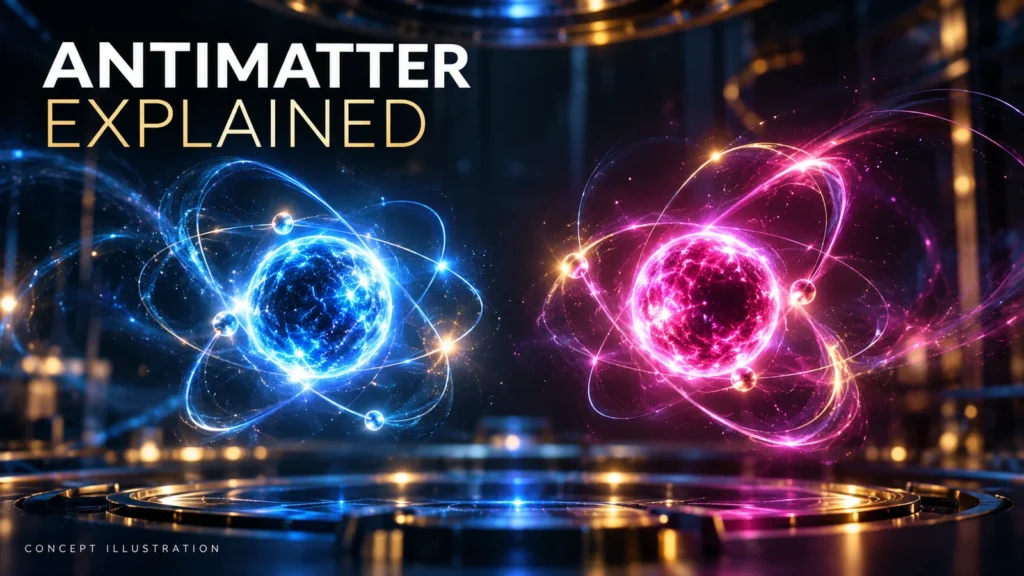
For price claims, look for a date, quantity and calculation method. Do not interpret colourful particle artwork as an experimental photograph. Our cover and posters are explanatory illustrations.
A useful reading sequence is to understand the electron–positron example, then the purpose of a trap, and then the new research. That makes it easier to assess the impressive headline without losing the science.
Frequently asked questions
Does antimatter really exist? Yes. Positrons and antiprotons are established examples.
Does antimatter have negative mass? No. A positron has the same mass as an electron, with opposite electric charge.
What is the confirmed price of one gram in rupees? This guide does not establish a current sale quotation. Do not treat production-cost estimates as normal market prices.
Did the experiment trap one gram? No. It concerns one positron.
Has it disproved existing physics? No. It prepares a path for more precise comparisons.
Sources and image notes
CERN: Antimatter; CERN: Antiproton Decelerator; Northwestern announcement, 21 October 2026; Myers et al., One-Positron Quantum Cyclotron, PRL 137, 173001; NIH/NIBIB: Nuclear Medicine. General science information. Images are explanatory artwork, not photographs of a particle or the actual experiment.
More technology and science posts