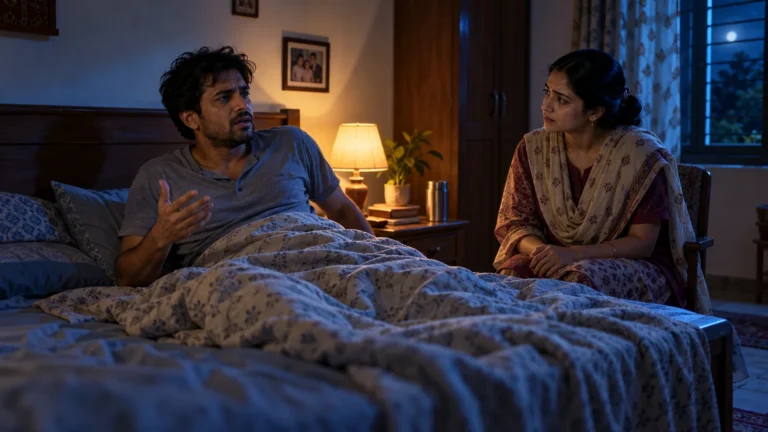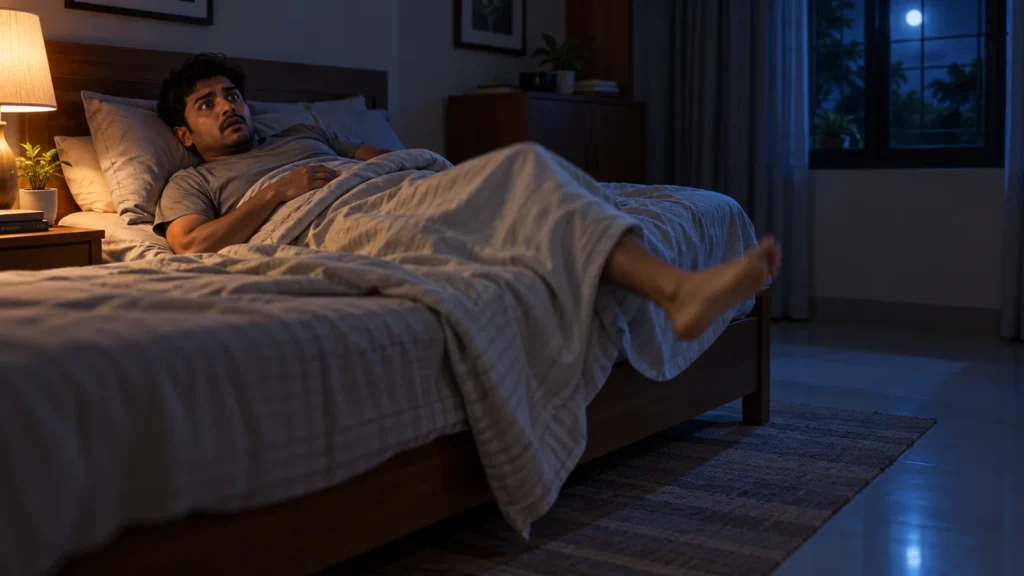
You were drifting off when it felt as though someone pulled your foot
You are lying in bed and your eyes begin to close. Suddenly a leg jumps. For an instant, it feels as if you are falling or something has pulled your foot from below. You open your eyes to an ordinary room. This illustrative scene captures why an abrupt sensation can make returning to sleep feel unsettling.
Jerking while falling asleep does not establish an invisible attack. A brief involuntary movement around the onset of sleep may be a hypnic jerk, also called a sleep start. That does not mean every muscle contraction, painful cramp or electric-shock sensation belongs to the same category. The actual pattern matters.
Begin with what happened rather than a frightening label. Did the body move, did you only feel a shock, or did pain remain in the leg? Respect the fear while leaving the cause open. Different descriptions can guide different next steps, and an article cannot diagnose an event solely from the words used.
What a hypnic jerk is and why timing helps
A sleep start is a sudden muscle movement during the transition from wakefulness to sleep. The legs or the whole body may jerk, sometimes with a feeling of falling. Royal Papworth NHS describes these experiences as normal and very common. An occasional sleep start does not itself establish epilepsy.
Think of a brief unintended movement as sleep begins. The story that your brain thinks you are dying, or deliberately kicks your legs to save you from a fall, should not be presented as an established mechanism. A memorable explanation still needs evidence; an appealing analogy is not the same as a proven cause.
Record whether an episode happens as you drift off, well into the night or while fully awake. Timing alone is not a diagnostic test, but it gives a clinician useful context. Saying that your leg briefly moved at sleep onset is more informative than deciding beforehand that an unseen presence must have pulled it.
Sleep loss, stress and caffeine are relevant possibilities
Sleep deprivation, stress and caffeine-containing drinks may worsen sleep starts. This association does not mean every jerk can be explained by tiredness. Consider irregular sleep timing, late work and evening tea, coffee or energy drinks. Describe the pattern honestly rather than choosing a single lifestyle factor as the certain cause.
A regular sleep schedule, sufficient opportunity to rest and a calm bedtime routine are practical starting points. Keep a brief note of whether changes help. There is no guarantee that one routine will eliminate all movements. Repeated episodes that significantly disturb sleep should not be dismissed simply because lifestyle factors are also present.
Staying awake to guard against another jerk or recording every small movement can interfere with rest. Family support can focus on a safe, comfortable sleeping environment and listening to the complaint. A routine is a supportive measure, not a substitute for assessing a persistent problem or a promise of a complete cure.
FACT: a sleep jerk and a brain zap are different descriptions
A hypnic jerk involves brief movement at sleep onset. Brain zaps usually describes an electric-shock-like sensation, often in the head, that can occur during antidepressant withdrawal. NHS and NICE recognise such withdrawal symptoms. The term does not establish a measured electrical discharge in the brain or prove that a seizure has occurred.
Stopping a medicine, missing doses or reducing a dose can be relevant history, but a shock sensation does not automatically identify medication as the cause. Speak with the prescriber. This article does not advise stopping, restarting, doubling a dose or designing your own taper. A medication review should consider your individual situation.
Source: Royal Papworth NHS: Sleep starts and other sleep behaviours
Keep cramps, restless legs and paralysis separate
A painful muscle that stays tight for a while is a different complaint from a momentary sleep start. Wanting to move but being unable to do so can resemble sleep paralysis. These comparisons help you describe a pattern; they are not instructions for making a final diagnosis at home from a symptom checklist.
An urge to keep moving the legs during rest, with some relief from movement, can fit a restless legs pattern. One abrupt kick is different from sustained restlessness. Iron status can be relevant in some cases, but that does not make starting iron supplements without assessment the appropriate response to every nighttime leg sensation.
Actual contact with electricity, an injury or a physical problem with the bed is another situation. Feeling something like a shock is different from electrical exposure. If a real hazard is possible, obtain appropriate safety and medical assistance. You do not need to force all complaints into either a paranormal explanation or the hypnic jerk label.
Make a useful record and explain the experience plainly
Note the frequency, timing, body part, pain, any change in awareness and impact on sleep. Tell a clinician about prescribed medicines and recent changes. A short factual record can help without becoming constant surveillance. Do not deliberately lose sleep or consume extra caffeine to provoke an episode for an experiment or a recording.
A partner can describe what they actually observed: “Your leg moved once and you woke up.” Avoid adding a story about an unseen attacker. If a safe recording already exists, sharing it with a clinician may be helpful with consent. Obtaining a video should never delay assistance during an event that appears serious.
For a child, offer reassurance rather than a label of possession, weakness or blame. Seek paediatric advice for recurring or concerning events. Borrowed sleeping pills, unfamiliar medicines and painful rituals do not help establish the cause. The aim is to preserve safety, useful observations and the person’s ability to ask for help.
Advice: routine assessment or urgent help?
Seek medical assessment if movements recur frequently, also happen while fully awake, cause injury or interfere with sleep and daily activities. Explain the episode rather than requesting a diagnosis based on its name. An EEG, scan or sleep study is not automatically necessary for everyone; a clinician decides what investigations the pattern warrants.
Collapse, serious breathing difficulty, prolonged or repeated seizure-like episodes, substantial injury or rapidly worsening symptoms call for urgent assistance. In India, 112 is the emergency support number. Do not dismiss a serious event as an ordinary sleep start because it occurred at night or because you previously had harmless brief movements.
An occasional brief jerk at the start of sleep can be approached calmly in the appropriate context. If the pattern changes, reassessment may be useful. Naming a possible experience is the beginning of understanding it, not the end of evaluation. Respectful support and clear descriptions are more helpful than confident supernatural or medical guesses.
Frequently asked questions
Does feeling my feet pulled prove a supernatural attack?
No. A brief sleep-onset movement is one ordinary possibility. Recurring episodes, events at other times or serious accompanying symptoms may need assessment.
Are hypnic jerks and sleep paralysis the same?
No. A hypnic jerk involves movement; sleep paralysis involves being unable to move despite wanting to. The experiences should not be merged into one explanation.
Is every shock-like sensation a brain zap?
No. The description does not identify the cause. Mention relevant medicine changes to your prescriber. Actual electrical exposure is a separate safety issue.
Will reducing caffeine always stop the jerks?
There is no guarantee. Caffeine may worsen sleep starts in some people. Review sleep habits and seek assessment for persistent or troublesome episodes.
Should I stop my antidepressant or sleeping medicine?
Do not stop or adjust prescribed medicine yourself. Withdrawal symptoms can occur. Speak with the prescriber and do not borrow another person’s medicine.
Related reading
A Crawling or Pins-and-Needles Feeling on Your Skin: Formication, Tingling and Safe Help
Sleep paralysis: being unable to move
Fear of a supernatural presence: main guide
Sources and review
Information reviewed: 18 October 2026. The opening scene is illustrative, not a reported case.
Royal Papworth NHS: Sleep starts and other sleep behaviours
NHS: Antidepressants and withdrawal
NICE NG222: Stopping antidepressant medication
MHA: Emergency response support system — 112
This is general information, not an individual diagnosis or treatment. Seek professional help for severe or persistent symptoms.