
A sudden thought at a height: what does it mean?
You are on a rooftop and an unwanted thought appears: “What if I jumped?” You do not want to do it, yet the thought leaves you frightened and questioning yourself. This experience is often called the call of the void. A passing unwanted thought does not, by itself, establish your wishes, intentions or a mental health diagnosis.
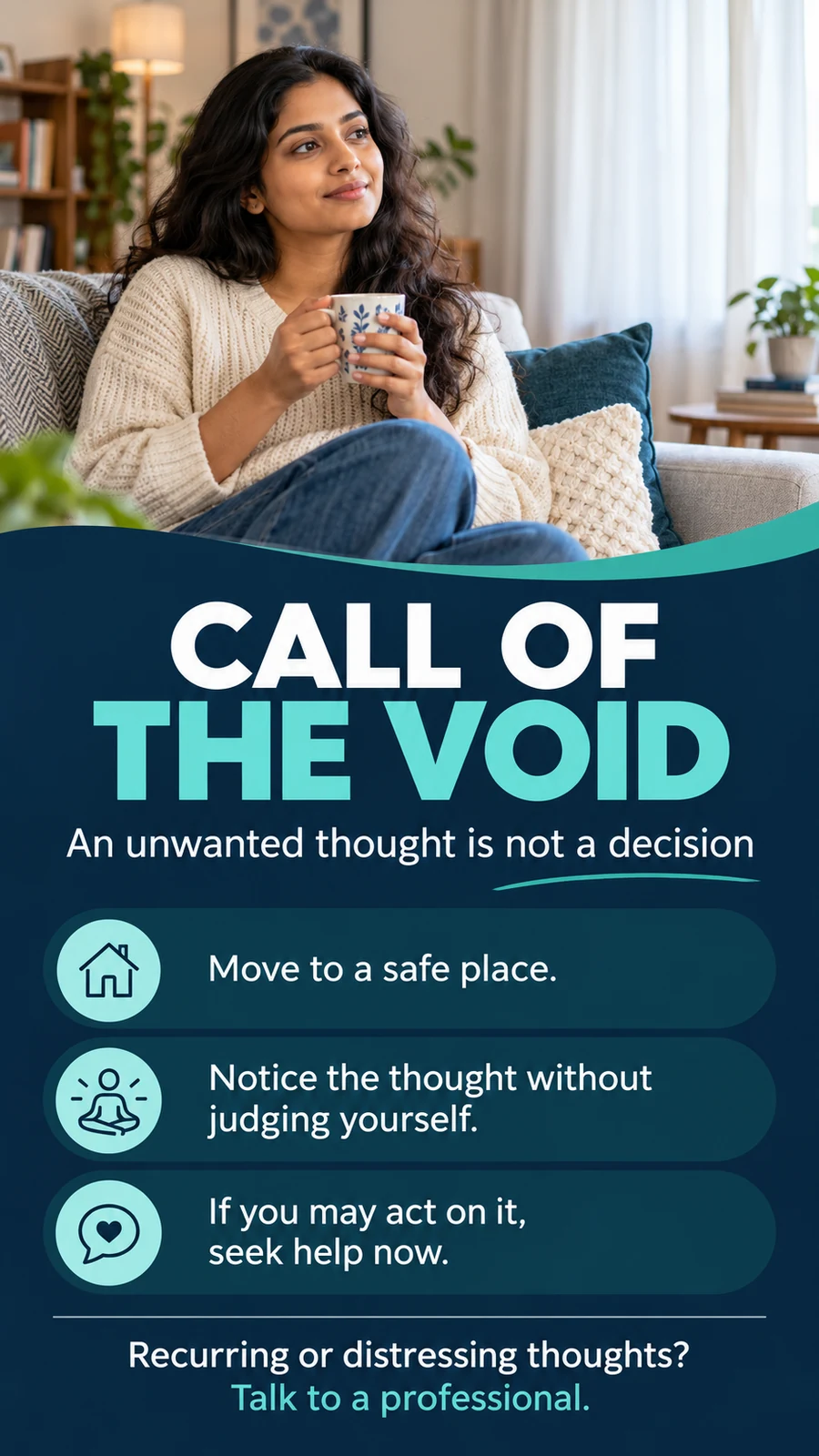
If you want to harm yourself, think you might act on the thought or cannot trust yourself to stay safe, move away from the edge into a safe indoor space now. Ask a trusted person to stay with you and seek immediate help. In India call 112 for an emergency; elsewhere use your local emergency number.
What is the high place phenomenon?
Researchers use high place phenomenon (HPP) for a sudden thought or urge to jump when at a height. Call of the void is a popular name for it, rather than an individual diagnosis.
Hames and colleagues’ 2012 study found the experience among people without a history of suicidal thoughts too. It does not automatically reveal a hidden wish to die.
Is it a survival signal? What research can actually say
One proposed explanation is that a rapid warning to move away from danger gets misinterpreted. That is a hypothesis, not a proven mechanism for every person who has the experience.
The 2020 BMC Psychiatry study also describes limits on proving that explanation. “This proves your brain wants you alive” and “there can never be any risk” both go beyond the evidence.
FACT: HPP alone neither establishes suicidal intent nor guarantees safety. A person’s current wishes, distress and ability to remain safe still matter.
Unwanted thought versus intention: avoid a self-diagnosis
A person may find a thought frightening and inconsistent with what they want. An actual desire to self-harm, preparation or uncertainty about staying safe calls for immediate support. These experiences can overlap; a neat online checklist cannot replace an assessment.
You can tell someone, “I had the thought but do not want to do it,” or “I am worried I might act.” You do not need a polished explanation or a diagnosis before asking for help. Describe the uncertainty honestly.
Being frightened by a thought or moving back from an edge does not, by itself, establish that support is unnecessary. If you cannot make sense of the experience, discussing it with a qualified professional is a reasonable next step.
Do recurring intrusive thoughts mean OCD?
Unwanted thoughts are common. Persistent distress, substantial time spent on them or repeated checking and reassurance-seeking can warrant assessment. One thought does not diagnose OCD. See the NHS guide to OCD symptoms.
A 2025 study found an association between HPP and obsessive-compulsive symptoms. Association does not mean everyone with HPP has OCD, or prove that one causes the other.
Advice: respond safely rather than testing yourself
First, leave the edge and go indoors. Do not return to a dangerous position to prove courage, test your control or see whether the thought returns. A risky place is not a setting for self-directed practice.
Once safe, you might briefly acknowledge: “An unwanted thought showed up; I do not have to act on it.” This is not a substitute for crisis help or assessment. You do not need to repeat the sentence until you achieve perfect certainty.
Ask someone you trust: “I had a frightening thought. Could you sit with me for a while?” The purpose is connection and practical support, rather than endlessly decoding every thought. Mention repeated online searching to a counsellor if it is becoming part of your distress.
Family or friends can listen calmly, avoid ridicule and help the person connect with support. The NIMH guidance describes ways to support someone with suicidal thoughts.
Related reading: Sudden Anxiety and a Racing Heart at Night: Causes and What to Do
Related reading: Waking Up Gasping or Choking in Your Sleep: Causes and When to Get Help
When to speak to a professional
Arrange help if thoughts recur, affect ordinary safe activities or leave you persistently frightened. Explain what happened, how you feel about the thought and how it affects your day. Uncertainty is something you can bring to the appointment, rather than solve before attending.
For diagnosed OCD, CBT with exposure and response prevention (ERP), and sometimes medication, may be used. Treatment should be professionally guided; do not interpret exposure as advice to visit a dangerous height. See NHS OCD treatment information.
In India, Tele-MANAS offers free, 24/7 mental health support: 14416. Website: https://telemanas.mohfw.gov.in/home. Outside India, use local mental health services. For immediate danger, contact emergency services or the nearest emergency department rather than waiting only for a helpline.
Frequently asked questions and disclaimer
Does the thought reveal a hidden death wish? Not automatically. Actual desire to self-harm or uncertainty about safety needs immediate support.
Is the call of the void always harmless? The label cannot establish safety in every situation. Context matters.
Does one thought mean I have a mental illness? No diagnosis follows from one thought alone. Recurring distress or disruption deserves assessment.
Does offering a helpline label someone suicidal? No. Providing access to support is not a diagnosis.
Should I return to the rooftop to test myself? No. Do not use a hazardous situation as a self-test. Seek help in a safe setting.
Disclaimer: This is general education, not a personal diagnosis, risk assessment or treatment plan. Research and clinical sources are linked in the relevant sections. If you are unsure you can remain safe, seek immediate support.