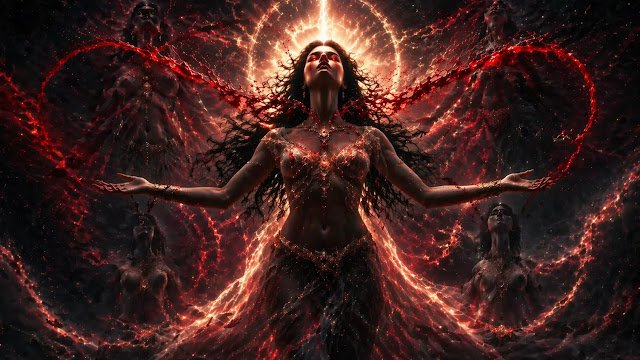
When a viewer encounters the imagery of Goddess Chhinnamasta for the first time, the initial reaction is almost universally one of shock and disorientation. Depicted holding her own severed head in her hand while three streams of blood spout from her neck—one feeding her own severed head and the other two nourishing her female attendants—her form breaks every conventional expectation of divine iconography. To an uninitiated observer or someone browsing internet graphics without context, the immediate question arises: why is Chhinnamasta scary, and why would a revered deity be depicted in such a jarring manner?
The fear triggered by this imagery is understandable. Modern society conditions us to associate decapitation, blood, and nudity with violence, horror, or dark forces. However, within the ancient framework of Hindu Tantra and the wisdom traditions of the Dasa Mahavidyas (the Ten Great Wisdom Goddesses), nothing in this iconography is meant to induce terror for its own sake. Rather, the startling visual design is a deliberate pedagogical tool—a sacred shock therapy meant to shatter superficial human conditioning and force the seeker to look beyond physical form into ultimate spiritual truths.
To truly comprehend why Goddess Chhinnamasta appears frightening, one must look past surface-level appearances and explore her documented history, iconographic symbolism, psychological impact, and the profound philosophy of self-sacrifice and energy control that she embodies.
Documented History and Tradition of Goddess Chhinnamasta
In the sacred texts and historical traditions of Shaktism, Goddess Chhinnamasta holds the fifth position among the Ten Mahavidyas. Historical references to her worship and iconography are found across various Shakta Puranas, Tantric digests such as the Pranatoshini Tantra and Tantrasara, as well as Buddhist Vajrayana traditions where she is venerated under the name Chinnamunda.
According to classical scriptural accounts, the origin myth of Chhinnamasta illustrates the ultimate principle of motherly sacrifice and nourishment. Traditional narratives relate that while bathing in the Mandakini River with her attendants, Jaya and Vijaya (also referred to as Dakini and Varnini), the attendants became overwhelmed by intense hunger. Moved by infinite compassion, the Goddess decapitated herself with her own scimitar to quench their spiritual and physical hunger with her own life blood. This narrative establishes that her act was not one of self-destruction out of despair, but an act of supreme creation and selfless sustenance.
Historical pilgrimage centers dedicated to her worship further reflect her revered standing. Prominent among these is the Chhinnamastika Temple located at Rajrappa in Jharkhand, situated at the confluence of the Damodar and Bheira rivers. Built over ancient Tantric sites and supported historically by local rulers, this shrine draws thousands of devotees who approach the Goddess with deep faith (shraddha), seeking spiritual strength, protection, and the severance of worldly attachments. Another significant shrine is the Chintpurni Temple in Himachal Pradesh, linked to the same divine lineage.
Deconstructing the Iconography: What Does Each Element Symbolize?
To move beyond fear, we must decode the rich Tantric symbolism embedded in every detail of Goddess Chhinnamasta’s depiction. Far from being a random assemblage of horrific motifs, every element represents a precise aspect of spiritual metaphysics and Kundalini yoga.
1. The Severed Head and the Destruction of Ego
In Yogic and Tantric philosophy, the head represents the seat of the ego (Ahamkara), intellect, and individual identity. By cutting off her own head, Chhinnamasta symbolizes the complete transcendence of the ego. The terrifying aspect of her decapitation reflects the psychological pain that the human ego experiences when it is asked to surrender its pride, attachments, and false sense of separateness. For spiritual awakening to occur, the false identification with the physical body and intellect must be severed.
2. The Three Streams of Blood and Energy Transmutation
The three jets of blood spouting from her neck are directly connected to the subtle energetic anatomy of the human body. In Kundalini Yoga, there are three primary energy channels (nadis): Ida (lunar/passive), Pingala (solar/active), and Sushumna (the central channel of spiritual awakening). The central stream of blood entering the Goddess’s own mouth represents the divine energy returning to its source through the Sushumna Nadi, while the two side streams feeding her attendants represent the balanced distribution of life force (prana) throughout the cosmos.
3. Standing Upon Kamadeva and Rati
Goddess Chhinnamasta is traditionally depicted standing upon the copulating bodies of Kamadeva (the deity of desire) and Rati (his consort). To an untrained eye, this posture appears shocking or controversial. Symbolically, however, it represents absolute mastery over desire and procreative force. Rather than destroying sexual energy, the Goddess stands atop it to demonstrate that instinctual life force must be controlled, sublimated, and redirected upward for spiritual enlightenment. She demonstrates that life and death, creation and dissolution, are intimately intertwined.
4. Her Nakedness and Nude Form
Her nakedness signifies absolute freedom from worldly illusion (Maya), social taboos, and artificial masks. She represents unvarnished cosmic truth in its rawest, most unadulterated state. Just as truth requires no embellishment, the divine reality embodied by Chhinnamasta strips away all superficial pretense.
Psychological Context: Why Does Her Image Trigger Fear?
Psychologically, human fear is almost always rooted in the unknown and the fear of mortality. When modern viewers look at Chhinnamasta, her imagery confronts them directly with three universal human anxieties:
- The Fear of Death: Severed heads and blood immediately evoke mortality. Society conditions individuals to avoid thinking about death, whereas Tantric philosophy embraces death as a natural transition and a necessary prerequisite for renewal.
- The Fear of Losing Control: The act of self-decapitation symbolizes giving up control over one’s life, identity, and mental constructs. The ego deeply fears losing its grip on personal narrative and sensory dominance.
- The Confrontation with Raw Reality: Most religious imagery presents the divine in gentle, reassuring forms. When confronted with a form that encompasses destruction alongside creation, the mind experiences cognitive dissonance and discomfort.
From a psychological standpoint, contemplating Chhinnamasta serves as a form of spiritual exposure therapy. By compelling the seeker to face the imagery of mortality and ego-loss with calm reverence, the mind gradually transcends irrational dread and develops resilience, clarity, and deep emotional strength.
Myths vs. Reality: Clearing Popular Misconceptions
Due to internet sensationalism and a lack of proper spiritual instruction, numerous misconceptions surround Goddess Chhinnamasta. It is essential to separate cultural myth and modern rumors from authentic traditional understanding.
- Myth 1: Chhinnamasta is a dark or evil entity.
Reality: In authentic Shakta tradition, Chhinnamasta is a revered manifestation of the Supreme Divine Mother (Adhya Shakti). She represents compassionate self-sacrifice, wisdom, and liberation, not malevolence or harm. - Myth 2: Looking at her image brings bad luck or physical harm.
Reality: Divine iconography in Hinduism is designed for meditation and reflection. While esoteric Tantric rituals involving her mantra require formal initiation under a qualified teacher, simply viewing or studying her image with respect causes no harm. - Myth 3: Her worship is strictly meant for occult practitioners.
Reality: While she holds a primary place in esoteric Tantric sadhana, ordinary householders venerate her at established pilgrimage sites like Rajrappa for general protection, mental fortitude, and spiritual growth.
FACT BOX: Symbolism at a Glance
- Severed Head: Annihilation of the ego (Ahamkara) and intellectual pride.
- Scimitar / Sword: The blade of discrimination (Viveka) cutting through ignorance.
- Three Blood Streams: Flow of vital energy through Ida, Pingala, and Sushumna nadis.
- Standing on Kama & Rati: Transmutation of sensory desire into spiritual consciousness.
- Attendants (Jaya & Vijaya): The manifest universe sustained by divine sacrifice.
Devotional and Practical Perspective: How Seekers Approach the Goddess
For devotees and spiritual seekers approaching the shrines of Goddess Chhinnamasta, the focus is never on sensationalism or fear. Instead, visitors and practitioners follow mindful, respectful guidelines to align their consciousness with her higher teachings.
- Cultivate Respectful Intent (Shraddha): Approach her image or temple with solemnity, recognizing that her alarming appearance is a metaphor for ultimate spiritual liberation.
- Focus on Inner Mastery: Use her imagery as a reminder to master one’s anger, lust, pride, and irrational fears. Ask yourself what aspects of your ego need to be surrendered for personal growth.
- Avoid Horror-Driven Media: Distinguish between authentic spiritual art and sensationalized internet content that uses sacred iconography for clickbait or shock value.
- Prioritize Mental Health: If visual representations of mortality or blood trigger severe anxiety, panic, or distress, step back. True spiritual practice should foster peace and clarity. Individuals dealing with existential dread or anxiety disorders should seek supportive psychological care alongside calm, gentle spiritual practices.
FAQ
Frequently Asked Questions
Why is Goddess Chhinnamasta depicted with her head cut off?
She is depicted holding her severed head to symbolize the complete surrender and destruction of the ego (Ahamkara). It represents transcending physical body-consciousness to attain supreme spiritual liberation and wisdom.
Is Goddess Chhinnamasta associated with evil or black magic?
No. In authentic Hindu and Tantric traditions, Goddess Chhinnamasta is a revered form of the Divine Mother (Mahavidya). She embodies ultimate self-sacrifice, cosmic energy balance, and liberation from ignorance, not dark magic or malevolence.
Who are the two female figures standing beside Chhinnamasta?
The two figures are her attendants, traditionally named Dakini and Varnini (or Jaya and Vijaya). They represent the manifest creation and the subtle energy channels that are nourished by the Mother’s cosmic life force.
Why do people feel scared when looking at her image for the first time?
The fear arises because modern social conditioning associates blood and decapitation with violence and death. Because the ego fears its own destruction, her jarring iconography triggers an automatic psychological defense mechanism until its inner philosophical meaning is understood.
Can ordinary people visit her temples like Rajrappa?
Yes. Thousands of householders and pilgrims visit established temples dedicated to Goddess Chhinnamasta, such as the Rajrappa shrine in Jharkhand, to offer prayers, seek blessings, and experience the sacred environment with faith and devotion.
Disclaimer: This article is intended solely for educational, cultural, historical, and philosophical analysis. It does not constitute medical, psychological, legal, or occult advice. Symbolic interpretations are based on traditional Shakta philosophy and folklore. If you experience severe fear, existential anxiety, or mental distress, please consult a qualified healthcare or mental health professional. Temple visitation guidelines and local customs should be verified independently prior to travel.