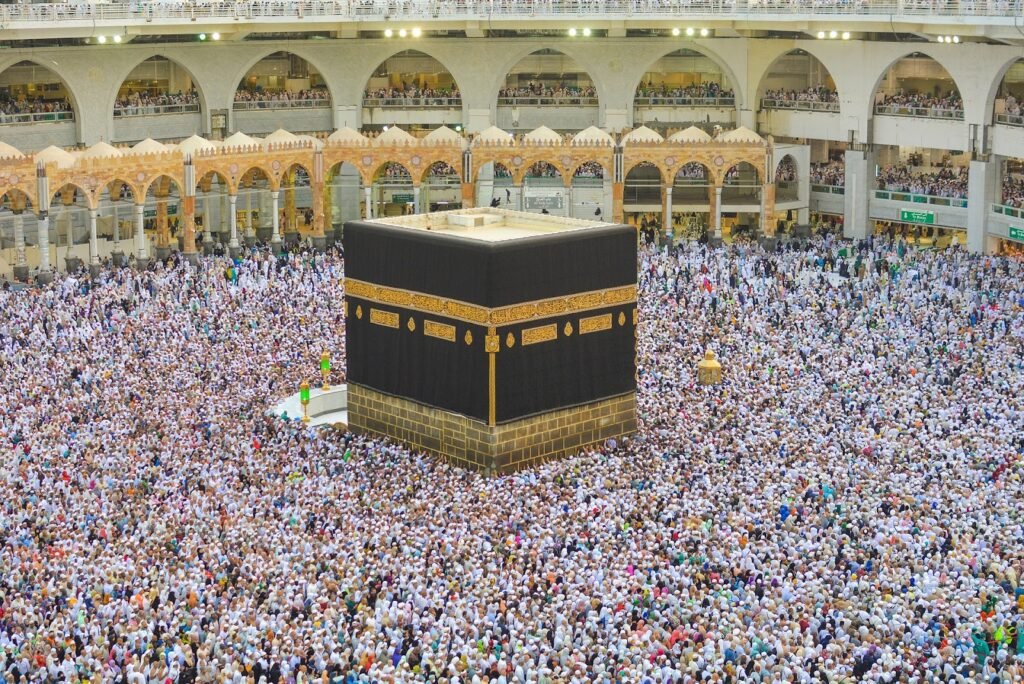
Every year, images of pilgrims throwing pebbles during Hajj travel across phones, television, and social feeds. For many non-Muslim readers in India, the scene looks mysterious. The question behind those pictures is simple: what is the hajj stoning of the devil meaning, and why is that act treated as part of a sacred journey rather than a random gesture? This article explains the Hindi source’s framing in clear English — what Hajj is, where it sits among Islam’s five pillars, when it falls on the Islamic calendar, and the traditional Ibrahim account used to explain the stones — without adding extra ritual steps, counts, or claims the source does not make.
The source treats Hajj as duty and devotion, not as spectacle. It also answers a second, louder rumor that often travels with Hajj videos: that the Kaaba, Mecca, or Medina hides a Shiva temple. That claim, the source says, is completely false. Read the sections below as an explanation of that article’s scope. Faith claims are labeled as traditional religious belief. Calendar timing and the five-pillar list are presented as the source states them. Viral temple stories are labeled as rumor and rejected by the same source.
What Hajj Is in Islam
Hajj, in the source’s words, is a kind of Islamic pilgrimage. It is not described there as a tourist trip, a holiday, or an optional cultural festival. It is named as one of the five pillars of Islam. In that framing, a pillar is a core duty of the religion, not a side custom. The source says that according to Islam, every Muslim — woman or man — has a duty to go to Mecca for Hajj at least once in a lifetime.
That duty is immediately qualified. The source does not say every person on earth must go, and it does not say a person who cannot go has failed the faith in some automatic way. It says the journey should be undertaken only by those who are able in both body and money. Physical capacity and financial capacity sit together in that sentence. A reader who only notices the “once in a lifetime” line and skips the ability line will misunderstand the source.
The destination named in the source is Mecca. The source does not walk through a full map of every stop on the pilgrimage. It does not list extra rites beyond the themes it actually covers: the duty of Hajj, the five pillars, the Islamic-calendar window, the Ibrahim story used to explain stone-throwing, the later custom of sacrificing goats and lambs on that occasion, and the rejection of a temple rumor. Keeping that boundary matters. Hajj is larger than any one explainer. This page stays inside what the Hindi article actually said.
Because Hajj is framed as a pillar, the source places it next to belief, prayer, fasting, and charity. That placement is the point. Hajj is not introduced as an isolated mystery about stones. It is introduced as one duty among five, then the stone-throwing is explained through a traditional story about Prophet Ibrahim, his son Ismail, a command of sacrifice, and a devil who tried to break that resolve. The stones, in that telling, remember the refusal to be misled.
The Five Pillars of Islam and Where Hajj Fits
The Hindi source lists five pillars and then spends a short line on each. The list is not a textbook of Islamic law. It is a plain summary meant for general readers. The five items, in the source’s order and wording, are Iman, Namaz, Ramzan, Zakat, and Hajj.
Iman, as the source describes it, means that every Muslim community will believe that Muhammad — called Hazrat Sahab in the source — is the Rasul, and will not worship anyone other than Allah. Two ideas sit in that one line: trust in the messenger, and exclusive worship of Allah. The source does not add extra creed formulas beyond that summary.
Namaz, in the same list, means each Muslim will pray five times a day. The source does not name prayer times or describe postures. It only states the five-times duty.
Ramzan is listed as the month in which each Muslim will keep roza, the fast, and follow its rules. Again, the source does not write a fasting manual. It names the month and the obligation.
Zakat is described as every Muslim giving some percentage of earnings for religious work. The source does not fix a number. It only says “some percentage.” That vagueness should stay vague. Inventing a figure would go beyond the article.
Hajj closes the list: every Muslim will perform the Mecca Hajj journey once in a lifetime if able. The “if able” clause is part of the pillar as the source writes it. Ability is not a footnote added later by this English page. It is already in the Hindi text.
Read together, the five pillars show why Hajj videos confuse outsiders. Prayer and fasting are private or local. Charity can happen at home. Hajj is public, long-distance, and visually striking. The stone-throwing is the image that travels farthest. The source’s answer is that the image still belongs to the same pillar-structure: a once-in-a-lifetime journey for those who can make it, remembered through a story of obedience under pressure.
When Hajj Takes Place on the Islamic Calendar
The source gives a calendar window, not a Gregorian date. It says that according to the Islamic calendar, Hajj takes place from the eighth to the twelfth date of the last month. Those dates, it adds, keep changing when they are mapped onto the English calendar, because the two calendars are counted differently.
That is the whole timing claim. The source does not name the last Islamic month in Arabic in that sentence, and it does not pin Hajj to a particular English year. An honest rewrite should not invent a year, a weekday, or a conversion table. What the reader needs is the principle: Hajj is dated on the Islamic calendar; the English calendar will not hold still under it.
Why does that matter for the stone-throwing question? Because the ritual the source describes is not a random day when someone feels like throwing pebbles. It is placed inside a fixed stretch of the Islamic year’s last month. The Ibrahim story, the later custom of animal sacrifice on that occasion, and the pilgrimage duty are all tied, in the source, to that religious calendar — not to a viral clip with no date.
Readers who only watch short videos often miss this. A clip can look like a sudden crowd event. The source treats it as a dated pilgrimage window. Eighth to twelfth of the last Islamic month is the frame. Outside that frame, this article does not add extra scheduling claims.
FACT BOX
The source calls Hajj an Islamic pilgrimage and one of Islam’s five pillars, alongside Iman, Namaz, Ramzan, and Zakat. It says every Muslim, woman or man, should perform Hajj at least once if physically and financially able. It dates Hajj from the 8th to the 12th of the Islamic calendar’s last month; English-calendar dates shift because the calendars are counted differently. The hajj stoning of the devil meaning, in the source, is tied to a traditional account: a devil tried to stop Ibrahim from obeying a command involving his son Ismail. The same source says WhatsApp and Facebook claims that a Shiva temple stands in the Kaaba, Mecca, or Medina are completely false. Hajj Stoning of the Devil Meaning in the Story of Ibrahim
This is the heart of the query. The source heading asks why stones are thrown at the devil during Hajj. The answer it gives is not a modern political theory and not a claim that a devil is standing in the street for cameras. It is a traditional religious narrative about Hazrat Ibrahim.
According to that account, as the source tells it, Allah once asked Ibrahim for a sacrifice of his most beloved thing. Ibrahim had been blessed with a child in old age. He named the child Ismail and loved him deeply. Even so, the narrative says, Ibrahim accepted Allah’s command and prepared to sacrifice his son.
That setup is the moral center of the story in the source: love for the child is real, and the command is still treated as binding. The English page should not soften that tension or decorate it with extra miracles the Hindi text does not mention. The source’s Ibrahim is an aged father with a late-born son, facing a demand that costs him what he loves most.
The stone-throwing, later in the same telling, is not explained as anger at a child or as a hunt for a visible monster in Mecca. It is explained as a response to the being who tried to break Ibrahim’s resolve on the road. If a reader wants the hajj stoning of the devil meaning in one line from this source, that line is: pilgrims remember the devil who tried to turn Ibrahim away from obedience, and they throw stones because of that attempt to mislead him.
Label the genre clearly. This is a traditional Islamic account as presented in the Hindi article. It is not a laboratory finding. It is not a court record. It is belief and sacred memory. Readers who share the faith will hear it as history of the prophets. Readers who do not share the faith can still understand the meaning the ritual carries for those who perform it. Neither response requires inventing extra plot points.
How the Traditional Account Describes the Devil’s Attempt
The source says that when Ibrahim was taking his son for the sacrifice, a devil met him on the way. The devil’s argument, in that telling, was practical and emotional at the same time. He said Ibrahim was sacrificing his son at this age; after the son died, who would care for Ibrahim; Ibrahim would have to live the rest of his life alone.
The source then says Ibrahim heard this and fell into thought. His intention to offer the sacrifice also broke. Then he recovered himself and went ahead with the sacrifice. Those three beats matter: the doubt was real, the recovery was real, and the journey continued. The Hindi article does not present Ibrahim as a statue who never felt the pull of the argument. It presents a father who almost stopped and then steadied.
That is why the devil belongs in the explanation of the stones. In the source’s logic, the danger was not only the command. The danger was persuasion — a voice that used old age, loneliness, and caretaking to loosen obedience. Throwing stones during Hajj, as the source concludes later, is done because that devil tried to lead Ibrahim astray.
What the source does not say is just as important. It does not say the devil is a tourist attraction in Mecca. It does not say pilgrims see a body and aim at a face. It does not give a count of stones, a map of pillars, or a minute-by-minute rite. Those details exist in many other books and explainers; they are not in this source, so they stay out of this rewrite. The meaning offered here is moral and memorial: reject the whisper that tells a believer to abandon a command out of fear of being left alone.
What the Source Narrative Says Happened After the Test
The source adds a second scene. Ibrahim feared that his own emotions might stop him at the moment of sacrifice, so he tied a bandage over his eyes in order not to see his son. After the sacrifice he removed the bandage. He saw his son alive in front of him. On the altar lay a slaughtered lamb.
From that moment, the source says, the custom of offering goats and lambs on this occasion has continued. The English page should keep that causal link as the source writes it: the living son, the slain lamb, then a continuing practice of animal sacrifice on that occasion. It should not rename the occasion with extra festival titles the source does not use, and it should not add legal rules about who must offer an animal.
How does this scene connect to the stones? In the source’s sequence, the devil’s work happens on the road, before the altar. The bandage and the lamb happen at the sacrifice itself. The stones remember the first interference. The animal offering remembers the outcome the narrative gives after the test: the son lives, a lamb is found slain, and a custom follows.
A careful reader will notice what kind of story this is. It is a story about command, love, doubt, recovery, and substitution as the source narrates substitution — a lamb on the altar, the son unharmed. Presenting that as “what Muslims believe this account says” is honest. Presenting it as a news event filmed last week would not be. The source is teaching meaning, not filing an eyewitness report from the present-day streets of Mecca.
Does Satan Appear in Mecca? Belief Versus Viral Claims
The Hindi title asks whether Satan is seen in Mecca. The body never answers that with a yes. It never says a devil stands visible in the city today. It explains stone-throwing through the Ibrahim story summarized above. That gap should be respected. A title can pose a sharp question. The article’s actual claim is narrower: people throw stones during Hajj because, in this traditional account, a devil tried to mislead Ibrahim.
A second claim travels on WhatsApp and Facebook, and the source faces it directly. Many messages say a Shiva temple stands in the Kaaba, in Mecca, or in Medina. The source’s verdict is blunt: those talks are completely wrong; there is nothing of that kind. This English page repeats that rejection without turning it into mockery of any community. The point is source-accuracy. A pilgrimage site explained through Islamic pillars and the Ibrahim narrative is not, in this article, re-described as a hidden Hindu temple.
Those two issues get mixed in comment threads because both sound like “secret Mecca.” They are not the same issue. One is a religious memory about a devil tempting a prophet. The other is a communal rumor about a temple. The source accepts the first as the meaning of the stones. It rejects the second as false. An explainer that blurs them does the reader no service.
For a general audience, the clean distinction is this. Traditional belief, in the source, gives the stones a story. Documented-as-false, in the same source, is the temple rumor. Neither point requires hatred of another faith. Neither point requires inventing a visible devil walking through present-day Mecca. Curiosity can stay curious without turning rumor into fact.
Who Is Expected to Perform Hajj
The source repeats the ability rule in more than one place. Hajj is a duty for Muslim women and men at least once in life, and it should be done by those who are physically and financially capable. People who are not capable in body or money, the source says, may not be able to go. In that situation, it adds, there are institutions and charities that send people on Hajj free of cost, and such people can contact those bodies.
That charity line is a source claim about the existence of help, not a directory. This page does not name organizations, fees, or application steps, because the Hindi article does not name them. Readers looking for actual travel help should treat this only as a pointer that the source believes such help exists — then verify any offer through trusted local channels. Unverified “free Hajj” messages on the same WhatsApp threads that carry temple rumors deserve the same caution the source already shows toward fake temple stories.
Putting the duty and the charity note side by side keeps the tone respectful. Hajj is not framed here as a luxury brand and not framed as a punishment for the poor. It is framed as a pillar for those who can carry it, with a mention that some institutions try to carry others. That is the whole social picture the source draws. Extra politics, extra crowd figures, and extra travel advice would be padding, not explanation.
The stone-throwing sits inside that same picture. It is part of the pilgrimage the source is describing, not a separate street fight and not a dare for people who are not on Hajj. Meaning and setting belong together: a timed Islamic journey, a five-pillar duty for the able, and a remembered refusal to be talked out of obedience.
FAQ
What is Hajj according to this source?
Hajj is described as an Islamic pilgrimage and one of the five pillars of Islam. The source says every Muslim, woman or man, should go to Mecca for Hajj at least once in a lifetime if physically and financially able.
What is the hajj stoning of the devil meaning in the Hindi article?
The source links the stones to a traditional account of Hazrat Ibrahim. On the way to offer a commanded sacrifice involving his son Ismail, a devil tried to stop him with fear of old age and loneliness. After doubt, Ibrahim recovered and continued. Muslims throw stones during Hajj, the source says, because that devil tried to mislead him.
Does the source say Satan is visible in Mecca?
No. The title asks the question, but the body explains the rite through the Ibrahim narrative. It does not claim that a devil is seen in present-day Mecca as a physical sighting.
Is there a Shiva temple in the Kaaba, Mecca, or Medina?
The source says WhatsApp and Facebook claims of that kind are completely false and that no such thing is the case.
When does Hajj happen, and who can go if they cannot afford it?
The source dates Hajj from the eighth to the twelfth of the Islamic calendar’s last month; English dates change because the calendars differ. It also says some institutions and charities send people on Hajj free of cost, and those who need that help can contact such bodies — without naming any organization in the article.
Disclaimer
This page is an English rewrite of a general Hindi explainer. It is not a fatwa, not a pilgrimage manual, and not a substitute for qualified religious guidance. Traditional stories are presented as the source’s religious narrative, not as laboratory proof. Ritual details that the source does not give — including extra steps, stone counts, maps, or named authorities — are left out on purpose. Readers should treat viral temple claims and unverified travel offers with the same caution the source already asks for. Respect for Muslim belief and practice is intended throughout.