 Vista

Gold jewellery bills in India often mix weights, rates and charges in a way that is easy to misread. If you have wondered how to check if a gold jewellery bill is correct, what making charges and wastage mean, or what VA charges in gold jewellery are, this guide walks through each line. It explains how GST is applied, how to verify the HUID hallmark, and how to compare two quotations. Wastage and VA wording varies by jeweller, so there is no single universal formula. All figures below are hypothetical numbers chosen to show the arithmetic; they are not today’s gold rate.
What each gold jewellery bill field means
A gold jewellery bill explained simply is a short list: how much gold you are paying for, at what price, plus charges, plus tax. The confusion usually starts because shops use different labels for similar things, so match each line on your bill to the fields below before you compare shops.
Net gold weight, purity, rate and stone weight
- Gross weight is the whole piece; net gold weight excludes stones, pearls, lac or other non-gold parts. Gold value should be based on net weight.
- Purity should match the hallmark on the piece, for example 22K916 or 18K750. Ask the shop to write the same purity on the bill.
- The rate per gram must be for the same purity. A 24K rate should not be applied directly to 22K gold.
- Stone weight and stone value should be listed separately. Stones are priced differently from gold.
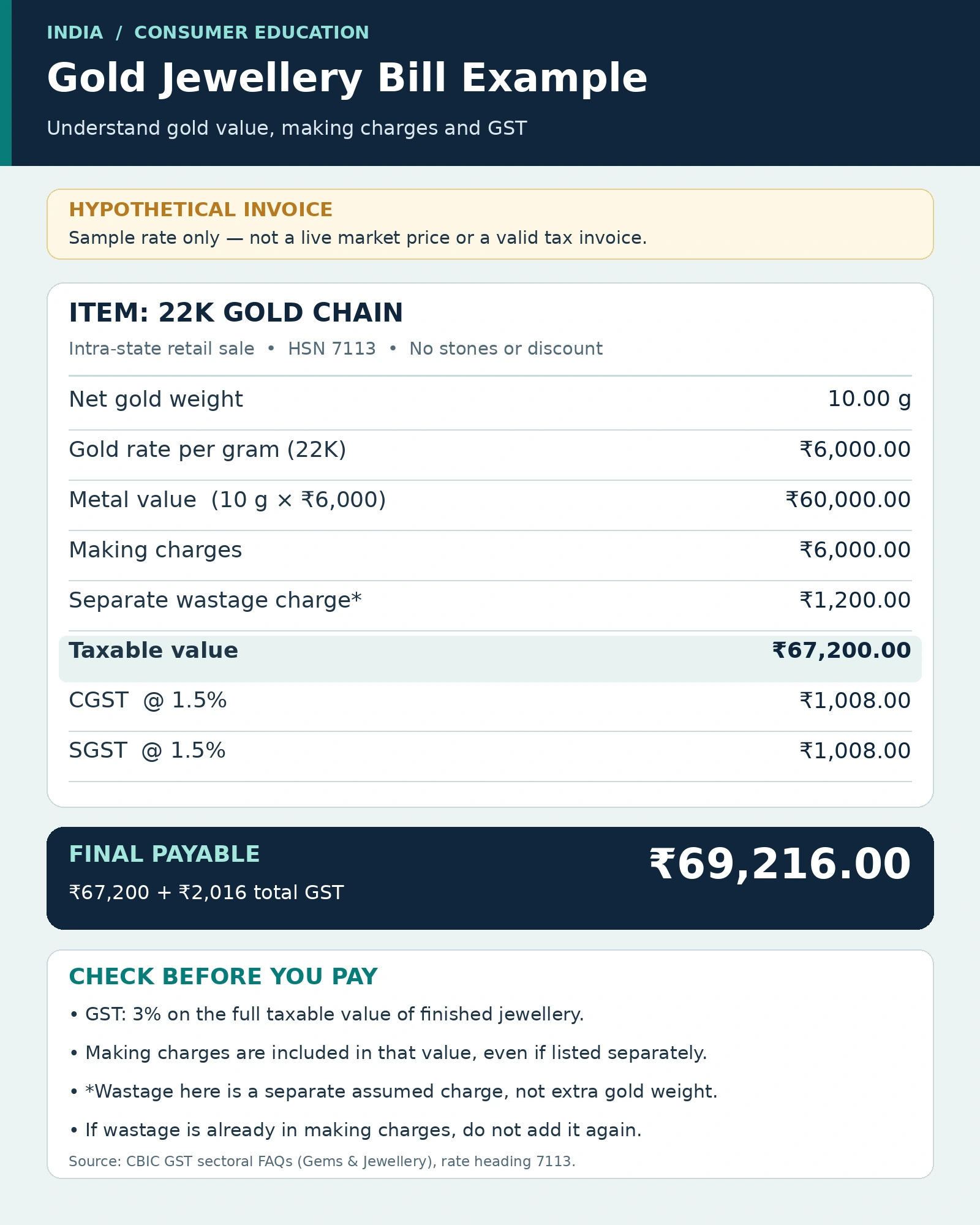
Making charges, wastage and value addition
Making charges pay for crafting the piece. Wastage is a charge linked to gold lost in manufacturing, and some shops add it as extra billed weight rather than as money. VA, or value addition, is a term many jewellers use for making plus wastage combined, though some use it differently. Because the meanings vary, ask the shop what exactly sits inside any VA line, and ask whether wastage is already included in it. A gold making charges and wastage calculator is only as accurate as the percentages you type in, so always take them from the shop’s own quotation.
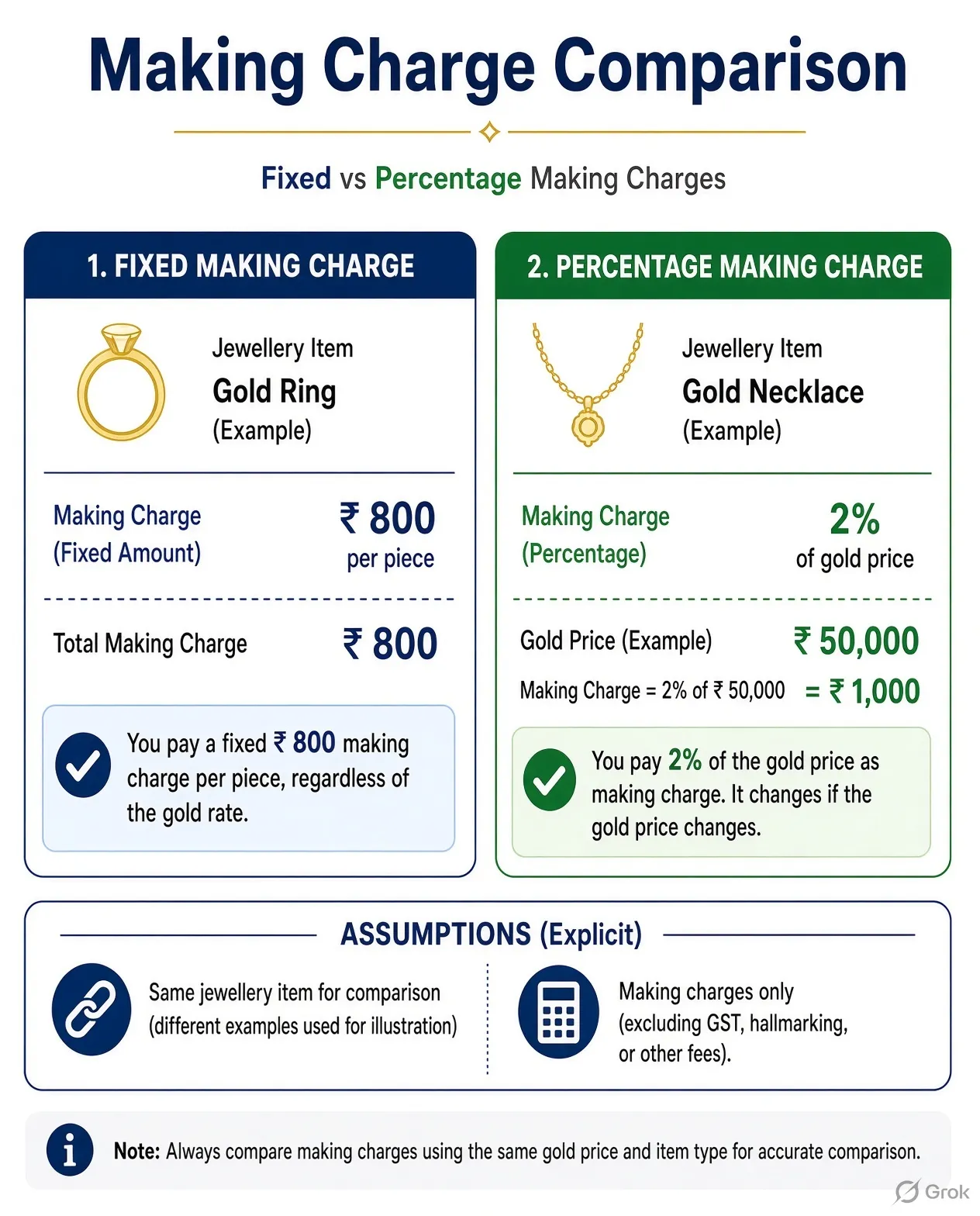
Flat fees versus percentage charges
| Method | How it is applied | Watch for |
|---|---|---|
| Percentage | A % of the gold value | Rises when the gold rate rises |
| Per gram | A rupee amount per gram | Unaffected by the gold rate |
| Flat | A fixed amount for the piece | Can look high on a light piece |
Which method is cheaper depends on the piece. A percentage charge is fairer on a heavy plain bangle when gold is cheap, but costs more when the gold rate climbs. A per-gram charge stays steady. A flat charge can suit a heavy piece but feels expensive on a light, intricate one. Always compare the final total, not just the percentage.
GST and HUID verification
Current official rules and a sample itemised bill
The GST Council’s gems and jewellery sectoral FAQ states that GST on a jewellery sale is 3% of the total transaction value, whether the making charge is shown separately or not. The 5% rate in that FAQ applies to job work, such as a registered job worker’s charges to a jeweller, not to a normal retail invoice. Some websites describe it differently, so confirm the current position on an official page or with a tax professional, because rules can change.
Hallmarks now carry three marks: the BIS logo, the purity grade and a six-digit alphanumeric HUID. Sale of hallmarked gold jewellery without HUID was prohibited from 31 March 2023, according to the government’s announcement. The BIS CARE app’s “Verify HUID” feature lets you check the piece against the bill. See also our BIS gold hallmark symbols chart.
| Hypothetical bill (10 g net, 22K, ₹10,000 per gram assumed) | Amount |
|---|---|
| Gold value: 10 × 10,000 | ₹1,00,000 |
| Making charge at 8% | ₹8,000 |
| Taxable value | ₹1,08,000 |
| GST at 3% | ₹3,240 |
| Invoice total | ₹1,11,240 |
If a shop bills wastage as extra weight instead, a 6% wastage on a 10 g piece makes the billed weight 10.6 g: 10.6 × 10,000 = ₹1,06,000; GST at 3% = ₹3,180; total ₹1,09,180 (no separate making charge in this version). If the same shop also adds stone value of ₹2,000 to the first bill, the taxable value becomes ₹1,10,000, GST ₹3,300 and the total ₹1,13,300. These are illustrations of possible methods only.
Using the existing jewellery bill calculator
Enter the net metal weight, the jeweller’s quoted rate for that purity, the making-charge method (percentage, per gram or flat) and its value, any stone or other taxable value, any invoice discount, and the GST rate. The tool does not show a live market price, so use the rate quoted on your bill. Open the free tool (English) to run your own numbers and compare them with the invoice.
Comparing quotations, exchange and invoice checks
Compare two quotes on the same piece: 8% making (₹8,000) gives ₹1,11,240 in total, while ₹750 per gram (₹7,500) gives ₹1,10,725, a difference of ₹515. Treat any old-gold exchange credit separately, and ask the shop how it appears on the invoice, because it is not automatically a GST discount. Also check whether a hallmarking fee, packing charge or insurance line has been added and whether it is taxed.
Worked examples, practical checks and limitations
- Check that net weight, purity, rate, stone value, making or VA and GST each appear on their own line.
- Recompute the gold value yourself: net weight multiplied by the quoted rate for that purity.
- Match the HUID on the piece with the bill and verify it in the BIS CARE app.
- Ask for a written breakdown if the bill shows only one lump-sum figure.
- The calculator gives an estimate; the jeweller’s invoice decides the final amount.
- Diamond or special-design jewellery may have extra charges not covered here.
Common mistakes and when to seek expert confirmation
Counting stone weight as gold, using a 24K rate for 22K gold, comparing percentage figures instead of final totals, and adding GST twice are frequent errors. For a dispute, ask for a written explanation from the jeweller and, for large purchases, consult a tax professional or a consumer helpline. BIS also lets consumers get jewellery tested at recognised assaying and hallmarking centres.
Frequently asked questions
How do I check if a gold jewellery bill is correct?
Recalculate gold value from net weight and rate, add making or VA and any stone value, then 3% GST on the total, and compare with the invoice. Verify the HUID in the BIS CARE app.
What are VA charges in gold jewellery?
VA means value addition. Many jewellers use it for making plus wastage, but the meaning varies, so ask the shop what it includes.
Is there extra GST on making charges?
According to the GST Council FAQ, a retail jewellery sale carries 3% on the total transaction value, even if making charges are shown separately. Confirm current rules officially.
What is the difference between making charges and wastage?
Making charges pay for labour and craftsmanship. Wastage relates to gold lost while making the piece. Some shops combine both in VA.
What is a HUID?
A six-digit alphanumeric code on hallmarked jewellery that can be verified in the BIS CARE app.
Does the calculator use today’s gold rate?
No. You enter the rate the jeweller quotes.
Conclusion
Read the bill line by line, verify the hallmark and compare quotations on the final total before you pay. A few minutes of checking can prevent expensive misunderstandings and give you something concrete to discuss with the jeweller.
Sources
- GST Council: Sectoral FAQ on gems and jewellery
- BIS: Hallmarking FAQ
- PIB: Sale of hallmarked gold jewellery without HUID prohibited



















Share Your Opinion
Comments are closed on this post.