 Vista
Updated: 24 November 2026
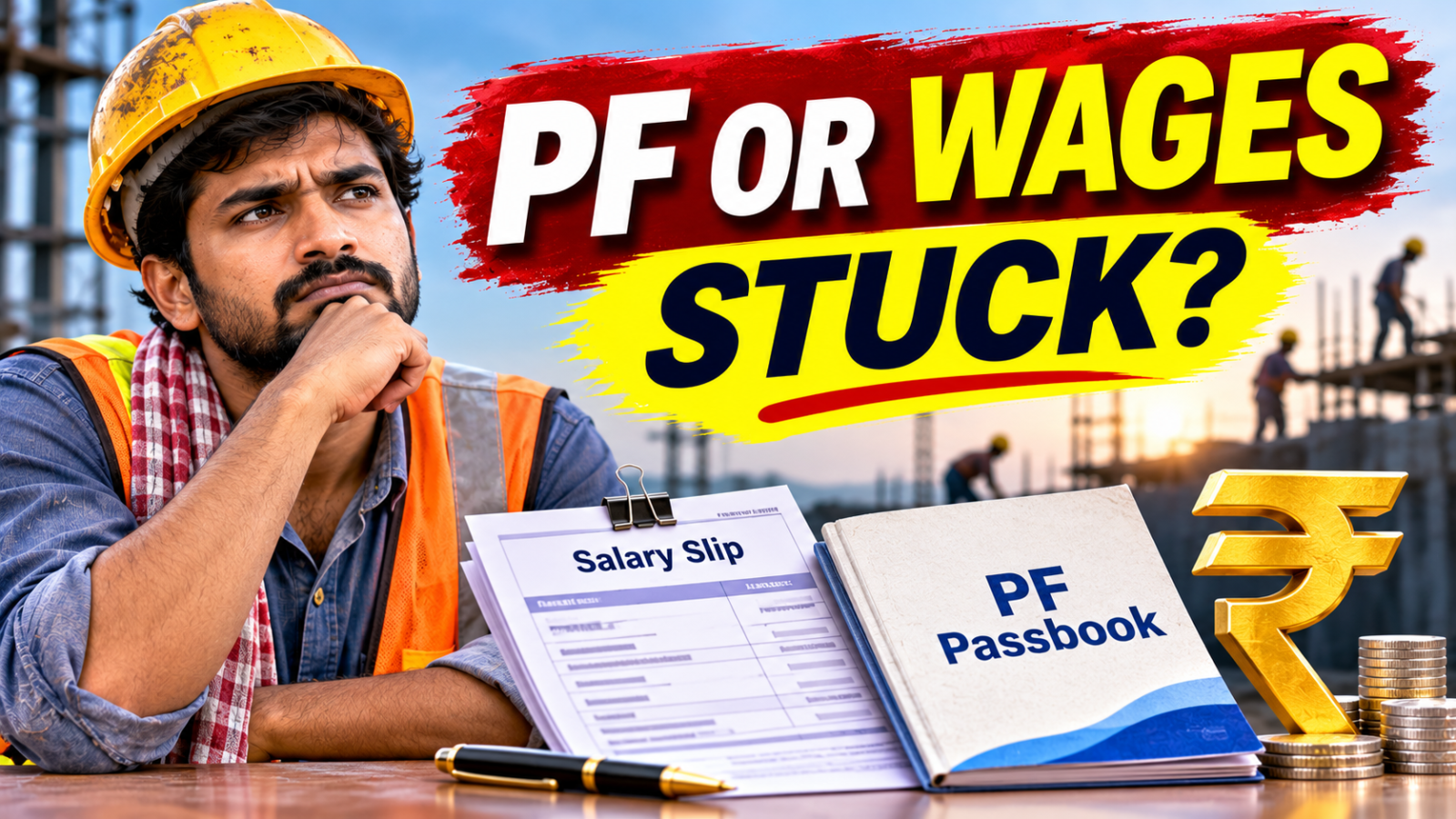
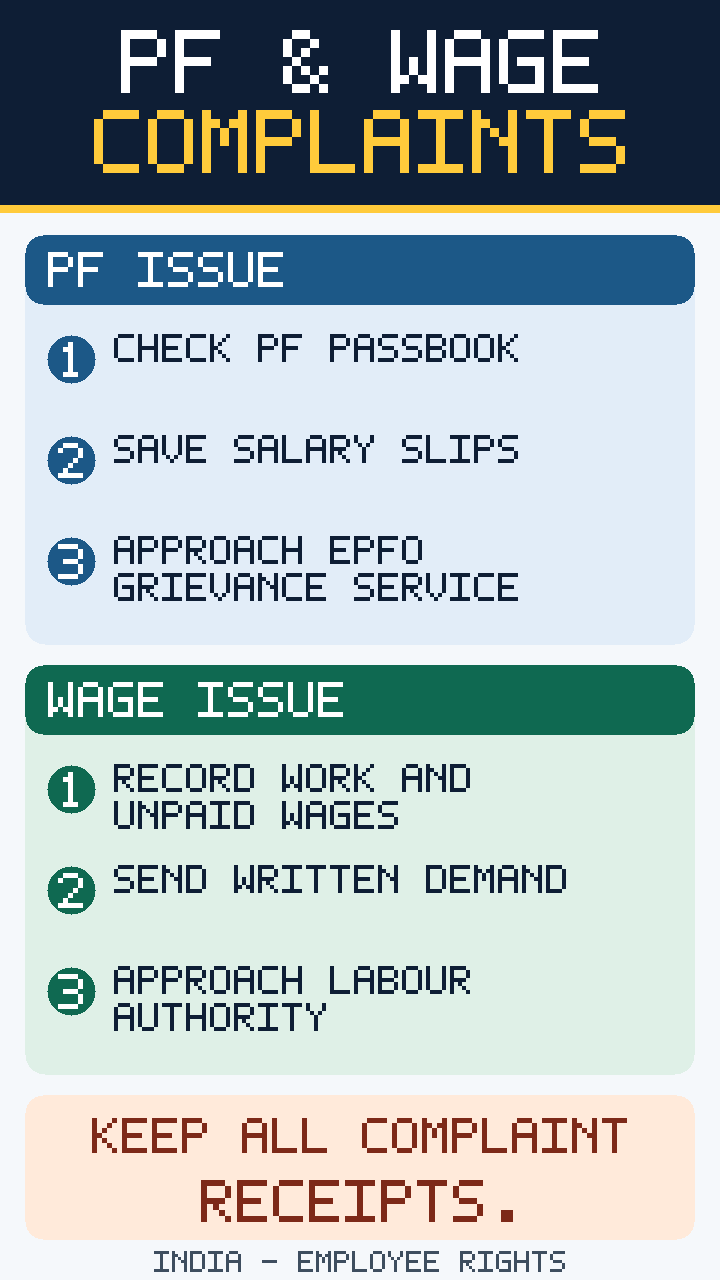
If your employer deducts provident fund (PF) contributions from your salary but does not deposit them, compare your payslips with your PF account and raise a grievance through EPFiGMS. If a contractor has not paid your daily wages or other earned wages, collect evidence of the work and approach the competent labour authority. These are separate complaint routes. You can pursue both when both problems affect you.
A missing passbook entry does not automatically establish that the employer has failed to pay. Posting delays, incorrect member records and exempted provident fund trusts can affect what appears online. Nevertheless, repeated missing entries and an employer’s refusal to explain them deserve prompt investigation. Similarly, a worker without a written appointment letter may still have a wage claim if the employment relationship and work performed can be established.
How to check whether your employer has deposited PF contributions
Open the official EPFO member passbook service and sign in with the required UAN credentials. Select the Member ID corresponding to the employer and employment period in question. Compare monthly deductions with the contribution entries. The employee’s EPF contribution, employer’s EPF contribution and pension allocation may appear separately. Do not assume that the employer’s entire contribution should appear in one EPF column.
Ask payroll for the employee-specific Electronic Challan-cum-Return (ECR) details and confirmation that payment was completed. An ECR prepared or uploaded by the employer does not necessarily establish that the money was remitted. Where an exempted establishment operates a provident fund trust, request the relevant trust statement instead of relying exclusively on the ordinary EPFO passbook.
Prepare a simple month-by-month record of salary deductions, available contribution entries and apparent discrepancies. Save payslips, bank salary credits, appointment documents and any written explanations from payroll. Distinguish confirmed amounts from estimates when making your complaint.
PF deposit deadlines and the 2026 EPFO rules
The Employees’ Provident Funds Scheme, 2026, notified under the Code on Social Security, 2020, replaced the 1952 scheme subject to transitional provisions for earlier acts and omissions. Paragraph 28 of the current scheme generally requires employers to remit contributions within fifteen days after the end of each month. An authorised extension may apply in exceptional circumstances. For example, October contributions would ordinarily be due by 15 November, although passbook posting may occur separately.
According to the government’s September 2026 announcement, the statutory wage ceiling for mandatory EPF coverage increased from ₹15,000 to ₹25,000 per month with effect from 17 September 2026. This does not mean that every individual earning a CTC below ₹25,000 is automatically covered. Establishment coverage, statutory wages, membership status and applicable exceptions must also be considered. The treatment of existing members can differ from that of new entrants.
EPFO can investigate contribution defaults and pursue assessment, recovery, interest and other applicable statutory measures. Section 127 of the Social Security Code concerns interest on delayed payments. Earlier defaults may require consideration of the legislation applicable during the relevant period. Do not pay a private agent to recover employer contributions.
How to register a PF complaint through EPFiGMS
- Go to epfigms.gov.in and select Register Grievance.
- Choose PF Member if you have a UAN. The Others option is intended for persons without the relevant UAN, PPO or establishment number.
- Complete the required verification and select the relevant member record or office.
- Choose the grievance category that corresponds to missing contributions or incorrect membership records.
- Explain the employer’s name, location, wage months and apparent missing contributions. Attach the relevant evidence.
- Save the grievance registration number. Check View Status and use the available reminder facility if appropriate.
For unresolved complaints, contact the relevant regional EPFO office with the registration number. EPFO’s helpline 14470 and its district-level Nidhi Aapke Nikat 2.0 camps may also help members obtain guidance. Check official announcements for camp locations. An unresolved departmental grievance can additionally be raised through CPGRAMS where appropriate. A complaint acknowledgement is not a guarantee of immediate recovery.
Sample application for missing PF contributions
To: Regional Provident Fund Commissioner, EPFO, ______. Subject: Request to investigate missing provident fund contributions.
I, ______, UAN/Member ID ______, am employed or formerly employed by ______. My payslips show PF deductions for the period ______ to ______, but the corresponding contributions do not appear in my passbook or trust statement. Please verify the employer’s remittance records and take appropriate action to recover applicable dues and correct my member records. Attached: relevant payslips, account statements and correspondence. Name, contact, date and signature: ______.
What if the company does not provide your UAN or your KYC is incorrect?
A Universal Account Number is distinct from the Member ID associated with a particular employment. One UAN can link several employment records. Check the Know Your UAN facility in the official member services. For new UAN generation, follow the current Aadhaar-based face authentication instructions for EPFO services on the official UMANG app. Do not create an unnecessary duplicate UAN if you already have one.
For incorrect names, dates of birth or Aadhaar details, use the prescribed profile correction process and seek employer confirmation where required. UAN activation, KYC correction and actual contribution payment are different matters. An unresolved KYC issue does not automatically extinguish the employer’s contribution obligations. Never share your password or OTP with an unsolicited caller.
Contractor not paying wages: who is responsible?
Implementation of India’s four labour codes began on 21 November 2025. Section 17 of the Code on Wages, 2019 provides the following ordinary wage payment deadlines, subject to applicable exceptions or specific directions.
| Wage period | Ordinary payment deadline |
|---|---|
| Daily | At the end of the shift |
| Weekly | Last working day before the weekly holiday |
| Fortnightly | Within two days after the fortnight ends |
| Monthly | By the seventh day of the following month |
Under section 55 of the Occupational Safety, Health and Working Conditions Code, 2020, where the relevant contract labour provisions apply, the principal employer is responsible for paying unpaid or short-paid wages when the contractor defaults, and may recover that amount from the contractor. Notify the organisation operating the workplace as well as the contractor. The provision does not automatically cover every independent contractor’s commercial invoice or self-employed service arrangement.
Collect attendance records, gate passes, work dates, agreed rates, payment records and the contractor’s and principal employer’s details. For example, if you worked twenty days at an agreed ₹600 per day and received ₹4,000, the simple outstanding balance is ₹8,000. Applicable minimum wages, overtime and lawful deductions must be considered separately.
How to file an unpaid wages complaint with the labour department
Contact the competent labour office, Labour Commissioner or Inspector-cum-Facilitator for the workplace. Jurisdiction depends on whether the central or state government is the appropriate government. Check the official SAMADHAN portal for the Wages, Overtime and Bonus Claims facility and applicable filing instructions. If online filing is unavailable, submit a written complaint and retain an acknowledgement.
Sample wage recovery application: To the competent Labour Officer, District ______. I worked through contractor ______ at workplace ______ from ______ to ______. My agreed wage was ______. Total earned ______; amount received ______; outstanding ______. The principal employer’s details are ______. Despite my requests, the wages remain unpaid. Please investigate and assist with recovery under the applicable law. Evidence attached: ______. Name, safe contact, date and signature: ______.
Section 45 of the Code on Wages provides for eligible claims to be filed generally within three years from the date they arise, with delayed applications potentially admitted for sufficient cause. The authority may award compensation up to ten times the claim in appropriate cases; this is discretionary, not an automatic entitlement. Earlier claims may involve transitional issues. Do not assume that submitting an informal grievance extends the formal claim deadline.
Frequently asked questions
Can I complain about both PF and wages?
Yes. Use the appropriate separate channels for each issue.
Can I complain without a UAN?
Use the applicable Others option in EPFiGMS or seek regional office assistance.
Can a daily wage worker complain without payslips?
Other genuine evidence of work and agreed wages can support a claim.
What if the contractor disappears?
Ask the labour authority to examine the principal employer’s liability under applicable law.
Where can I obtain free legal help?
Contact your District Legal Services Authority or NALSA’s 15100 helpline to check eligibility.
Conclusion: Preserve contribution and employment evidence, raise PF defaults with EPFO and pursue unpaid wages through the competent labour authority. Keep every acknowledgement.
Official references: EPFO; EPFiGMS; Labour Codes; Code on Wages explanation; OSH Code explanation. General legal information, not individual legal advice.

















Share Your Opinion
Comments are closed on this post.